English: Formal vs Informal Register
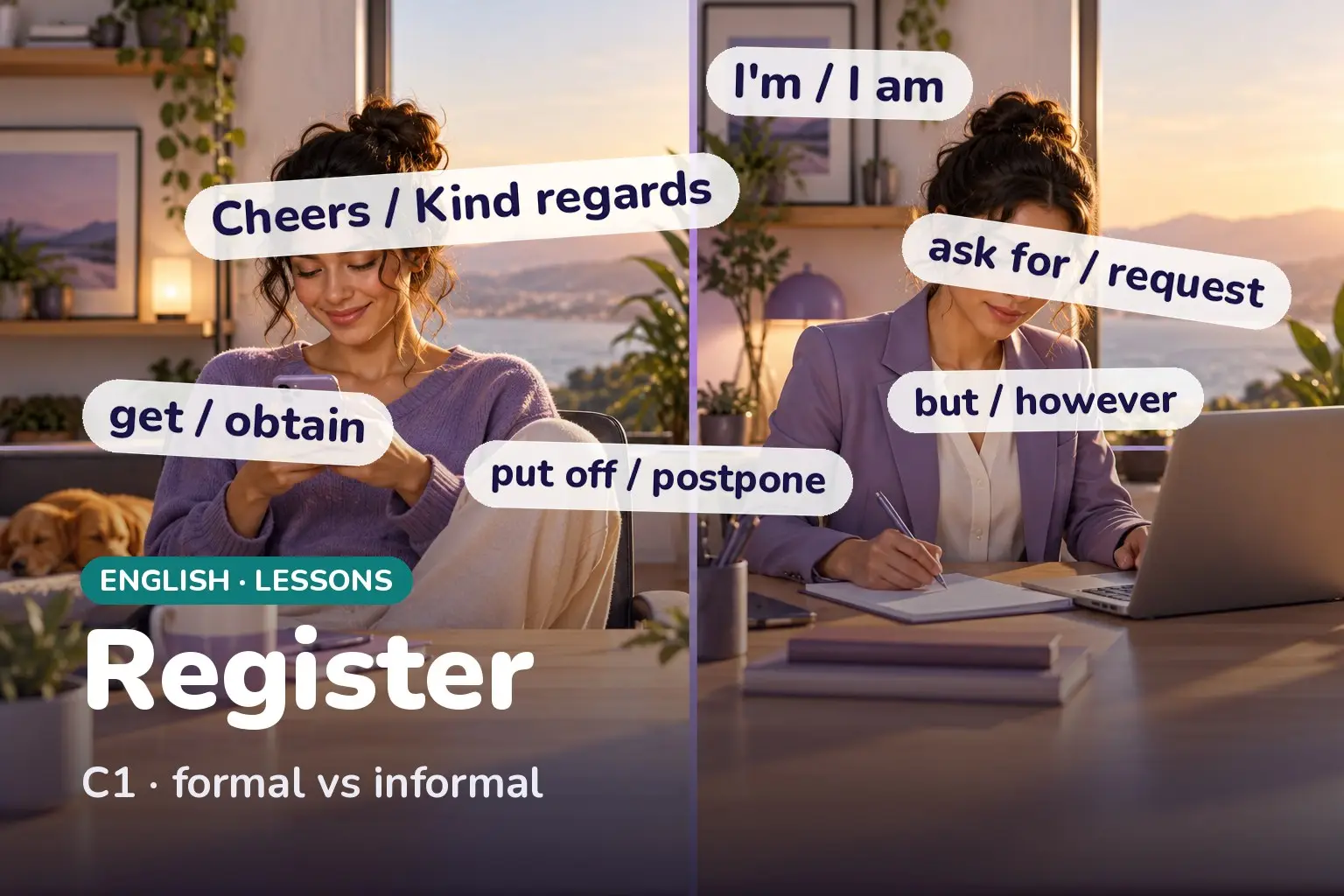
Register is how formal or informal your English is. The same idea can be an informal 'Can you help me out?' or a formal 'I would be grateful for your assistance.' This lesson shows the choices that shift register and how to rewrite a message more formally or informally.
Level: C1. At C1, your grammar is mostly solid; the next gain is control of register — sounding warm with a friend and professional with a stranger, on purpose. This lesson gives you the word choices and structures that move English up and down the formality scale, with side-by-side rewrites you can copy.
By the end of this page you can…
…recognise formal, neutral and informal English, name the main features of each, and rewrite the same message in a more formal or more informal way without changing its meaning.
Register is a scale
Register is how formal your language is. It is not right or wrong in itself — it is a match, or a mismatch, with your reader and your purpose. Picture a line:
- Informal: texts, chats, messages to friends and family.
- Neutral: most everyday emails, notices, articles — safe when unsure.
- Formal: official letters, applications, academic essays, reports, legal or business documents.
Getting it wrong is jarring in both directions: slang in a job application looks careless, and stiff formal English to a close friend sounds cold or sarcastic. Aim deliberately for the level the situation calls for.
What makes English formal
Three levers do most of the work. For the grammar behind the first two, see the passive (advanced) and nominalisation.
- Verb choice. Formal English prefers a single, often Latin-based verb over a phrasal verb: request not ask for, obtain not get, postpone not put off.
- No contractions, fewer personal touches. Write I would not I’d, cannot not can’t; lean on the passive and abstract nouns (A decision was made rather than We decided).
- Measured tone. Formal writing hedges and stays polite and impersonal: It would appear that…, We regret to inform you…. For careful, tentative phrasing, see cautious language and hedging.
Formal and informal word pairs
Learn these in pairs. The left column is for speech and friendly messages; the right is for formal writing.
| Informal | Formal |
|---|---|
| ask for | request |
| get | receive / obtain |
| help (out) | assist |
| buy | purchase |
| need | require |
| show | demonstrate |
| tell | inform |
| find out | discover / ascertain |
| put off | postpone |
| set up | establish |
| look into | investigate |
| sorry | I apologise / we regret |
| a lot of | numerous / a great deal of |
| but | however |
| so | therefore |
The same message, two registers
Watch how little the content changes — only the words and contractions move.
Informal (text to a colleague you know well): Hey, sorry but I can’t make the meeting tomorrow — something’s come up. Can we push it to Friday? Cheers.
Formal (email to a client): Dear Ms Lee, I am writing to apologise that I will be unable to attend tomorrow’s meeting owing to an unexpected commitment. Would it be possible to postpone it until Friday? Thank you for your understanding.
Features at a glance
| Feature | Informal | Formal |
|---|---|---|
| Contractions | I’m, don’t, we’ll | I am, do not, we will |
| Verbs | phrasal: find out, put off | single: discover, postpone |
| Pronouns | lots of you / I / we | often passive / impersonal |
| Idioms & slang | common | avoided |
| Greetings | Hi Sam, Hey | Dear Dr Sam, Dear Sir or Madam |
| Sign-off | Cheers, See you | Yours sincerely, Kind regards |
Example sentences
Play each pair and hear the shift in tone.
- Can you help me out with this?Informal: phrasal verb 'help out' plus a contraction.
- I would be grateful for your assistance with this matter.Formal version of the same request.
- We need the report by Friday.Neutral and direct with 'need'.
- The report is required by Friday.Formal: 'required' plus the passive.
- Sorry, I can't come to the party.Informal apology with a contraction.
- I regret that I will be unable to attend.Formal: 'regret', 'unable to attend', no contraction.
- Let me know if you want to meet up.Informal invitation with 'meet up'.
- Please inform me if you wish to arrange a meeting.Formal: 'inform', 'wish', 'arrange'.
- We're putting off the launch till next month.Informal: contraction plus 'put off'.
- The launch has been postponed until next month.Formal: single verb 'postpone' plus the passive.
- Thanks a lot for getting back to me so fast.Informal thanks with 'get back to' and 'fast'.
- Thank you for your prompt reply.Formal, concise, no phrasal verb.
- I found out that the office is closed.Informal: 'find out'.
- I have ascertained that the office is closed.Formal: 'ascertain'.
- Hi Sam, hope you're well!Informal greeting with a contraction.
- Dear Dr Carter, I hope this email finds you well.Formal greeting and opening line.
- But it costs too much.Informal connector 'but'.
- However, the cost is prohibitive.Formal connector 'however' plus a formal adjective.
- Cheers, talk soon.Informal sign-off.
- Yours sincerely, with kind regards.Formal sign-off for a named recipient.
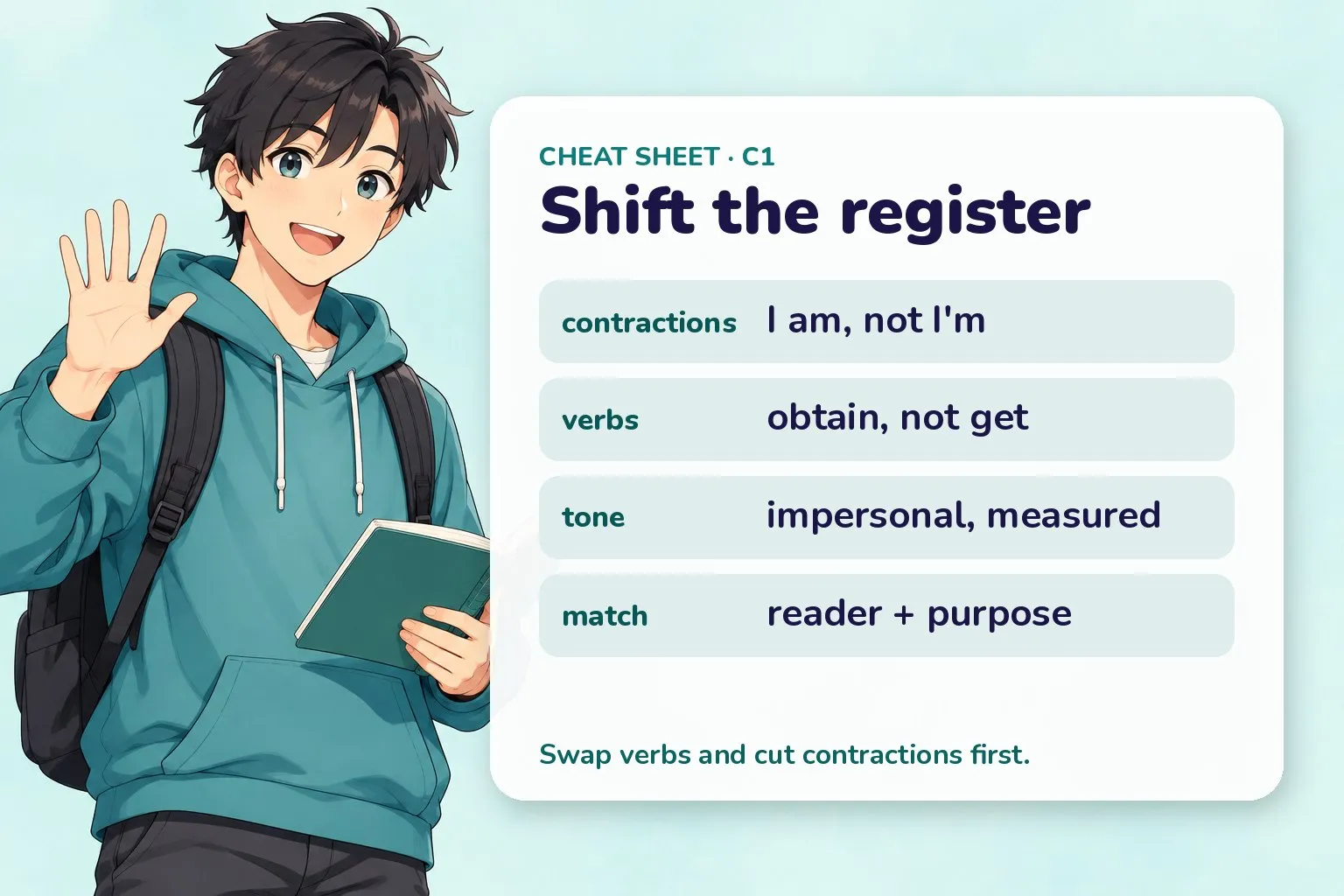
Quick recap before you practise.
Usage notes
- Yours sincerely vs faithfully: in British letters, use Yours sincerely when you named the person (Dear Ms Lee) and Yours faithfully when you did not (Dear Sir or Madam). Kind regards is a safe neutral-to-formal email sign-off.
- Not all phrasal verbs are informal: some have no neat single-word equivalent (grow up, point out). Replace them only where a clean formal verb exists.
- Formal is not the same as long: good formal writing is clear and concise, not padded. Owing to beats due to the fact that.
- Spoken formal exists too: interviews and presentations use fuller forms and politeness, but still sound natural — don’t read a stiff letter aloud.
Practice
Register practice
Try each one, then press Check. No sign-up, nothing is sent anywhere — it all runs in your browser.
Hint: single verb for 'put off'
Show answer
postponed — 'Postpone' is the formal single verb for 'put off'; here in the passive, 'postponed'.
Hint: r______
Show answer
request — 'Request' is the formal verb for 'ask for'.
5 Order the words into a formal request.
Show answer
I would appreciate your assistance — 'I would appreciate your assistance' is a formal, polite request.
6 Match the informal word to its formal partner.
- get
- help
- buy
- put off
Show answer
- get → obtain
- help → assist
- buy → purchase
- put off → postpone
These informal/formal pairs are the fastest way to shift register.
How to say it
Register also shows in how you say things — contractions and reductions are a spoken, informal signal.
- I would (formal) vs I’d (informal): the contraction “ayd” marks relaxed speech; the full form sounds careful.
- cannot is usually two clear syllables in formal speech; can’t is the everyday spoken form.
- going to reduces to “gonna” only in casual speech — keep the full form in a presentation or interview.
- thank you (full) reads as more formal than thanks or cheers in both speech and writing.
Quiz
Register quiz
10 questions · pick an answer and you'll see straight away if it's right.
-
Show answer
how formal or informal your language is — Register is the level of formality, matched to reader and purpose.
-
Show answer
no contractions — Formal writing avoids contractions, slang and most idioms.
-
Show answer
discover — 'Discover' (or 'ascertain') is the formal single verb for 'find out'.
-
Show answer
Yours sincerely — Named recipient -> 'Yours sincerely'; unnamed -> 'Yours faithfully'.
-
Show answer
I would be grateful if you could sort this out ASAP, cheers. — It pairs a formal opening with slang ('sort out', 'ASAP', 'cheers').
-
Show answer
establish — 'Establish' is the formal single verb for 'set up'.
-
Show answer
however — 'However' is the formal equivalent of the informal 'but' at the start of a point.
-
Show answer
swap phrasal verbs for single verbs and remove contractions — Changing the verbs and cutting contractions shifts register with minimal rewriting.
-
Show answer
Hi Sam, hope you're well! — A warm, contracted greeting fits an informal message.
-
Show answer
uses the passive and avoids 'we' — The impersonal passive ('was made') removes the personal 'we', a formal feature.
Recap cheat-sheet
| Lever | Informal | Formal |
|---|---|---|
| Contractions | I’m, can’t | I am, cannot |
| Verbs | ask for, get, put off | request, obtain, postpone |
| Tone | personal, warm | impersonal, measured |
| Connectors | but, so | however, therefore |
| Sign-off | Cheers | Yours sincerely / Kind regards |
Next
- Previous lesson: English: Idioms & Colloquialisms
- Next lesson: English: Storytelling & Narration
- New here? Start with Start Learning English Here
All English lessons topics
Vocabulary, pronunciation, phrases, practice and exam help, ordered by level. Pick a topic and go straight to it. New lessons go live every day, so topics marked Coming soon fill in over the next weeks.
Lessons
A1 9 topics · 9 ready
A2 14 topics · 14 ready
- 10 English: Describing People
- 11 English: Ordering at a Cafe
- 12 English: Shopping & Prices
- 13 English: Clothing & Sizes
- 14 English: Asking for Directions
- 15 English: Using Public Transport
- 16 English: At the Hotel
- 17 English: Weather & Seasons
- 18 English: Hobbies & Free Time
- 19 English: Daily Routine
- 20 English: Housing & Rooms
- 21 English: Parts of the Body
- 22 English: Emotions & Feelings
- 23 English: Supermarket & Groceries
B1 19 topics · 19 ready
- 24 English: Household Chores
- 25 English: At the Doctor
- 26 English: Making Appointments
- 27 English: Making Plans & Invitations
- 28 English: Phone & Messaging
- 29 English: Expressing Opinions
- 30 English: Talking About Past Experiences
- 31 English: Future Plans & Goals
- 32 English: School & Education
- 33 English: Jobs & Professions
- 34 English: Money & Banking
- 35 English: Restaurant & Dining Out
- 36 English: Travel & the Airport
- 37 English: Sightseeing & Tourism
- 38 English: Emergencies & Safety
- 39 English: Technology & the Internet
- 40 English: Complaints & Solving Problems
- 41 English: Small Talk & Networking
- 42 English Small-Talk & Politeness Culture
B2 11 topics · 11 ready
- 43 English: At the Office
- 44 English: The Job Interview
- 45 English: Formal Writing & Emails
- 46 English: News & Current Affairs
- 47 English: Environment & Nature
- 48 English: Health & Lifestyle
- 49 English: Culture & Traditions
- 50 English: Describing Trends & Data
- 51 English: Storytelling & Narration
- 52 English: Giving a Short Presentation
- 53 Writing Business Emails in English
C1 3 topics · 3 ready
- 54 English: Debating & Argumentation
- 55 English: Idioms & Colloquialisms
- 56 English: Formal vs Informal Register You are here