English: Future Plans & Goals
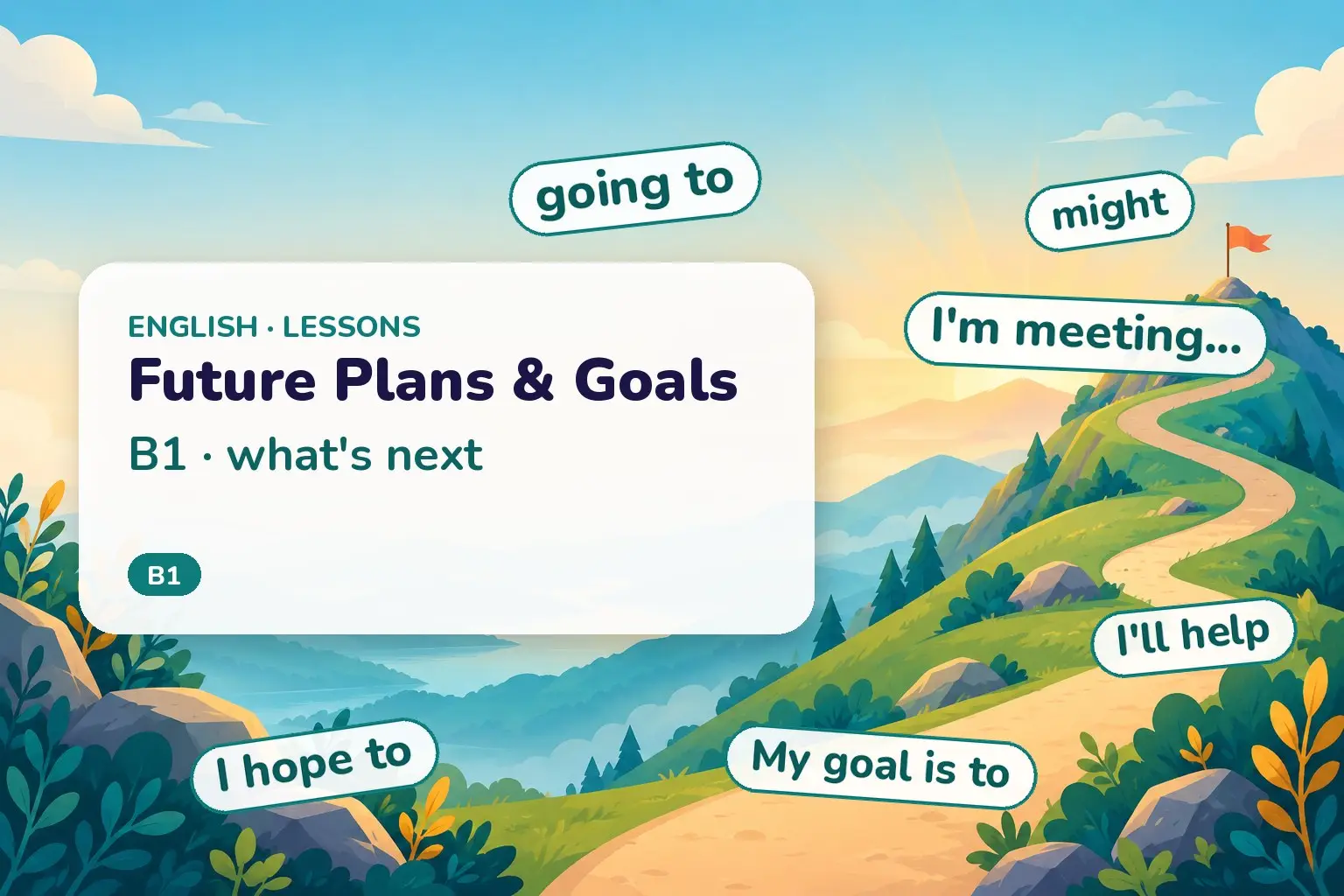
For a plan or intention, use 'going to' or 'planning to': 'I'm going to study abroad.' For a fixed arrangement with a time, use the present continuous: 'I'm meeting her on Friday.' Use 'will' for decisions made now and predictions, and 'might' for things that are not certain.
On this page13 sections · tap to jump
- 01By the end of this page you can…
- 02going to — plans and intentions
- 03will — decisions, offers and predictions
- 04Present continuous — fixed arrangements
- 05might and may — uncertain plans
- 06Talking about goals and intentions
- 07Example sentences
- 08A short conversation
- 09Usage notes
- 10Practice
- 11How to say it
- 12Quiz
- 13Recap cheat-sheet
Level: B1. English has several ways to talk about the future, and the right one depends on how fixed and how certain your plan is. This lesson sorts out going to, will, the present continuous and might, then gives you the phrases to talk about goals, intentions and resolutions.
By the end of this page you can…
…describe your plans and goals, choose between going to, will and the present continuous, and soften a plan you are not sure about.
going to — plans and intentions
Use be going to + base verb for a plan or intention you have already decided before speaking. It is the everyday way to talk about the future you have in mind.
- I’m going to start a course next month.
- She’s going to look for a new flat.
- We’re not going to travel this summer.
going to is also used for a prediction based on what you can see now: Look at those clouds — it’s going to rain.
will — decisions, offers and predictions
Use will + base verb for a decision you make at the moment of speaking, for offers and promises, and for general predictions.
- (The phone rings) I’ll get it. — a decision made now.
- I’ll help you with that. — an offer.
- I think prices will rise next year. — a prediction/opinion.
| Use | Form | Example |
|---|---|---|
| Plan decided before | be going to + verb | I’m going to call her. |
| Decision made now | will + verb | OK, I’ll call her. |
| Offer / promise | will + verb | I’ll carry that for you. |
| Prediction | will / going to + verb | It will be cold tonight. |
Present continuous — fixed arrangements
For a fixed arrangement — something organised with a time, place or other people — use the present continuous (am/is/are + -ing). It feels more certain than going to because it is already booked.
- I’m meeting the doctor at four.
- We’re flying to Rome on Saturday.
- She’s starting her new job next week.
The time word (at four, on Saturday, next week) shows it is future, not now.
might and may — uncertain plans
When a plan is possible but not certain, use might or may + base verb. This is very useful at B1 for being honest about what you haven’t decided.
- I might look for a new job next year.
- We may go to the coast if the weather is good.
Talking about goals and intentions
To talk about goals, resolutions and hopes, use these fixed patterns with to + base verb:
-
Plans: I’m planning to…, I intend to…, I’m hoping to…
-
Hopes and wishes: I hope to…, I’d like to…, I want to…
-
Goals: My goal is to…, I’m trying to…, I’ve decided to…
-
My goal is to speak English fluently by next year.
-
I’m planning to save some money every month.
-
I’d like to travel more in the future.
Example sentences
Press play and copy the rhythm. Notice how fixed or certain each plan is.
- I'm going to study abroad next year.going to for a decided plan.
- She's going to look for a new job.An intention already in mind.
- Look at the sky — it's going to rain.going to for a prediction from evidence.
- OK, I'll answer the door.will for a decision made right now.
- I'll help you move the boxes.will for an offer.
- I think it will be a great year.will for a prediction or opinion.
- I'm meeting my boss at four.Present continuous for a fixed arrangement.
- We're flying to Rome on Saturday.A booked trip with a day.
- She's starting her new job next week.An arranged future event.
- I might look for a new flat.might for an uncertain plan.
- We may go away if the weather's good.may for a possible plan.
- My goal is to run a marathon.My goal is to + base verb.
- I'm planning to save more money.I'm planning to + base verb.
- I hope to finish my degree in June.I hope to + base verb.
- I'd like to learn to drive this year.I'd like to for a wish.
- I've decided to take a break.I've decided to for a settled choice.
- I intend to apply for the course.I intend to is a firm plan.
- I'm trying to eat more healthily.I'm trying to for an ongoing goal.
- What are you doing this weekend?Present continuous question about plans.
- I won't forget your birthday this time.won't (will not) for a promise.
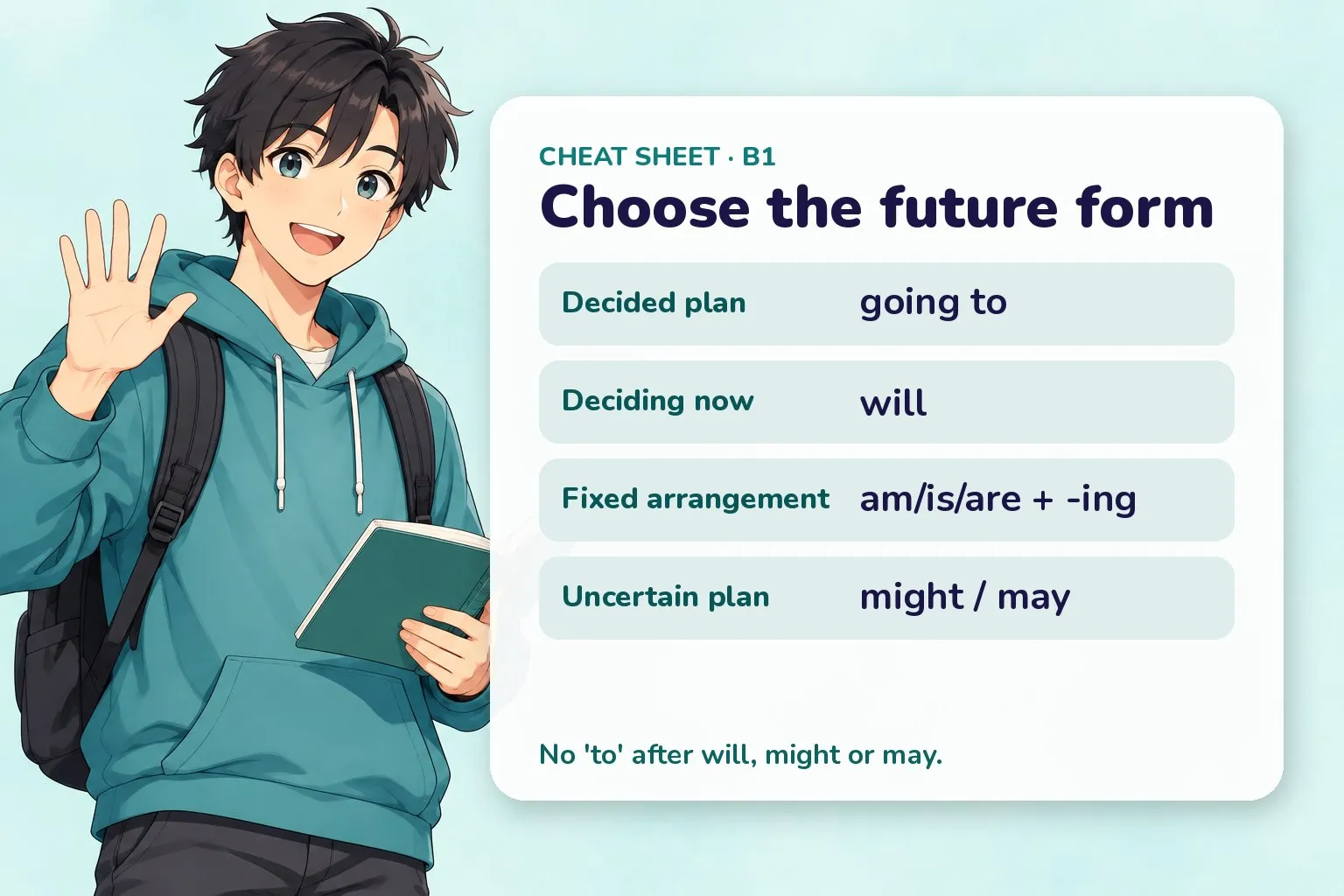
Quick recap before you practise.
A short conversation
Sam: What are you doing after the summer? Aisha: I’m going to start a design course. I’ve already signed up. Sam: That’s great! I might do something similar, but I’m not sure yet. Aisha: You should. My goal is to work as a designer in a couple of years. Sam: Nice. Tell me how it goes — I’ll probably ask you for advice.
Usage notes
- will often contracts to ’ll: I’ll, she’ll, we’ll; the negative is won’t (= will not).
- going to shortens in speech to ‘gonna’: you will hear “gonna”, but write going to.
- shall (British, formal): Shall I open the window? offers help; shall is rare in everyday American English.
- Don’t use ‘will’ for arrangements: for something already booked, the present continuous is more natural: I’m seeing the dentist tomorrow, not I will see the dentist tomorrow (which sounds like a decision just made).
- Time clauses take the present, not will: after when, if, before, after, as soon as, use the present simple: I’ll call you when I arrive (not when I will arrive).
Practice
Future plans and goals practice
Try each one, then press Check. No sign-up, nothing is sent anywhere — it all runs in your browser.
Hint: the future form for an on-the-spot decision
Show answer
will — Use 'will' (I'll) for a decision made at the moment of speaking.
Hint: present continuous: I ___ meeting…
Show answer
am — Present continuous (I'm meeting) is used for a fixed arrangement with a time.
4 Put the words in order to state a goal.
Show answer
My goal is to run a marathon — The pattern is 'My goal is to + base verb': My goal is to run a marathon.
5 Match each form to its use.
- going to
- will
- present continuous
- might
Show answer
- going to → a decided plan
- will → a decision made now
- present continuous → a fixed arrangement
- might → an uncertain plan
Each future form signals how fixed or certain the plan is.
Hint: after 'when', use the present simple, not will
Show answer
arrive — After when/if/before, use the present simple: when I arrive.
How to say it
A few future forms are easy to mishear. Copy the audio.
- going to is often said “gonna” in relaxed speech: “I’m gonna go” — but write going to.
- ’ll is very short: I’ll is almost “ale”, we’ll is “weel”; don’t turn it into a full “will”.
- won’t rhymes with “don’t”: “wohnt”, not “wont” (which means a habit).
- goal is one syllable: “gohl”, with the long o.
Quiz
Future plans and goals quiz
10 questions · pick an answer and you'll see straight away if it's right.
-
Show answer
I'll help you. — 'will' (I'll) marks a decision made as you speak.
-
Show answer
I'm going to cook dinner tonight. — 'going to' is for a plan already in mind.
-
Show answer
I'm seeing the dentist tomorrow at nine. — Present continuous (I'm seeing) suits a booked arrangement with a time.
-
Show answer
I might look for a job. — After 'might', use the base verb with no 'to'.
-
Show answer
to — 'My goal is to + base verb': My goal is to speak…
-
Show answer
Look at those clouds — it's going to rain. — 'going to' predicts from what you can see now (the clouds).
-
Show answer
I'll call you when I arrive. — After 'when', use the present simple, not 'will'.
-
Show answer
will not — won't is the contraction of 'will not'.
-
Show answer
I may go on Friday if I'm free. — 'may' (or 'might') marks a possible but not certain plan.
-
Show answer
I'll carry that for you. — 'will' is used for an offer made on the spot.
Recap cheat-sheet
| Idea | Pattern | Example |
|---|---|---|
| Plan decided before | be going to + verb | I’m going to study abroad. |
| Decision made now / offer | will + verb | I’ll get it. |
| Prediction | will / going to + verb | It will be cold. |
| Fixed arrangement | am/is/are + -ing | I’m meeting her at four. |
| Uncertain plan | might / may + verb | I might look for a job. |
| Goal / intention | I hope / plan / intend + to + verb | My goal is to travel more. |
Next
- Previous lesson: English: Talking About Past Experiences
- Next lesson: English: School & Education
- New here? Start with Start Learning English Here
- Build the sounds: English Pronunciation Overview
All English lessons topics
Vocabulary, pronunciation, phrases, practice and exam help, ordered by level. Pick a topic and go straight to it. New lessons go live every day, so topics marked Coming soon fill in over the next weeks.
Lessons
A1 9 topics · 9 ready
A2 14 topics · 14 ready
- 10 English: Describing People
- 11 English: Ordering at a Cafe
- 12 English: Shopping & Prices
- 13 English: Clothing & Sizes
- 14 English: Asking for Directions
- 15 English: Using Public Transport
- 16 English: At the Hotel
- 17 English: Weather & Seasons
- 18 English: Hobbies & Free Time
- 19 English: Daily Routine
- 20 English: Housing & Rooms
- 21 English: Parts of the Body
- 22 English: Emotions & Feelings
- 23 English: Supermarket & Groceries
B1 19 topics · 19 ready
- 24 English: Household Chores
- 25 English: At the Doctor
- 26 English: Making Appointments
- 27 English: Making Plans & Invitations
- 28 English: Phone & Messaging
- 29 English: Expressing Opinions
- 30 English: Talking About Past Experiences
- 31 English: Future Plans & Goals You are here
- 32 English: School & Education
- 33 English: Jobs & Professions
- 34 English: Money & Banking
- 35 English: Restaurant & Dining Out
- 36 English: Travel & the Airport
- 37 English: Sightseeing & Tourism
- 38 English: Emergencies & Safety
- 39 English: Technology & the Internet
- 40 English: Complaints & Solving Problems
- 41 English: Small Talk & Networking
- 42 English Small-Talk & Politeness Culture
B2 11 topics · 11 ready
- 43 English: At the Office
- 44 English: The Job Interview
- 45 English: Formal Writing & Emails
- 46 English: News & Current Affairs
- 47 English: Environment & Nature
- 48 English: Health & Lifestyle
- 49 English: Culture & Traditions
- 50 English: Describing Trends & Data
- 51 English: Storytelling & Narration
- 52 English: Giving a Short Presentation
- 53 Writing Business Emails in English