English: Complaints & Solving Problems
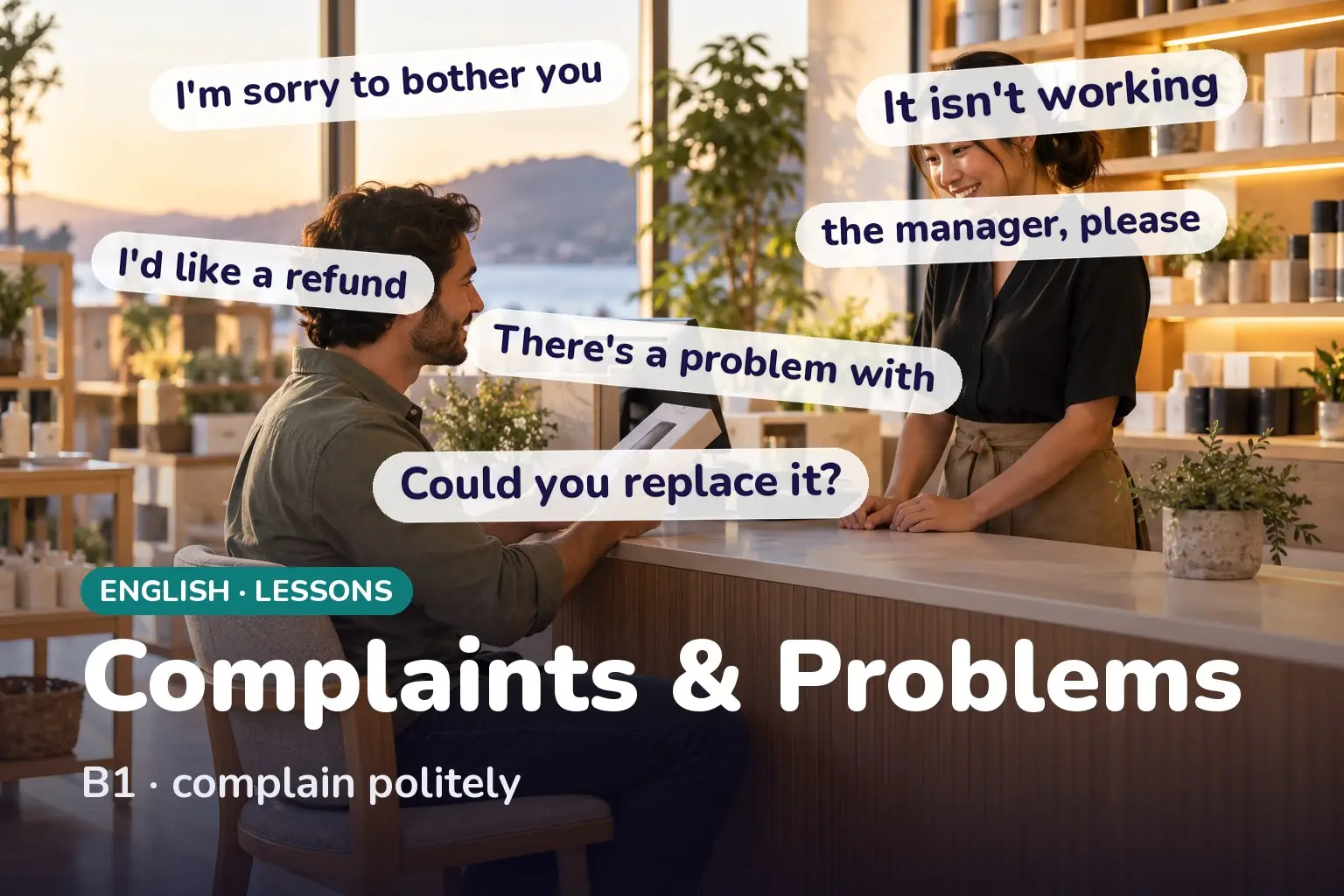
To complain in English, soften the start ('I'm sorry to bother you, but…'), say the problem plainly ('This isn't working / There's a problem with…'), then say what you want ('Could you replace it?'). Keep it calm; escalate in small, polite steps only if needed.
On this page13 sections · tap to jump
Level: B1. Things go wrong everywhere — a broken item, a wrong bill, a late delivery. In English the trick is not to be louder but to be clearer and calmer: soften the opening, name the problem, then say what you want. This lesson gives you the fixed phrases so a complaint sounds firm but polite, and so you get the result instead of an argument.
By the end of this page you can…
…open a complaint politely, describe a problem clearly, ask for a fix (refund, replacement, repair), and escalate one calm step at a time if the first answer is no.
Step 1 — Open softly
A hard opening (“You sold me a broken phone!”) puts the other person on the defensive. English complaints usually start with a softener, so the listener wants to help you.
- I’m sorry to bother you, but… — the all-purpose opener.
- Excuse me, I think there’s been a mistake. — for bills and orders.
- I’m afraid I have a problem with… — afraid here means “I regret saying this,” not fear.
Step 2 — Say the problem plainly
After the softener, say exactly what is wrong in one clear sentence. Learn these frames whole:
| Frame | Example |
|---|---|
| This isn’t working. | The remote isn’t working. |
| There’s a problem with… | There’s a problem with my order. |
| It hasn’t … yet. | My parcel hasn’t arrived yet. |
| I was charged (twice / too much). | I was charged twice for one coffee. |
| … is faulty / broken / damaged. | The screen is cracked. |
The present perfect with yet is useful here — it says something was expected but has not happened. See present perfect with just, yet and already for the full rule.
Step 3 — Say what you want
A complaint without a request is just a story. End with a polite request so the person knows how to fix it. Use Could you…?, Would it be possible to…? or I’d like…, please.
- Could you replace it, please?
- Would it be possible to get a refund?
- I’d like to exchange this for a different size.
For the grammar of these polite forms, see requests with can and could, could for polite past and would like.
Step 4 — Escalate calmly
If the first answer is no, go up one small step at a time. Stay polite — a calm voice gets further than a loud one.
- Is there anything you can do? (ask once more)
- Could I speak to the manager, please? (ask for someone senior)
- I’d like to make a formal complaint. (put it in writing)
Common mistakes
- ❌ You broke my order. → ✅ There’s a problem with my order. (Blame the problem, not the person.)
- ❌ I want refund. → ✅ I’d like a refund, please. (Add a and a polite frame.)
- ❌ It doesn’t work since two days. → ✅ It hasn’t worked for two days. (Use for + length, not since.)
- ❌ Give me the manager. → ✅ Could I speak to the manager, please? (A bare order sounds rude.)
- ❌ I’m boring with this service. → ✅ I’m bored / frustrated with this service. (Boring describes the thing, bored describes you.)
A short conversation
Customer: Excuse me, I’m sorry to bother you, but there’s a problem with my coffee. Server: Oh? What’s wrong? Customer: I ordered a decaf, but this one is normal, and I was charged twice. Server: I’m so sorry about that. Let me make you a fresh decaf and fix the bill. Customer: Thank you. Could I also get a receipt for the correct amount? Server: Of course. Again, I apologise for the mix-up.
Usage notes
- complain vs complaint: complain is the verb (I’d like to complain); complaint is the noun (I’d like to make a complaint).
- sorry, two meanings: I’m sorry to bother you softens your own request; I’m sorry about that is how the other person apologises. Both are everyday complaint language.
- BrE vs AmE: British I’d like to return this / a refund, please; American I’d like to return this / get my money back. Both are understood everywhere.
- faulty / defective / dodgy: faulty and defective are neutral and safe in writing; dodgy is informal British for “not reliable” — fine when speaking, not in a formal letter.
Example sentences
Play each line and say it aloud. These are the exact phrases you will use when something goes wrong.
- I'm sorry to bother you, but I have a problem.The all-purpose soft opener.
- Excuse me, I think there's been a mistake with my bill.Softener for a wrong charge.
- I'm afraid this isn't working.'I'm afraid' keeps a complaint polite.
- There's a problem with my order.Blame the problem, not the person.
- My parcel hasn't arrived yet.Present perfect + yet for something still missing.
- I was charged twice for one item.Reporting a billing error.
- The screen is cracked and the button is broken.Describing a faulty product.
- It stopped working after two days.Saying when the problem started.
- Could you replace it, please?Asking for a replacement.
- Would it be possible to get a refund?A softer way to ask for your money back.
- I'd like to exchange this for a larger size.Asking for an exchange.
- Could you fix it or send someone to repair it?Asking for a repair.
- Is there anything you can do to help?Asking once more after a 'no'.
- Could I speak to the manager, please?Escalating one polite step.
- I'd like to make a formal complaint.Putting the complaint on record.
- I've already called twice about this.Stating the history calmly.
- This is the third time it has broken.Pressing the point with facts, not insults.
- Thank you for sorting this out so quickly.Thanking them when it is fixed.
- Could I have that in writing, please?Asking for confirmation of the fix.
- I appreciate your help with this.A warm, polite close.
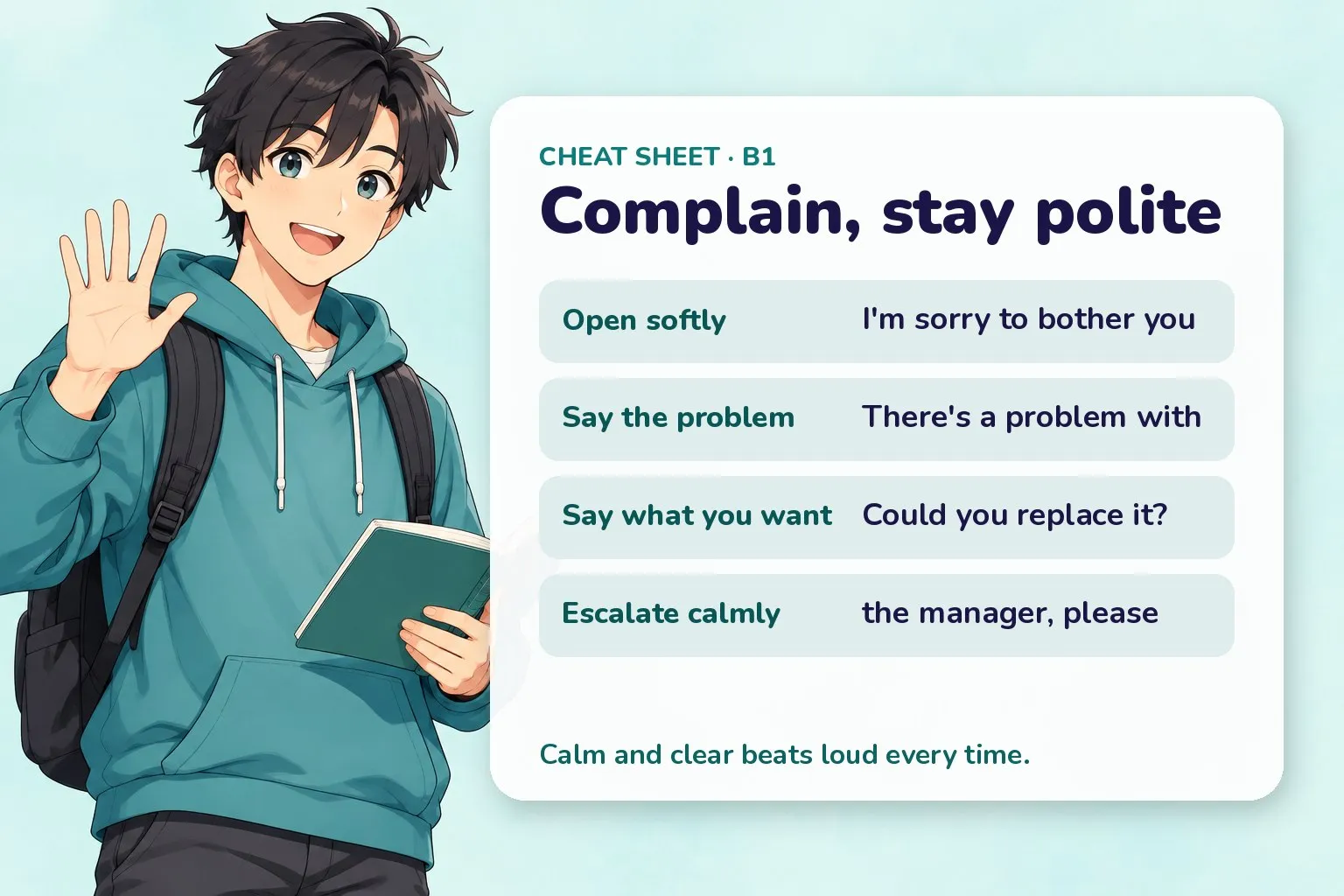
Quick recap before you practise.
How to say it
A few complaint words trip up English learners — copy the audio, not the spelling.
- receipt sounds like “ri-SEET” — the p is silent.
- refund (the noun) stresses the first part: “REE-fund”.
- faulty sounds like “FAWL-tee” — the l is light but there.
- apologise / apologize stresses the second part: “a-POL-o-jize”.
Practice
Complaints practice
Try each one, then press Check. No sign-up, nothing is sent anywhere — it all runs in your browser.
Hint: goes at the end, with the present perfect
Show answer
yet — Use 'yet' for something expected that has not happened: hasn't arrived yet.
Hint: your money back
Show answer
refund — A refund is your money back; 'Would it be possible to…?' makes the request soft.
5 Put the words in order to ask for a replacement.
Show answer
Could you replace it please — Polite requests use 'Could you…?' + base verb, with 'please' at the end.
6 Match each fix to its meaning.
- refund
- replacement
- repair
- exchange
Show answer
- refund → your money back
- replacement → a new one of the same thing
- repair → they fix the one you have
- exchange → swap for a different one
Ask for the exact outcome you want.
Quiz
Complaints and problems quiz
10 questions · pick an answer and you'll see straight away if it's right.
-
Show answer
There's a problem with my order. — Describe the problem neutrally so the person wants to help.
-
Show answer
I regret to say it is not working — 'I'm afraid' is a politeness word that softens bad news.
-
Show answer
hasn't — Present perfect + yet: hasn't arrived yet, for something still missing.
-
Show answer
Would it be possible to get a refund? — A softening frame plus the noun 'a refund' is polite and clear.
-
Show answer
bored — A person feels 'bored'; a thing that causes it is 'boring'.
-
Show answer
Could I speak to the manager, please? — Ask calmly for someone senior; threats and insults end the conversation.
-
Show answer
I think there's been a mistake with my bill. — 'I think there's been a mistake' is neutral and polite for billing errors.
-
Show answer
repair — A repair means they fix the item you already have.
-
Show answer
It hasn't worked for two days. — Use 'for' with a length of time: for two days.
-
Show answer
Thank you for sorting this out. — Thank the person when the issue is resolved — it keeps goodwill.
Recap cheat-sheet
| Step | Pattern | Example |
|---|---|---|
| Open softly | I’m sorry to bother you, but… | …there’s a problem. |
| Say the problem | There’s a problem with… / It isn’t working | My order is wrong. |
| Say what you want | Could you…? / I’d like…, please | Could you replace it? |
| Escalate calmly | Could I speak to the manager? | …make a formal complaint. |
| Close | Thank you for sorting this out. | I appreciate your help. |
Next
- Next lesson: English: Giving a Short Presentation
- Related grammar: requests with can and could · would like
- New here? Start with Start Learning English Here
All English lessons topics
Vocabulary, pronunciation, phrases, practice and exam help, ordered by level. Pick a topic and go straight to it. New lessons go live every day, so topics marked Coming soon fill in over the next weeks.
Lessons
A1 9 topics · 9 ready
A2 14 topics · 14 ready
- 10 English: Describing People
- 11 English: Ordering at a Cafe
- 12 English: Shopping & Prices
- 13 English: Clothing & Sizes
- 14 English: Asking for Directions
- 15 English: Using Public Transport
- 16 English: At the Hotel
- 17 English: Weather & Seasons
- 18 English: Hobbies & Free Time
- 19 English: Daily Routine
- 20 English: Housing & Rooms
- 21 English: Parts of the Body
- 22 English: Emotions & Feelings
- 23 English: Supermarket & Groceries
B1 19 topics · 19 ready
- 24 English: Household Chores
- 25 English: At the Doctor
- 26 English: Making Appointments
- 27 English: Making Plans & Invitations
- 28 English: Phone & Messaging
- 29 English: Expressing Opinions
- 30 English: Talking About Past Experiences
- 31 English: Future Plans & Goals
- 32 English: School & Education
- 33 English: Jobs & Professions
- 34 English: Money & Banking
- 35 English: Restaurant & Dining Out
- 36 English: Travel & the Airport
- 37 English: Sightseeing & Tourism
- 38 English: Emergencies & Safety
- 39 English: Technology & the Internet
- 40 English: Complaints & Solving Problems You are here
- 41 English: Small Talk & Networking
- 42 English Small-Talk & Politeness Culture
B2 11 topics · 11 ready
- 43 English: At the Office
- 44 English: The Job Interview
- 45 English: Formal Writing & Emails
- 46 English: News & Current Affairs
- 47 English: Environment & Nature
- 48 English: Health & Lifestyle
- 49 English: Culture & Traditions
- 50 English: Describing Trends & Data
- 51 English: Storytelling & Narration
- 52 English: Giving a Short Presentation
- 53 Writing Business Emails in English