English: Using Public Transport
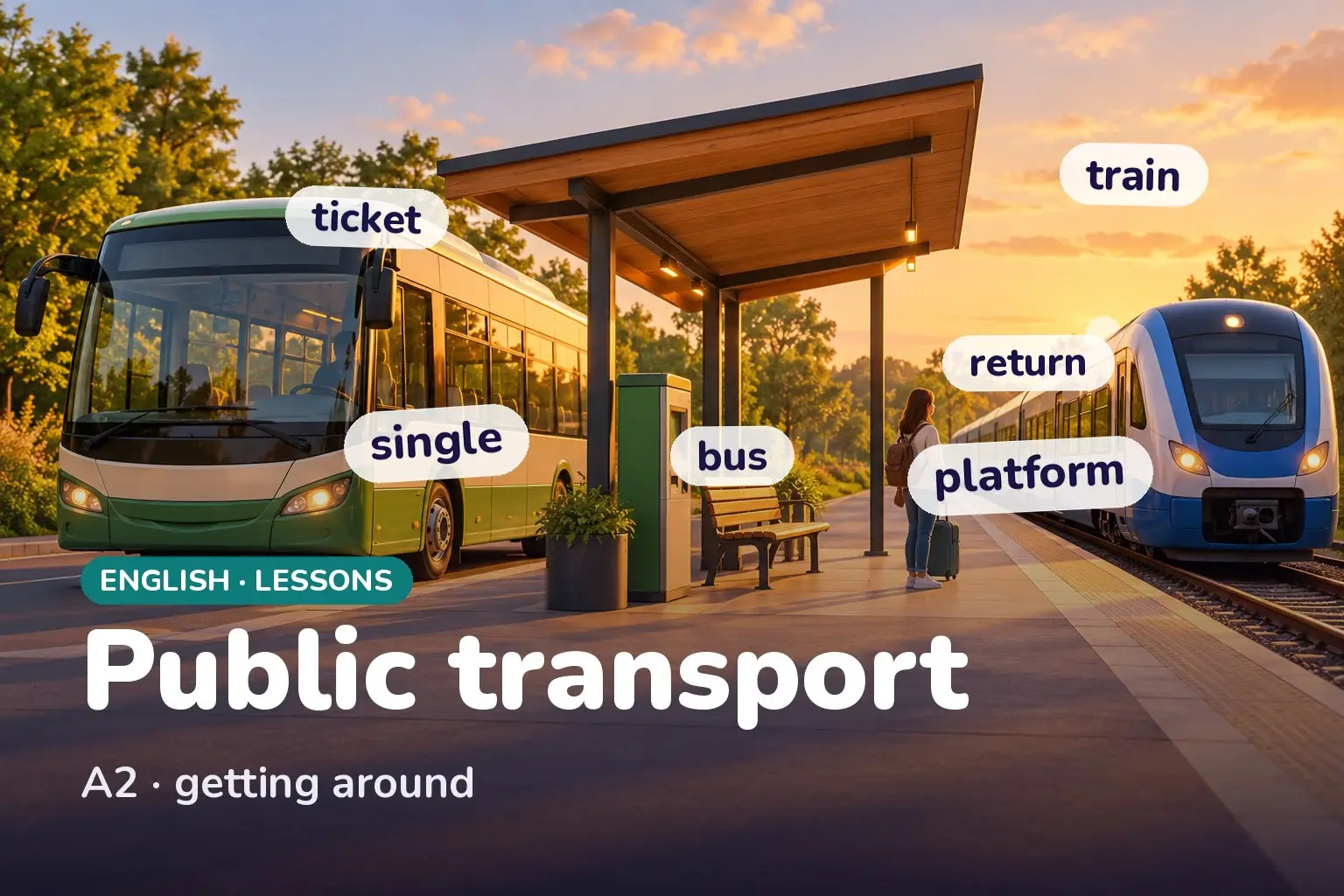
At the counter say 'A single to York, please' or 'A return, please'. Ask 'Which platform?' and 'What time does the next train leave?'. You catch a bus, get on and off it, and change at a station.
Level: A2. Buses, trains and the underground get you around any city, and the language at the ticket counter is short and repetitive. Learn a handful of words and phrases and you can buy a ticket, find your platform and ask about times.
By the end of this page you can…
…name types of public transport, buy a single or return ticket, ask about platforms and times, and use the verbs ‘catch’, ‘get on/off’ and ‘change’.
Types of transport
The common ways to travel in a city or between towns: the bus, the coach (a long-distance bus), the train, the tram, the underground (the Tube in London, the subway in the US, the metro in many cities), the ferry, and a taxi. The place you wait is a bus stop, a station or a platform; the price of the trip is the fare; the paper or card that lets you travel is a ticket.
The verbs that go with transport
English pairs certain verbs with transport, and using the wrong one sounds odd:
- You catch or take a bus, a train or a flight. If you are late, you miss it.
- You get on and get off a bus, a train, a tram or a plane.
- You get in(to) and get out of a taxi or a car.
- You change (trains/buses) when you swap to another line to continue your journey.
Buying a ticket
At the counter or machine, a few fixed phrases do almost everything. A single (American one-way) takes you one way; a return (American round-trip) takes you there and back.
- A single to York, please. / A return to York, please.
- How much is a return to the city centre?
- Two singles to the airport, please.
- Can I use this ticket on the bus too?
Platforms, times and stops
Trains leave from platforms; you need to know which one and when. Timetable (American schedule) is the list of times.
- Which platform does the train to Leeds leave from?
- What time does the next bus leave?
- Does this train stop at Reading?
- How many stops is it to the museum?
- Is this the right bus for the station?
A short conversation
You: A return to Cambridge, please. Which platform? Clerk: That’s platform four. The next train leaves at ten past. You: Do I need to change? Clerk: No, it’s direct. About an hour. You: Great, thank you!
Example sentences
Press play and repeat. These are the lines you will use at the station and on the bus.
- A single to York, please.Buying a one-way ticket.
- A return to the city centre, please.A ticket there and back.
- How much is a return to the airport?Asking the price of a ticket.
- Two singles to Bath, please.Buying more than one ticket.
- Which platform does the train leave from?Finding where to wait for the train.
- What time does the next bus leave?Asking about the timetable.
- Does this train stop at Reading?Checking the train stops where you need.
- Is this the right bus for the station?Checking you are catching the right bus.
- I need to catch the 8 o'clock train.'Catch' goes with trains and buses.
- Hurry up, or we'll miss the bus!'Miss' = fail to catch it in time.
- Get on at the front of the bus.'Get on' a bus, train or plane.
- We get off at the next stop.'Get off' to leave a bus or train.
- You have to change at Clapham.'Change' = swap to another line.
- How many stops is it to the museum?Counting the stops to your destination.
- Let's get a taxi, it's faster.'Get a taxi' = take a taxi.
- Can I use this ticket on the bus too?Asking if a ticket covers more than one service.
- The next train is in ten minutes.Time until the next service.
- Is it direct, or do I have to change?Asking whether the journey needs a change.
- Excuse me, is this seat free?A polite question on a busy train or bus.
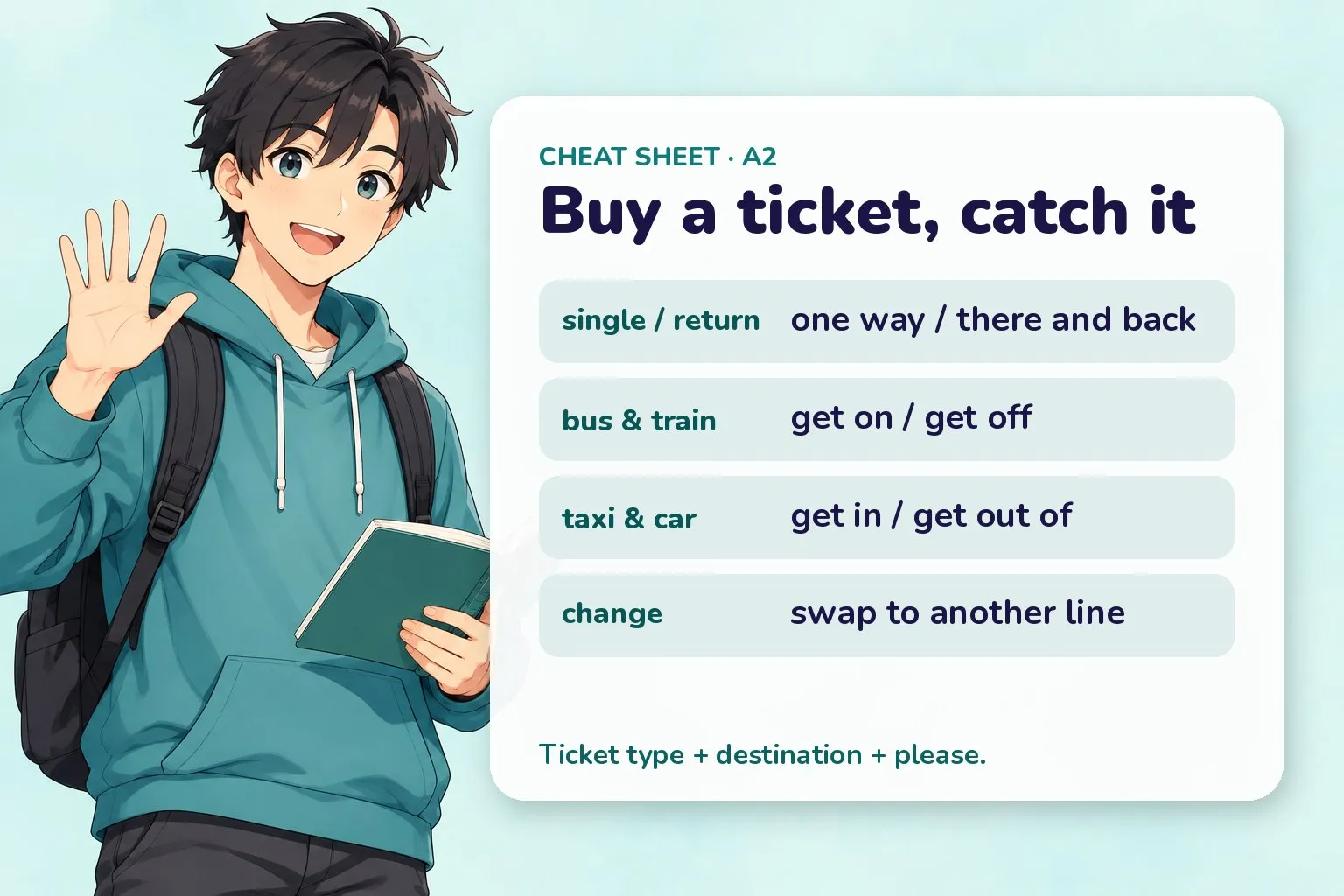
Quick recap before you practise.
Practice
Public transport practice
Try each one, then press Check. No sign-up, nothing is sent anywhere — it all runs in your browser.
Hint: get ___ / get off
Show answer
get — You 'get on' and 'get off' a bus, train or plane.
4 Put the words in order to ask about the next bus.
Show answer
What time does the next bus leave? — A natural question: What time does the next bus leave?
5 Match each verb to the right transport.
- get on
- get in
- catch
- change
Show answer
- get on → a bus or train
- get in → a taxi or car
- catch → a train before it leaves
- change → swap to another line
English fixes these verbs to particular kinds of transport and actions.
How to say it
A few transport words are tricky — copy the sounds.
- queue sounds like the letter Q (/kjuː/) — the -ueue is silent.
- vehicle has a silent h: say VEE-i-kl, stressing the first part.
- return stresses the second part: ri-TURN, with a clear r at the end.
- platform stresses the first part: PLAT-form, short a.
Quiz
Using public transport quiz
8 questions · pick an answer and you'll see straight away if it's right.
-
Show answer
return — 'Return' = there and back; 'single' = one way.
-
Show answer
get in — You 'get in(to)' and 'get out of' a taxi or car.
-
Show answer
missed the train — To 'miss' a train or bus is to fail to catch it in time.
-
Show answer
schedule — British 'timetable' is American 'schedule'.
-
Show answer
swap to another train there — 'Change' means move to a different line or service to continue.
-
Show answer
Which platform does it leave from? — Trains leave from platforms, so you ask which platform.
-
Show answer
Tube — In London the underground is known as the Tube (the subway in the US, the metro elsewhere).
-
Show answer
get on the bus — Use 'get on' for a bus (and train or plane).
Next
- Previous lesson: English: Asking for Directions
- Next lesson: English: At the Hotel
- New here? Start with Start Learning English Here
All English lessons topics
Vocabulary, pronunciation, phrases, practice and exam help, ordered by level. Pick a topic and go straight to it. New lessons go live every day, so topics marked Coming soon fill in over the next weeks.
Lessons
A1 9 topics · 9 ready
A2 14 topics · 14 ready
- 10 English: Describing People
- 11 English: Ordering at a Cafe
- 12 English: Shopping & Prices
- 13 English: Clothing & Sizes
- 14 English: Asking for Directions
- 15 English: Using Public Transport You are here
- 16 English: At the Hotel
- 17 English: Weather & Seasons
- 18 English: Hobbies & Free Time
- 19 English: Daily Routine
- 20 English: Housing & Rooms
- 21 English: Parts of the Body
- 22 English: Emotions & Feelings
- 23 English: Supermarket & Groceries
B1 19 topics · 19 ready
- 24 English: Household Chores
- 25 English: At the Doctor
- 26 English: Making Appointments
- 27 English: Making Plans & Invitations
- 28 English: Phone & Messaging
- 29 English: Expressing Opinions
- 30 English: Talking About Past Experiences
- 31 English: Future Plans & Goals
- 32 English: School & Education
- 33 English: Jobs & Professions
- 34 English: Money & Banking
- 35 English: Restaurant & Dining Out
- 36 English: Travel & the Airport
- 37 English: Sightseeing & Tourism
- 38 English: Emergencies & Safety
- 39 English: Technology & the Internet
- 40 English: Complaints & Solving Problems
- 41 English: Small Talk & Networking
- 42 English Small-Talk & Politeness Culture
B2 11 topics · 11 ready
- 43 English: At the Office
- 44 English: The Job Interview
- 45 English: Formal Writing & Emails
- 46 English: News & Current Affairs
- 47 English: Environment & Nature
- 48 English: Health & Lifestyle
- 49 English: Culture & Traditions
- 50 English: Describing Trends & Data
- 51 English: Storytelling & Narration
- 52 English: Giving a Short Presentation
- 53 Writing Business Emails in English