English: At the Hotel
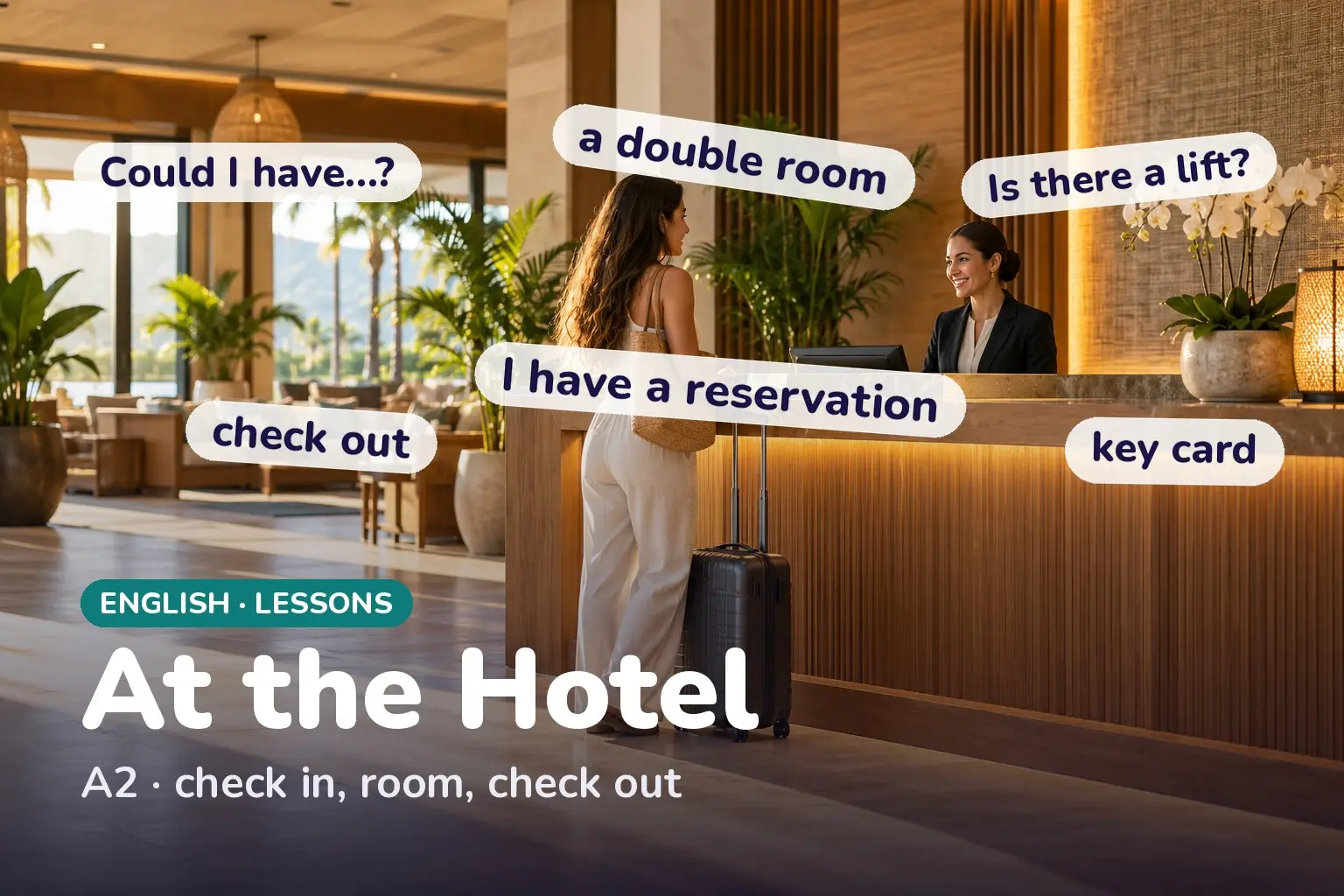
At check-in, say 'I have a reservation under' and your name. Ask for things with 'Could I have …?' or 'Is there …?', and on your last day say 'I'd like to check out.' Learn the room words and these phrases and a hotel stay is easy.
Level: A2. A hotel stay runs on a small set of fixed phrases: a few words at the desk when you arrive, the names of things in your room, polite ways to ask for what you need, and one phrase to leave. Learn these and you can handle most stays in English without stress.
By the end of this page you can…
…check in and check out, name the main things in a hotel room, ask for extra items politely, and report a simple problem.
Checking in
When you arrive, you go to the reception (also called the front desk) and speak to the receptionist. If you booked ahead, you have a reservation (or booking).
Start with the key sentence: I have a reservation under … and then your name. The receptionist will ask for ID or a passport, may take a deposit or your card, and then gives you your key or key card and your room number.
- I have a reservation under Garcia.
- I’d like to check in, please.
- What time is breakfast?
Room vocabulary
Rooms are described by their bed, not by the number of people. A single room has one bed for one person; a double room has one large bed; a twin room has two separate beds. Common features include an en-suite bathroom (a bathroom inside the room), air conditioning, a safe, a minibar, and free Wi-Fi.
| English | What it means |
|---|---|
| single room | one bed, usually for one person |
| double room | one large bed for two |
| twin room | two separate single beds |
| en-suite | bathroom inside the room |
| key card | the card that opens your door |
| wake-up call | a phone call to wake you |
Making polite requests
This is the most useful skill of the whole lesson. To ask for something, do not say I want or Give me — they sound rude. Use one of these polite openers:
- Could I have …? — for a thing: Could I have an extra towel?
- Could you …? — for an action: Could you call a taxi for me?
- Is there …? — to check if something exists: Is there a lift?
- Do you have …? — Do you have a spare pillow?
Problems and checking out
If something is wrong, say it simply with isn’t working or there’s a problem with …:
- The air conditioning isn’t working.
- There’s a problem with the shower.
- The room is too noisy. Could I change rooms?
On your last day you check out, usually before late morning (often 11 a.m. or noon — ask at reception to be sure). The phrase is I’d like to check out. You may be asked to settle the bill (pay) and hand back your key.
A short conversation
Receptionist: Good evening. How can I help you? Guest: Hi, I have a reservation under Mendez. Receptionist: Welcome. A double room for two nights. Could I see your passport, please? Guest: Here you are. And is there Wi-Fi in the room? Receptionist: Yes, it’s free. Here’s your key card — room 214, on the second floor. Guest: Thank you. What time is check-out? Receptionist: By 11 a.m. Enjoy your stay!
Example sentences
Play each line and say it along with the audio. These are the exact phrases you will use at a hotel.
- I have a reservation under Garcia.The key sentence at check-in.Say your name clearly after 'under'.
- I'd like to check in, please.A polite way to start at the desk.
- Here's my passport.Handing over your ID when asked.
- Is breakfast included?Asking whether breakfast comes with the room.
- What time is breakfast?A common first question.
- Could I have a double room?Asking for one large bed.
- Do you have a twin room?Asking for two separate beds.
- Is there a lift?Checking if there is an elevator.Lift is British; elevator is American.
- Could I have an extra towel, please?A polite request for a thing.
- Could you call a taxi for me?A polite request for an action.
- Do you have a spare pillow?Asking for one more pillow.
- What's the Wi-Fi password?Asking how to get online.
- The air conditioning isn't working.Reporting a problem simply.
- There's a problem with the shower.Another way to report a fault.
- The room is too noisy. Could I change rooms?Asking to move.
- Could I have a wake-up call at seven?Asking the desk to wake you.
- Can I leave my bags here after check-out?Storing luggage at reception.
- I'd like to check out, please.The phrase for your last day.
- Could I have the bill, please?Asking to pay.
- Can I have a late check-out?Asking to stay a little longer.
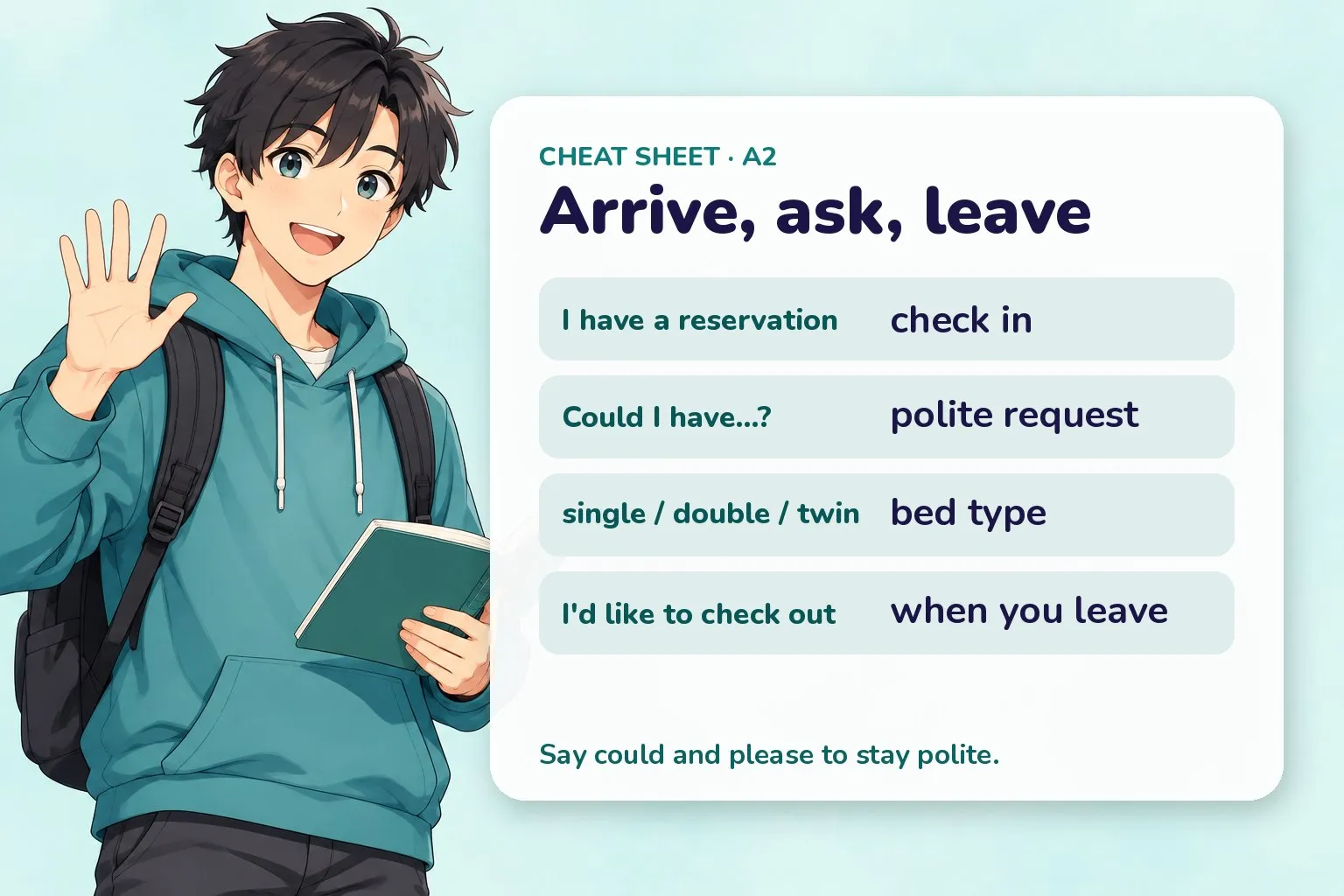
Quick recap before you practise.
Practice
At the hotel practice
Try each one, then press Check. No sign-up, nothing is sent anywhere — it all runs in your browser.
Hint: a polite modal verb, not 'can' here
Show answer
Could — 'Could I have …?' is the polite way to ask for a thing.
Hint: the opposite of 'in'
Show answer
out — You check in when you arrive and check out when you leave.
5 Put the words in order to report a problem.
Show answer
The air conditioning isn't working — Report a fault plainly: 'The air conditioning isn't working.'
6 Match each hotel word to its meaning.
- reception
- key card
- en-suite
- wake-up call
Show answer
- reception → the front desk
- key card → opens your door
- en-suite → bathroom in the room
- wake-up call → a call to wake you
These are the core hotel words you will hear at the desk and in your room.
How to say it
A few hotel words trip up English learners — copy the sounds, not the spelling.
- reservation has the stress on the third part: re-zer-VAY-shun, not on the first.
- reception is ri-SEP-shun — the stress is in the middle.
- en-suite comes from French and sounds like on-SWEET.
- check out links together in speech: “che-kout”, almost one word.
Quiz
At the hotel quiz
8 questions · pick an answer and you'll see straight away if it's right.
-
Show answer
I'd like to check in, please. — 'I'd like to check in, please' is the polite, natural opener.
-
Show answer
one large bed — A double room has one large bed; a twin room has two separate beds.
-
Show answer
Could I have a towel, please? — 'Could I have … , please?' is the polite form; 'I want' and 'Give me' sound like orders.
-
Show answer
the reception / front desk — You check in at reception, also called the front desk.
-
Show answer
There's a problem with the shower. — 'There's a problem with …' is a simple, clear way to report a fault.
-
Show answer
leave the hotel and settle the bill — You check out when you leave, usually paying the bill and returning your key.
-
Show answer
wake-up call — A wake-up call is a phone call from the desk to wake you.
-
Show answer
an elevator — 'Lift' (British) and 'elevator' (American) are the same thing.
Next
- Next lesson: English: Weather & Seasons
- Review the journey there: English: Public Transport
- New here? Start with Start Learning English Here
All English lessons topics
Vocabulary, pronunciation, phrases, practice and exam help, ordered by level. Pick a topic and go straight to it. New lessons go live every day, so topics marked Coming soon fill in over the next weeks.
Lessons
A1 9 topics · 9 ready
A2 14 topics · 14 ready
- 10 English: Describing People
- 11 English: Ordering at a Cafe
- 12 English: Shopping & Prices
- 13 English: Clothing & Sizes
- 14 English: Asking for Directions
- 15 English: Using Public Transport
- 16 English: At the Hotel You are here
- 17 English: Weather & Seasons
- 18 English: Hobbies & Free Time
- 19 English: Daily Routine
- 20 English: Housing & Rooms
- 21 English: Parts of the Body
- 22 English: Emotions & Feelings
- 23 English: Supermarket & Groceries
B1 19 topics · 19 ready
- 24 English: Household Chores
- 25 English: At the Doctor
- 26 English: Making Appointments
- 27 English: Making Plans & Invitations
- 28 English: Phone & Messaging
- 29 English: Expressing Opinions
- 30 English: Talking About Past Experiences
- 31 English: Future Plans & Goals
- 32 English: School & Education
- 33 English: Jobs & Professions
- 34 English: Money & Banking
- 35 English: Restaurant & Dining Out
- 36 English: Travel & the Airport
- 37 English: Sightseeing & Tourism
- 38 English: Emergencies & Safety
- 39 English: Technology & the Internet
- 40 English: Complaints & Solving Problems
- 41 English: Small Talk & Networking
- 42 English Small-Talk & Politeness Culture
B2 11 topics · 11 ready
- 43 English: At the Office
- 44 English: The Job Interview
- 45 English: Formal Writing & Emails
- 46 English: News & Current Affairs
- 47 English: Environment & Nature
- 48 English: Health & Lifestyle
- 49 English: Culture & Traditions
- 50 English: Describing Trends & Data
- 51 English: Storytelling & Narration
- 52 English: Giving a Short Presentation
- 53 Writing Business Emails in English