English: School & Education
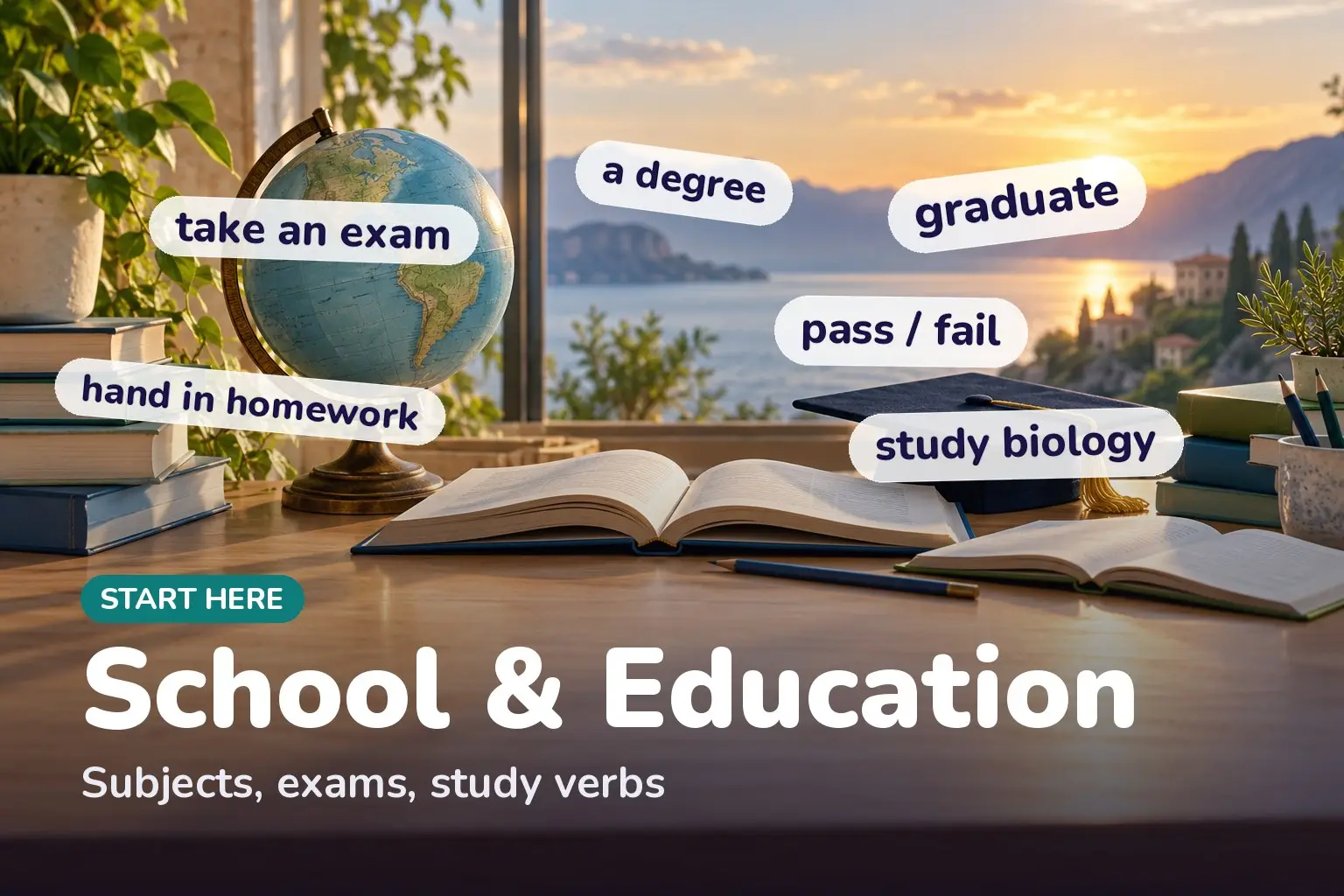
To talk about education in English, name the stage (primary school, secondary school, university), the subject you study (maths, history, biology), and the action with a study verb (study, revise, take an exam, pass, graduate). Say 'I'm studying' for a course you are doing now.
Level: B1. Education is one of the first topics you meet in an exam or a conversation with someone new. This lesson gives you the stages of study, the names of school subjects, and the small set of verbs — study, revise, pass, graduate — that carry almost every sentence about learning.
By the end of this page you can…
…name the stages of education, say which subjects you study or studied, describe exams and results, and talk about your own learning in both the present and the past.
The stages of education
English describes education as a ladder of stages. Learn them in order:
- nursery / kindergarten — for very young children, before school proper.
- primary school (BrE) / elementary school (AmE) — roughly ages 5 to 11.
- secondary school (BrE) / high school (AmE) — roughly ages 11 to 18.
- university or college — higher education after school, where you study for a degree.
A person who teaches at school is a teacher; at university they are a lecturer or professor. A child at school is a pupil (BrE) or student; at university everyone is a student.
School subjects
Subjects are the things you study. Note that maths (BrE) / math (AmE) and PE are short forms you will hear every day.
| Subject | What it covers |
|---|---|
| maths / math | numbers, shapes, calculation |
| science | biology, chemistry, physics |
| history | the past, events and people |
| geography | countries, maps, the earth |
| literature | reading and studying books |
| a foreign language | French, Spanish, English, etc. |
| PE (physical education) | sport and exercise |
We say I’m good at maths and I’m not very good at science — the fixed phrase is good at + subject, never good in.
The study verbs you need
Most sentences about education use one of these verbs, and several come in fixed pairs:
- study a subject; do / take a course.
- revise (BrE) / review (AmE) before an exam.
- take, sit or do an exam, then pass or fail it.
- get a grade or a mark (an A, a B, 70%).
- enrol on a course, attend classes, hand in (submit) your homework.
- graduate from university and get a degree.
Present simple or continuous?
Use the present simple for a general fact about your education, and the present continuous for a course happening now.
- I study biology. — a general fact (perhaps it is your main subject).
- I’m studying for my exams this week. — happening around now.
- She teaches history. — her job in general.
- She’s teaching a new class this term. — a temporary, current situation.
Example sentences
Press play and say each line out loud. These are the exact sentences you will use to talk about school and study.
- I went to primary school in a small town.Naming the first stage of school.
- She is still at secondary school.At secondary school describes an ongoing stage.
- My brother is studying engineering at university.Present continuous for a course in progress.
- I study three languages this year.Present simple for a general fact.
- What subjects do you like best?A common question about school.
- I'm quite good at maths but not at science.Good at + subject is the fixed phrase.
- We have a history lesson every Tuesday.Have a lesson is the natural collocation.
- I need to revise for my chemistry exam.Revise before an exam.
- He took the exam twice before he passed.You take an exam, then pass or fail.
- Unfortunately, I failed the first test.Fail is the opposite of pass.
- I got a good grade in geography.Get a grade or a mark for a result.
- Please hand in your homework by Friday.Hand in means submit.
- She enrolled on an evening course.Enrol on a course to join it.
- The students attend lectures three days a week.Attend classes or lectures.
- I graduated from university two years ago.Graduate from, with the preposition from.
- He is doing a degree in economics.Do a degree in a subject.
- Our teacher gives us a lot of homework.Homework is uncountable: a lot of homework.
- The new term starts in September.A term is a part of the school year.
- I'm learning English to study abroad.A reason for learning, with the infinitive of purpose.
- She won a scholarship to a top university.A scholarship pays for your study.
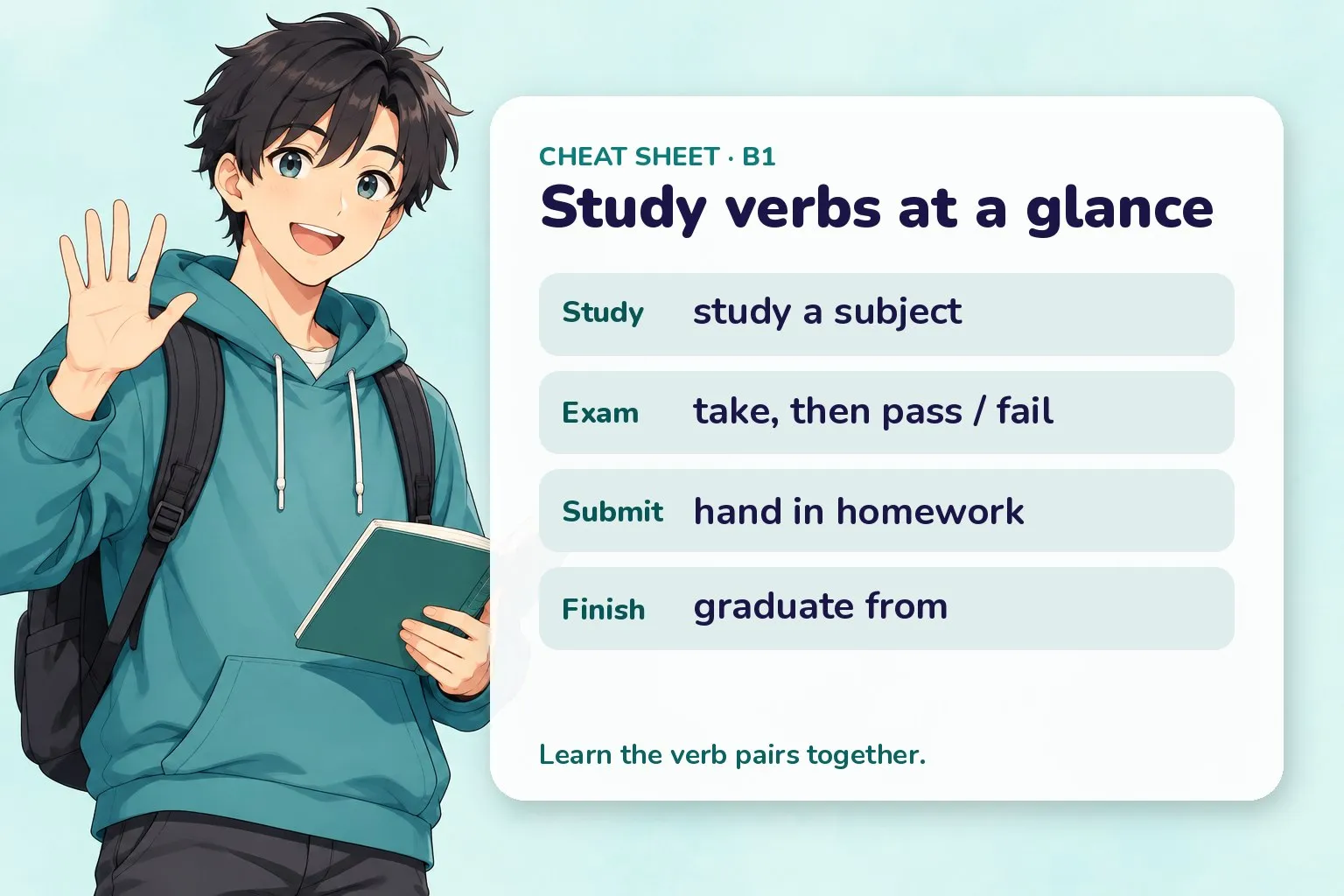
Quick recap before you practise.
A short conversation
Omar: So, what are you studying at the moment? Lena: I’m doing a degree in biology. I’ve got exams next week, so I’m revising all the time. Omar: Are you good at it? Lena: Pretty good, yes. I passed everything last year. What about you? Omar: I left school at eighteen and started work, but I’m thinking of enrolling on an evening course.
Quick recap before the quiz.
Usage notes
- homework is uncountable: say a lot of homework or a piece of homework, never a homework or homeworks.
- at school / in school: British English prefers at school and at university; American English often uses in school and in college. Both are correct — pick one and stay consistent.
- learn vs study vs teach: you learn a skill or fact (the result), you study a subject (the activity), and a teacher teaches you. Do not use learn to mean teach.
- course vs class vs lesson: a course runs over weeks or months; a single meeting is a class or a lesson.
Practice
School and education practice
Try each one, then press Check. No sign-up, nothing is sent anywhere — it all runs in your browser.
Hint: the fixed phrase is good ___ a subject
Show answer
at — The fixed phrase is good at + subject, never good in.
Hint: the verb graduate takes this preposition
Show answer
from — You graduate from a school or university.
4 Put the words in order to make a request about homework.
Show answer
Please hand in your homework by Friday — Hand in means submit: Please hand in your homework by Friday.
5 Match each word to its meaning.
- pupil
- lecturer
- degree
- term
Show answer
- pupil → a child at school
- lecturer → a university teacher
- degree → a university qualification
- term → a part of the school year
These are the core people and periods in education.
How to say it
A few education words trip up English learners. Copy the audio rather than spelling them out.
- university has four beats with the stress on the third: yoo-ni-VER-si-tee.
- degree stresses the second part: di-GREE, not DEE-gree.
- maths keeps the th and ends in an s sound: maths, one syllable (American math has no final s).
- science is two syllables — SY-uhns — with a silent c blended into the s.
Quiz
School and education quiz
10 questions · pick an answer and you'll see straight away if it's right.
-
Show answer
pupil — A pupil is a child at school; student works for any age.
-
Show answer
studies — You study a subject; study is the natural verb here.
-
Show answer
take an exam — You take (or sit) an exam, then pass or fail it.
-
Show answer
good at maths — The fixed phrase is good at + subject.
-
Show answer
hand it in — You hand in (submit) your homework.
-
Show answer
term — A term is a part of the school year; a semester is the longer US unit.
-
Show answer
from — You graduate from a university.
-
Show answer
I'm studying for my exams right now. — Use the present continuous for an action happening now.
-
Show answer
money that pays for your study — A scholarship is financial support that pays for study.
-
Show answer
homework — Homework is uncountable: a lot of homework, not a homework.
Recap cheat-sheet
| Idea | Pattern | Example |
|---|---|---|
| Stage of study | primary / secondary / university | She is at secondary school. |
| Study a subject | study + subject | I study biology. |
| Course now | present continuous | I’m studying for exams. |
| Exams | take / sit → pass / fail | He took the exam and passed. |
| Submit work | hand in | Hand in your homework by Friday. |
| Finish university | graduate from | I graduated from university. |
Next
- Previous lesson: English: Future Plans & Goals
- Next lesson: English: Jobs & Professions
- New here? Start with Start Learning English Here
- Build the sounds: English Pronunciation Overview
All English lessons topics
Vocabulary, pronunciation, phrases, practice and exam help, ordered by level. Pick a topic and go straight to it. New lessons go live every day, so topics marked Coming soon fill in over the next weeks.
Lessons
A1 9 topics · 9 ready
A2 14 topics · 14 ready
- 10 English: Describing People
- 11 English: Ordering at a Cafe
- 12 English: Shopping & Prices
- 13 English: Clothing & Sizes
- 14 English: Asking for Directions
- 15 English: Using Public Transport
- 16 English: At the Hotel
- 17 English: Weather & Seasons
- 18 English: Hobbies & Free Time
- 19 English: Daily Routine
- 20 English: Housing & Rooms
- 21 English: Parts of the Body
- 22 English: Emotions & Feelings
- 23 English: Supermarket & Groceries
B1 19 topics · 19 ready
- 24 English: Household Chores
- 25 English: At the Doctor
- 26 English: Making Appointments
- 27 English: Making Plans & Invitations
- 28 English: Phone & Messaging
- 29 English: Expressing Opinions
- 30 English: Talking About Past Experiences
- 31 English: Future Plans & Goals
- 32 English: School & Education You are here
- 33 English: Jobs & Professions
- 34 English: Money & Banking
- 35 English: Restaurant & Dining Out
- 36 English: Travel & the Airport
- 37 English: Sightseeing & Tourism
- 38 English: Emergencies & Safety
- 39 English: Technology & the Internet
- 40 English: Complaints & Solving Problems
- 41 English: Small Talk & Networking
- 42 English Small-Talk & Politeness Culture
B2 11 topics · 11 ready
- 43 English: At the Office
- 44 English: The Job Interview
- 45 English: Formal Writing & Emails
- 46 English: News & Current Affairs
- 47 English: Environment & Nature
- 48 English: Health & Lifestyle
- 49 English: Culture & Traditions
- 50 English: Describing Trends & Data
- 51 English: Storytelling & Narration
- 52 English: Giving a Short Presentation
- 53 Writing Business Emails in English