English Pronunciation Overview
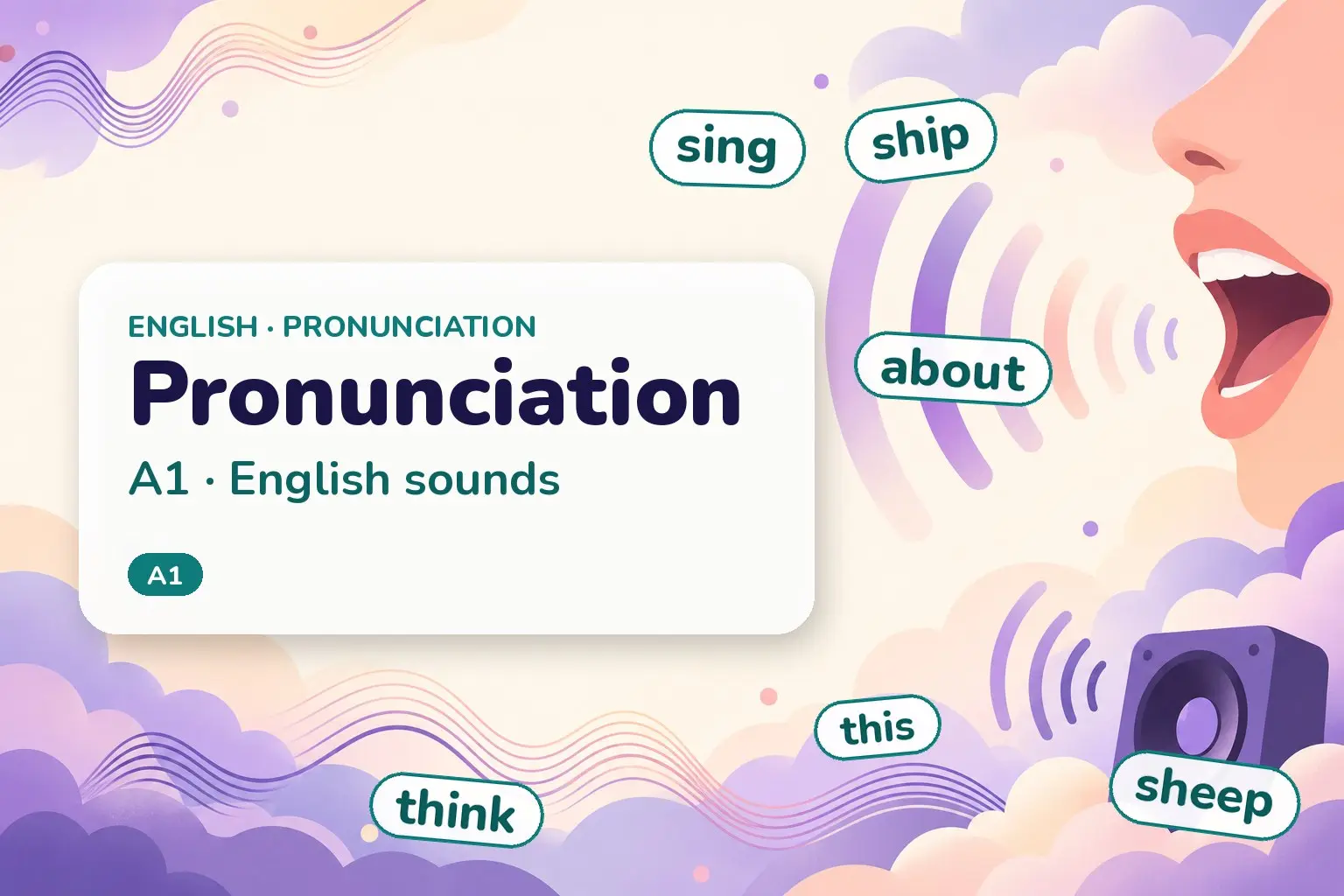
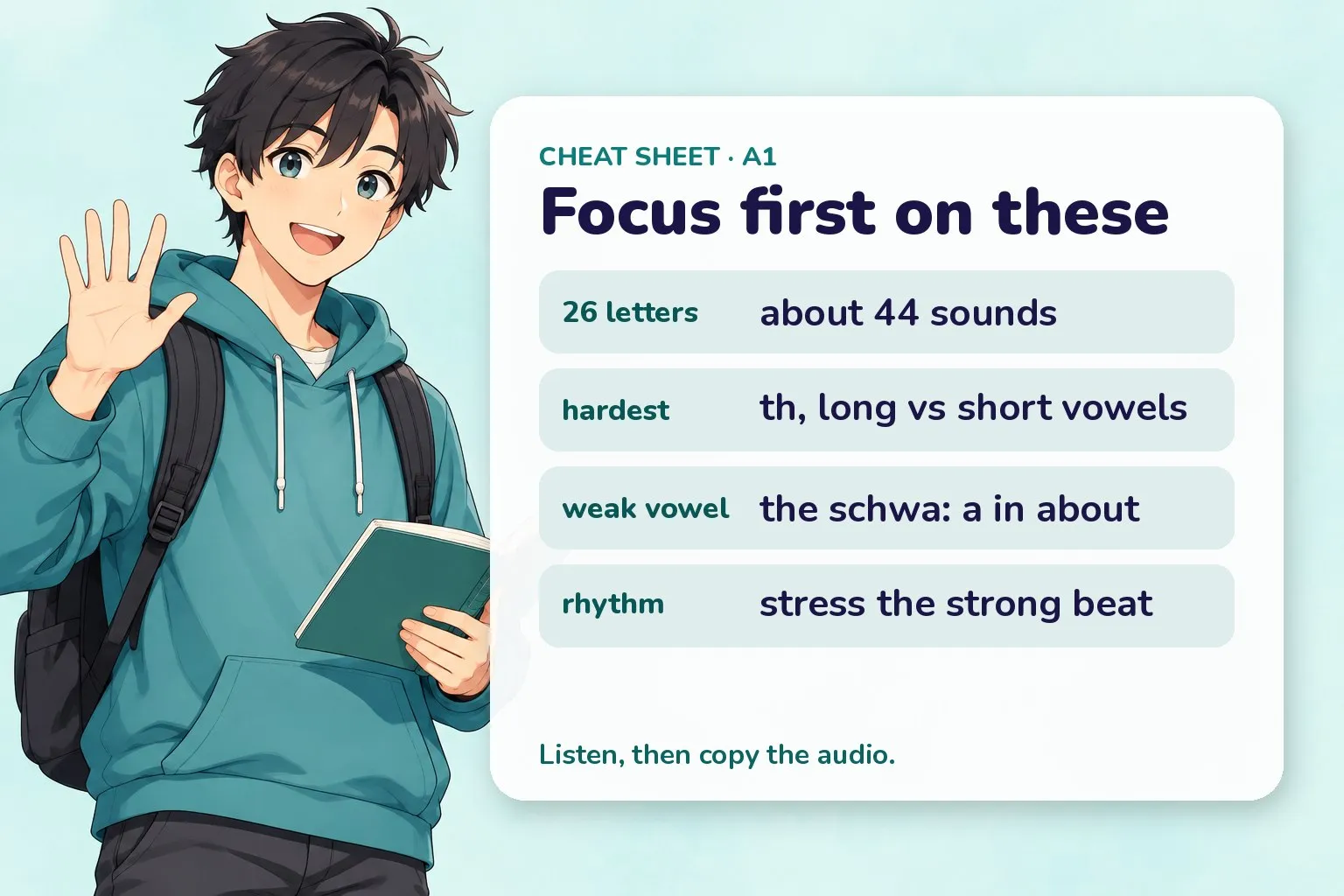
English has 26 letters but around 44 sounds, so spelling rarely tells you the pronunciation. Learn the sounds by ear, copy audio closely, and focus first on the few sounds and stress patterns that cause the most confusion.
Level: A1. English spelling is a poor map of English sound. The quickest way to sound clearer is to learn the sounds by ear and copy good audio, rather than reading a word and guessing. This page shows you what to focus on first.
By the end of this page you can…
…explain why English spelling and sound differ, name the sounds that trip up most learners, and use the audio here to practise.
Spelling is not the same as sound
English uses 26 letters to write around 44 sounds. Because there are far more sounds than letters, one letter can stand for several sounds, and one sound can be spelled many ways. The letter c is a hard sound in cat but a soft one in city. The sound at the start of ship is also spelled in sugar and station. So the spelling often cannot tell you the pronunciation on its own.
Linguists call a single distinct sound a phoneme. The exact number depends on the accent and on how you count, but a common figure for standard British English is about 20 vowel sounds and 24 consonant sounds. You do not need to memorise that list — you need to hear the differences and produce them.
The sounds learners find hardest
A few sounds and patterns cause most early mistakes. Spend your first efforts here:
- The two th sounds. think uses a voiceless th (/θ/); this uses a voiced th (/ð/). Put your tongue lightly between your teeth. Many learners replace them with t, d, s or z — the listener still understands, but it marks an accent strongly.
- Long versus short vowels. ship (/ɪ/) and sheep (/iː/) are different words. So are full and fool. Hold the long vowel clearly longer.
- The schwa. The most common vowel in English is the weak /ə/ in unstressed syllables — the a in about or the er in teacher. Reducing these syllables is what makes speech sound natural.
- Word stress. English squeezes unstressed syllables and leans on the strong one. comfortable is said with three clear beats (KUMF-tuh-bul), not four even ones.
- Consonant clusters. Groups like the str in street or the -sks in asks are hard. Say them slowly and join them up; do not add an extra vowel between the consonants.
How to say it
Three quick habits fix most beginner errors:
- th: tongue tip just touching the back of the top teeth, then let air out. Voiceless for think, with voice for this.
- Vowel length: stretch the vowel in sheep, food, car; keep it short and quick in ship, foot, cut.
- Schwa: in a weak syllable, relax the mouth to a small, lazy uh — banana is buh-NAH-nuh, not bah-nah-nah.
Listen and repeat with the audio
Press play on each word, then say it back. These contrast the sounds above.
- shipa large boatshort vowel /ɪ/, said quickly
- sheepthe farm animallong vowel /iː/, held longer than ship
- thinkto use your mindvoiceless th /θ/, tongue between the teeth
- thisthe thing near youvoiced th /ð/, the same tongue position with voice
- singto make music with your voicethe ng sound /ŋ/ at the end, no hard g
- churcha building for worshipthe ch sound /tʃ/ at both ends
- abouton the subject ofthe first syllable is a weak schwa: uh-BOUT
- teachera person who teachesthe ending -er is a weak schwa, not a strong vowel
- comfortablerelaxed and pleasantthree beats: KUMF-tuh-bul, stress on the first
- saysthe verb say, he or she saysrhymes with sez, not with days
- doesthe verb do, he or she doesrhymes with buzz: duz, not dohs
- streeta road in a townsay the str cluster joined up, no vowel between
How to use the audio on this site
Every example and quiz word has a play button that uses your browser voice. Make it work for you:
- Shadow it. Play, then speak at the same time on the next play, matching the rhythm.
- Slow down. Repeat a hard word five times before moving on.
- Record and compare. Use your phone to record yourself, then play the example again and listen for the gap.
- Chunk it. For long words, break them into syllables, stress the strong one, then speed up.
Quick recap before you practise.
Practice
Pronunciation overview practice
Try each one, then press Check. No sign-up, nothing is sent anywhere — it all runs in your browser.
Hint: it is the most common vowel sound in English
Show answer
schwa — The schwa /ə/ appears in weak syllables such as a-bout and teach-er.
4 Match each word to the sound it practises.
- think
- this
- sing
- church
Show answer
- think → voiceless th
- this → voiced th
- sing → ng sound
- church → ch sound
think = /θ/, this = /ð/, sing = /ŋ/, church = /tʃ/.
Quiz
English pronunciation overview quiz
7 questions · pick an answer and you'll see straight away if it's right.
-
Show answer
around 44 — Roughly 20 vowel and 24 consonant sounds in standard British English, depending on the accent.
-
Show answer
listen and repeat, then check the spelling — English spelling is an unreliable guide, so train your ear first.
-
Show answer
the same th, one voiceless and one voiced — think uses voiceless /θ/ and this uses voiced /ð/, same tongue position.
-
Show answer
about — The first syllable of about is the weak schwa: uh-BOUT.
-
Show answer
sez (like fez) — Despite the spelling, says is pronounced to rhyme with fez.
-
Show answer
English leans on the strong syllable and weakens the rest — Stress-timing gives English its rhythm; weak syllables reduce to schwa.
-
Show answer
shadow it: repeat out loud and compare — Shadowing and recording yourself build the sounds faster than reading.
Next
- Learn the letters and their sounds in The English Alphabet and Its Sounds
- Browse every topic in the English pronunciation section
- New here? Start with Start Learning English Here
All English pronunciation & writing topics
Vocabulary, pronunciation, phrases, practice and exam help, ordered by level. Pick a topic and go straight to it. New lessons go live every day, so topics marked Coming soon fill in over the next weeks.
Pronunciation & writing
A1 2 topics · 2 ready
- 01 English Pronunciation Overview You are here
- 02 The English Alphabet & Its Sounds