English Connected Speech (Linking)
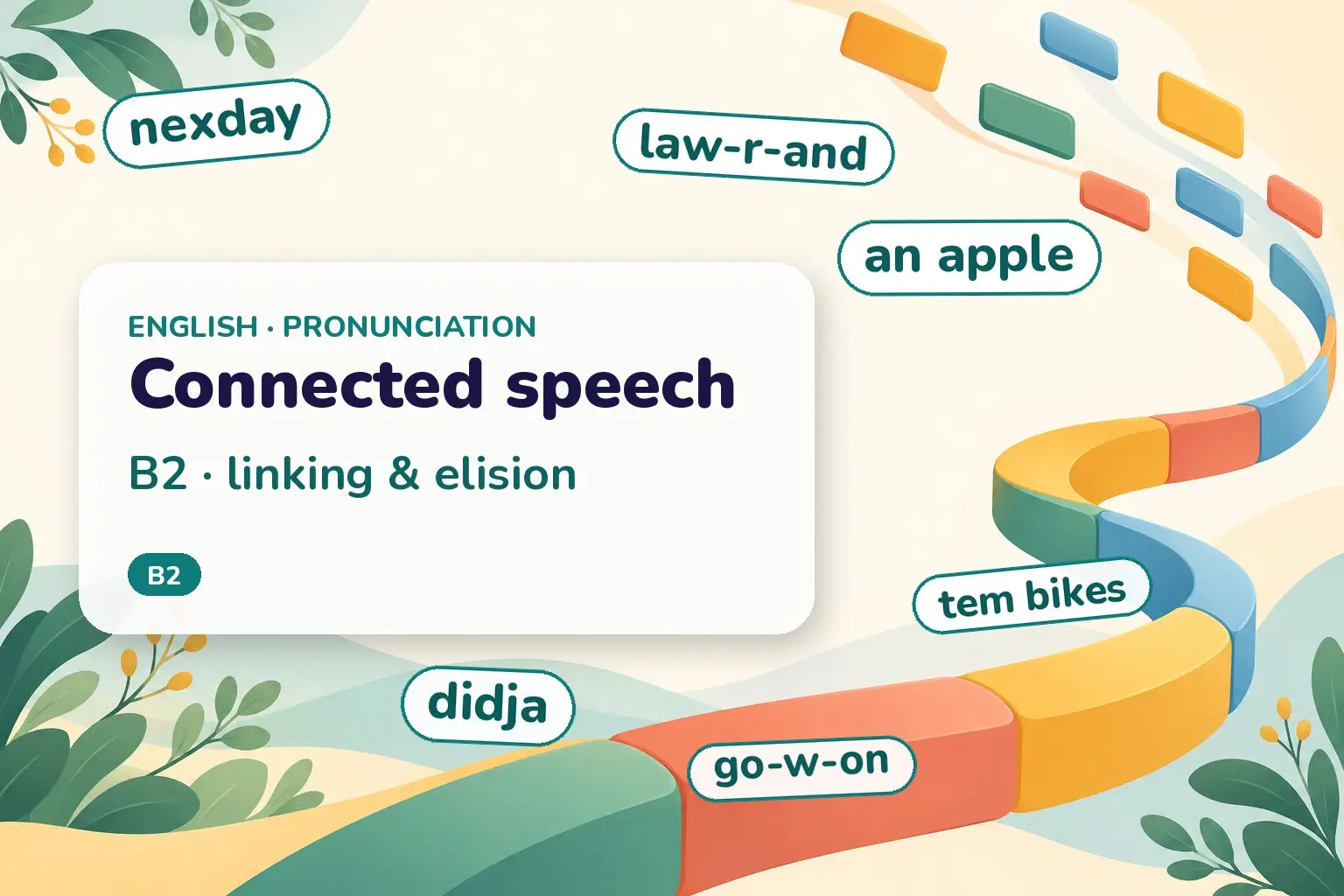
In natural English, words join together instead of being said one by one. Four processes do this: linking (joining a final consonant to a next vowel), intrusion (adding a small /r/, /j/ or /w/), assimilation (a sound changing to match its neighbour), and elision (a sound dropping out).
Level: B2. When English feels “too fast”, it is usually not speed — it is connected speech: words blend, change and lose sounds at their edges. Once you know the four processes, fluent English stops sounding like a blur.
By the end of this page you can…
…recognise linking, intrusion, assimilation and elision in what you hear, and start using them so your own speech flows more naturally.
The four processes
A sound here means a spoken sound, not a letter. Connected speech is the way sounds behave when words meet. Four processes do most of the work.
1. Linking. A word ending in a consonant sound joins straight onto a following word starting with a vowel sound: an apple sounds like “a-napple”, turn off like “tur-noff”. Nothing is added or lost; the boundary just moves.
2. Intrusion. English dislikes two vowel sounds meeting, so a tiny glide slips in between them — a /r/, /j/ (a “y” sound) or /w/. Law and order gains an /r/ (“law-r-and order”); I agree gains a /j/ (“I-y-agree”); go on gains a /w/ (“go-w-on”).
3. Assimilation. A sound changes to become more like its neighbour. Ten bikes becomes “tem bikes” (the /n/ turns into /m/ before /b/); good boy can become “gub boy”. When /t/ or /d/ meets a following /j/, the two merge (coalescence): did you → “didja”, don’t you → “doncha”.
4. Elision. A sound disappears, usually a /t/ or /d/ squeezed between two other consonants: next day → “nexday”, last night → “lasnight”, friendship → “frienship”. An unstressed vowel can also drop: camera → “camra”, comfortable → “comftable”.
Quick reference
| Process | What happens | Example |
|---|---|---|
| linking | consonant joins to next vowel | an apple → a-napple |
| intrusion | /r/, /j/ or /w/ added between vowels | law and order → law-r-and |
| assimilation | a sound changes to match a neighbour | ten bikes → tem bikes |
| coalescence | /t/ or /d/ + /j/ merge | did you → didja |
| elision | a sound (often /t/, /d/) drops | next day → nexday |
How to say it
Try these three habits; the audio buttons below let you hear each one.
- Do not stop between words. Let a final consonant run into the next vowel: say pick it up as one smooth “pi-ki-tup”, never three separate words.
- Let the little /r/, /j/ and /w/ appear. Between two vowels they come out on their own if you keep the airflow going: I agree, go on, the end.
- Allow weak /t/ and /d/ to drop between consonants. Mashed potatoes is comfortably “mash potatoes”; forcing every /t/ and /d/ makes you sound stiff.
Example sentences
- Have an apple.Linking: an-apple sounds like a-napple.
- Please turn off the light.Linking: turn-off sounds like tur-noff.
- Pick it up, please.Linking across three words: pi-ki-tup.
- It's the end of the road.Linking /j/: the-end sounds like thee-yend.
- Law and order matter.Intrusive /r/: law-r-and order.
- I saw it happen.Intrusive /r/: I saw-r-it.
- I agree with you.Intrusive /j/: I-y-agree.
- Go on without me.Intrusive /w/: go-w-on.
- There are ten bikes outside.Assimilation: ten becomes tem before bikes.
- He is a good boy.Assimilation: good boy can sound like gub boy.
- Did you see that?Coalescence: did you becomes didja.
- Don't you want it?Coalescence: don't you becomes doncha.
- Would you help me?Coalescence: would you becomes wouldja.
- See you next day.Elision: the /t/ drops, nexday.
- We talked last night.Elision: lasnight, the /t/ disappears.
- Friendship takes time.Elision: the /d/ drops, frienship.
- I bought a new camera.Vowel elision: camera becomes camra.
- This chair is comfortable.Vowel elision: comfortable becomes comftable.
- Fish and chips for dinner.Weak form plus linking: fish-n-chips.
- What do you do?Reduction and linking: whaddya do.
Common mistakes
- ❌ Saying every word with a hard stop → ✅ link final consonants to the next vowel so speech flows.
- ❌ Hearing didja and thinking it is a new word → ✅ it is just did you with coalescence.
- ❌ Pronouncing every /t/ in next day, last night → ✅ the /t/ is usually elided: nexday, lasnight.
- ❌ Writing connected-speech forms down (nexday, didja) → ✅ spelling never changes; these are spoken only.
- ❌ Panicking that native speech is “too fast” → ✅ it is mostly linking and elision; train with shadowing.
Practice
Connected speech practice
Try each one, then press Check. No sign-up, nothing is sent anywhere — it all runs in your browser.
1 Match each phrase to the process it shows.
- an apple → a-napple
- law and order → law-r-and
- ten bikes → tem bikes
- next day → nexday
Show answer
- an apple → a-napple → linking
- law and order → law-r-and → intrusion
- ten bikes → tem bikes → assimilation
- next day → nexday → elision
Linking joins; intrusion adds a glide; assimilation changes a sound; elision drops one.
Hint: the /t/ of last drops
Show answer
night — The /t/ between two consonants is elided: lasnight.
4 Order the words, then say them with linking.
Show answer
pick it up — Linked, it flows as pi-ki-tup.
Hint: two words, with an apostrophe
Show answer
don't you — doncha = don't you (coalescence of /t/ + /j/).
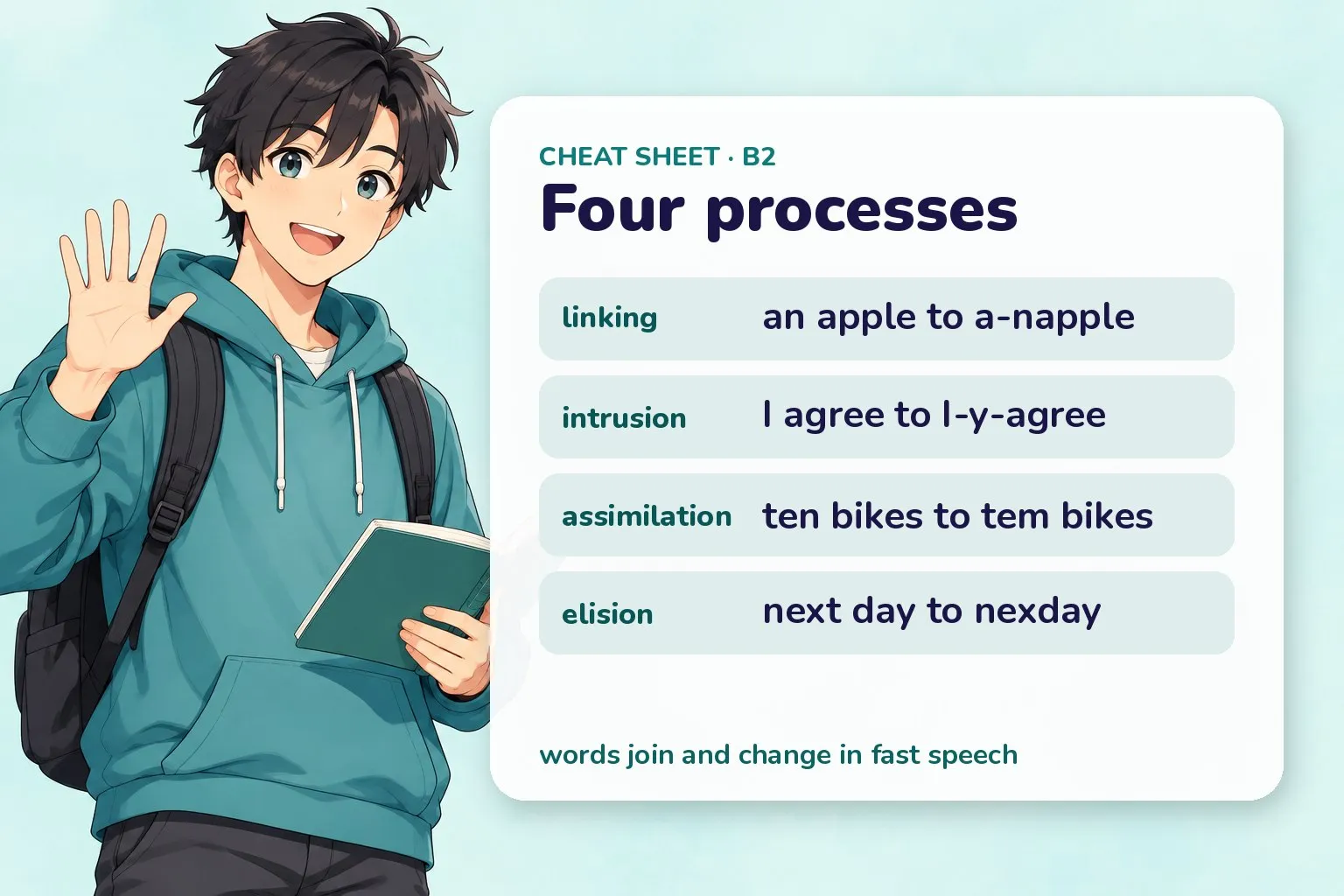
Quick recap before you practise.
Quiz
Connected speech quiz
10 questions · pick an answer and you'll see straight away if it's right.
-
Show answer
Joining a final consonant to a following vowel — Linking moves a final consonant onto the next word's vowel: an apple → a-napple.
-
Show answer
/r/ — An intrusive /r/ appears between the two vowels: law-r-and.
-
Show answer
assimilation — The /n/ changes to /m/ to match /b/: assimilation.
-
Show answer
The /t/ is elided between consonants — A /t/ squeezed between consonants is commonly dropped (elided).
-
Show answer
coalescent assimilation of /d/ + /j/ — /d/ + /j/ merge into a single sound: normal connected speech.
-
Show answer
Shadow short audio clips — Shadowing trains the ear and mouth for real connected speech.
-
Show answer
No, spelling stays the same — These are spoken features; writing keeps the full spelling.
-
Show answer
elision — Losing the unstressed vowel is elision.
-
Show answer
understand fast speech — Decoding fluent speech comes first; natural production follows.
-
Show answer
go on — Between the vowels of go and on, a /w/ glide appears: go-w-on.
Recap cheat-sheet
| Process | Clue | Example |
|---|---|---|
| linking | consonant + vowel join | turn off → tur-noff |
| intrusion | glide added between vowels | I agree → I-y-agree |
| assimilation | a sound shifts | ten bikes → tem bikes |
| elision | a sound drops | friendship → frienship |
| coalescence | /t/,/d/ + /j/ merge | did you → didja |
Next
- Previous: English Contractions & Reductions
- Related: Sentence Stress & Rhythm
- Back to Start Learning English Here
All English pronunciation & writing topics
Vocabulary, pronunciation, phrases, practice and exam help, ordered by level. Pick a topic and go straight to it. New lessons go live every day, so topics marked Coming soon fill in over the next weeks.
Pronunciation & writing
A1 2 topics · 2 ready
A2 6 topics · 6 ready
B1 2 topics · 2 ready
B2 1 topics · 1 ready
- 11 English Connected Speech (Linking) You are here