English Consonant Sounds (IPA)
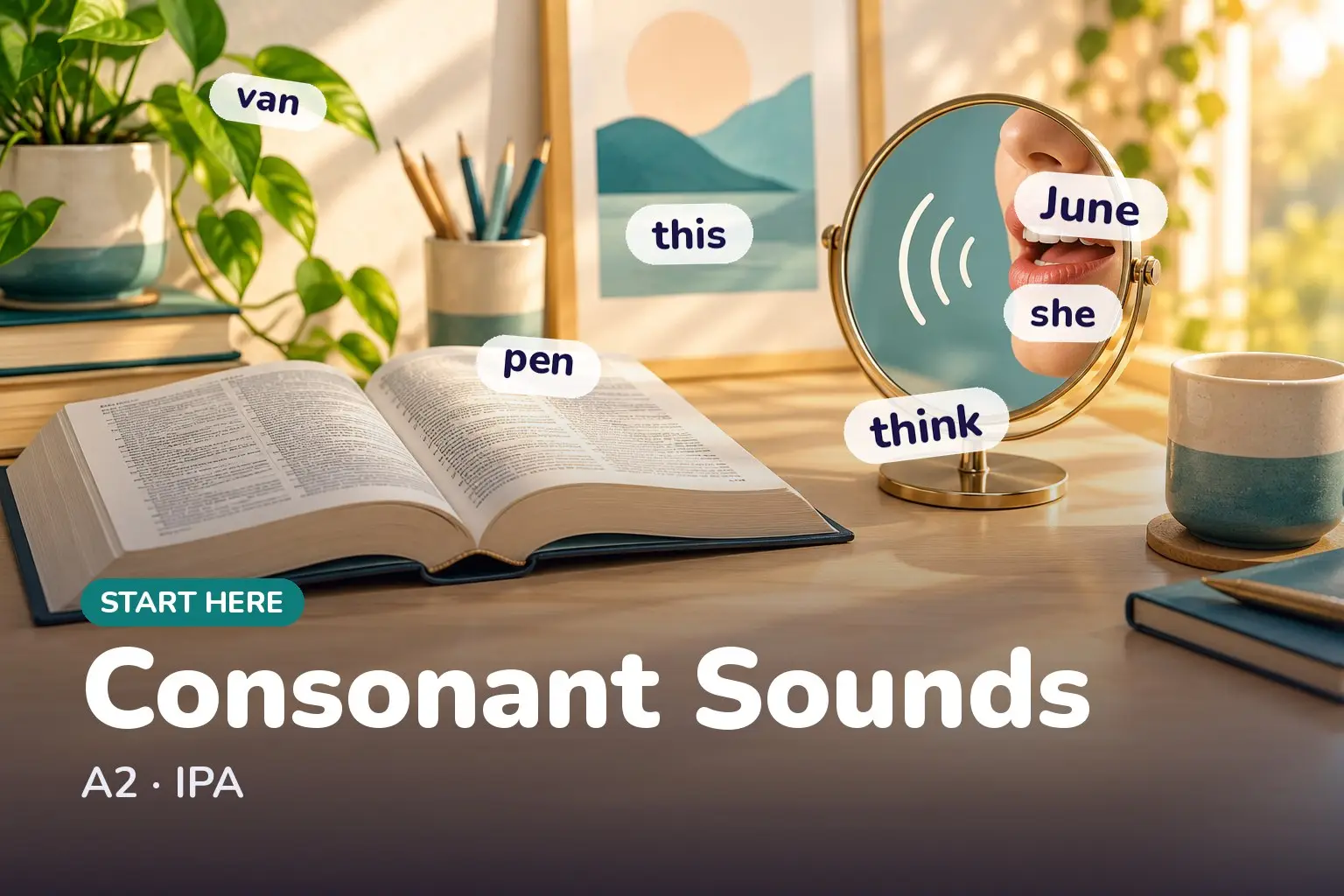
English has 24 consonant sounds. Most come in voiced and voiceless pairs — such as /b/ and /p/ — made in the same place but with the voice switched on or off. The two th sounds, /θ/ in think and /ð/ in this, are the ones learners most often miss.
Level: A2. English has 24 consonant sounds, and the IPA gives each one a single symbol. Once you can match the symbol to the sound, a dictionary tells you exactly how to say any word — spelling included or not.
By the end of this page you can…
…read the main consonant symbols, tell a voiced sound from a voiceless one, and produce the two th sounds that many learners find hardest.
What a consonant is
A consonant is a sound made by blocking or narrowing the airflow somewhere in the mouth — with the lips, the tongue, or the teeth. That contrasts with vowels, where the air flows out freely. English writes consonant sounds between slashes in the IPA, for example /t/ in ten /ten/.
The symbols here follow the British set used by the Cambridge Dictionary; nearly all consonants are the same in American English. Two points of vocabulary will help: a sound is voiced if your vocal cords vibrate while you make it, and voiceless if they do not.
The consonant chart
Consonants are grouped by how the air is blocked. Plosives stop the air and release it; fricatives squeeze it through a narrow gap; affricates are a stop plus a fricative; nasals send air through the nose; approximants only narrow the air a little.
| Type | Voiceless | Voiced |
|---|---|---|
| Plosive (lips) | /p/ pen | /b/ bad |
| Plosive (tongue–ridge) | /t/ ten | /d/ dog |
| Plosive (back) | /k/ cat | /ɡ/ go |
| Fricative (lip–teeth) | /f/ fish | /v/ van |
| Fricative (th) | /θ/ think | /ð/ this |
| Fricative (ridge) | /s/ sun | /z/ zoo |
| Fricative (palate) | /ʃ/ she | /ʒ/ measure |
| Fricative (throat) | /h/ house | — |
| Affricate | /tʃ/ cheese | /dʒ/ June |
| Nasal | — | /m/ man, /n/ no, /ŋ/ sing |
| Approximant | — | /l/ leg, /r/ red, /w/ wet, /j/ yes |
The th sounds: /θ/ and /ð/
English has two th sounds, and both are made the same way: put the tip of your tongue lightly between your teeth and push air past it.
- /θ/ is voiceless — no buzz: think /θɪŋk/, bath /bɑːθ/, three /θriː/.
- /ð/ is voiced — the throat buzzes: this /ðɪs/, mother /ˈmʌð.ə/, they /ðeɪ/.
Many learners replace them with the nearest sound from their first language — /s/ or /t/ for /θ/, /z/ or /d/ for /ð/. That turns think into sink and they into day, so it is worth drilling.
Minimal pairs: hear the difference
A minimal pair is two words separated by exactly one sound. These pairs isolate the consonant so your ear can lock onto it.
- pen/pen/ — voiceless /p/.
- Ben/ben/ — voiced /b/. Pair with pen (p vs b).
- fan/fæn/ — voiceless /f/.
- van/væn/ — voiced /v/. Pair with fan (f vs v).
- think/θɪŋk/ — voiceless th /θ/.
- sink/sɪŋk/ — /s/; the common wrong swap for think.
- they/ðeɪ/ — voiced th /ð/.
- day/deɪ/ — /d/; the common wrong swap for they.
- rice/raɪs/ — voiceless /s/.
- rise/raɪz/ — voiced /z/. Pair with rice (s vs z).
- ship/ʃɪp/ — /ʃ/ as in she.
- chip/tʃɪp/ — affricate /tʃ/. Pair with ship (sh vs ch).
- cheap/tʃiːp/ — voiceless affricate /tʃ/.
- jeep/dʒiːp/ — voiced affricate /dʒ/. Pair with cheap.
- light/laɪt/ — /l/.
- right/raɪt/ — /r/. Pair with light (l vs r).
- sing/sɪŋ/ — the single nasal /ŋ/ at the end.
How to say it
The consonants English learners most often get wrong:
- /θ/ and /ð/ (think, this). Tongue tip between the teeth, air flowing. /θ/ silent, /ð/ buzzing. Watch yourself in a mirror — if your tongue stays behind the teeth you are probably saying /s/ or /t/ instead.
- /v/ (van), not /w/ or /b/. Rest your top teeth on your bottom lip and buzz. /w/ uses rounded lips with no teeth; /b/ closes both lips.
- /r/ and /l/ (right, light). For /l/ the tongue tip touches the ridge behind the top teeth; for /r/ it curls back and touches nothing. They are different sounds in English.
- /ŋ/ (sing). Keep the back of the tongue up and let the sound out through the nose. Do not add a hard /ɡ/ — singer is /ˈsɪŋ.ə/, not “sing-ger”.
British and American notes
Consonants are the most stable part of English pronunciation, so British and American speakers share nearly all 24. The clearest difference is the /t/ between vowels: in American English, water and better often use a quick tap that sounds close to a /d/ (/ˈwɑː.t̬ɚ/), while British English keeps a clear /t/ (/ˈwɔː.tə/). The /r/ is also pronounced after vowels in American English but dropped in British English (see the vowels lesson).
Practice
Consonant sounds practice
Try each one, then press Check. No sign-up, nothing is sent anywhere — it all runs in your browser.
3 Match each voiceless sound to its voiced partner.
- /p/
- /f/
- /s/
- /tʃ/
Show answer
- /p/ → /b/
- /f/ → /v/
- /s/ → /z/
- /tʃ/ → /dʒ/
Same place of articulation, voice off then on: p–b, f–v, s–z, tʃ–dʒ.
Hint: your throat buzzes
Show answer
voiced — Voiced sounds vibrate the vocal cords; voiceless sounds do not.
Quiz
English consonant sounds quiz
7 questions · pick an answer and you'll see straight away if it's right.
-
Show answer
blocking or narrowing the airflow — Consonants block or narrow the air; vowels let it flow freely.
-
Show answer
/p/ and /b/ — /p/ is voiceless and /b/ is its voiced partner.
-
Show answer
/θ/ — Think starts with the voiceless th sound /θ/.
-
Show answer
/ð/ — This starts with the voiced th sound /ð/.
-
Show answer
/ŋ/ as in sing — /ŋ/ is one nasal sound, even though it is written ng.
-
Show answer
yes — IPA /j/ is the y sound in yes; the j of June is /dʒ/.
-
Show answer
bet — Devoicing the final /d/ to /t/ turns bed into bet, a different word.
Recap cheat-sheet
| Idea | Key point |
|---|---|
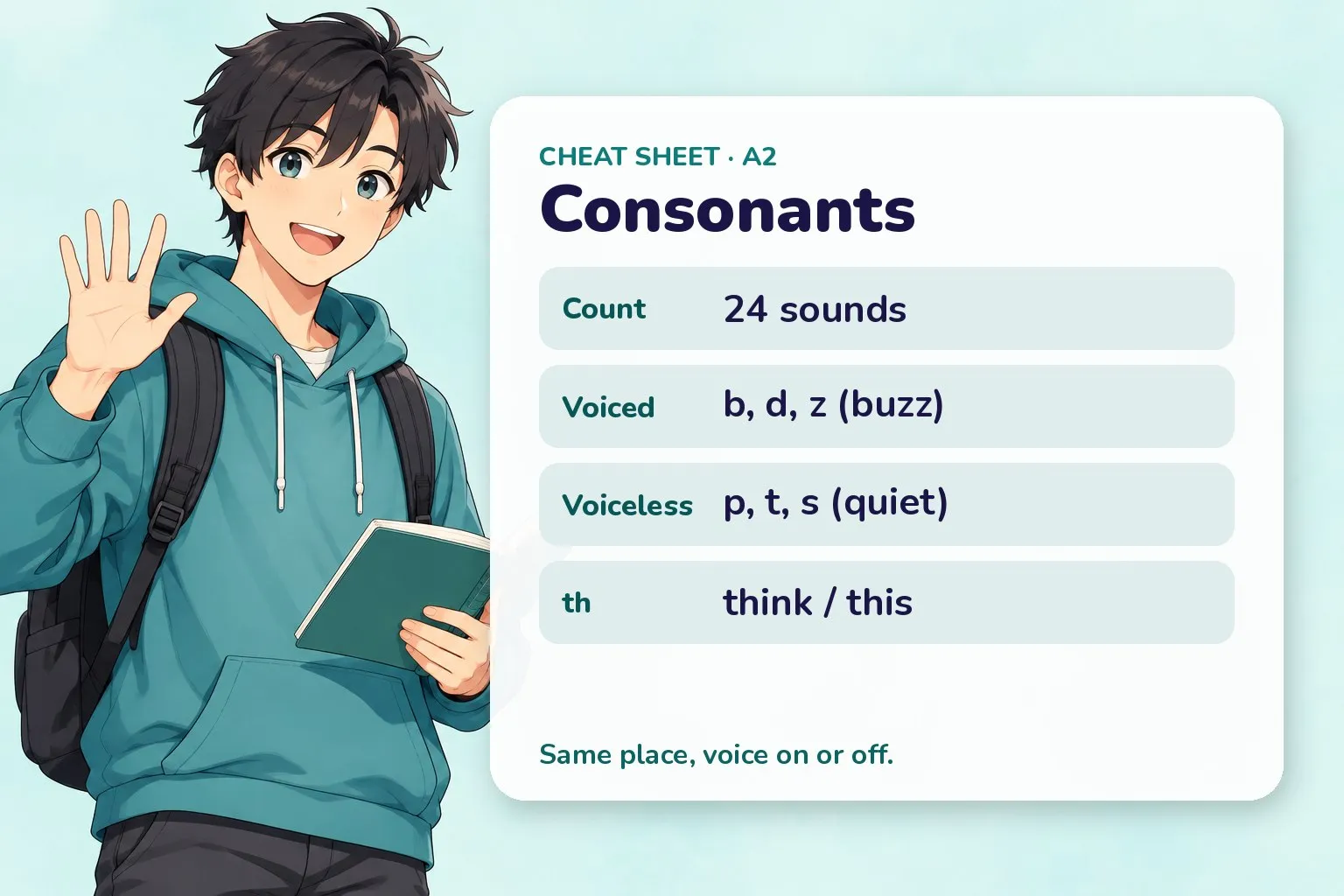
| Count | 24 consonant sounds |
| Voicing | voiced buzzes (/b d z/), voiceless does not (/p t s/) |
| th | /θ/ think (silent), /ð/ this (buzzing) |
| One sound, two letters | /ʃ/ sh, /tʃ/ ch, /dʒ/ j, /ŋ/ ng |
Quick recap before the quiz.
Next
- Previous in pronunciation: English Vowel Sounds (IPA)
- Next: English Word Stress
- Browse the English pronunciation section
- New here? Start with Start Learning English Here
All English pronunciation & writing topics
Vocabulary, pronunciation, phrases, practice and exam help, ordered by level. Pick a topic and go straight to it. New lessons go live every day, so topics marked Coming soon fill in over the next weeks.
Pronunciation & writing
A1 2 topics · 2 ready
A2 6 topics · 6 ready
- 03 English Vowel Sounds (IPA)
- 04 English Consonant Sounds (IPA) You are here
- 05 English Word Stress
- 06 English Silent Letters
- 07 English Spelling Rules & Patterns
- 08 English Contractions & Reductions