English Spelling Rules & Patterns
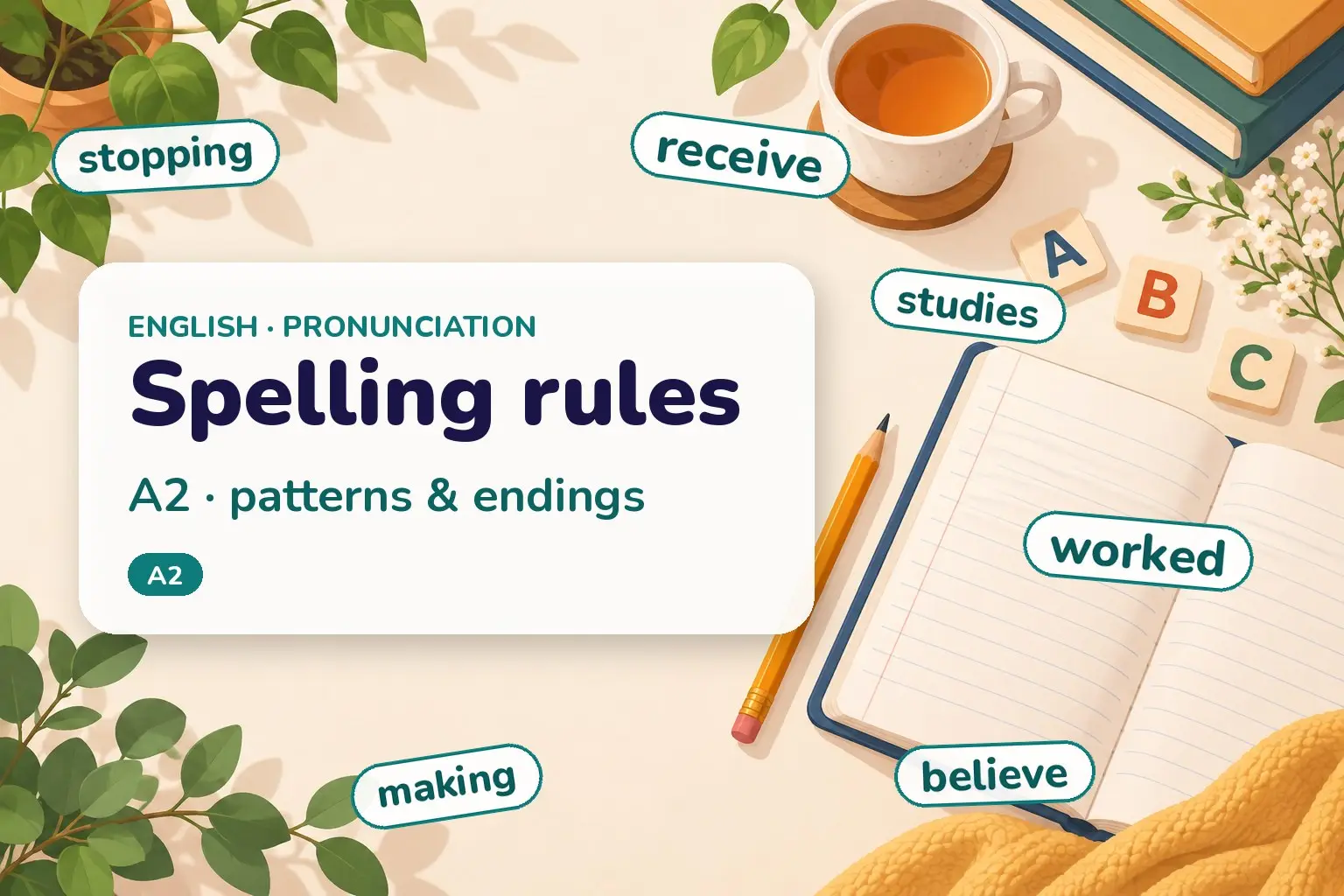
English spelling follows patterns more often than it seems. Learn five: i before e except after c, doubling a final consonant before a vowel suffix, dropping silent e before a vowel suffix, changing consonant + y to -ies, and the sound of -s and -ed endings.
On this page9 sections · tap to jump
Level: A2. English spelling has a reputation for chaos, but a handful of rules cover most everyday words. Learn these five patterns and you will spell — and read aloud — far more confidently.
By the end of this page you can…
…apply the five core spelling rules, handle their common exceptions, and say the written -s and -ed endings with the right sound.
The rules
A suffix is an ending you add to a word (-ing, -ed, -er, -ful). A vowel letter is a, e, i, o, u; every other letter is a consonant. Most spelling rules depend on what the word ends in and what you add.
1. i before e. After most letters, write ie: believe, piece, field. After the letter c, write ei: receive, ceiling. When the sound is a long “ay” /eɪ/, also write ei: eight, weigh, neighbour.
2. Doubling the final consonant. In a short word that ends in one vowel + one consonant, double that consonant before a vowel suffix: stop → stopping, big → bigger. In a longer word, double only when the stress is on the last syllable: beGIN → beginning, but ENter → entering.
3. Drop the silent e. When a word ends in a silent e, drop it before a vowel suffix (make → making, hope → hoping) but keep it before a consonant suffix (hope → hopeful, care → careful).
4. Consonant + y becomes -ies / -ied. When a word ends in a consonant + y, change the y to i before most endings: study → studies, carry → carried, happy → happiest. A vowel + y does not change: play → played, enjoy → enjoyed.
5. The -s and -ed endings are spelled the same way but spoken in more than one way — see “How to say it” below.
Quick reference
| Rule | Add this | Example |
|---|---|---|
| i before e | ie / ei after c | believe, piece / receive, ceiling |
| double final consonant | vowel suffix | stop → stopping, big → bigger |
| drop silent e | vowel suffix | make → making, hope → hoping |
| keep silent e | consonant suffix | hope → hopeful, care → careful |
| consonant + y → i | most suffixes | study → studies, carry → carried |
| vowel + y (no change) | add directly | play → played, enjoy → enjoying |
How to say it
The written endings -s and -ed each have three possible sounds. Match the sound to the last sound of the base word, not to the letters.
- Plural / third-person -s: after a voiceless sound (p, t, k, f) say /s/ (maps, cats); after a voiced sound or vowel say /z/ (dogs, plays); after a hissing sound (s, z, sh, ch, x) say an extra syllable /ɪz/ (watches, boxes).
- Past-tense -ed: after a voiceless sound say /t/ (worked, stopped); after a voiced sound or vowel say /d/ (played, opened); after a t or d sound say an extra syllable /ɪd/ (wanted, needed).
So worked is one syllable but wanted is two. Learners often add a wrong extra syllable (saying “work-ed”); only words ending in a t/d sound get the /ɪd/.
Example sentences
- I believe you.i before e after most letters.
- Cut another piece of cake.ie: piece, not peice.
- She will receive the parcel today.ei after c: receive.
- Our neighbours weigh the apples.ei for the /eɪ/ sound: neighbour, weigh.
- Please seize this chance.Exception: seize keeps ei with no c.
- He stopped the car.Doubling: stop plus -ed becomes stopped.
- They are planning a trip.plan becomes planning (one vowel, one consonant).
- We are beginning the lesson.Stress on the last syllable: begin becomes beginning.
- She is entering her name.No doubling: stress is not on the last syllable of enter.
- She is travelling to work.British English doubles the final -l: travelling.
- I am making a cake.Drop the silent e before -ing: make becomes making.
- It was hopeful news.Keep the e before a consonant suffix: hopeful.
- He studies every night.Consonant + y becomes -ies: study becomes studies.
- She carried the heavy bag.Consonant + y becomes -ied: carry becomes carried.
- The children played outside.Vowel + y does not change: play becomes played.
- The cats ran away.The -s here is said /s/ after a voiceless t.
- She watches old films.The -es is an extra syllable /ɪz/ after -ch.
- They worked all day.The -ed is said /t/ after a voiceless k.
- We opened the windows.The -ed is said /d/ after a voiced n.
- I wanted more time.The -ed is an extra syllable /ɪd/ after t.
Common mistakes
- ❌ I recieve your email. → ✅ I receive your email. After c, write ei: receive.
- ❌ He stoped running. → ✅ He stopped running. Double the final consonant before -ed: stopped.
- ❌ She is makeing dinner. → ✅ She is making dinner. Drop the silent e before -ing: making.
- ❌ He studys hard. → ✅ He studies hard. Consonant + y changes to -ies: studies.
- ❌ We enjoied the film. → ✅ We enjoyed the film. Vowel + y does not change: enjoyed.
- ❌ They work-ed late (said with two syllables) → ✅ worked is one syllable, ending in /t/.
Practice
Spelling rules practice
Try each one, then press Check. No sign-up, nothing is sent anywhere — it all runs in your browser.
Hint: one vowel + one consonant
Show answer
stopping — Double the final consonant before a vowel suffix: stopping.
Hint: silent e
Show answer
making — Drop the silent e before -ing: making.
4 Put the words in order to make a correct sentence.
Show answer
She studies every night — Consonant + y becomes -ies: study to studies.
5 Match each -ed word to how the ending sounds.
- worked
- opened
- wanted
- played
Show answer
- worked → /t/
- opened → /d/
- wanted → /ɪd/
- played → /d/
Voiceless base to /t/; voiced base or vowel to /d/; t/d base to the extra syllable /ɪd/.
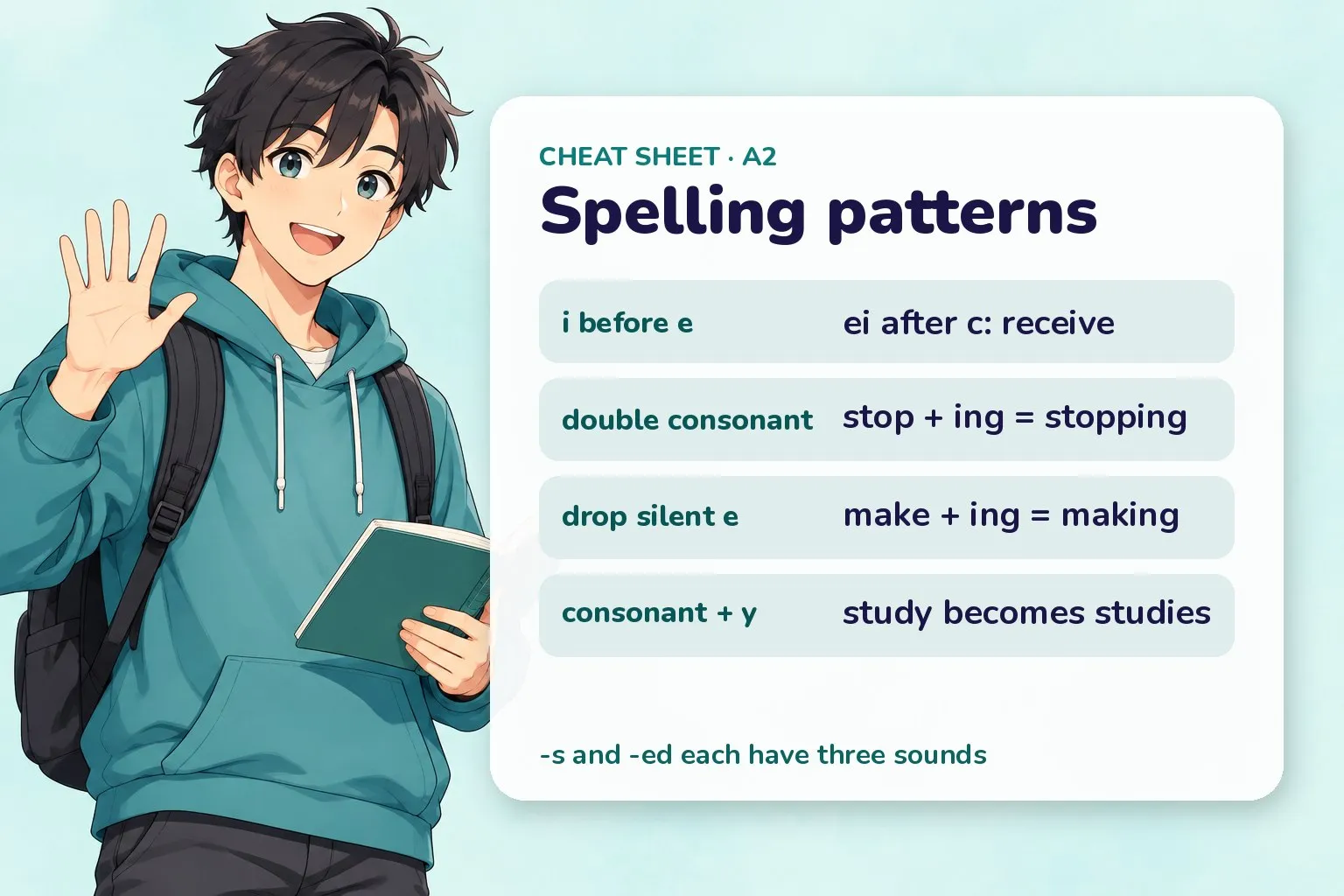
Quick recap before you practise.
Quiz
Spelling rules quiz
10 questions · pick an answer and you'll see straight away if it's right.
-
Show answer
believe — i before e after most letters: believe.
-
Show answer
planned — One vowel + one consonant: double it, planned.
-
Show answer
beginning — Stress on the last syllable, so double: beginning.
-
Show answer
hopeful — Keep the silent e before a consonant suffix: hopeful.
-
Show answer
carried — Consonant + y becomes -ied: carried.
-
Show answer
enjoyed — Vowel + y does not change: enjoyed.
-
Show answer
/t/ — After a voiceless sound (k) the -ed is /t/.
-
Show answer
/ɪd/ (extra syllable) — After a t sound the -ed is the extra syllable /ɪd/.
-
Show answer
babies — Consonant + y becomes -ies: babies.
-
Show answer
seize — seize keeps ei with no c before it, breaking the rule.
Recap cheat-sheet
| Pattern | Remember | Example |
|---|---|---|
| i before e | ei after c, or for /eɪ/ | receive, weigh |
| double consonant | short word + vowel suffix | stop → stopping |
| drop silent e | before a vowel suffix | make → making |
| consonant + y → i | before most suffixes | study → studies |
| -ed sound | /t/, /d/ or /ɪd/ | worked, played, wanted |
Next
- Next: English Contractions & Reductions
- Previous: English Silent Letters
- Back to Start Learning English Here
All English pronunciation & writing topics
Vocabulary, pronunciation, phrases, practice and exam help, ordered by level. Pick a topic and go straight to it. New lessons go live every day, so topics marked Coming soon fill in over the next weeks.
Pronunciation & writing
A1 2 topics · 2 ready
A2 6 topics · 6 ready
- 03 English Vowel Sounds (IPA)
- 04 English Consonant Sounds (IPA)
- 05 English Word Stress
- 06 English Silent Letters
- 07 English Spelling Rules & Patterns You are here
- 08 English Contractions & Reductions