English Vowel Sounds (IPA)
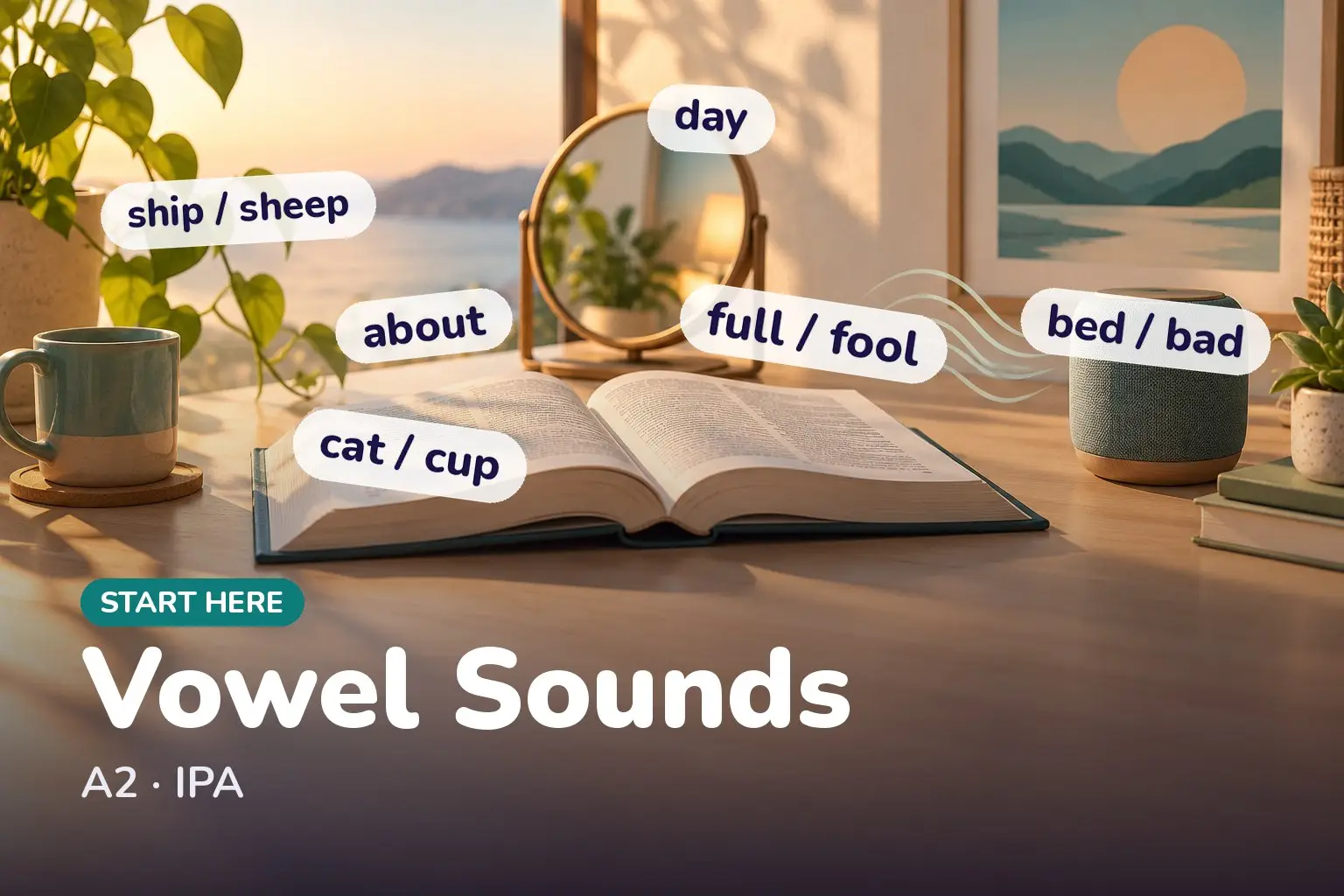
British English has about 20 vowel sounds — far more than its five vowel letters — split into short vowels, long vowels (shown with the length mark ː) and diphthongs that glide from one sound to another. The weak schwa /ə/ is the most frequent of all.
Level: A2. English has only five vowel letters — a, e, i, o, u — but roughly twenty vowel sounds. The IPA (International Phonetic Alphabet) gives each sound its own symbol, so you can see exactly what to say even when the spelling hides it.
By the end of this page you can…
…recognise the main English vowel symbols in a dictionary, tell short from long vowels, and hear the difference in minimal pairs like ship and sheep.
Why vowels need the IPA
A vowel is a sound you make with an open vocal tract — air flows out freely, with no blocking from the lips or tongue. English spelling maps badly onto its vowels: the letter a alone stands for different sounds in cat, car, cake and about. Dictionaries solve this with the IPA, writing each sound between slashes, for example /kæt/ for cat.
The transcriptions here follow the British (RP-based) set used by the Cambridge Dictionary. Where the American pronunciation differs clearly, it is noted. Slashes / / mark the sounds, and a small raised ˈ before a syllable marks stress.
The three vowel groups
English vowels fall into three groups. Short vowels are quick; long vowels are held longer and are written with a length mark /ː/; diphthongs glide from one vowel position to another inside a single syllable.
| Group | IPA | Example | Notes |
|---|---|---|---|
| Short | /ɪ/ | ship /ʃɪp/ | relaxed, short i |
| Short | /e/ | bed /bed/ | as in red |
| Short | /æ/ | cat /kæt/ | open, front a |
| Short | /ʌ/ | cup /kʌp/ | as in but |
| Short | /ɒ/ | hot /hɒt/ | British; US /ɑː/ |
| Short | /ʊ/ | put /pʊt/ | short, rounded u |
| Short | /ə/ | about /əˈbaʊt/ | the schwa — weak, unstressed |
| Long | /iː/ | sheep /ʃiːp/ | long ee |
| Long | /ɑː/ | car /kɑː/ | British; US adds the /r/ |
| Long | /ɔː/ | horse /hɔːs/ | long aw |
| Long | /ɜː/ | bird /bɜːd/ | the ur sound |
| Long | /uː/ | boot /buːt/ | long oo |
| Diphthong | /eɪ/ | day /deɪ/ | glides e → i |
| Diphthong | /aɪ/ | my /maɪ/ | glides a → i |
| Diphthong | /ɔɪ/ | boy /bɔɪ/ | glides o → i |
| Diphthong | /əʊ/ | go /ɡəʊ/ | British; US /oʊ/ |
| Diphthong | /aʊ/ | now /naʊ/ | glides a → u |
| Diphthong | /ɪə/ | near /nɪə/ | British centring diphthong |
| Diphthong | /eə/ | hair /heə/ | British centring diphthong |
The schwa: the most common sound
The schwa /ə/ is the short, weak vowel in an unstressed syllable. It is the single most frequent vowel in English because nearly every long word has at least one unstressed syllable that reduces to it: a in about /əˈbaʊt/, er in teacher /ˈtiː.tʃə/, o in today /təˈdeɪ/. The schwa never carries stress.
Minimal pairs: hear the difference
A minimal pair is two words that differ by exactly one sound. They are the best way to train your ear, because only the vowel changes.
- ship/ʃɪp/ — short /ɪ/; a large boat.
- sheep/ʃiːp/ — long /iː/; the farm animal. Pair with ship.
- cat/kæt/ — short /æ/; the pet.
- cup/kʌp/ — short /ʌ/; you drink from it. Pair with cat.
- full/fʊl/ — short /ʊ/; not empty.
- fool/fuːl/ — long /uː/; a silly person. Pair with full.
- bed/bed/ — short /e/; you sleep on it.
- bad/bæd/ — short /æ/; not good. Pair with bed.
- cot/kɒt/ — short /ɒ/, British; a baby's bed.
- caught/kɔːt/ — long /ɔː/; past of catch. Pair with cot.
- about/əˈbaʊt/ — schwa /ə/ then diphthong /aʊ/.
- teacher/ˈtiː.tʃə/ — long /iː/ then weak schwa /ə/.
- day/deɪ/ — diphthong /eɪ/ gliding e to i.
- go/ɡəʊ/ — British /əʊ/; US says /ɡoʊ/.
- near/nɪə/ — British centring diphthong /ɪə/.
- hair/heə/ — British centring diphthong /eə/.
How to say it
Three vowel contrasts cause English learners the most trouble:
- /iː/ vs /ɪ/ (sheep vs ship). For /iː/ stretch your lips into a wide smile and hold the sound; for /ɪ/ relax, open the jaw a little and keep it short. The length and tension both change.
- /æ/ vs /ʌ/ (cat vs cut). For /æ/ drop your jaw and spread the mouth wide; for /ʌ/ keep the mouth more neutral and central, like a short grunt.
- The schwa /ə/. Do not try to “pronounce the letter”. Relax the mouth completely and make the smallest, laziest vowel you can — that is the sound of almost every unstressed syllable.
British and American differences
Most vowels are shared, but a few differ in a predictable way:
- /ɒ/ → /ɑː/: British hot /hɒt/ is American /hɑːt/. American English has no short /ɒ/.
- The bath group: words like bath, dance, class use /ɑː/ in southern British English but /æ/ in American English.
- The letter r: British English is non-rhotic, so car is /kɑː/ with no /r/ sound; American English keeps it: /kɑːr/.
- /əʊ/ → /oʊ/: British go /ɡəʊ/ starts with a schwa-like sound; American go /ɡoʊ/ starts rounder.
Practice
Vowel sounds practice
Try each one, then press Check. No sign-up, nothing is sent anywhere — it all runs in your browser.
3 Match each word to its vowel sound.
- sheep
- cup
- hot
- bird
Show answer
- sheep → /iː/
- cup → /ʌ/
- hot → /ɒ/
- bird → /ɜː/
sheep /ʃiːp/, cup /kʌp/, hot /hɒt/, bird /bɜːd/.
Hint: it means the smallest possible difference
Show answer
minimal — A minimal pair differs by exactly one sound, so it isolates that contrast.
Quiz
English vowel sounds quiz
7 questions · pick an answer and you'll see straight away if it's right.
-
Show answer
About twenty — Five vowel letters, but about twenty vowel sounds.
-
Show answer
A long vowel — The length mark ː shows the vowel is held longer.
-
Show answer
a vowel that glides from one position to another — A diphthong glides between two vowel positions in one syllable, as in /aɪ/ (my).
-
Show answer
/ə/ the schwa — The schwa appears in the unstressed syllables of countless words.
-
Show answer
ship / sheep — ship /ʃɪp/ and sheep /ʃiːp/ differ only in the vowel /ɪ/ vs /iː/.
-
Show answer
unstressed syllables — The schwa is the weak vowel of unstressed syllables and never takes stress.
-
Show answer
/kɑː/ — British English drops the /r/ at the end: /kɑː/. American English keeps it: /kɑːr/.
Recap cheat-sheet
| Group | Mark | Examples |
|---|---|---|
| Short vowels | none | /ɪ/ ship, /æ/ cat, /ʌ/ cup, /ə/ about |
| Long vowels | ː | /iː/ sheep, /ɑː/ car, /uː/ boot |
| Diphthongs | glide | /eɪ/ day, /aɪ/ my, /əʊ/ go |
| Schwa | weak | the vowel of every unstressed syllable |
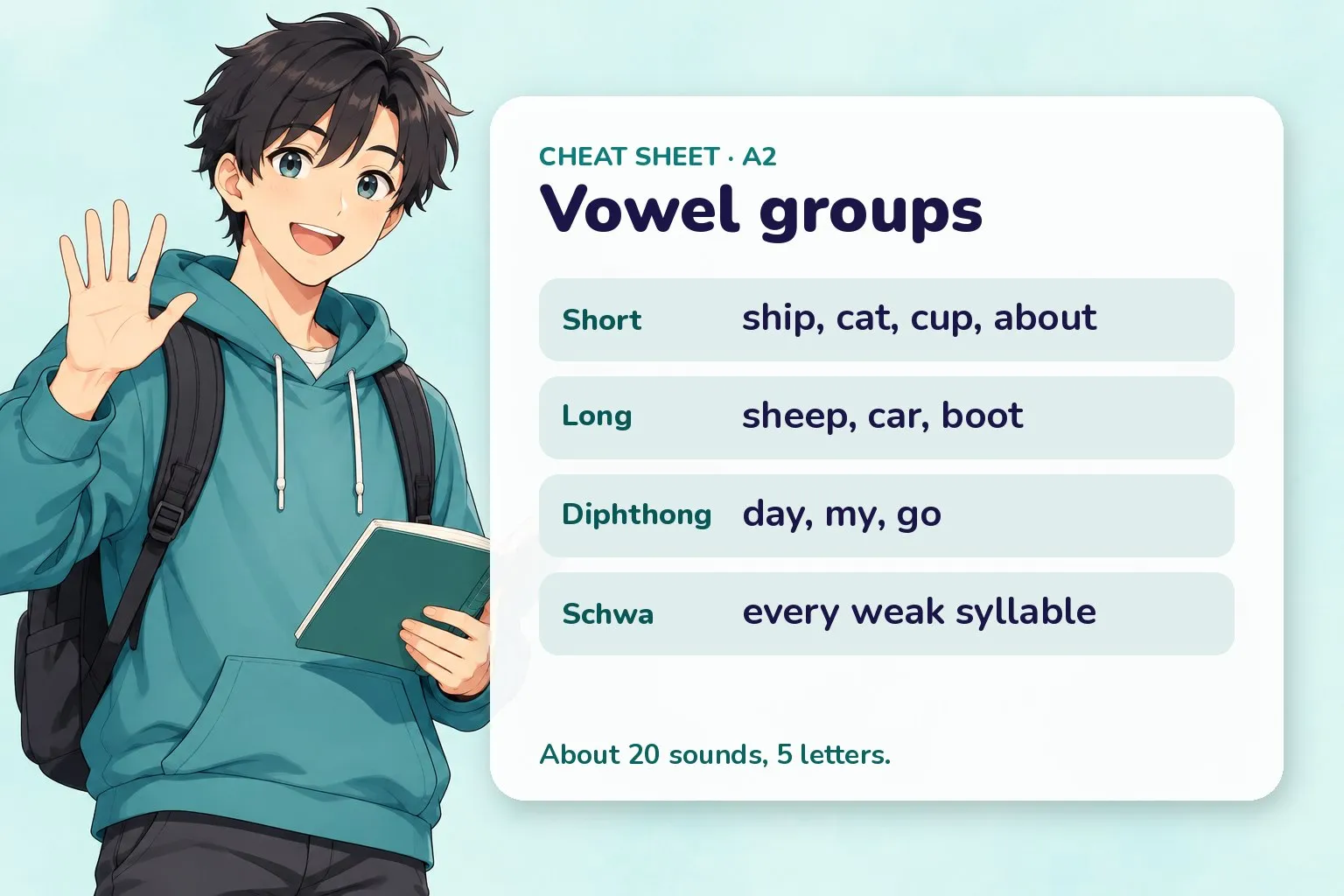
Quick recap before the quiz.
Next
- Next in pronunciation: English Consonant Sounds (IPA)
- Then: English Word Stress
- Browse the English pronunciation section
- New here? Start with Start Learning English Here
All English pronunciation & writing topics
Vocabulary, pronunciation, phrases, practice and exam help, ordered by level. Pick a topic and go straight to it. New lessons go live every day, so topics marked Coming soon fill in over the next weeks.
Pronunciation & writing
A1 2 topics · 2 ready
A2 6 topics · 6 ready
- 03 English Vowel Sounds (IPA) You are here
- 04 English Consonant Sounds (IPA)
- 05 English Word Stress
- 06 English Silent Letters
- 07 English Spelling Rules & Patterns
- 08 English Contractions & Reductions