English Silent Letters
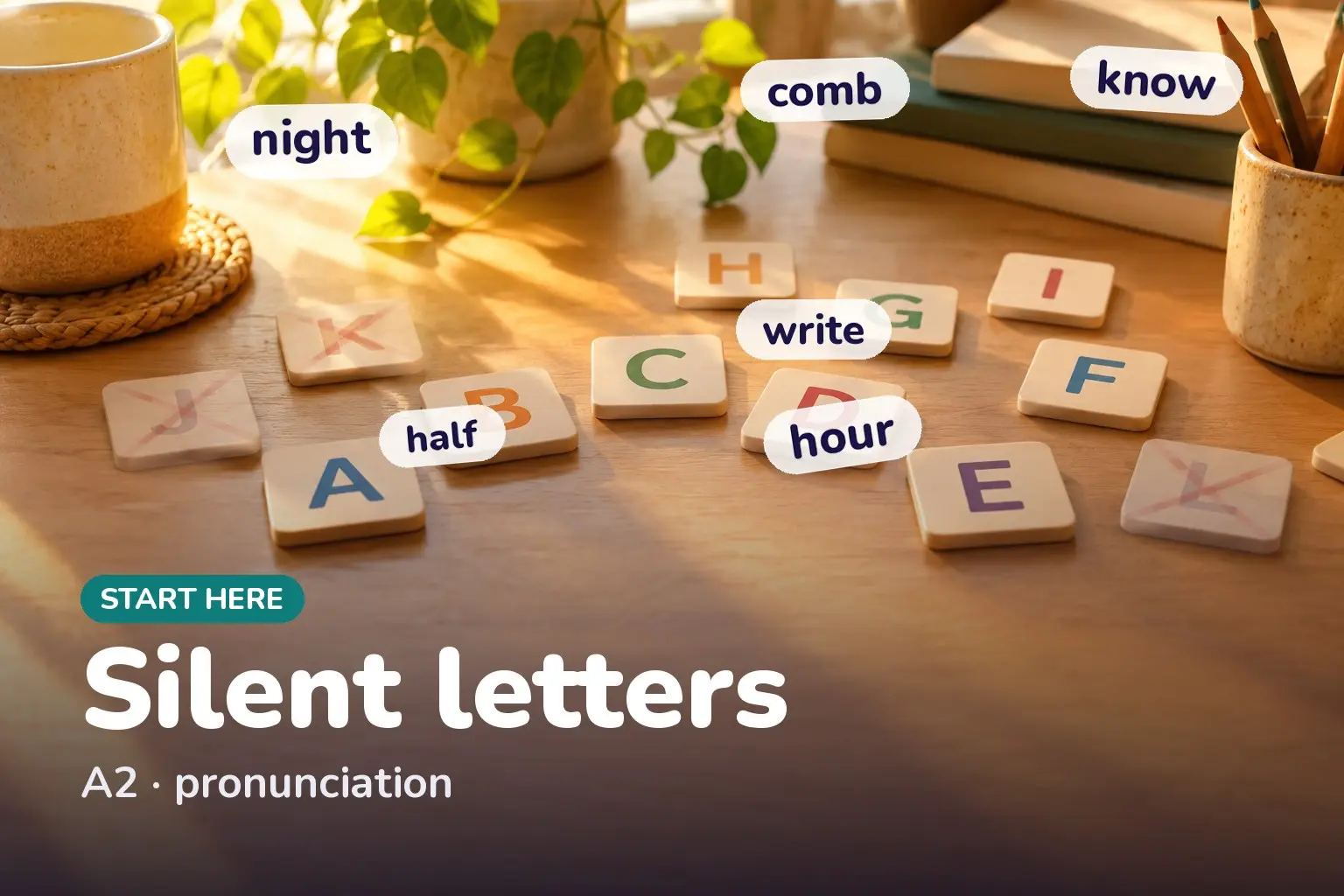
English keeps many letters in spelling that you don't say: the b in comb, the k in know, the w in write, the gh in night. Most silent letters follow patterns, like silent b after m and silent k before n, so learning the patterns helps you predict them.
Level: A2. English spelling is full of letters you write but never say. The good news: most of them follow patterns. Once you know that kn starts with a silent k, or that mb ends with a silent b, whole groups of words become predictable.
By the end of this page you can…
…recognise the common silent-letter patterns in English and say the words correctly without pronouncing the hidden letters.
Why letters go silent
A silent letter is written but not pronounced. English keeps them for two main reasons: some were pronounced centuries ago and spelling never caught up (the k in knight was once said), and some came from other languages along with the word (psychology from Greek). Because spelling rarely changes, these letters stay — which is why you have to learn them, but also why they are reliable once you do.
The key idea: silent letters mostly appear in fixed letter combinations. Learn the combination and you cover dozens of words at once.
Common silent-letter patterns
| Pattern | Silent letter | Examples |
|---|---|---|
| mb (end of word) | b | comb, thumb, climb, lamb, bomb |
| bt | b | debt, doubt, subtle |
| kn (start) | k | know, knife, knee, knock, knight |
| wr (start) | w | write, wrong, wrap, wrist, wrestle |
| gh (after a vowel) | gh | night, light, high, though, daughter |
| mn (end of word) | n | autumn, column, hymn, solemn |
| gn | g | sign, design, foreign, gnome |
| l (before k, m, f) | l | walk, talk, calm, half, could, should |
| t | t | listen, castle, whistle, Christmas, fasten |
| h (start, some words) | h | hour, honest, honour, heir |
| p (start, from Greek) | p | psychology, pneumonia, receipt |
| w (before r / in some words) | w | who, whole, sword, answer, two |
| c (in -scl-, some) | c | muscle, scissors |
You do not need to memorise the table — use it to spot the pattern, then practise the words you actually meet.
The special case: silent final e
A final e at the end of a word is usually silent, but it does an important job: it often makes the vowel before it long (its “name” sound). Compare:
- hop → hope, bit → bite, cut → cute, tap → tape, pin → pine.
So the e says nothing itself, but changes how you read the whole word. This is sometimes called the “magic e”.
How to say it
- Skip the silent letter completely. Say comb as “kohm”, know as “noh”, write as “rite”, hour as “our”. Do not let a little puff of the hidden letter slip in.
- Watch the mb and kn families. English learners very often say the b in climb or the k in knife. Picture the letter crossed out.
- gh is almost always silent after a vowel (night, high) — but in a few words it is said as “f”: enough, cough, laugh, rough. Learn those few as exceptions.
- When unsure, check the dictionary audio. A good dictionary gives a play button; one listen settles it.
Example sentences
Listen and copy. The silent letter is named in the note.
- She bought a new comb.comb = 'kohm' — the b is silent (mb).silent b
- The little lamb ran away.lamb = 'lam' — silent b.
- I have a big debt to pay.debt = 'det' — silent b (bt).
- I don't know the answer.know = 'noh'; answer = 'an-ser' — silent k and silent w.
- Be careful with the knife.knife = 'nife' — silent k (kn).
- He hurt his knee.knee = 'nee' — silent k.
- Please write your name.write = 'rite' — silent w (wr).
- You took the wrong turn.wrong = 'rong' — silent w.
- We walked home last night.walked = 'wawkt' (silent l); night = 'nite' (silent gh).
- The light is very bright.light = 'lite', bright = 'brite' — silent gh.
- Keep calm and talk quietly.calm = 'cahm', talk = 'tawk' — silent l.
- I'd like half an hour.half = 'haf' (silent l); hour = 'our' (silent h).
- Please listen to me.listen = 'li-sen' — silent t.
- The old castle is on the hill.castle = 'ca-sel' — silent t.
- Autumn is my favourite season.autumn = 'aw-tum' — silent n (mn).
- Sign here, please.sign = 'sine' — silent g (gn).
- Be honest with me.honest = 'on-est' — silent h.
- I have a doctor's receipt.receipt = 're-seet' — silent p.
- The whole thing is wrong.whole = 'hole' — silent w.
- We climb the hill every Sunday.climb = 'klime' — silent b.
Common mistakes
- ✗ “k-nife”, “k-now” (saying the k) → ✓ knife = “nife”, know = “noh”; kn starts with a silent k.
- ✗ “com-b”, “clim-b” (saying the b) → ✓ comb = “kohm”, climb = “klime”; mb ends with a silent b.
- ✗ “w-rite”, “w-rong” (saying the w) → ✓ write = “rite”, wrong = “rong”; wr starts with a silent w.
- ✗ “nig-ht”, “lig-ht” (saying the gh) → ✓ night = “nite”, light = “lite”; gh after a vowel is silent.
- ✗ “lis-ten”, “cas-tle” (saying the t) → ✓ listen = “li-sen”, castle = “ca-sel”; the t is silent.
- ✗ Treating enough and cough like though → ✓ here gh = “f”: “e-nuff”, “coff”.
A short conversation
A: Do you know how to make bread? B: A little. You knead the dough, then let it climb — I mean rise. A: Ha! The k in knead and the b in climb are both silent, right? B: Exactly. Say “need” and “klime”, not the letters you see.
Read it aloud and skip every silent letter: know (noh), knead (need), climb (klime).
Usage notes
- gh is the trickiest group. After a vowel it is usually silent (night, through, daughter), but in a handful of words it is said “f” (enough, rough, tough, cough, laugh). There is no rule — learn the “f” words as a short list.
- Silent letters stay the same across accents. British and American English differ in some sounds, but the silent letters above are silent in both; this is reliable.
- Spelling still needs the letter. Dout and rite are wrong spellings even though they match the sound. Keep the silent letter when you write.
- A dictionary’s audio is your friend. When a new word looks like it might hide a silent letter, play the pronunciation once and copy it.
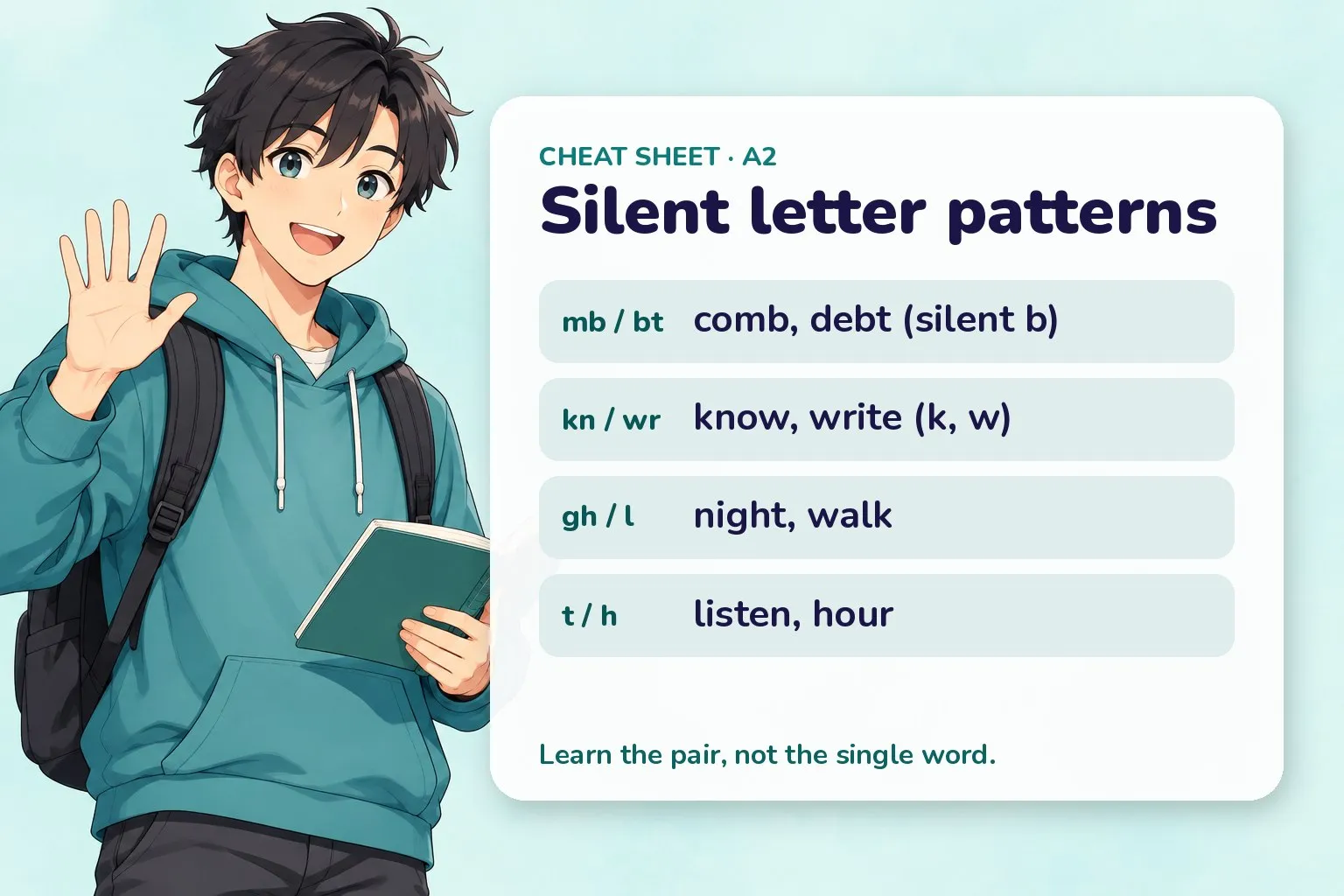
Quick recap before you practise.
Practice
Silent letters practice
Try each one, then press Check. No sign-up, nothing is sent anywhere — it all runs in your browser.
Hint: it comes before r at the start
Show answer
w — The wr pattern starts with a silent w: 'rite', 'rong'.
Hint: it sits between s and the next sound
Show answer
t — The t is silent: 'li-sen', 'ca-sel'.
6 Match each word to its silent letter.
- autumn
- sign
- hour
- receipt
Show answer
- autumn → n
- sign → g
- hour → h
- receipt → p
autumn (silent n), sign (silent g), hour (silent h), receipt (silent p).
7 Put the words in order to make a sentence, then say it skipping the silent letters.
Show answer
I don't know the answer — know = 'noh' (silent k), answer = 'an-ser' (silent w).
Quiz
English silent letters quiz
8 questions · pick an answer and you'll see straight away if it's right.
-
Show answer
written but not pronounced — You write it but you don't say it, like the b in 'comb'.
-
Show answer
k — The kn pattern starts with a silent k.
-
Show answer
rite — wr starts with a silent w, so 'write' = 'rite'.
-
Show answer
gh — gh after a vowel is silent: 'nite', 'lite'.
-
Show answer
walk — 'walk' = 'wawk'; the l is silent before k.
-
Show answer
it makes the vowel before it long — The silent e lengthens the vowel: hop (short o) becomes hope (long o).
-
Show answer
doubt — 'doubt' keeps its silent b even though you say 'dout'.
-
Show answer
listen to a dictionary's audio — Dictionary audio shows exactly which letters are not said.
Next
- Give those words their proper beat in Sentence Stress & Rhythm
- Learn the tune of a sentence in English Intonation Patterns
- New here? Start with Start Learning English Here
All English pronunciation & writing topics
Vocabulary, pronunciation, phrases, practice and exam help, ordered by level. Pick a topic and go straight to it. New lessons go live every day, so topics marked Coming soon fill in over the next weeks.
Pronunciation & writing
A1 2 topics · 2 ready
A2 6 topics · 6 ready
- 03 English Vowel Sounds (IPA)
- 04 English Consonant Sounds (IPA)
- 05 English Word Stress
- 06 English Silent Letters You are here
- 07 English Spelling Rules & Patterns
- 08 English Contractions & Reductions