English Word Stress
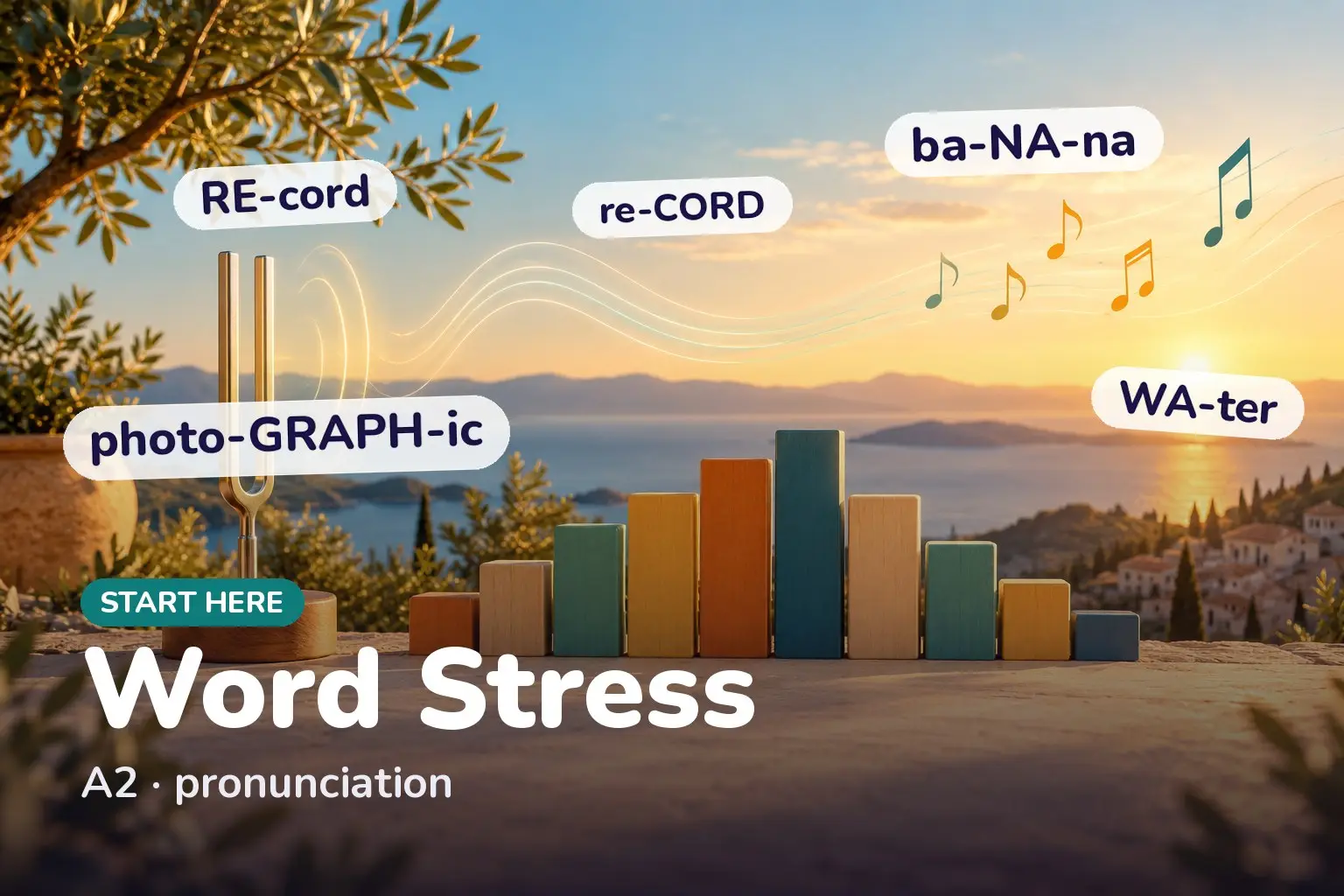
In English, words of two or more syllables put the main stress on one syllable, said louder, longer and clearer and marked with ˈ before it in the IPA. Stress is not decorative: it can separate a noun from a verb, as in ˈrecord and reˈcord.
Level: A2. English does not say every syllable with equal force. In each word of two or more syllables, one syllable is stressed — stronger than the rest — and getting that one syllable right often matters more for being understood than the individual sounds do.
By the end of this page you can…
…count the syllables in a word, find and mark the stressed one, and use the common patterns to predict where the stress falls.
What word stress is
A syllable is a beat built around one vowel sound: water has two (wa‑ter), banana has three (ba‑na‑na). The stressed syllable is said louder, longer, higher in pitch and with a clearer vowel than the others. In the IPA it is marked with a raised ˈ before the syllable: water is /ˈwɔː.tə/, so the stress is on wa.
Everything else weakens. The unstressed syllables lose length and pitch, and their vowels usually slide toward the schwa /ə/. That push-and-pull between one strong beat and weak surroundings is what gives English its rhythm.
How stress changes meaning
Stress is not just music — it can change a word’s job. A set of English words are spelled the same but stress the first syllable as a noun and the second as a verb.
| Word | Noun (stress 1st) | Verb (stress 2nd) |
|---|---|---|
| record | ˈrecord /ˈrek.ɔːd/ | reˈcord /rɪˈkɔːd/ |
| present | ˈpresent /ˈprez.ənt/ | preˈsent /prɪˈzent/ |
| object | ˈobject /ˈɒb.dʒɪkt/ | obˈject /əbˈdʒekt/ |
| export | ˈexport /ˈek.spɔːt/ | exˈport /ɪkˈspɔːt/ |
| increase | ˈincrease /ˈɪn.kriːs/ | inˈcrease /ɪnˈkriːs/ |
Say “I want to reˈcord a ˈrecord” and the stress alone tells a listener which is the verb and which is the thing.
Patterns that help you predict
English stress is not fully regular, but useful tendencies exist.
Two-syllable words: nouns and adjectives usually take the stress on the first syllable (ˈtable, ˈhappy, ˈmountain), while many verbs take it on the second (deˈcide, beˈgin, reˈlax). This is a tendency, not a law.
Suffixes that fix the stress — these endings pull the main stress onto the syllable right before them:
- -ion / -tion / -sion: eduˈcation, inforˈmation, deˈcision.
- -ic: ecoˈnomic, fanˈtastic, photoˈgraphic.
- -ity: aˈbility, posˈsibility, acˈtivity.
Stress shift across a word family
Related words often move the stress as endings are added. The classic set is the photograph family:
- ˈphotograph /ˈfəʊ.tə.ɡrɑːf/ — stress on the first syllable.
- phoˈtographer /fəˈtɒɡ.rə.fə/ — stress jumps to the second.
- photoˈgraphic /ˌfəʊ.təˈɡræf.ɪk/ — the -ic rule pulls it to the third.
Long words can also have a weaker secondary stress, marked with a low ˌ: university /ˌjuː.nɪˈvɜː.sə.ti/ has secondary stress on u and primary stress on ver.
Examples with the stress marked
In each example the stressed syllable is shown in capitals; play the audio and copy the strong beat.
- water/ˈwɔː.tə/ — WA-ter; stress on the first syllable.
- banana/bəˈnɑː.nə/ — ba-NA-na; stress in the middle, schwas around it.
- decide/dɪˈsaɪd/ — de-CIDE; a two-syllable verb, stress on the second.
- happy/ˈhæp.i/ — HAP-py; a two-syllable adjective, stress on the first.
- education/ˌedʒ.uˈkeɪ.ʃən/ — edu-CA-tion; -tion pulls stress before it.
- economic/ˌiːk.əˈnɒm.ɪk/ — eco-NOM-ic; -ic pulls stress before it.
- ability/əˈbɪl.ə.ti/ — a-BIL-i-ty; -ity pulls stress before it.
- photograph/ˈfəʊ.tə.ɡrɑːf/ — PHO-to-graph; stress first.
- photographer/fəˈtɒɡ.rə.fə/ — pho-TOG-ra-pher; stress second.
- photographic/ˌfəʊ.təˈɡræf.ɪk/ — pho-to-GRAPH-ic; stress third.
- record (noun)/ˈrek.ɔːd/ — REC-ord; the thing, stress first.
- record (verb)/rɪˈkɔːd/ — re-CORD; to capture sound, stress second.
- university/ˌjuː.nɪˈvɜː.sə.ti/ — secondary stress on U, primary on VER.
- comfortable/ˈkʌmf.tə.bəl/ — COMF-ta-ble; often three syllables, not four.
How to say it
- Make the strong syllable really strong. Learners often say every syllable at the same volume. Exaggerate at first: stretch the stressed vowel and almost swallow the others.
- Let the weak vowels go to schwa. In banana the first and last a are not clear “ah” sounds — they are tiny /ə/ schwas. Full vowels in the weak syllables are the giveaway of a non-native rhythm.
- Learn the stress with the word. When you meet a new word, note which syllable is strong, the same way you note its spelling. A dictionary shows it with the ˈ mark.
Practice
Word stress practice
Try each one, then press Check. No sign-up, nothing is sent anywhere — it all runs in your browser.
Hint: not a consonant
Show answer
vowel — Each syllable has one vowel sound, so counting vowel sounds counts syllables.
4 Match each ending to the word that uses its stress rule.
- -tion
- -ic
- -ity
Show answer
- -tion → education
- -ic → economic
- -ity → ability
Each suffix pulls the main stress onto the syllable just before it.
Quiz
English word stress quiz
7 questions · pick an answer and you'll see straight away if it's right.
-
Show answer
louder, longer and clearer than the rest — Stress means more volume, length, pitch and a clearer vowel.
-
Show answer
Before the stressed syllable — The raised ˈ goes immediately before the stressed syllable, as in /ˈwɔː.tə/.
-
Show answer
Two — Wa-ter: two vowel sounds, so two syllables, stress on the first.
-
Show answer
which syllable is stressed — Same spelling; the noun stresses the first syllable, the verb the second.
-
Show answer
The syllable just before -tion — Words in -tion stress the syllable before it: inforMAtion, eduCAtion.
-
Show answer
They usually weaken toward the schwa /ə/ — Unstressed vowels reduce, usually to the schwa, giving English its rhythm.
-
Show answer
can move as endings are added — ˈphotograph, phoˈtographer and photoˈgraphic each stress a different syllable.
Recap cheat-sheet
| Idea | Key point |
|---|---|
| Mark | ˈ before the strong syllable (ˌ for secondary) |
| Syllable | one beat per vowel sound |
| Noun vs verb | ˈrecord (noun) vs reˈcord (verb) |
| Suffix rule | -ion, -ic, -ity stress the syllable before them |
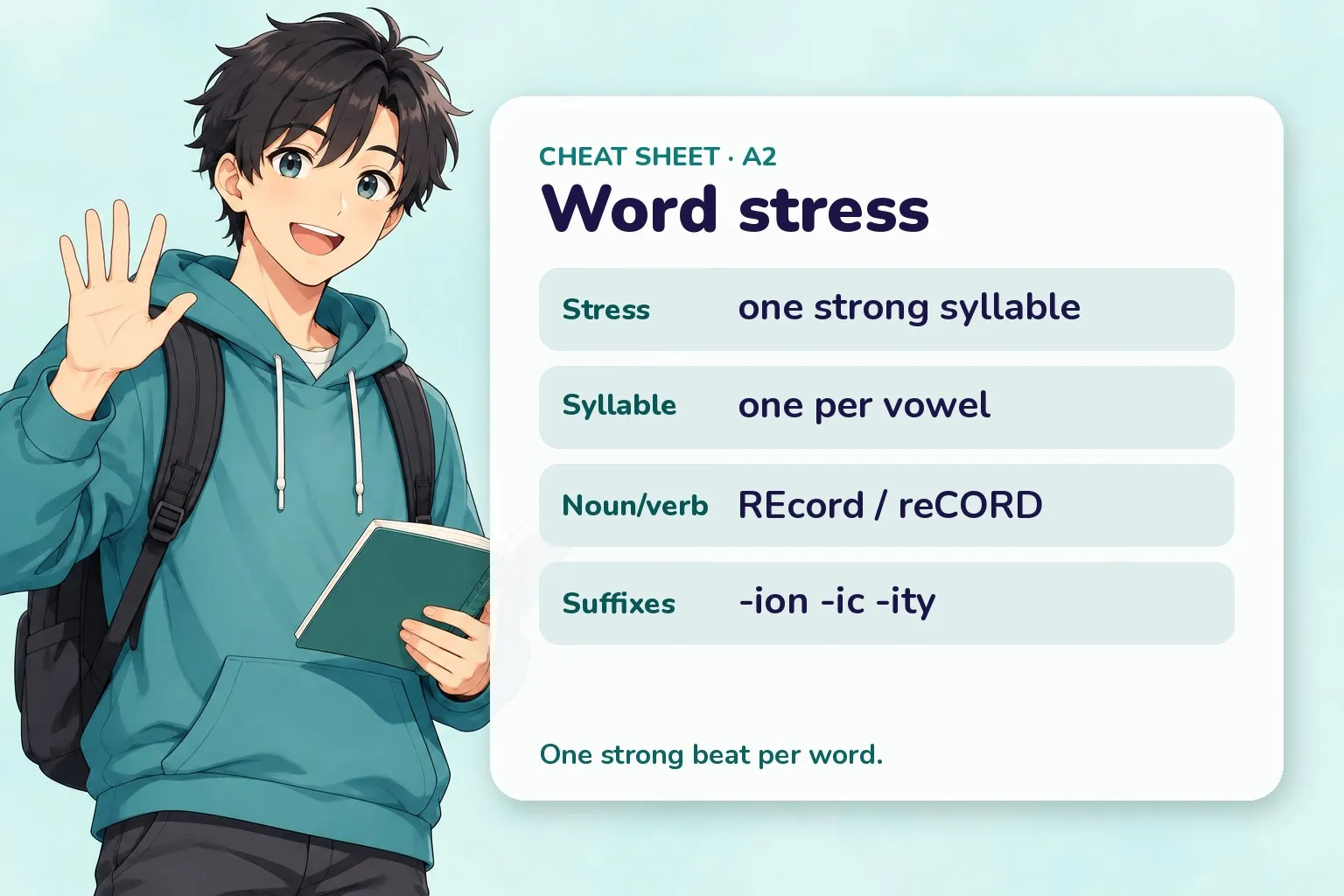
Quick recap before the quiz.
Next
- Previous in pronunciation: English Consonant Sounds (IPA)
- Also useful: English Vowel Sounds (IPA)
- Browse the English pronunciation section
- New here? Start with Start Learning English Here
All English pronunciation & writing topics
Vocabulary, pronunciation, phrases, practice and exam help, ordered by level. Pick a topic and go straight to it. New lessons go live every day, so topics marked Coming soon fill in over the next weeks.
Pronunciation & writing
A1 2 topics · 2 ready
A2 6 topics · 6 ready
- 03 English Vowel Sounds (IPA)
- 04 English Consonant Sounds (IPA)
- 05 English Word Stress You are here
- 06 English Silent Letters
- 07 English Spelling Rules & Patterns
- 08 English Contractions & Reductions