Sentence Stress & Rhythm
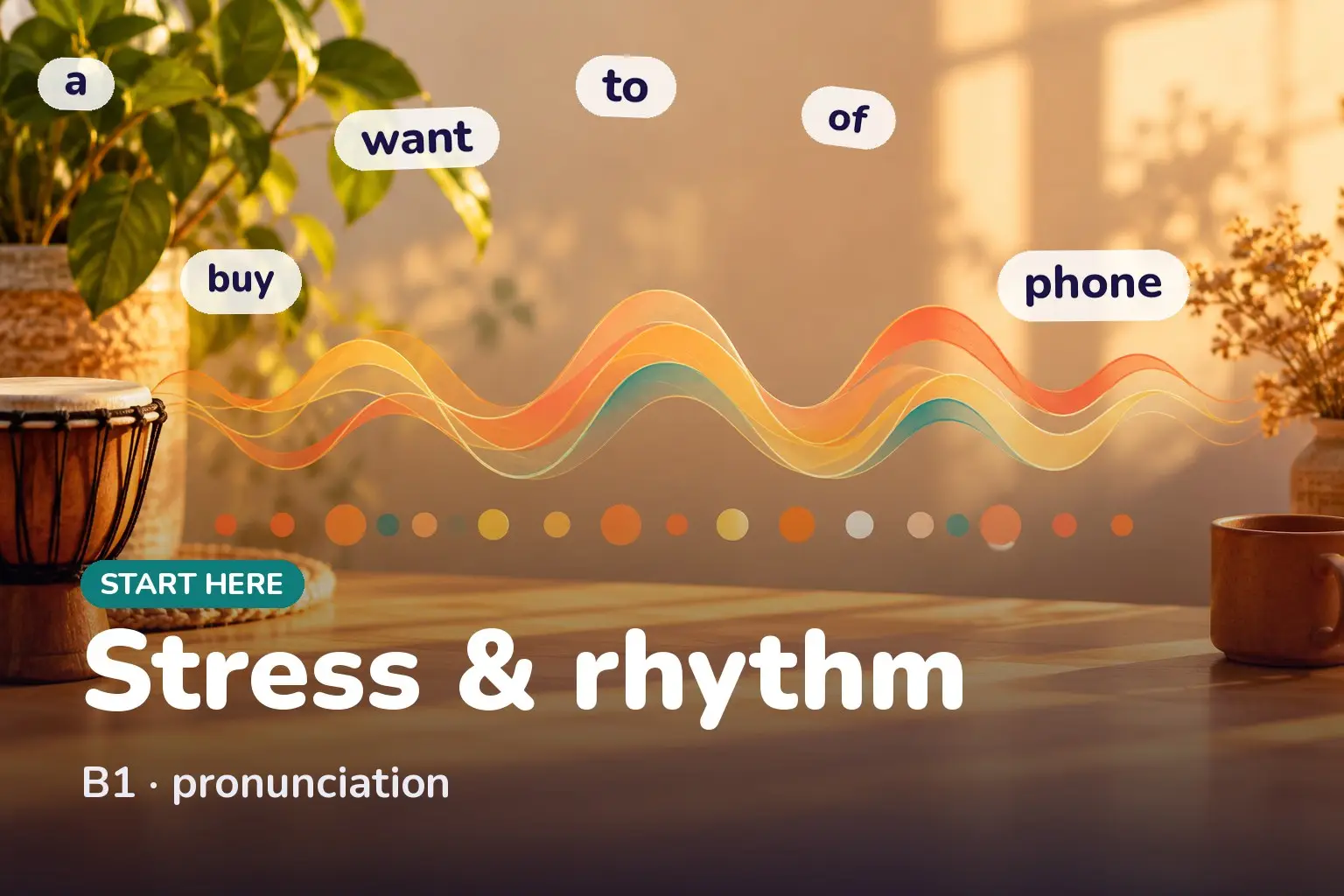
English is stress-timed: you stress the content words that carry meaning (nouns, main verbs, adjectives, adverbs) and squeeze the small function words (articles, prepositions, auxiliaries, pronouns) in between. The stressed words fall in a roughly even beat, so the weak words shorten to keep the rhythm.
Level: B1. English does not give every word the same weight. The words that carry the meaning get a strong, clear beat; the small grammar words shrink and blur. Get that contrast right and your English suddenly sounds smooth — even if some individual sounds are still off.
By the end of this page you can…
…pick out the content words in a sentence, weaken the function words, and keep a steady rhythm when you speak.
Content words carry the stress
A content word carries meaning on its own: nouns, main verbs, adjectives, adverbs, and the question words (who, what, where). These get the stress — they are said longer, louder, and on a clearer vowel.
A function word is a small grammar word that holds the sentence together: articles (a, the), prepositions (to, of, for), auxiliary and modal verbs (is, do, can, will), pronouns (I, you, it), and conjunctions (and, but). These are usually unstressed: short, quiet, and often said with a weak “uh” vowel.
Say this sentence and tap the stressed words: I want to buy a new phone. The three strong beats are want, buy, phone. Everything else gets squeezed in between.
Stress-timing: the beat stays steady
English is often called a stress-timed language. That means the stressed beats come at a roughly even pace, and the unstressed words stretch or squeeze to fit the gaps. So these two sentences take about the same time to say, even though one has far more words:
- CATS eat FISH.
- The CATS will have EATen the FISH.
Both have three strong beats (cats, eat/eaten, fish), so both land on roughly the same rhythm. The extra function words in the second sentence (the, will have, the) are crushed down to keep up.
Weak forms: the quiet little words
Because function words are unstressed, many of them have a weak form — a reduced pronunciation you will hear constantly but rarely see written:
| Word | Strong form | Weak form (as spoken) |
|---|---|---|
| to | “too” | “tuh” (I want tuh go) |
| and | “and” | “’n” (fish ’n chips) |
| a | “ay” | “uh” (uh book) |
| of | “ov” | “uhv” (a cup uhv tea) |
| can | “kan” | “kuhn” (I kuhn swim) |
| for | “for” | “fuh” (it’s fuh you) |
The weak form is not lazy or wrong — it is standard, careful English. Using the strong form for every little word is what sounds unnatural.
How to say it
These are the sounds that trip up learners when English speeds up:
- The weak “uh” (schwa): the most common vowel in English. Unstressed a, to, of, the, for all collapse toward a quick “uh”. Practise saying “a cup of tea” as “a-cup-uh-tea”.
- Contractions: I am → I’m, do not → don’t, will have → will’ve. These are not slang; they are the normal spoken form and they protect the rhythm.
- Linking: a final consonant joins the next word’s vowel: an apple sounds like “a-napple”, pick it up like “pi-ki-tup”. Let words run together inside a beat.
Example sentences
Listen and copy the rhythm. The bold idea is where the strong beats fall — say those clearly and let the rest rush by.
- I want to go home.Strong beats: want, go, home. 'to' is weak ('tuh').content: want/go/home
- She is reading a book.Strong beats: reading, book. 'She is' and 'a' are weak.
- We can meet at six.Strong beats: meet, six. 'can' is weak ('kuhn').
- He bought a cup of coffee.Strong beats: bought, cup, coffee. 'a' and 'of' are weak.
- They are waiting for the bus.Strong beats: waiting, bus. 'for the' is weak.
- I'll call you tomorrow.Strong beats: call, tomorrow. 'I'll' and 'you' are weak.
- Can you pass me the salt?Strong beats: pass, salt. 'Can you', 'me', 'the' are weak.
- The film was really good.Strong beats: film, really, good. 'The' and 'was' are weak.
- She works in a big office.Strong beats: works, big, office. 'in a' is weak.
- We should have left earlier.Strong beats: left, earlier. 'should have' blurs to 'shoulduv'.
- I don't know what to say.Strong beats: don't, know, say. 'what to' is weak ('wot-tuh').
- Give it to me, please.Strong beats: give, please. 'it to me' links and weakens.
- There's a letter for you.Strong beats: letter, you. 'There's a' and 'for' are weak.
- He's been working all day.Strong beats: working, all, day. 'He's been' is weak.
- I'd like a glass of water.Strong beats: like, glass, water. 'I'd', 'a', 'of' are weak.
- What time does it start?Strong beats: what, time, start. 'does it' blurs ('duzit').
- We're going to the beach.Strong beats: going, beach. 'We're', 'to the' are weak.
- She told me a funny story.Strong beats: told, funny, story. 'me a' is weak.
- Could you turn it down a bit?Strong beats: turn, down, bit. 'Could you', 'it', 'a' are weak.
- I think it's going to rain.Strong beats: think, rain. 'it's going to' blurs to 'itsgonna'.
Common mistakes
- ✗ I - am - go - ing - to - the - shop (every word equal) → ✓ “I’m going tuh thuh SHOP” — weaken the small words.
- ✗ Stressing to, of, and, a → ✓ let them collapse to a quick “uh”; stress only content words.
- ✗ Saying each syllable at the same length (syllable-timing, common for speakers of French, Spanish, or many Asian languages) → ✓ stretch the stressed beats, crush the rest.
- ✗ Dropping stress off the key content word → ✓ decide what matters most in the sentence and hit that word hardest.
- ✗ Avoiding contractions to “speak clearly” → ✓ I’m, don’t, we’ll are the clear, standard forms; full forms break the rhythm.
A short conversation
A: What are you doing this weekend? B: I’m going to visit my parents. You? A: Nothing much. I might see a film. B: Sounds good. Text me if you want some company.
Read it aloud twice: first slowly, then at a natural pace, keeping only the content words strong (doing, weekend; visit, parents; film; text, company).
Usage notes
- Emphasis can move the stress. Normally we say “I bought a new car,” but to correct someone you might stress a function word: “I said a car, not the car.” Stress follows meaning.
- New information gets the beat. The most important or newest word in a sentence usually carries the strongest stress, often near the end.
- Rhythm beats individual sounds. Learners often worry about single vowels, but getting stress and rhythm right does more for how clear and natural you sound than perfecting every sound.
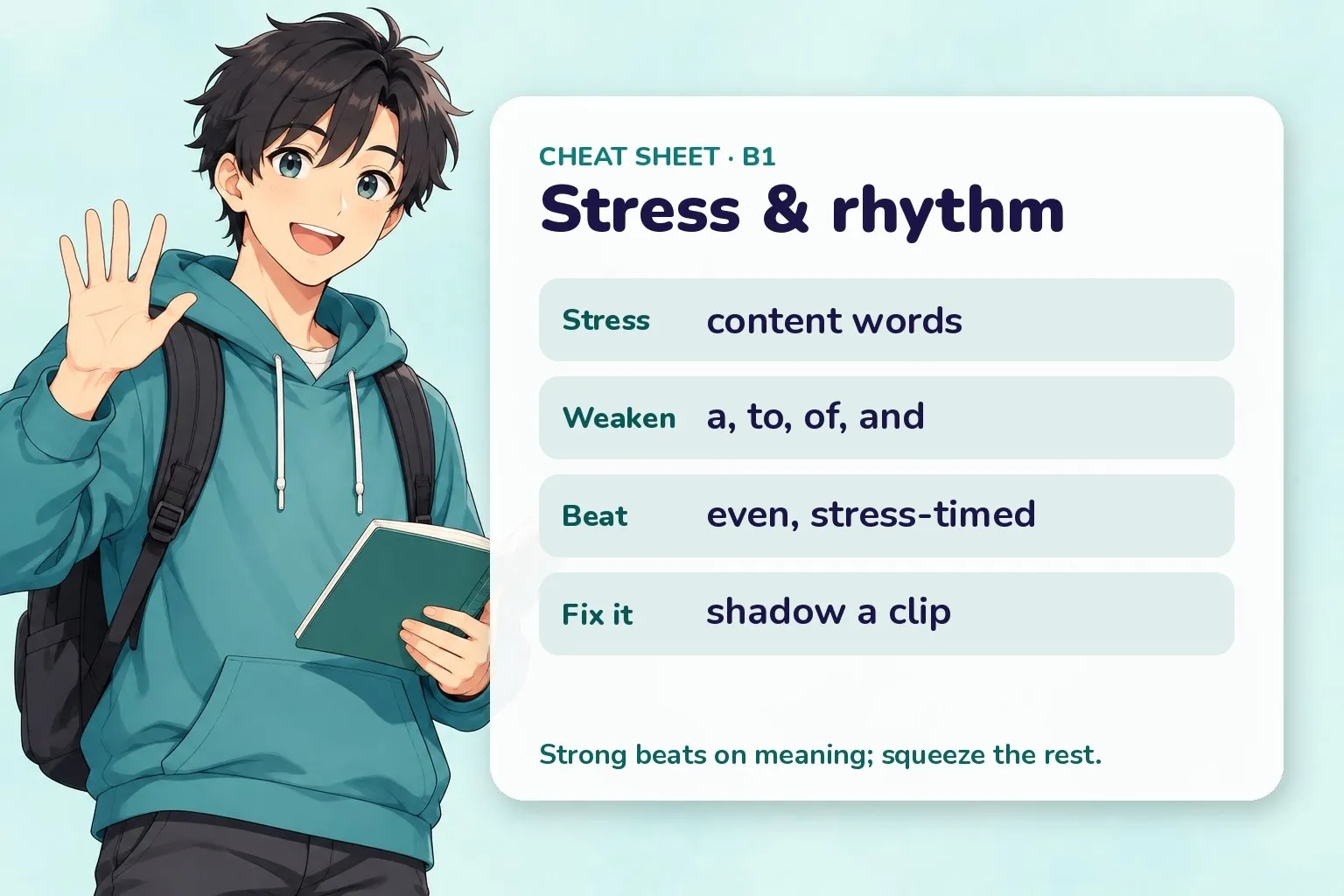
Quick recap before you practise.
Practice
Sentence stress and rhythm practice
Try each one, then press Check. No sign-up, nothing is sent anywhere — it all runs in your browser.
Hint: the opposite of syllable-timed
Show answer
stress — In stress-timed English the beats are even and weak words squeeze between them.
Hint: opposite of strong
Show answer
weak — Weak forms keep the small grammar words short and quiet.
5 Match each function word to its usual weak form.
- to
- and
- of
- can
Show answer
- to → tuh
- and → 'n
- of → uhv
- can → kuhn
Unstressed function words collapse toward a quick 'uh' vowel.
6 Put the words in order to make a sentence, then say it with the beats on 'like / cup / tea'.
Show answer
I'd like a cup of tea — Stress like, cup and tea; weaken I'd, a and of.
Quiz
Sentence stress and rhythm quiz
8 questions · pick an answer and you'll see straight away if it's right.
-
Show answer
a word that carries meaning, like a noun or main verb — Content words (nouns, main verbs, adjectives, adverbs, question words) carry the meaning and the stress.
-
Show answer
unstressed, often with a weak 'uh' vowel — They are reduced to weak forms to keep the rhythm.
-
Show answer
the stressed beats come at a roughly even pace — Weak words stretch or squeeze so the stressed beats stay even.
-
Show answer
I'm going tuh thuh SHOP — Weakening 'to the' and contracting 'I'm' gives the natural beat.
-
Show answer
reading and book — Reading and book are the content words; 'She is' and 'a' are weak.
-
Show answer
a quick 'uh' (schwa) — The schwa 'uh' appears in to, a, of, the, for when unstressed.
-
Show answer
they stress every word equally instead of weakening function words — Equal stress on every word removes the content/function contrast that English rhythm depends on.
-
Show answer
shadowing: playing a clip and speaking along in time — Shadowing trains you to match the beats and weak forms of natural speech.
Next
- Learn how pitch carries meaning in English Intonation Patterns
- See which letters you don’t pronounce in English Silent Letters
- New here? Start with Start Learning English Here
All English pronunciation & writing topics
Vocabulary, pronunciation, phrases, practice and exam help, ordered by level. Pick a topic and go straight to it. New lessons go live every day, so topics marked Coming soon fill in over the next weeks.
Pronunciation & writing
A1 2 topics · 2 ready
A2 6 topics · 6 ready
B1 2 topics · 2 ready
- 09 Sentence Stress & Rhythm You are here
- 10 English Intonation Patterns