English Intonation Patterns
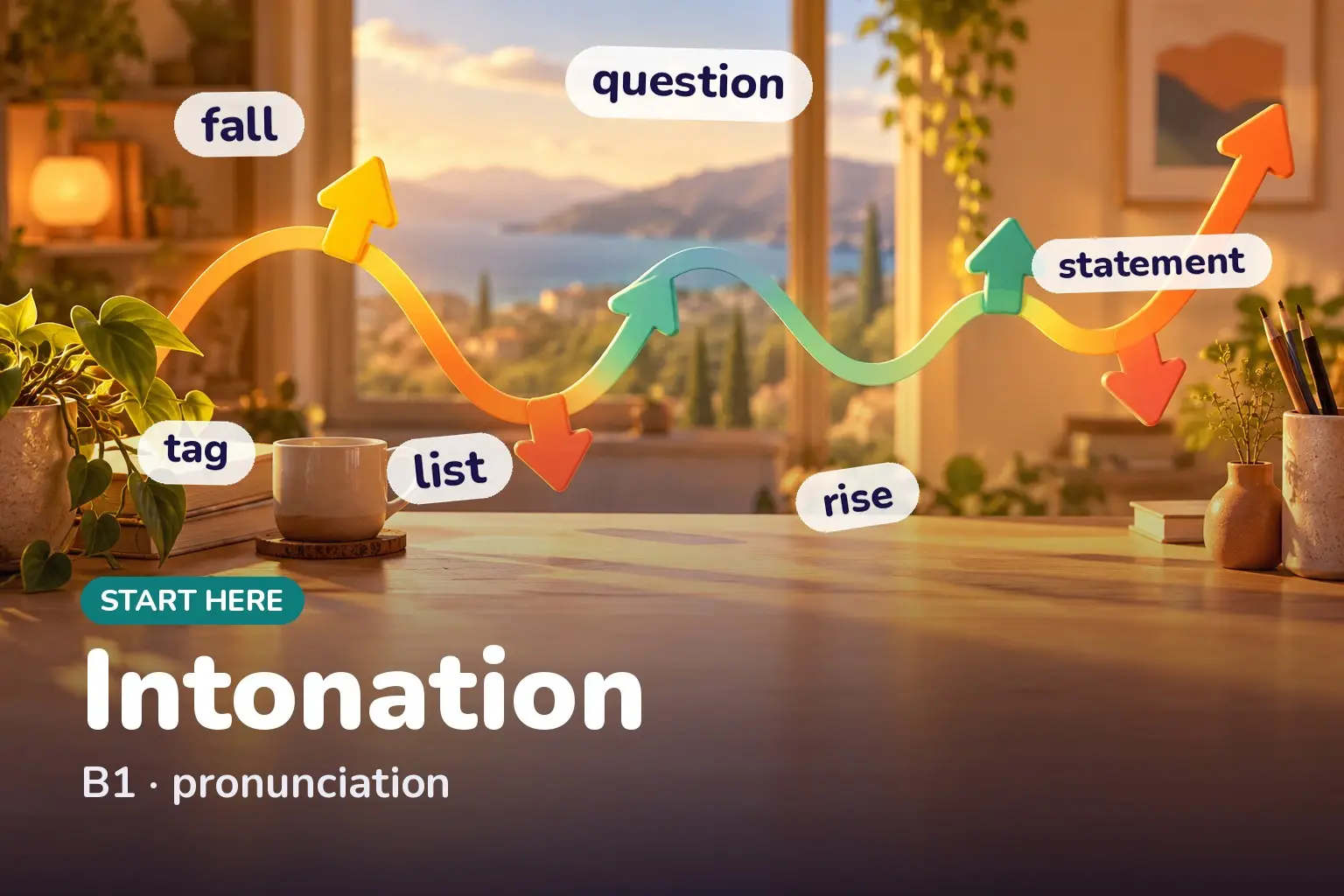
Intonation is the rise and fall of your voice. In English, statements, commands and wh-questions usually fall at the end, yes/no questions usually rise, and lists rise on each item before falling on the last. The same words can sound polite, surprised or annoyed depending on the tune.
Level: B1. Intonation is the tune of a sentence — the way your voice goes up and down. English leans on it heavily: the same five words can be a plain statement, a surprised question, or a sarcastic jab, just by changing the pitch. Learn the main patterns and you will both sound more natural and understand far more.
By the end of this page you can…
…use a falling tone for statements and wh-questions, a rising tone for yes/no questions, and recognise how pitch signals lists, choices and attitude.
What intonation does
Intonation is the rise and fall of pitch across a sentence. It usually peaks on the most important word — the one carrying the newest or key information — and then moves up or down from there. Two basic movements do most of the work:
- A falling tone (voice drops at the end) sounds complete, certain, and final.
- A rising tone (voice lifts at the end) sounds unfinished, uncertain, or like a question.
English does not use pitch to change the dictionary meaning of a word (unlike tonal languages such as Chinese). Instead, pitch works across the whole phrase to show grammar and attitude.
The main patterns
| Sentence type | Example | Tune |
|---|---|---|
| Statement | It’s raining. | fall ↘ |
| Command | Close the door. | fall ↘ |
| Wh-question | Where do you live? | fall ↘ |
| Yes/no question | Are you coming? | rise ↗ |
| Question tag (checking) | It’s cold, isn’t it? ↘ | fall (you expect agreement) |
| Question tag (real question) | You’re new, aren’t you? ↗ | rise (you’re not sure) |
| List (not last item) | tea, coffee… | rise ↗ on each |
| List (last item) | …or juice? / …and juice. | fall ↘ on the last |
| Choice (open) | Tea or coffee or water? | rise through, open |
| Choice (closed, just these two) | Tea ↗ or coffee? ↘ | rise then fall |
Pitch shows attitude
The same words carry different feelings depending on the tune:
- Flat / falling “Thank you.” — plain and sincere.
- Bright rising-then-falling “Thank you!” — warm and enthusiastic.
- Low, flat “Thanks.” — can sound bored or grudging.
A fall-rise (down then up) is especially useful: it signals but… — a polite reservation or something left unsaid. “The food was nice↘↗ (…but the service wasn’t).” A fall-rise often softens disagreement or adds doubt.
How to say it
- Hear the direction, then copy it. Hum the tune of a sentence without the words — up or down — then say the words on that hum. Your ear learns pitch faster than your eye.
- Land the movement on the key word. The rise or fall happens on the most important word, usually near the end: “I live in London↘”, “Are you coming↗?”
- Use a wide range. English pitch moves more than in many languages. Exaggerate the rise and fall at first; it will feel too much but sound about right.
Example sentences
Say each one and let your voice follow the arrow. ↘ = fall, ↗ = rise.
- I live in London.Statement — fall at the end (↘ on London).statement ↘
- Close the window, please.Command — fall at the end (↘).
- Where do you work?Wh-question — falls at the end (↘ on work), even though it's a question.
- What's your name?Wh-question — fall (↘ on name).
- Are you ready?Yes/no question — rise at the end (↗ on ready).
- Do you like coffee?Yes/no question — rise (↗ on coffee).
- Have you finished your work?Yes/no question — rise (↗ on work).
- It's a lovely day, isn't it?Tag checking agreement — the tag falls (↘); you expect a yes.
- You're the new teacher, aren't you?Tag as a real question — the tag rises (↗); you're unsure.
- I bought bread, milk and eggs.List — rise on bread↗ and milk↗, fall on eggs↘ (the last item).
- Would you like tea, coffee or juice?Open choice — rise through the options, final up/open (↗).
- Is it Monday or Tuesday?Closed choice — rise on Monday↗, fall on Tuesday↘ (just these two).
- That's great news!Enthusiastic — wide rise-fall; sounds warm.
- The film was okay.Fall-rise on okay↘↗ hints at a 'but…' — polite reservation.
- You did WHAT?Surprise/disbelief — sharp rise on WHAT↗.
- Sorry, could you say that again?Polite request — gentle rise (↗) to sound softer.
- Let's go to the beach.Suggestion — fall (↘); it sounds like a decision, not a question.
- Really?Rise (↗) = genuine question; fall (↘) = flat 'I see'.
- No, thank you.Fall (↘) on thank you — a firm but polite refusal.
- See you tomorrow!Friendly fall-then-lift; a warm goodbye.
Common mistakes
- ✗ Rising on wh-questions: Where are you going↗? → ✓ Where are you going↘? — wh-questions fall.
- ✗ Falling on yes/no questions: Are you coming↘? (sounds like an order) → ✓ Are you coming↗?
- ✗ Flat, monotone statements → ✓ end statements with a clear fall so they sound finished and friendly.
- ✗ Rising on every phrase (“uptalk” on everything) → ✓ a constant rise makes you sound unsure of facts; save the rise for real questions and list items.
- ✗ Falling on each item of a list → ✓ rise on every item except the last, which falls to signal “that’s the end.”
A short conversation
A: Are you free on Saturday? ↗ B: I think so. What did you have in mind? ↘ A: There’s a market in town. We could go together. ↘ B: That sounds lovely! ↘ What time? ↘
Notice the pattern: the yes/no question rises, the wh-questions and statements fall, and the enthusiasm shows in the width of the final fall.
Usage notes
- Tags change meaning with tone. “You’re coming, aren’t you?” with a falling tag expects agreement (“I’m fairly sure”); with a rising tag it is a genuine question (“I really don’t know”).
- Fall-rise is the tactful tune. Use it to disagree gently or hedge: “It’s possible↘↗” can mean “but I doubt it.”
- Politeness often rises. Requests and offers (“Could you help me?↗”, “Would you like a seat?↗”) sound warmer with a rise; the same words with a flat fall can sound brusque.
- One tune per thought group. Long sentences break into chunks, each with its own small rise or fall, usually at commas and clause boundaries.
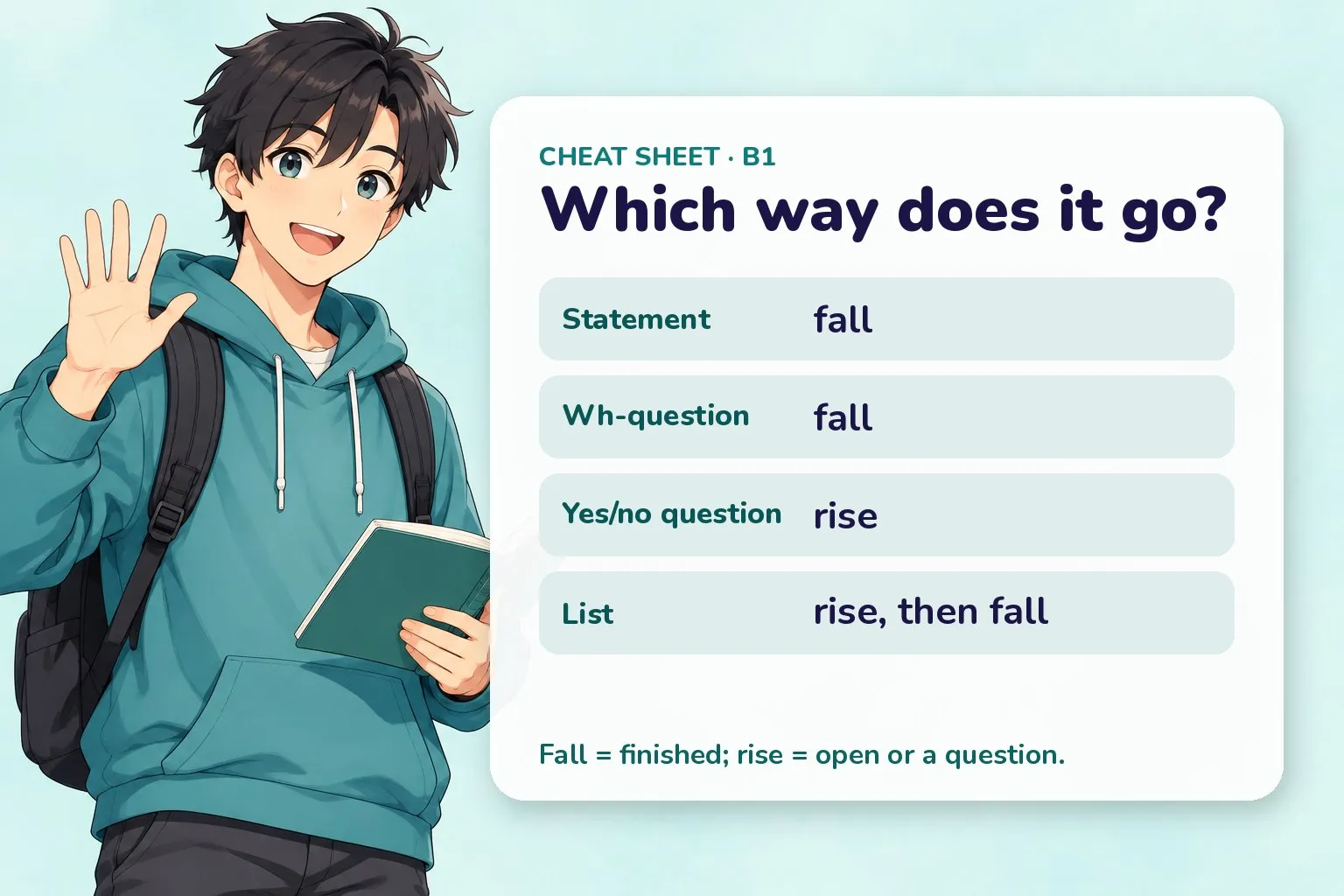
Quick recap before you practise.
Practice
Intonation patterns practice
Try each one, then press Check. No sign-up, nothing is sent anywhere — it all runs in your browser.
Hint: the voice goes up
Show answer
rising — A rising tone signals openness or a question.
Hint: the opposite of rises
Show answer
falls — The fall on the final item signals the list is complete.
6 Match each sentence to its usual tune.
- It's cold today.
- Are you tired?
- What's your name?
- Tea, coffee…?
Show answer
- It's cold today. → fall ↘
- Are you tired? → rise ↗
- What's your name? → fall ↘
- Tea, coffee…? → rise ↗ then fall
Statements and wh-questions fall; yes/no questions rise; lists rise then fall on the last item.
Quiz
English intonation quiz
8 questions · pick an answer and you'll see straight away if it's right.
-
Show answer
the rise and fall of pitch across a sentence — Intonation is the tune of a sentence — its pitch movement.
-
Show answer
complete and certain — A fall signals that the thought is finished.
-
Show answer
Where are you from? — Wh-questions fall; the other three are yes/no questions that rise.
-
Show answer
rises — Yes/no questions typically rise at the end.
-
Show answer
glue, the last item — Each earlier item rises; the final item falls to close the list.
-
Show answer
a 'but…' — a reservation or doubt — Fall-rise adds polite doubt or something left unsaid.
-
Show answer
expects you to agree — A falling tag checks for agreement; a rising tag is a genuine question.
-
Show answer
it can sound bored or unfriendly even with the right words — English relies on pitch movement; a monotone removes the friendliness and meaning it carries.
Next
- Build the rhythm underneath the tune in Sentence Stress & Rhythm
- See which letters stay silent in English Silent Letters
- New here? Start with Start Learning English Here
All English pronunciation & writing topics
Vocabulary, pronunciation, phrases, practice and exam help, ordered by level. Pick a topic and go straight to it. New lessons go live every day, so topics marked Coming soon fill in over the next weeks.
Pronunciation & writing
A1 2 topics · 2 ready
A2 6 topics · 6 ready
B1 2 topics · 2 ready
- 09 Sentence Stress & Rhythm
- 10 English Intonation Patterns You are here