English Contractions & Reductions
A contraction joins two words with an apostrophe (I am to I'm, do not to don't). In natural speech, small words like and, of and to also weaken to a quick /ən/, /əv/, /tə/. Reductions like gonna and wanna are spoken only — do not write them in formal English.
Level: A2. Native speakers rarely say every word in full. They contract (join) words and weaken small ones. Learning this makes you easier to understand and much easier to follow when you listen.
By the end of this page you can…
…use the common contractions correctly, recognise weak forms when you listen, and know when the spoken reductions gonna and wanna are appropriate.
Contractions
A contraction joins two words and marks the missing letters with an apostrophe (’). I am becomes I’m; do not becomes don’t. Contractions are standard in speech and in informal and semi-formal writing; very formal writing (reports, exams) often spells the words out.
The main groups are the verb be (I’m, you’re, she’s), the auxiliaries have/will/would (I’ve, I’ll, I’d), and negatives with not (isn’t, don’t, can’t, won’t).
Common contractions
| Full form | Contraction | Example |
|---|---|---|
| I am | I’m | I’m ready. |
| you are | you’re | You’re early. |
| he is / he has | he’s | He’s late. / He’s gone. |
| we are | we’re | We’re here. |
| they are | they’re | They’re friends. |
| I have | I’ve | I’ve finished. |
| I will | I’ll | I’ll call you. |
| I would / I had | I’d | I’d like tea. |
| is not | isn’t | It isn’t open. |
| do not | don’t | I don’t know. |
| does not | doesn’t | She doesn’t drive. |
| cannot | can’t | I can’t swim. |
| will not | won’t | They won’t come. |
How to say it
English rhythm comes from making the important words long and clear, and the small grammar words short and quiet. These quiet versions are called weak forms, and the quiet vowel in them is the schwa /ə/ (the relaxed “uh” sound).
- and → /ən/ or just /n/: fish and chips sounds like “fish-n-chips”.
- of → /əv/: a cup of tea sounds like “a cup-uv tea”.
- to → /tə/ before a consonant: I want to go sounds like “I wanna go” in fast speech.
- for → /fə/: for you sounds like “fuh you”.
- can → /kən/ (positive) but can’t → /kɑːnt/ or /kænt/ with a clear /t/. The weak vowel is the clue: a quiet vowel means can; a long, stressed vowel means can’t.
- was, from, them, your, at, as, than all reduce to a schwa in normal speech.
Say the sentence buttons above and copy the rhythm: strong on the content words, light on the small ones.
Reductions: gonna, wanna, gotta
In fast, casual speech these common phrases blend into single reduced forms:
- going to → gonna (I’m gonna leave)
- want to → wanna (I wanna sleep)
- got to → gotta (I gotta go)
- kind of → kinda, a lot of → a lotta
Example sentences
- I'm not sure about that.I am becomes I'm.
- You're going to love this.You are becomes you're.
- She's already left the office.She has becomes she's here.
- We're nearly there.We are becomes we're.
- They're my neighbours.They are becomes they're.
- I've seen that film before.I have becomes I've.
- I'll help you tomorrow.I will becomes I'll.
- I'd rather stay at home.I would becomes I'd.
- It isn't working today.is not becomes isn't.
- I don't understand the question.do not becomes don't.
- She doesn't eat meat.does not becomes doesn't.
- I can't come to the party.cannot becomes can't, with a clear vowel.
- They won't be late.will not becomes won't.
- It's raining and it's cold.it's = it is (never confuse with its).
- The cat licked its paws.its = possession, no apostrophe.
- Fish and chips, please.and weakens to /ən/ in speech.
- Have a cup of tea.of weakens to /əv/ in speech.
- I'm gonna call you later.going to becomes gonna in casual speech.
- Do you wanna come with us?want to becomes wanna in casual speech.
- I gotta leave now.got to becomes gotta in casual speech.
Common mistakes
- ❌ Its a good idea. → ✅ It’s a good idea. It’s = it is, so it needs the apostrophe.
- ❌ The dog hurt it’s leg. → ✅ The dog hurt its leg. Possession takes its, with no apostrophe.
- ❌ I’m gonna the shop. → ✅ I’m going to the shop. Gonna replaces only the future going to, not movement.
- ❌ She don’t like coffee. → ✅ She doesn’t like coffee. Third person uses doesn’t.
- ❌ I write gonna in my essay. → ✅ Write “going to” in formal work. Keep reductions for speech and casual messages.
- ❌ Saying every word with full stress → ✅ weaken and, of, to, for; strong words carry the meaning.
Practice
Contractions and reductions practice
Try each one, then press Check. No sign-up, nothing is sent anywhere — it all runs in your browser.
Hint: apostrophe replaces the o of not
Show answer
don't — do not becomes don't.
Hint: apostrophe + s
Show answer
She's — she is becomes she's.
4 Match each full form to its contraction.
- cannot
- will not
- I have
- they are
Show answer
- cannot → can't
- will not → won't
- I have → I've
- they are → they're
The apostrophe marks the missing letters in each case.
5 Put the words in order to make a correct sentence.
Show answer
I'm gonna call you — Casual reduction of 'I am going to call you'.
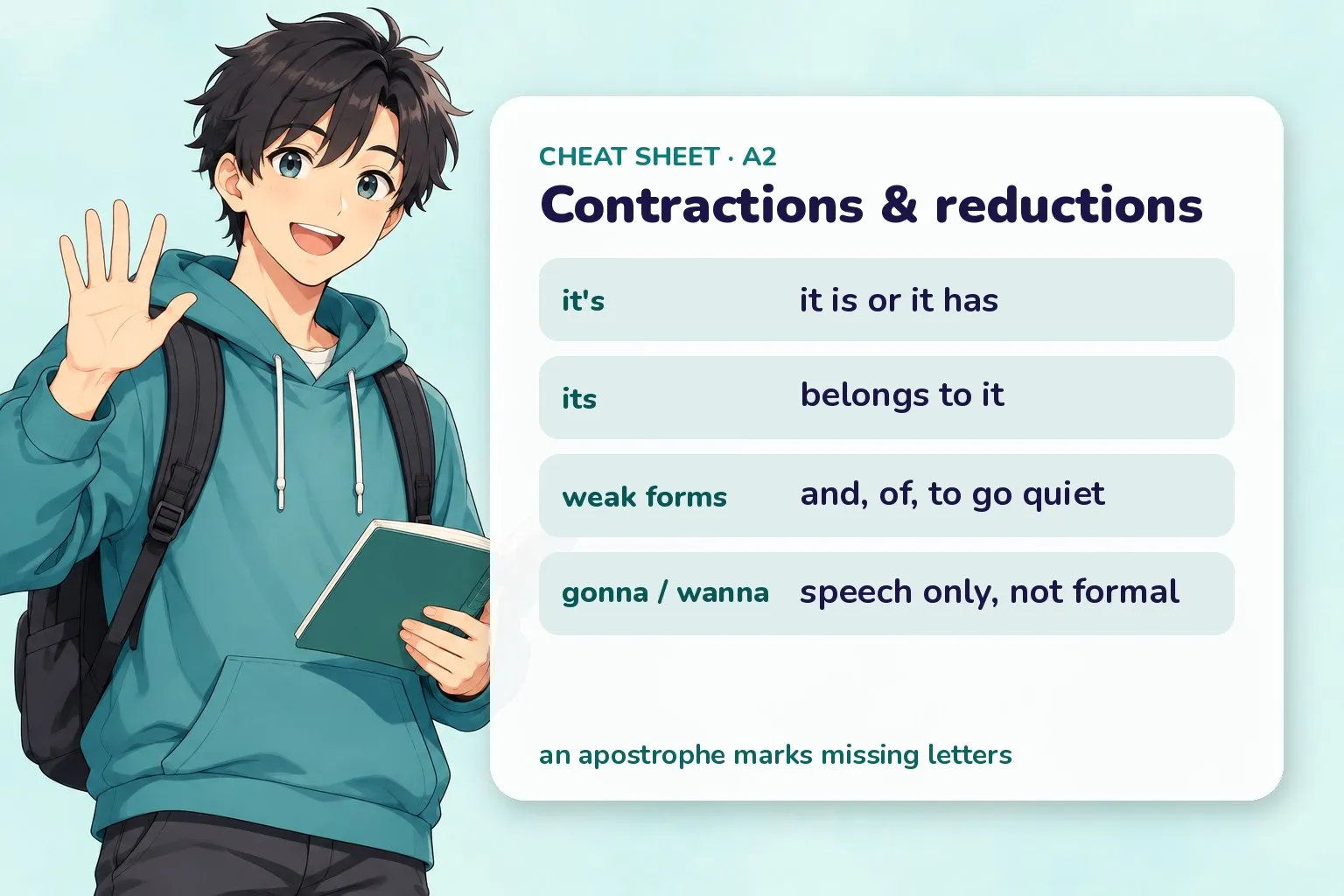
Quick recap before you practise.
Quiz
Contractions and reductions quiz
10 questions · pick an answer and you'll see straight away if it's right.
-
Show answer
I am — I'm = I am.
-
Show answer
she has — With a past participle (gone), she's = she has.
-
Show answer
The team lost its match. — Possession uses its with no apostrophe.
-
Show answer
can't — cannot becomes can't.
-
Show answer
going to (future) — gonna = going to, used for the future, not for movement.
-
Show answer
A casual text to a friend — Reductions belong in casual speech and messages, not formal writing.
-
Show answer
fish-n-chips (weak and) — and weakens to /ən/ or /n/.
-
Show answer
won't — will not becomes the irregular contraction won't.
-
Show answer
By the vowel: weak for can, strong for can't — can has a weak schwa; can't has a long, stressed vowel.
-
Show answer
I've — I have becomes I've.
Recap cheat-sheet
| Point | Remember | Example |
|---|---|---|
| contraction | apostrophe = missing letters | do not → don’t |
| it’s vs its | it’s = it is/has; its = owns | it’s cold; its tail |
| weak forms | small words go quiet | and → /ən/, of → /əv/ |
| can vs can’t | listen to the vowel | weak = can, strong = can’t |
| gonna / wanna | speech only, not formal | going to, want to in essays |
Next
- Next: English Connected Speech (Linking)
- Previous: English Spelling Rules & Patterns
- Back to Start Learning English Here
All English pronunciation & writing topics
Vocabulary, pronunciation, phrases, practice and exam help, ordered by level. Pick a topic and go straight to it. New lessons go live every day, so topics marked Coming soon fill in over the next weeks.
Pronunciation & writing
A1 2 topics · 2 ready
A2 6 topics · 6 ready
- 03 English Vowel Sounds (IPA)
- 04 English Consonant Sounds (IPA)
- 05 English Word Stress
- 06 English Silent Letters
- 07 English Spelling Rules & Patterns
- 08 English Contractions & Reductions You are here