English Exams: Which One & How to Prepare
IELTS, TOEFL iBT and the Cambridge English qualifications all test reading, listening, writing and speaking, but they differ in format and scoring. Choose the one your university, employer or government accepts, then prepare for its CEFR level using this course's grammar, vocabulary and practice pages.
Level: B1. There is no single “English exam”. The three families most learners meet — IELTS, TOEFL iBT and the Cambridge English qualifications — all test the same four skills (reading, listening, writing, speaking), but they package and score them differently. This page helps you pick the right one and points you to the course pages that build the skills it tests.
By the end of this page you can…
…tell the three main exam families apart, understand how each is scored, see how the levels map onto this course, and start a preparation plan.
The shared yardstick: CEFR
All of these exams relate to the Common European Framework of Reference (CEFR), an international six-point scale from A1 (beginner) up to C2 (mastery), with A2, B1, B2 and C1 in between (Council of Europe; Cambridge English). Every lesson on this site carries a CEFR level badge, so the framework is the bridge between your study here and any exam you take.
| CEFR | Rough meaning |
|---|---|
| A1 | Beginner — simple phrases, basic needs |
| A2 | Elementary — routine, everyday situations |
| B1 | Intermediate — main points, familiar topics |
| B2 | Upper-intermediate — fluent, detailed discussion |
| C1 | Advanced — flexible, effective use for work/study |
| C2 | Mastery — near-effortless, precise |
IELTS at a glance
IELTS comes in two main formats — Academic (for study and professional registration) and General Training (for migration, work and training); the Speaking and Listening parts are the same, while Reading and Writing differ (IELTS). It has four sections:
| Section | Time | Notes |
|---|---|---|
| Listening | 30 minutes | four recordings, 40 questions |
| Reading | 60 minutes | three long passages, 40 questions |
| Writing | 60 minutes | Task 1 (~150 words) + Task 2 (~250 words) |
| Speaking | 11–14 minutes | a face-to-face interview in three parts |
Listening, Reading and Writing are taken on the same day with no breaks; Speaking may be the same day or up to a week before or after. Results are reported on a 9-band scale from 0 to 9, in whole and half bands, with a score for each section and an overall band that is the average of the four. There is no pass or fail (IELTS). IELTS is available on paper or computer, with the same scoring.
TOEFL iBT at a glance
The TOEFL iBT test is taken on a computer, either at a test centre or at home with a live proctor (Home Edition). It has four sections (ETS):
| Section | Approx. time | Items |
|---|---|---|
| Reading | ~30 minutes | 50 |
| Listening | ~29 minutes | 47 |
| Writing | ~23 minutes | 12 |
| Speaking | ~8 minutes | 11 |
Plan for about two hours in total. You receive four section scores and an overall score on a 1–6 scale; the overall is the average of the four sections, rounded to the nearest half band. For a two-year transition period after January 2026, ETS also reports a comparable overall score on the older 0–120 scale (ETS).
Cambridge English at a glance
Cambridge English is a ladder of qualifications, each aimed at one CEFR level, so you take the exam that matches where you are (Cambridge English):
| Qualification | CEFR level |
|---|---|
| A2 Key | A2 |
| B1 Preliminary | B1 |
| B2 First | B2 |
| C1 Advanced | C1 |
| C2 Proficiency | C2 |
(There are also young-learner and “for Schools” versions.) Each exam has four components — Reading and Use of English, Writing, Listening and Speaking. As a worked example, B2 First runs about 3½ hours in total: Reading and Use of English (1 hour 15 minutes, 7 parts), Writing (1 hour 20 minutes, two tasks of 140–190 words), Listening (about 40 minutes, heard twice) and a Speaking test of 14 minutes taken with a partner and two examiners (Cambridge English). Results are reported on the Cambridge English Scale, with a score for each skill plus an overall score, designed to align with the CEFR and with IELTS (Cambridge English).
How to choose
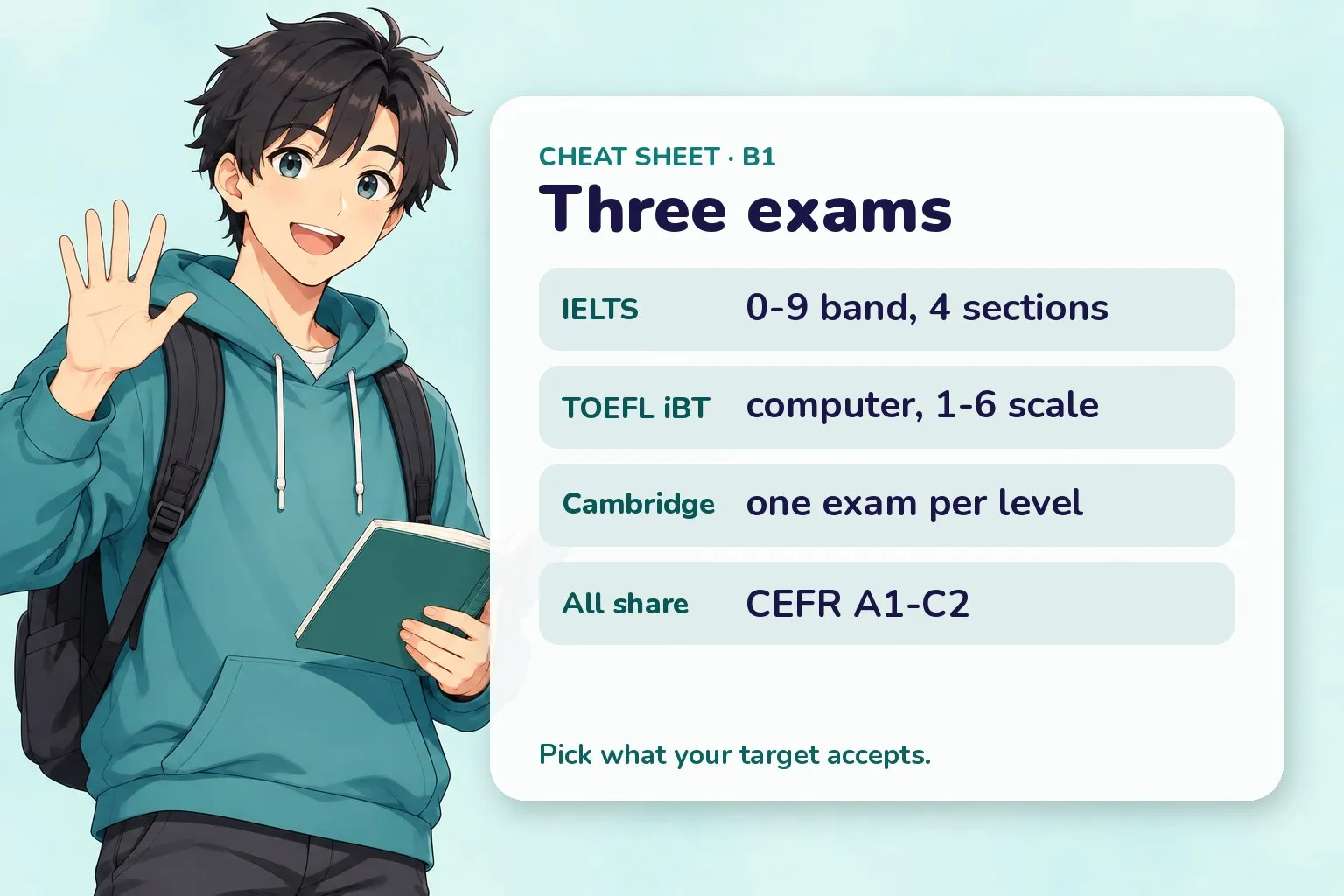
Quick recap of the three families.
How to prepare with this course
Whichever exam you choose, the skills are the same, and this course is organised to build them:
- Grammar: work through the grammar lessons at and just above your CEFR level — accuracy lifts your Writing and Speaking marks most.
- Vocabulary: the vocabulary sets give you the everyday and topic words examiners expect; this hub’s companion page English Numbers, Dates & Money covers a point every exam tests.
- Writing: Writing Business Emails in English and Formal Writing & Emails train the structure and register that writing tasks reward.
- Practice: the practice pages help you rehearse under time pressure, which is half the battle in any exam.
Detailed, exam-by-exam guides — an IELTS overview, a TOEFL iBT overview and Cambridge exam pages — are coming soon and will be linked here when they are published.
Practice
Choosing an English exam
Try each one, then press Check. No sign-up, nothing is sent anywhere — it all runs in your browser.
Hint: the number of bands
Show answer
9 — IELTS uses a 9-band scale with whole and half bands.
4 Match each Cambridge qualification to its CEFR level.
- A2 Key
- B1 Preliminary
- B2 First
- C1 Advanced
Show answer
- A2 Key → A2
- B1 Preliminary → B1
- B2 First → B2
- C1 Advanced → C1
Each Cambridge exam targets one CEFR level.
5 Put the four skills every exam tests in the usual order.
Show answer
Reading Listening Writing Speaking — All three families assess reading, listening, writing and speaking.
Quiz
English exams quiz
10 questions · pick an answer and you'll see straight away if it's right.
-
Show answer
That your target institution accepts that test and score — Choose by acceptance: use the exact test the institution requires.
-
Show answer
A1 to C2 — The CEFR has six levels, A1 up to C2.
-
Show answer
Four — IELTS tests Listening, Reading, Writing and Speaking.
-
Show answer
The average of the four sections — The overall band is the average of the four section scores; there is no pass or fail.
-
Show answer
Academic and General Training — IELTS offers Academic and General Training; Speaking and Listening are the same in both.
-
Show answer
At a test centre or at home with a live proctor — TOEFL iBT is computer-based at a centre or via the Home Edition with a proctor.
-
Show answer
B2 First — B2 First is aimed at CEFR level B2.
-
Show answer
the Cambridge English Scale — Cambridge uses its own Cambridge English Scale, aligned to the CEFR and IELTS.
-
Show answer
No — use the official comparison tools — The scales differ; use the exam bodies' official converters, with CEFR as the shared reference.
-
Show answer
Build all four skills, with timed practice — Every exam tests four skills, so a balanced, timed plan works best.
Recap cheat-sheet
| Exam | Scoring | Delivery |
|---|---|---|
| IELTS | 0–9 band, overall = average of 4 | paper or computer |
| TOEFL iBT | 1–6 per section + overall (0–120 in transition) | computer, centre or home |
| Cambridge English | Cambridge English Scale, per level | paper or computer |
| Shared yardstick | CEFR A1–C2 | — |
Next
- Build accuracy: English Grammar lessons
- Build range: English Vocabulary sets
- Rehearse under time: English Practice pages
- Previous in this set: Writing Business Emails in English
- New here? Start with Start Learning English Here
All English exams topics
Vocabulary, pronunciation, phrases, practice and exam help, ordered by level. Pick a topic and go straight to it. New lessons go live every day, so topics marked Coming soon fill in over the next weeks.
Exams
A2 1 topics · 1 ready
B1 6 topics · 6 ready
- 02 English Exams: Which One & How to Prepare You are here
- 03 IELTS Overview: Format & Scoring
- 04 IELTS Listening: Format & Strategies
- 05 Understanding IELTS Band Scores
- 06 Cambridge English Exams Explained
- 07 B1 Preliminary (PET) Overview
B2 12 topics · 12 ready
- 08 IELTS Reading: Format & Strategies
- 09 IELTS Academic Writing Task 1
- 10 IELTS Writing Task 2 (Essay)
- 11 IELTS Speaking: Parts 1-3
- 12 TOEFL iBT Overview: Format & Scoring
- 13 TOEFL Reading Strategies
- 14 TOEFL Listening Strategies
- 15 TOEFL Speaking Tasks
- 16 TOEFL Writing (incl. Integrated)
- 17 B2 First (FCE) Overview
- 18 Exam Essay & Writing Skills
- 19 Exam Speaking Strategies