Cambridge English Exams Explained
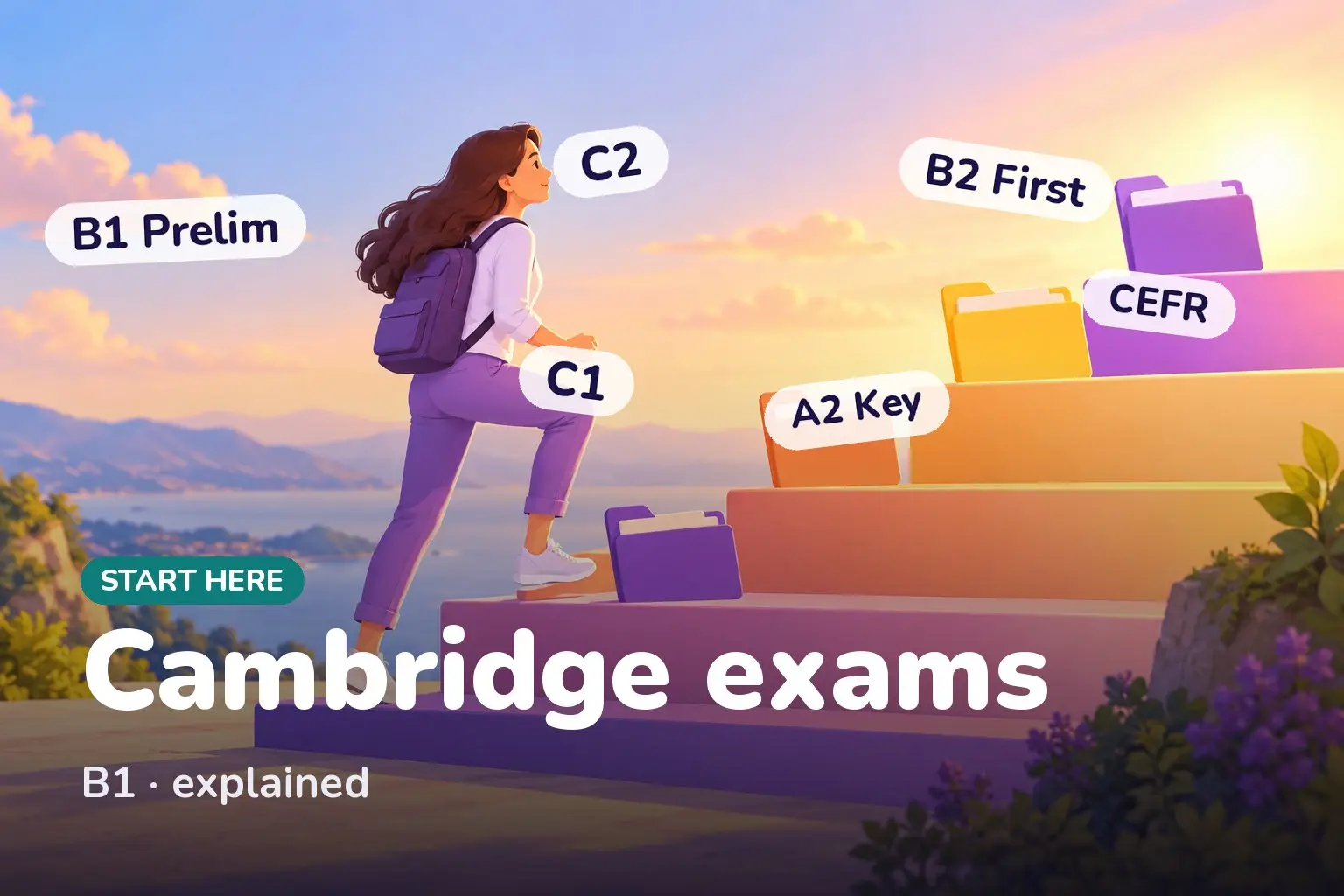
Cambridge English offers a ladder of qualifications, one per CEFR level from A2 Key up to C2 Proficiency. Each tests reading, writing, listening and speaking, and reports results on the Cambridge English Scale with a grade and CEFR level.
On this page12 sections · tap to jump
Level: B1. Cambridge English is not one test but a family of exams, each aimed at a single level of the Common European Framework of Reference (CEFR). You pick the exam that matches where you are now, prepare for it, and take it when you are ready. This page explains how the ladder works, what every exam shares, and how the scores are read.
By the end of this page you can…
…name the main Cambridge English qualifications in order, say which CEFR level each one targets, explain how they are scored, and start a preparation plan with this course.
The Cambridge English ladder
Each qualification is built for one CEFR level, so you take the exam that fits your current ability rather than a single test for everyone (Cambridge English):
| Qualification | CEFR level | Who it is for |
|---|---|---|
| Pre A1 Starters, A1 Movers, A2 Flyers | Pre A1 to A2 | young learners taking their first steps |
| A2 Key | A2 | basic everyday communication |
| B1 Preliminary | B1 | practical, everyday language |
| B2 First | B2 | upper-intermediate, study and work |
| C1 Advanced | C1 | high-level academic or professional use |
| C2 Proficiency | C2 | mastery, the highest level |
There are for Schools versions of A2 Key, B1 Preliminary and B2 First, with the same format and the same certificate but topics aimed at school-age candidates.
What every exam shares
All of these qualifications test the same four skills — reading, writing, listening and speaking (Cambridge English). They differ in how the papers are grouped:
- A2 Key has three components: Reading and Writing is one combined paper, then Listening and Speaking.
- B1 Preliminary and above split Reading and Writing into separate papers, giving four components.
You can take any of them two ways: a digital exam (an on-screen test with faster results) or a traditional paper exam. It is the same qualification, so you prepare the same way (Cambridge English). Speaking is always face to face with an examiner and, at most levels, another candidate — not a recording into a computer.
How scoring works
A2 Key up to C2 Proficiency all report on the Cambridge English Scale (Cambridge English). You get:
- a separate score for each skill, so you can see your strengths and weaknesses;
- an overall score (the average of the skills);
- a grade (A, B or C) and the matching CEFR level.
Because the scale is shared across exams, it also makes it easy to compare results and see your progress from one level to the next (Cambridge English). The scores reach above and below the target level too, which is why a very strong performance can earn you a certificate one CEFR level higher than the exam aims at.
When results arrive
Results reach you faster on the digital exams: digital results are available 5–10 working days after the session, while paper-based results normally take 4–6 weeks (Cambridge English). Your Confirmation of Entry from the exam centre gives the final date by which results will be available.
Which exam should you take
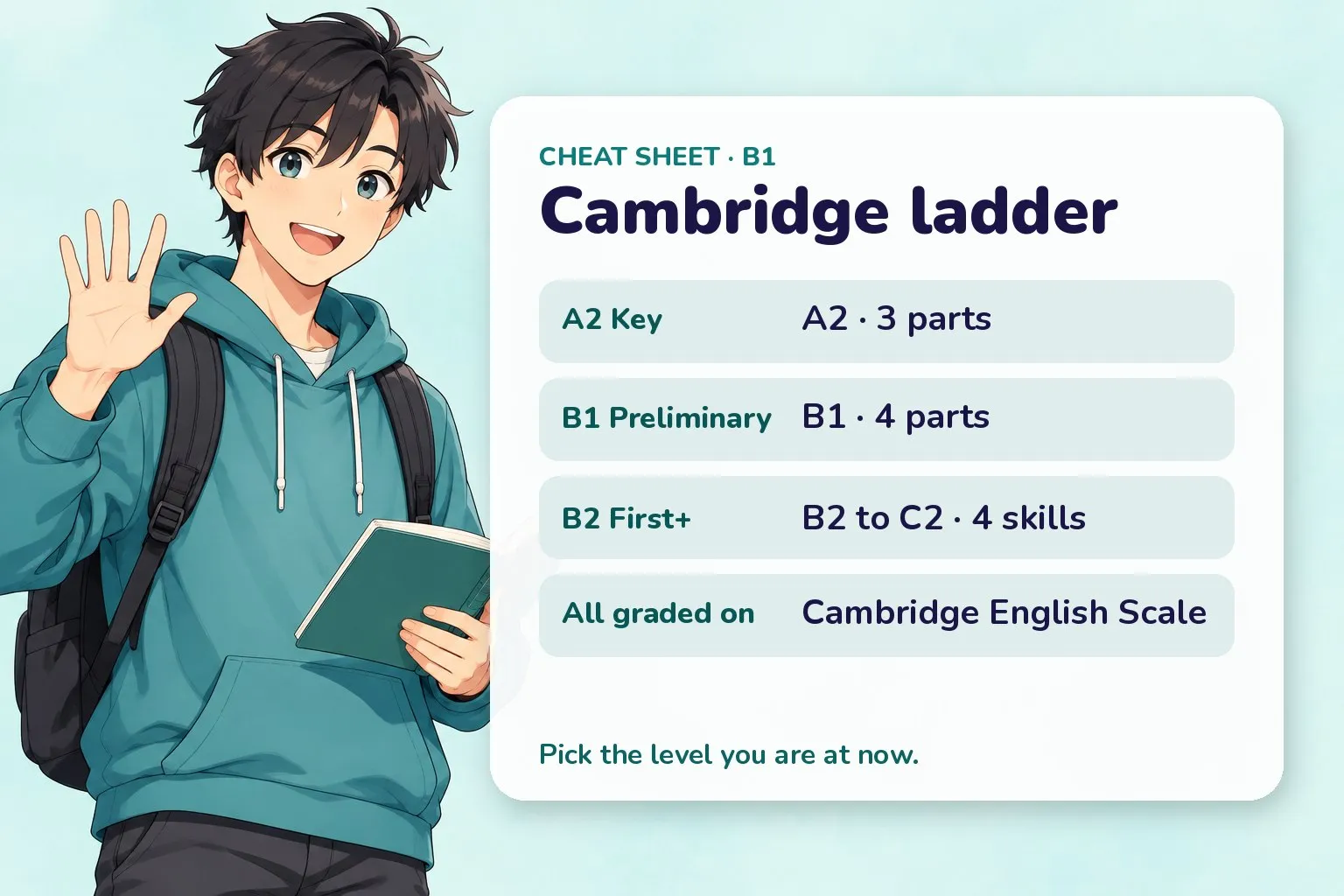
The Cambridge English ladder at a glance.
Work from your current level. If simple, everyday situations are still a stretch, start at A2 Key. If you can already cope with everyday reading, writing and conversation, B1 Preliminary is the natural target. From there the ladder continues through B2 First, C1 Advanced and C2 Proficiency. Detailed pages on A2 Key and B1 Preliminary sit in this same exams section — use the hub to find them.
How to prepare with this course
The skills are the same whichever exam you choose, and this course is built to train them:
- Grammar: work through the grammar lessons at and just above your CEFR level — accuracy is what Writing and Speaking marks reward most.
- Vocabulary: the vocabulary sets give you the everyday and topic words examiners expect; English Numbers, Dates & Money covers a point every exam tests.
- Writing: the Writing practice guide and Formal Writing & Emails train the structure and register the Writing tasks reward.
- Reading and listening: rehearse under time pressure with the practice pages, including B1 reading practice.
- Starting out? Start Learning English Here and the exams hub help you plan.
Sample exam English
These are the kinds of sentence a Cambridge candidate reads, writes or says. Use the audio to check how they sound.
Example sentences
- The library closes at six on weekdays.A short public notice of the kind you read in the test.
- Please bring your ID to the exam room.A simple instruction, read for the main message.
- I would like to book a table for two on Friday.An everyday request in writing or speaking.
- Can you tell me how to get to the station?Asking for directions in the Speaking test.
- The meeting has been moved to Thursday morning.Understanding a change in a short message.
- She has lived in Madrid for three years.A B1 sentence using the present perfect.
- If it rains tomorrow, we will stay at home.A first conditional, common at B1.
- I am writing to ask about your English courses.Opening line of a semi-formal email.
- Could you send me the details by Monday, please?A polite request in an email.
- The report was finished before the deadline.A passive sentence tested from B1.
- I think public transport is better than driving.Giving an opinion in Speaking or Writing.
- We are looking forward to seeing you next week.A friendly email closing.
- There is a small café next to the museum.Describing a place, tested from A2.
- Thank you for your email. I will reply soon.A short, polite written reply.
Practice
Cambridge English exams
Try each one, then press Check. No sign-up, nothing is sent anywhere — it all runs in your browser.
2 Match each qualification to its CEFR level.
- A2 Key
- B1 Preliminary
- B2 First
- C1 Advanced
Show answer
- A2 Key → A2
- B1 Preliminary → B1
- B2 First → B2
- C1 Advanced → C1
Each Cambridge English exam targets one CEFR level.
Hint: the shared number line
Show answer
Scale — Results are reported on the Cambridge English Scale, with a score per skill plus an overall score.
4 Put the main qualifications in order from lowest level to highest.
Show answer
A2 Key B1 Preliminary B2 First C1 Advanced C2 Proficiency — The ladder climbs A2, B1, B2, C1, C2.
Quiz
Cambridge English exams quiz
12 questions · pick an answer and you'll see straight away if it's right.
-
Show answer
a ladder of qualifications, one per CEFR level — Each qualification is built for one CEFR level, so you sit the exam that fits you.
-
Show answer
B1 Preliminary — B1 Preliminary is aimed at CEFR level B1.
-
Show answer
Four — All of them test reading, writing, listening and speaking.
-
Show answer
Reading and Writing are combined into one paper — At A2 Key, Reading and Writing form one paper; from B1 Preliminary they are separate.
-
Show answer
a score for each skill plus an overall score — Candidates get a score per skill, an overall score, a grade and a CEFR level.
-
Show answer
B1 — The scale reaches above the target, so a top A2 Key result can be certified at B1.
-
Show answer
a for Schools version — A2 Key, B1 Preliminary and B2 First also come in for Schools versions with the same certificate.
-
Show answer
digital or on paper — Each qualification is available as a digital exam or a paper exam.
-
Show answer
the paper-based A2 Key is withdrawn, digital remains — Cambridge English withdraws the A2 Key paper exam after December 2026; the digital version continues and A2 Key for Schools keeps both formats.
-
Show answer
C2 Proficiency — C2 Proficiency sits at the top of the ladder, at CEFR C2.
-
Show answer
5 to 10 working days — Digital results come in 5–10 working days; paper results normally take 4–6 weeks.
-
Show answer
build all four skills with timed practice — Every exam tests four skills, so a balanced, timed plan works best.
Recap cheat-sheet
| Point | What to remember |
|---|---|
| Structure | one exam per CEFR level, A2 Key up to C2 Proficiency |
| Skills | reading, writing, listening, speaking on every exam |
| Scoring | Cambridge English Scale: score per skill + overall, grade, CEFR |
| Delivery | digital or paper; standard and for Schools versions |
| 2026 change | A2 Key paper withdrawn after Dec 2026 (digital stays) |
Next
- Build accuracy: English Grammar lessons
- Build range: English Vocabulary sets
- Rehearse under time: English Practice pages
- Back to the English exams hub
- New here? Start with Start Learning English Here
All English exams topics
Vocabulary, pronunciation, phrases, practice and exam help, ordered by level. Pick a topic and go straight to it. New lessons go live every day, so topics marked Coming soon fill in over the next weeks.
Exams
A2 1 topics · 1 ready
B1 6 topics · 6 ready
- 02 English Exams: Which One & How to Prepare
- 03 IELTS Overview: Format & Scoring
- 04 IELTS Listening: Format & Strategies
- 05 Understanding IELTS Band Scores
- 06 Cambridge English Exams Explained You are here
- 07 B1 Preliminary (PET) Overview
B2 12 topics · 12 ready
- 08 IELTS Reading: Format & Strategies
- 09 IELTS Academic Writing Task 1
- 10 IELTS Writing Task 2 (Essay)
- 11 IELTS Speaking: Parts 1-3
- 12 TOEFL iBT Overview: Format & Scoring
- 13 TOEFL Reading Strategies
- 14 TOEFL Listening Strategies
- 15 TOEFL Speaking Tasks
- 16 TOEFL Writing (incl. Integrated)
- 17 B2 First (FCE) Overview
- 18 Exam Essay & Writing Skills
- 19 Exam Speaking Strategies