English Reading Practice: Intermediate
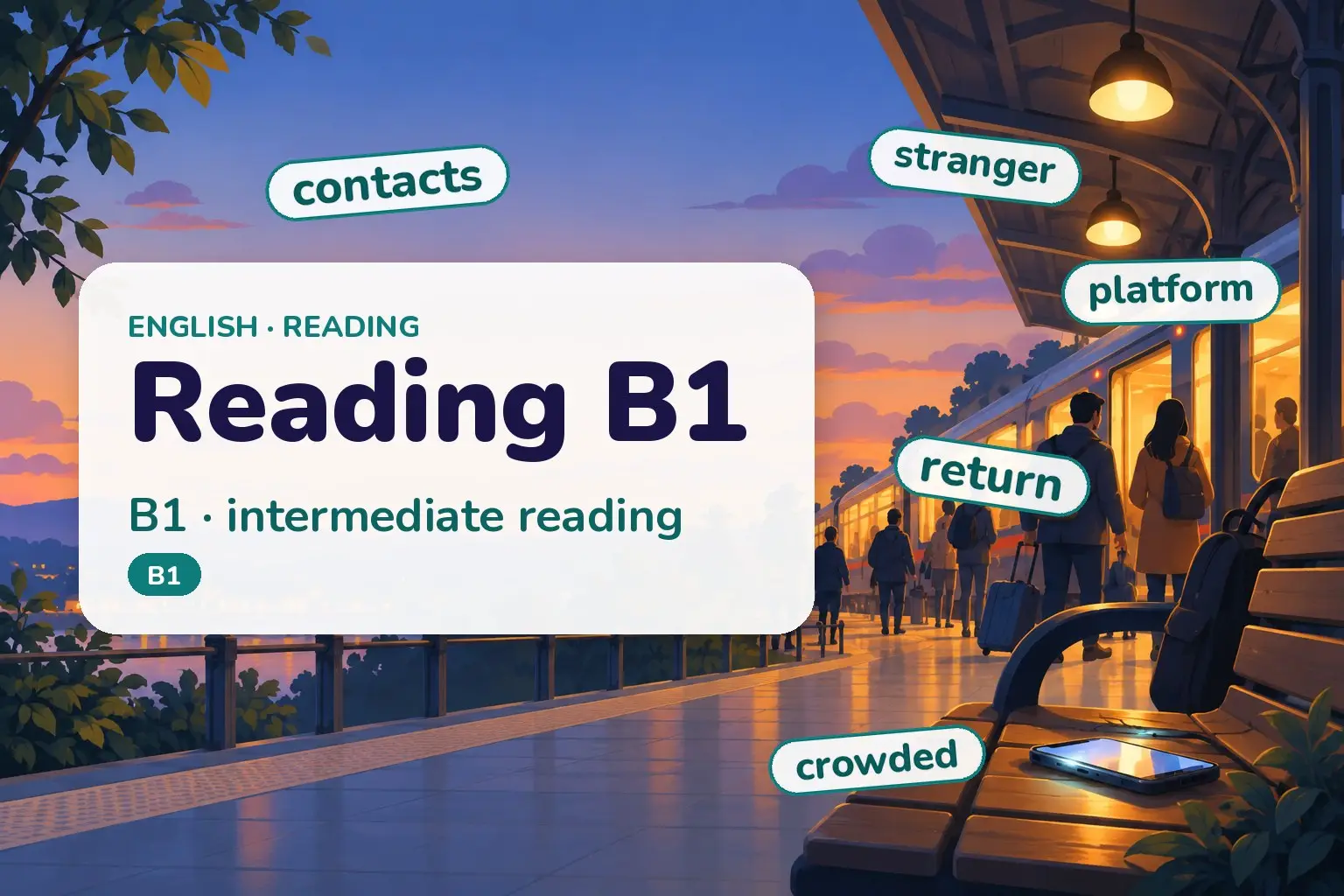
This B1 lesson gives you a longer narrative with past tenses and linking words, plus a glossary, comprehension practice and a quiz. Read the whole story first for the plot, then reread to follow how the events connect.
On this page6 sections · tap to jump
Level: B1. This story is longer than an A2 text and mixes past tenses: past simple, past continuous and past perfect. Read it once for the plot, then again to see how each event leads to the next.
By the end of this page you can…
…follow a B1 narrative, understand how the past perfect orders events, and infer a narrator’s feelings from their actions.
How to use this page
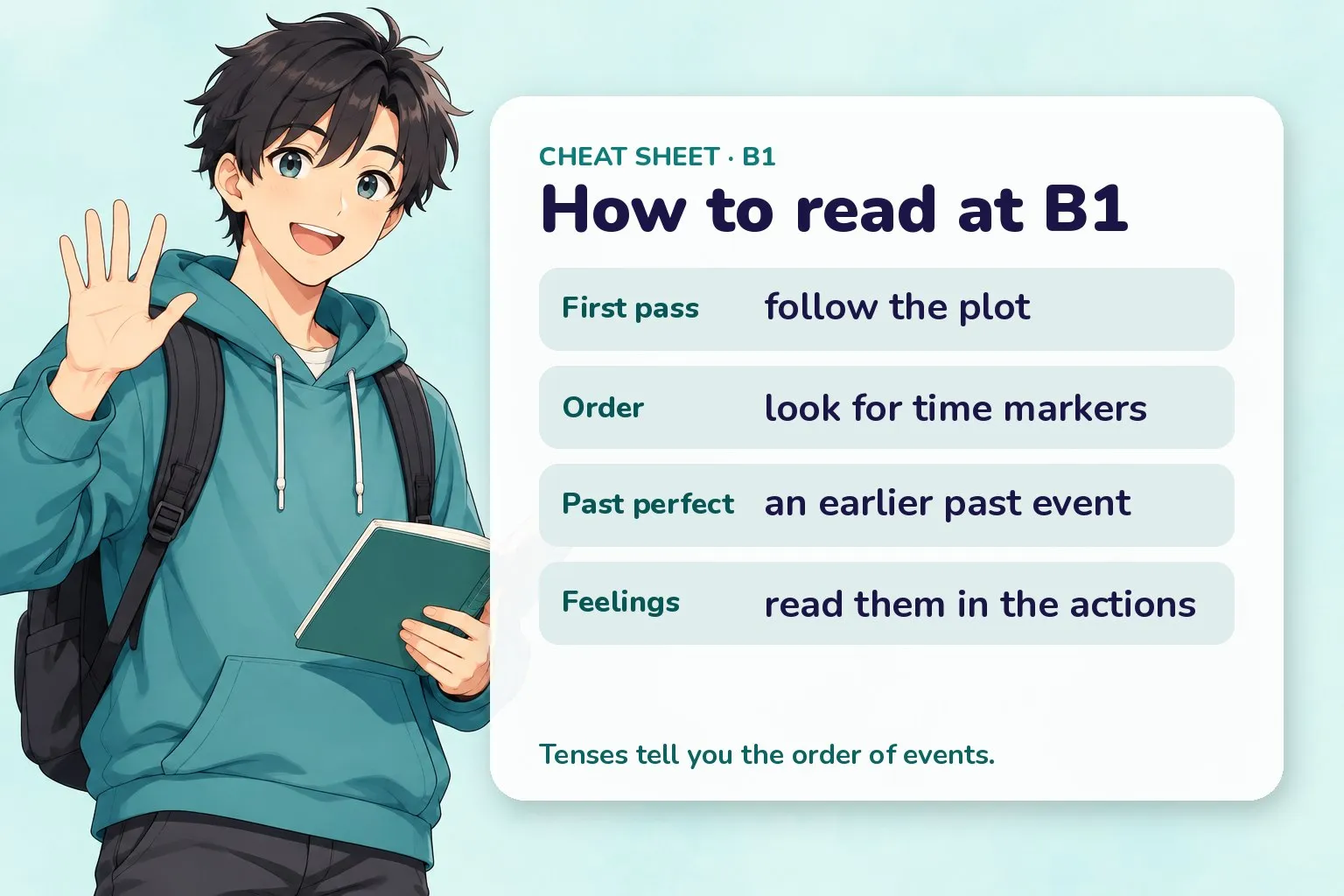
First, read for the story: what happens, and how it ends. Do not stop for new words yet. On the second reading, pay attention to the linking words and the verb tenses — they tell you the order in which things happened, which is not always the order in which they are written.
Read the text: The Lost Phone
Last winter, I lost my phone on a crowded train. I had been reading the news when the train reached my station, and I jumped up quickly. It was only on the platform that I realised my pocket was empty.
At first, I panicked. All my photos, messages and contacts were on that phone. I ran back towards the doors, but they had already closed, and the train was pulling away. I stood there, watching it disappear into the dark.
Then I remembered something useful. A week earlier, a friend had shown me how to track a lost phone from any computer. I hurried to a café, borrowed a laptop and logged in. A small blue dot appeared on the map. My phone was moving across the city, stopping at each station along the line.
I did not try to chase it. Instead, I left a message on the screen with my email address and a short note: please contact me, this is my phone. Then I waited.
Two hours later, an email arrived. A woman had found the phone under a seat and wanted to return it. We agreed to meet the next morning at the station café. She would not accept any money, so I bought her a coffee and thanked her again and again.
Looking back, I learned two things. First, technology can help, but only if you set it up before you need it. Second, most people are kinder than we expect. I had imagined the worst, yet a stranger went out of her way to help me.
Now I keep my phone in a zipped pocket, and I have written down my most important numbers on paper. I still lose things sometimes, but I worry a little less.
Glossary
Tap a word to hear it. Notice which words carry the feeling of the story.
- crowdedfull of people, with little space to move.
- platformthe raised area beside the track where you wait for and leave a train.
- to panicto suddenly feel so much fear or worry that it is hard to think clearly.
- contactsthe list of names and phone numbers saved on a phone.
- to trackto follow where something is, often using a signal or a map.
- to log into enter a username and password to open an online account.
- to chaseto run after someone or something to try to catch it.
- to returnto give something back to its owner.
- a strangera person you do not know.
- to go out of your wayto make a special effort to help, more than is expected.
Comprehension practice
Answer, then check the explanation. Reread the text as often as you like.
The Lost Phone — comprehension
Try each one, then press Check. No sign-up, nothing is sent anywhere — it all runs in your browser.
Hint: to follow where it is
Show answer
track — A friend had shown the narrator how to track a lost phone from any computer.
5 Put the events in the order they happened in the story.
Show answer
lost the phone on the train left a message on the screen got an email from a woman met her and said thank you — Loss, then the message, then the email, then the meeting.
6 Match each word with its meaning.
- crowded
- to panic
- a stranger
- to return
Show answer
- crowded → full of people
- to panic → to feel sudden fear
- a stranger → a person you do not know
- to return → to give something back
These four words are central to the mood and events of the story.
Quick recap before the quiz.
Quiz
B1 reading quiz
8 questions · pick an answer and you'll see straight away if it's right.
-
Show answer
last winter — The story opens with 'Last winter, I lost my phone'.
-
Show answer
on the platform — It was only on the platform that the narrator noticed the empty pocket.
-
Show answer
a friend, a week earlier — A week earlier, a friend had shown the narrator how to track a lost phone.
-
Show answer
the phone moving across the city — The dot was the phone, moving and stopping at each station along the line.
-
Show answer
the story does not say she wanted payment; she simply refused — She refused money, so the narrator bought her a coffee instead.
-
Show answer
to make a special effort to help — It describes doing more than expected to help someone.
-
Show answer
set up help before you need it — Technology helps only if you set it up in advance, the narrator says.
-
Show answer
before the narrator ran back — The past perfect marks an action completed before another past action.
Next
- Go back a level: English Reading Practice: Elementary
- Step up a level: English Reading Practice: Upper-Intermediate
- Browse the English practice section
- New here? Start with Start Learning English Here
All English practice topics
Vocabulary, pronunciation, phrases, practice and exam help, ordered by level. Pick a topic and go straight to it. New lessons go live every day, so topics marked Coming soon fill in over the next weeks.
Practice
A1 1 topics · 1 ready
A2 3 topics · 3 ready
B1 3 topics · 3 ready
- 05 Shadowing to Improve English Speaking
- 06 English Reading Practice: Intermediate You are here
- 07 How to Practise English Writing