Common English Collocations
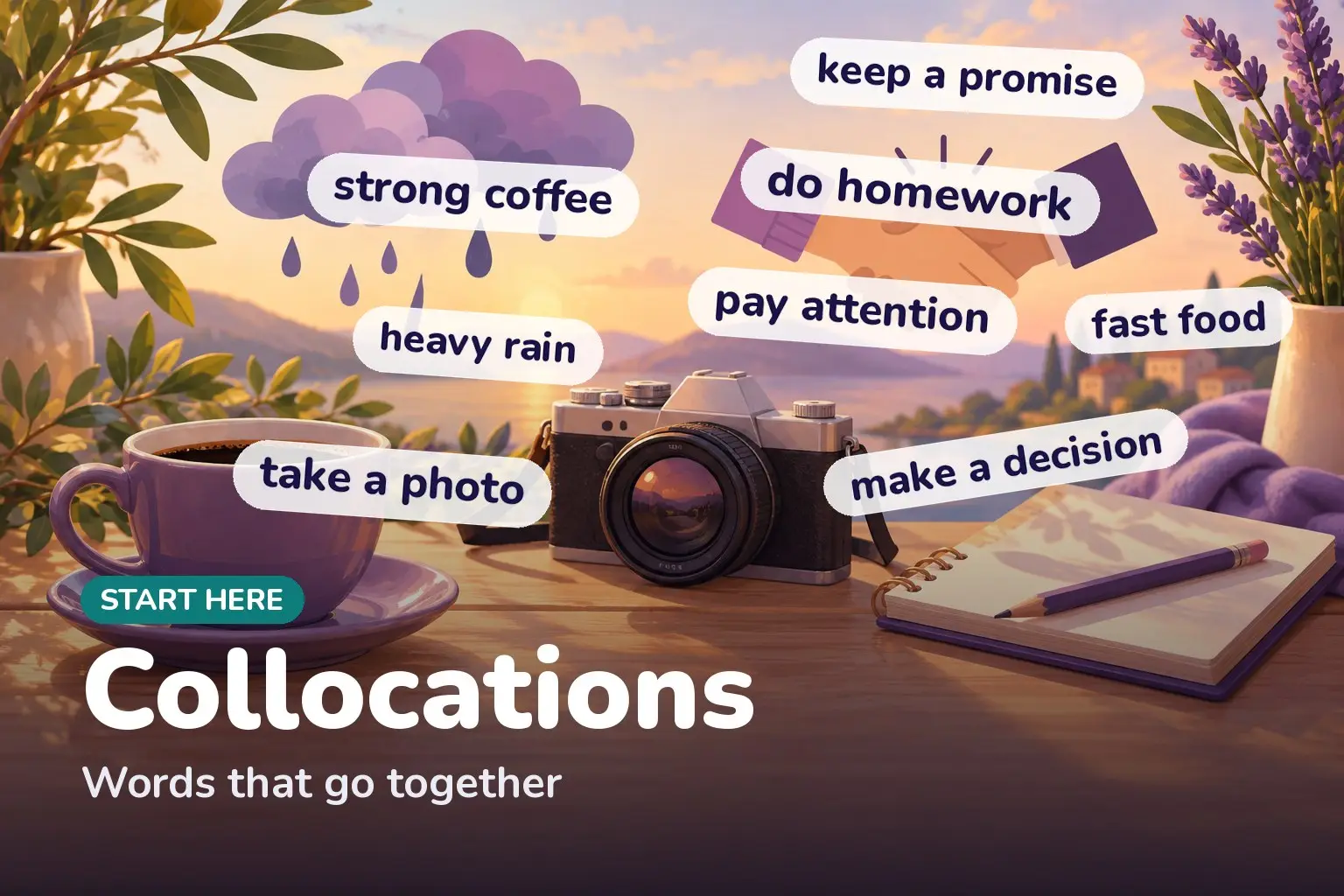
A collocation is a pair of words English speakers naturally use together: you make a decision but do your homework, rain is heavy not strong, coffee is strong not powerful. Learn the common partners as whole chunks and your English sounds far more natural.
Level: B2. A collocation is simply two or more words that English speakers habitually use together. The grammar may allow other combinations, but only one sounds right to a native ear: you make a decision, you do the washing up, rain is heavy, and coffee is strong. This page drills the highest-value pairs — especially make vs do and the strong-adjective and intensifier partners — so your English stops sounding translated.
By the end of this page you can…
…choose between make and do with confidence, pick the natural intensifier for a noun or adjective, and recognise and repair the collocation errors that mark out non-native English.
What a collocation is (and why it matters)
A collocation is a word partnership that sounds natural because speakers use it over and over: fast food, take a photo, keep a promise. Each word is common on its own, but the pairing is fixed by habit, not by a rule you can work out. Powerful coffee is perfectly grammatical and perfectly wrong — the word English chose is strong. Because the choice is arbitrary, the only reliable way to learn collocations is to meet them in context and store them as whole chunks.
make or do?
Both verbs are nearly empty of meaning here; the noun decides which one you need. As a rough guide, make is for producing, creating or causing something, and do is for tasks, work and activities. The guide helps, but the safest route is to memorise the common pairs below.
| Use make for… | Use do for… |
|---|---|
| make a decision | do your homework |
| make a mistake | do the housework |
| make progress | do the washing-up |
| make an effort | do business |
| make a plan | do research |
| make a suggestion | do a favour |
| make money | do your best |
| make a noise | do damage |
| make friends | do exercise |
| make a difference | do the shopping |
Strong collocations: intensifiers and their partners
Some adjectives and adverbs only pair with certain nouns. English does not use a single all-purpose word for strong; it chooses a different partner for each noun.
| Natural | Not natural | Meaning |
|---|---|---|
| heavy rain | strong rain | rain falling hard |
| strong coffee | powerful coffee | coffee with a lot of taste |
| fast food | quick food | food served very quickly |
| high chance | big chance | a strong probability |
| a deep sleep | a strong sleep | sleeping heavily |
| bitterly cold | strongly cold | extremely cold |
| highly likely | very likely (ok) / strongly likely | very probable |
| strongly recommend | heavily recommend | recommend firmly |
| fully aware | deeply aware | completely aware |
| closely linked | strongly linked (ok) / near linked | connected tightly |
Delexical verbs: have, take, give, pay, keep
A handful of common verbs act as near-empty partners for an action noun. The noun carries the meaning; the verb is fixed by habit.
| Verb | Common partners |
|---|---|
| have | have a shower, have a rest, have a look, have breakfast |
| take | take a photo, take a break, take a risk, take a seat |
| give | give a speech, give advice, give a hand, give an example |
| pay | pay attention, pay a visit, pay a compliment, pay the bill |
| keep | keep a promise, keep calm, keep in touch, keep a secret |
Example sentences
Play each line, then say it aloud. Notice the partnership, not just the single word.
- We need to make a decision before Friday.make a decision, never do a decision.
- The children do their homework after dinner.do homework, never make homework.
- She made good progress this term.make progress is the fixed pair.
- Could you do me a favour and close the window?do a favour, not make a favour.
- I made a silly mistake in the report.make a mistake is the standard chunk.
- He does business with firms across Asia.do business, not make business.
- Heavy rain is expected on the coast tonight.heavy rain, not strong rain.
- I like my coffee strong and black.strong coffee, not powerful coffee.
- There is a high chance of delays this morning.a high chance, not a big chance.
- It is highly likely that prices will rise.highly likely, a fixed intensifier pair.
- I strongly recommend the earlier train.strongly recommend, not heavily recommend.
- It was bitterly cold on the mountain.bitterly cold, a fixed partnership.
- Please take a seat; the doctor is ready.take a seat, not make a seat.
- Let us take a short break before the next part.take a break, not do a break.
- She gave a clear speech at the conference.give a speech, not make a speech (both heard, give is safe).
- Pay attention to the final paragraph.pay attention, not make attention.
- He always keeps his promises.keep a promise, not hold a promise.
- Can you tell me the truth about last night?tell someone the truth; tell, not say, with a person.
- We had a quick look at the figures.have a look, not make a look.
- The new rule made a real difference to staff.make a difference, a high-value chunk.
Recap cheat-sheet
A few partnerships to lock in before the quiz.
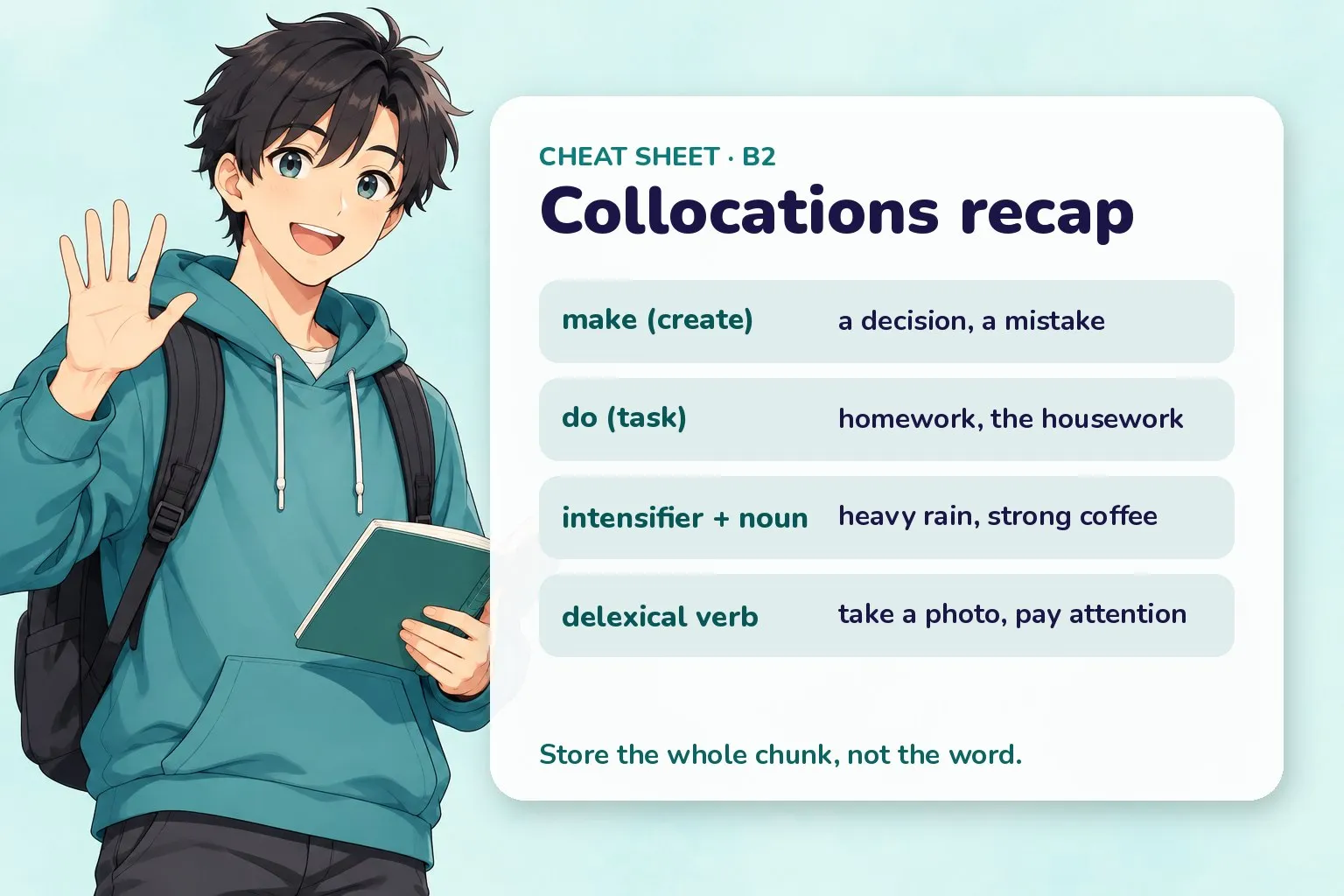
Quick recap before the quiz.
| Group | Keep these together |
|---|---|
| make (create) | a decision, a mistake, progress |
| do (task) | homework, the housework, business |
| intensifier + noun | heavy rain, strong coffee |
| delexical verb | take a photo, pay attention |
Practice
Collocations practice
Try each one, then press Check. No sign-up, nothing is sent anywhere — it all runs in your browser.
1 Match each noun with its usual verb.
- a decision
- your homework
- a photo
- attention
Show answer
- a decision → make
- your homework → do
- a photo → take
- attention → pay
make a decision, do homework, take a photo, pay attention.
Hint: create or reach it
Show answer
make — You make a decision; do a decision is a classic error.
Hint: a task or chore
Show answer
do — Chores take do: do the housework, do the washing-up.
6 Put the words in order.
Show answer
I strongly recommend the earlier train — strongly recommend is the fixed adverb + verb pair: I strongly recommend the earlier train.
Hint: not make
Show answer
do — You do someone a favour; make a favour is wrong.
Quiz
Collocations quiz
12 questions · pick an answer and you'll see straight away if it's right.
-
Show answer
make — make a decision is the fixed collocation.
-
Show answer
do — Tasks and chores take do: do homework.
-
Show answer
strong coffee — Coffee collocates with strong.
-
Show answer
heavy rain — Rain collocates with heavy.
-
Show answer
highly — highly likely is the fixed intensifier pair.
-
Show answer
pay — pay attention is fixed.
-
Show answer
do — do someone a favour, not make a favour.
-
Show answer
keeps — keep a promise is the fixed pair.
-
Show answer
take — take a break is the standard collocation.
-
Show answer
told — tell + person: he told me; say takes no person.
-
Show answer
do a decision — It must be make a decision, not do a decision.
-
Show answer
bitterly — bitterly cold is the fixed intensifier pair.
Next
- Build the verbs behind these chunks: English Core Verbs
- For formal writing partners: English Academic Vocabulary
- Browse the English practice section
- New here? Start with Start Learning English Here
All English practice topics
Vocabulary, pronunciation, phrases, practice and exam help, ordered by level. Pick a topic and go straight to it. New lessons go live every day, so topics marked Coming soon fill in over the next weeks.
Practice
A1 1 topics · 1 ready
A2 3 topics · 3 ready
B1 3 topics · 3 ready
B2 2 topics · 2 ready
- 08 English Reading Practice: Upper-Intermediate
- 09 Common English Collocations You are here