English Reading Practice: Upper-Intermediate
This B2 lesson gives you a reflective essay with abstract ideas and more complex sentences, plus a glossary, comprehension practice and a quiz. Read it once for the argument, then reread to see how each paragraph supports the main point.
On this page6 sections · tap to jump
Level: B2. This is a short reflective essay. The ideas are abstract and the sentences are longer, with linking words that build an argument. Read it once to catch the main point, then reread to see how the writer supports and qualifies it.
By the end of this page you can…
…follow a B2 argument, recognise hedging and concession, and interpret figurative language from context.
How to use this page
An essay is not a story; it makes a case. On your first reading, find the one idea the writer is defending. On the second, label each paragraph: is it the claim, a reason, an example, an objection, or the conclusion? This structure is what B2 reading tasks test.
Read the text: Learning to Be Bored
We have become remarkably good at avoiding boredom. The moment a queue forms or the lift doors close, our hands reach for a screen. Boredom, we assume, is a problem to be solved — an empty space that ought to be filled as quickly as possible. Yet there is a growing argument that we may have thrown away something valuable in our rush to stay entertained.
Boredom is uncomfortable, and that discomfort has a purpose. It is a signal that our current situation is not meeting our needs, and it nudges us to do something about it. A child left with nothing to do will eventually invent a game. An adult staring out of a window may, almost by accident, stumble upon the answer to a problem that direct effort had failed to crack. The mind, when it is not being fed, tends to wander — and wandering is where a good deal of original thinking happens.
The trouble with constant stimulation is that it never lets the mind reach that restless, searching state. Each time we feel the first flicker of boredom and reach for a distraction, we interrupt the very process that might have led somewhere interesting. We trade a moment of mild discomfort for a steady drip of content that asks nothing of us and leaves little behind.
None of this means that boredom is always productive, or that every idle moment blossoms into genius. Much of the time, boredom is simply dull. But the ability to sit with it, rather than flee at the first opportunity, seems to be a skill worth keeping. It lets us notice our own thoughts, feel curiosity build, and choose what to do next, instead of having the choice made for us by whatever is loudest on the screen.
Perhaps the goal, then, is not to eliminate boredom but to make a little room for it. We might leave the phone in another room for an hour, or take a walk with no particular destination. At first, the silence feels awkward. But given time, the mind settles, and something quietly begins to stir. We may find that the empty space we were so eager to fill was never quite as empty as it seemed.
Glossary
Tap a word to hear it. These are the higher-level words that carry the argument.
- remarkablyin a way that is surprising or worth noticing; strikingly.
- to assumeto accept that something is true without checking it.
- to nudgeto push gently, or to encourage someone towards an action.
- to stumble uponto find something by chance, without looking for it.
- stimulationthings that keep the mind or senses active and busy.
- a flickera brief, faint appearance of something, like a small flame or feeling.
- a distractionsomething that takes your attention away from what you are doing.
- idlenot active or working; spending time doing nothing in particular.
- curiositya strong wish to know or learn about something.
- to eliminateto remove something completely.
Comprehension practice
Read closely. Each answer can be justified from the text.
Learning to Be Bored — comprehension
Try each one, then press Check. No sign-up, nothing is sent anywhere — it all runs in your browser.
Hint: water falling slowly, drop by drop
Show answer
drip — 'A steady drip of content' is a figurative image of endless, low-value input.
6 Match each word with its meaning.
- to assume
- a distraction
- idle
- to eliminate
Show answer
- to assume → to accept as true without checking
- a distraction → something that pulls attention away
- idle → doing nothing in particular
- to eliminate → to remove completely
These four words are key to the essay's argument.
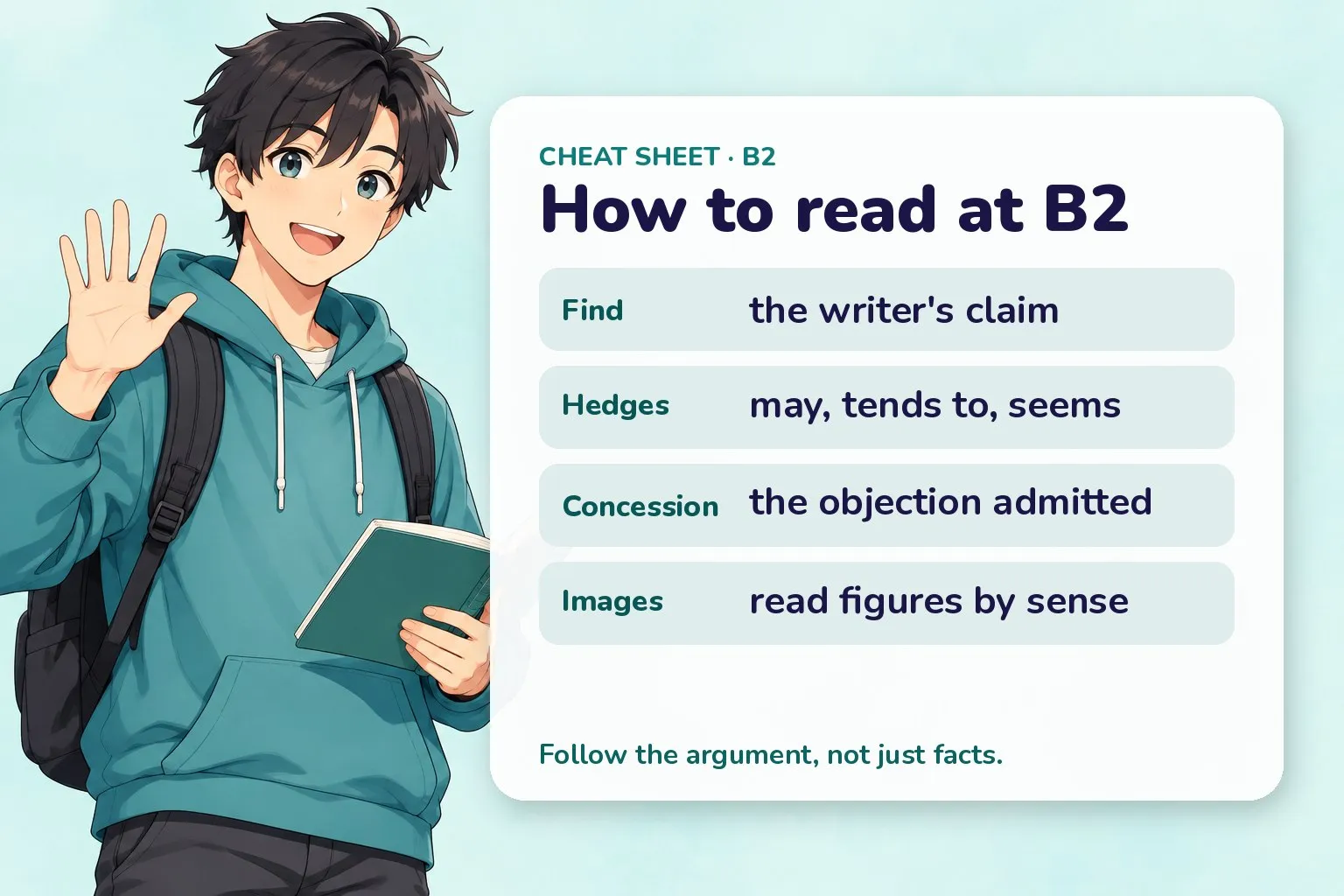
Quick recap before the quiz.
Quiz
B2 reading quiz
8 questions · pick an answer and you'll see straight away if it's right.
-
Show answer
make a little room for boredom — The conclusion suggests making room for boredom, not eliminating it.
-
Show answer
boredom can lead to creativity — Left with nothing to do, the mind wanders towards invention.
-
Show answer
may — 'May' is hedging language: it softens the claim rather than stating it as fact.
-
Show answer
by chance, not on purpose — To stumble upon something is to find it accidentally.
-
Show answer
that boredom is often simply dull — This concession strengthens the argument before the writer answers it.
-
Show answer
spent doing nothing in particular — Idle means inactive, doing nothing in particular.
-
Show answer
was never as empty as it seemed — The essay closes by reversing the idea that the space was empty.
-
Show answer
a reflective argumentative essay — It makes and defends a claim, which is argumentative and reflective in style.
Next
- Go back a level: English Reading Practice: Intermediate
- Browse the English practice section
- New here? Start with Start Learning English Here
All English practice topics
Vocabulary, pronunciation, phrases, practice and exam help, ordered by level. Pick a topic and go straight to it. New lessons go live every day, so topics marked Coming soon fill in over the next weeks.
Practice
A1 1 topics · 1 ready
A2 3 topics · 3 ready
B1 3 topics · 3 ready
B2 2 topics · 2 ready
- 08 English Reading Practice: Upper-Intermediate You are here
- 09 Common English Collocations