How to Practise English Listening
Good listening practice means working with audio you mostly understand, then re-listening with a goal each time — first for the gist, then for details and exact words. Mix guessing from context with catching individual sounds.
On this page11 sections · tap to jump
Level: A2. Listening often feels like the hardest skill, because you cannot slow real speech down or ask it to wait. The fix is not “listen to more English” in general — it is listening to the right audio in the right way, a few focused minutes at a time.
By the end of this page you can…
…choose listening material at your level and practise it with a clear goal for each replay.
What good listening practice looks like
Playing English in the background while you do something else barely helps. Useful practice has three features: the audio is at your level (you understand most of it), it is short, and you listen with a purpose — a question you are trying to answer. Then you listen again with a new purpose.
Two ways your brain listens
You understand speech using two skills at once:
- Top-down: using what you already know — the topic, the situation, the speaker’s tone — to guess and predict. If you know two friends are ordering food, you expect words about menus and prices.
- Bottom-up: catching the actual sounds, words and grammar as they go past.
Weak listeners lean on only one. If you guess everything from context, you miss details; if you hunt for every single word, you lose the thread. Good practice trains both: predict first, then check what you really heard.
Graded listening: start where you understand most
“Graded” means matched to your level. Start with audio where you catch most of the message. If you understand less than about half, the clip is too hard — switch to something slower or simpler rather than struggling. As it gets easy, step up. The lesson dialogues and example sentences on this site are graded for exactly this.
A simple listening routine
- Before you listen, read the title or look at the picture and predict what you will hear.
- First listen — gist. Answer one big question: what is it about? Who is talking?
- Second listen — details. Answer two or three small questions: numbers, names, what someone wants.
- Third listen — exact words. Now read the transcript while you listen and mark the parts your ear missed.
- Listen once more with the transcript closed to enjoy how much more you now catch.
Sample listening tasks
- Gist task: listen to a short café dialogue and decide — did the customer order a hot drink or a cold one?
- Detail task: listen again and write the price and the number of items.
- Gap task: cover the transcript, listen, and fill one missing word in each line.
- Dictation: play one short sentence, pause, and write exactly what you heard; then check.
Common pitfalls
- Material that is too hard. If you understand almost nothing, you are not practising, you are suffering. Drop a level.
- Listening once and quitting. The gains are in the replays.
- Reading the transcript first. Then you are reading, not listening. Save the transcript for the later passes.
- Giving up at one unknown word. Keep going; the next sentence often makes it clear.
How to say it
Most “I can’t understand fast English” problems are really connected-speech problems — the words are familiar, but they join and shrink:
- Linking: an hour sounds like “a-nour”; turn it off sounds like “ter-ni-toff”.
- Weak forms: do you becomes “d’you”; want to becomes “wanna”; going to becomes “gonna”.
- Lost sounds: the t in next day almost vanishes (“nex day”).
When you know these patterns, fast speech stops sounding like a blur.
Example sentences
Listen to each line, then read how it sounds in natural, fast speech. The words are easy — the joining is the challenge.
- What do you want to do?Fast speech: 'wadda you wanna do' — same four ideas, joined up.want to becomes wanna.
- Do you know what time it is?Sounds like 'd'you know what time it is' — do-you shrinks.
- I'm going to call you later.going to becomes gonna: 'I'm gonna call you later'.
- Can I have a cup of tea?cup of becomes 'cuppa': 'Can I have a cuppa tea'.
- Turn it off, please.Linking: 'ter-ni-toff' — the words run together.
- It's half past nine.A time detail to catch; stress half and nine.
- The train leaves at a quarter to six.Listen for the exact time: quarter to six.
- She said she'd be here in ten minutes.she'd = she would; catch the ten minutes.
- We don't have any left, sorry.don't have shrinks; the key word is any.
- Could you speak a little more slowly?A useful phrase when the audio feels fast.
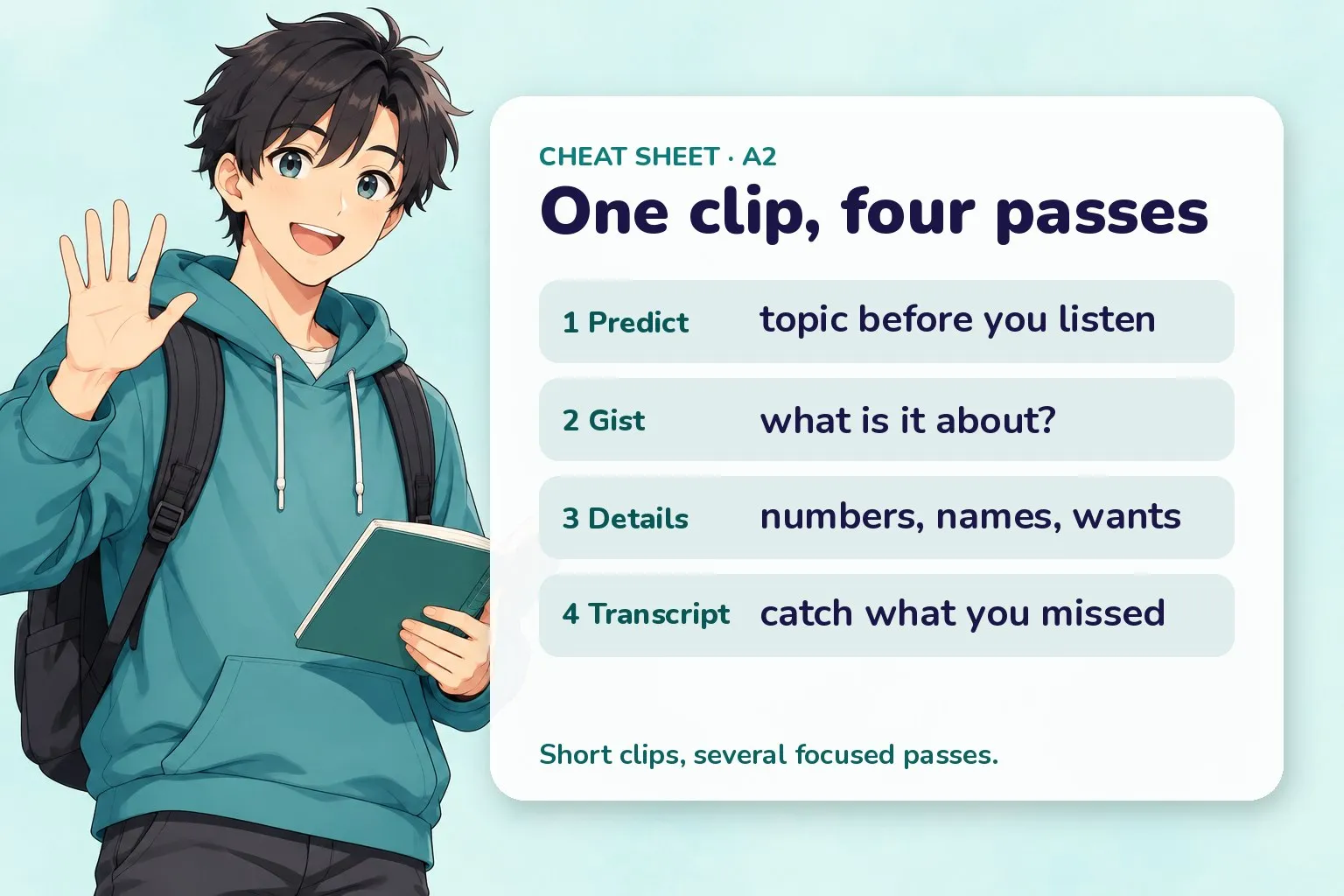
Quick recap before you practise.
Practice
Listening method practice
Try each one, then press Check. No sign-up, nothing is sent anywhere — it all runs in your browser.
Hint: the overall meaning, not small facts
Show answer
gist — First pass for gist, then later passes for details and exact words.
4 Order the passes of a good listening routine.
Show answer
predict before listening gist: what is it about details: numbers and names exact words with transcript — Predict, then gist, then details, then the exact words.
5 Match the fast-speech sound to its full words.
- wanna
- gonna
- d'you
- cuppa
Show answer
- wanna → want to
- gonna → going to
- d'you → do you
- cuppa → cup of
These weak forms join and shrink common words in natural English.
Quiz
Listening practice quiz
8 questions · pick an answer and you'll see straight away if it's right.
-
Show answer
at your level, mostly understandable — Graded audio you mostly follow is where real practice happens.
-
Show answer
switch to slower or simpler audio — Too-hard audio is not practice; step down a level.
-
Show answer
several times, with a new goal each pass — The gains are in focused replays with different purposes.
-
Show answer
catching the actual sounds, words and grammar — Bottom-up is catching the sounds; top-down is predicting from context.
-
Show answer
on a later pass, to catch what you missed — Reading first turns listening into reading; save the transcript for later passes.
-
Show answer
familiar words join and weaken in connected speech — Linking and weak forms hide words you already know.
-
Show answer
gonna — going to reduces to gonna in natural speech.
-
Show answer
short and frequent, with focus — Ten focused minutes a day beats a rare long session.
Next
- Turn listening into speaking with Shadowing to Improve English Speaking
- Train the sounds that hide words: English Connected Speech (Linking)
- New here? Start with Start Learning English Here
All English practice topics
Vocabulary, pronunciation, phrases, practice and exam help, ordered by level. Pick a topic and go straight to it. New lessons go live every day, so topics marked Coming soon fill in over the next weeks.
Practice
A1 1 topics · 1 ready
A2 3 topics · 3 ready
- 02 How to Practise English Listening You are here
- 03 English Reading Practice: Elementary
- 04 English Minimal Pairs Practice