English Minimal Pairs Practice
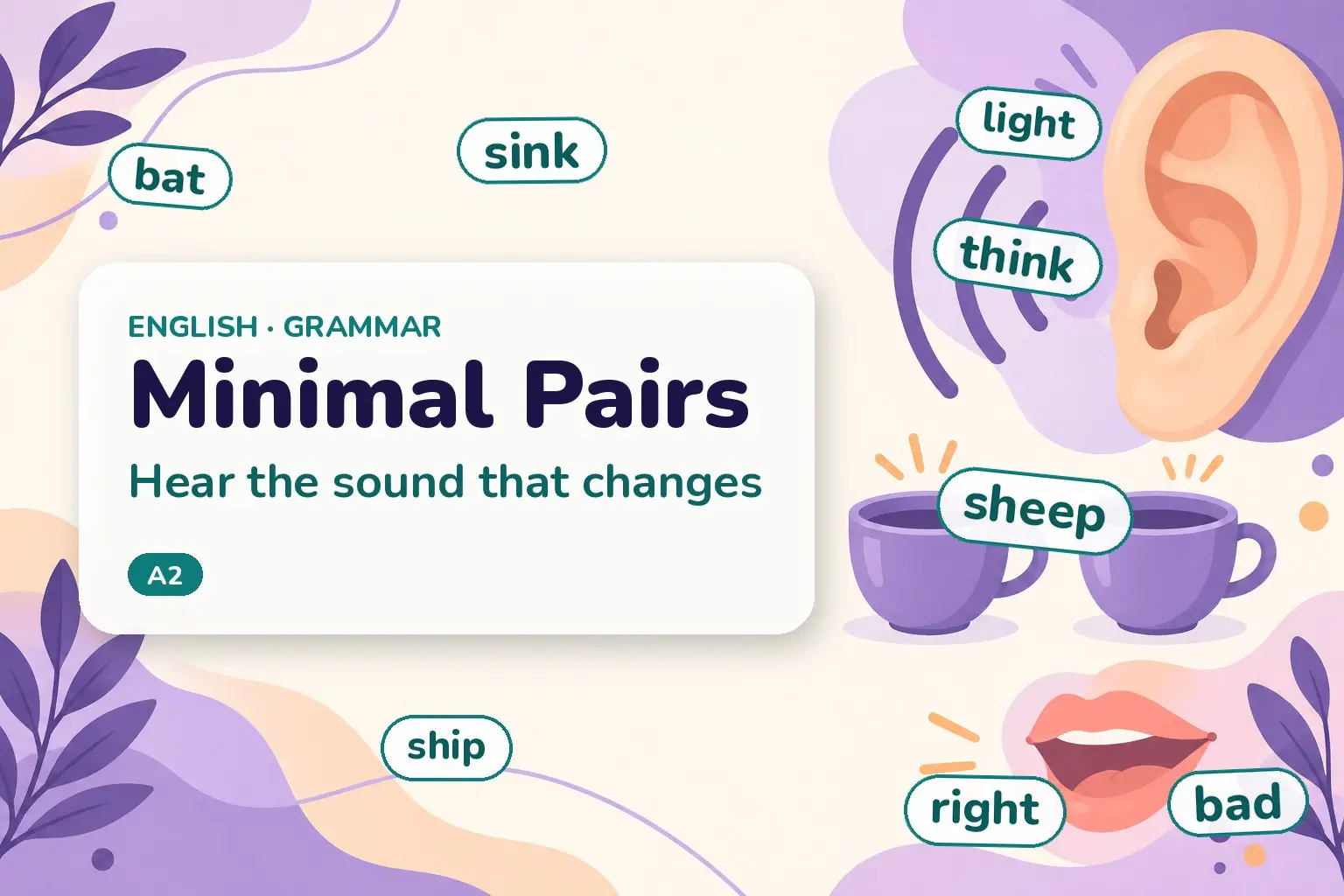
A minimal pair is two words that differ in only one sound, like ship and sheep or bat and bad. Practising them trains your ear and mouth to hear and make contrasts your first language may merge. Play each pair, copy the mouth shape, then test yourself.
On this page12 sections · tap to jump
Level: A2. A minimal pair is two words that differ in only one sound — ship and sheep, bat and bad. If your first language does not use one of those sounds, the two words can sound identical to you. Minimal-pair practice fixes that: you train your ear to hear the gap and your mouth to make it.
By the end of this page you can…
…hear the most common English sound contrasts, make them with the right mouth shape, and test your listening with the audio on this page.
How to use this page
Each pair below has an audio button. Play it, listen for the one sound that changes, then say both words aloud yourself. The audio is your device’s built-in voice, not a recording of a specific person, so treat it as a model of the contrast rather than one perfect accent.
Long vs short vowels: /iː/ and /ɪ/
This is the pair most learners merge. /iː/ (sheep) is long, tense, with the lips spread in a smile. /ɪ/ (ship) is short and relaxed, the tongue a little lower. It is about tongue position and length, not the letters.
| /iː/ long | /ɪ/ short |
|---|---|
| sheep | ship |
| seat | sit |
| feel | fill |
| leave | live |
| heat | hit |
Vowels: /æ/ and /e/
/æ/ (cat) is a wide, open mouth; /e/ (bed) is higher and tighter.
| /æ/ as in cat | /e/ as in bed |
|---|---|
| bad | bed |
| bat | bet |
| man | men |
| sat | set |
| had | head |
Final consonants: voiceless vs voiced
The last sound changes, and so does the length of the vowel before it. A voiced ending (/d/, /z/, /g/) stretches the vowel; a voiceless ending (/t/, /s/, /k/) keeps it short.
| voiceless end | voiced end |
|---|---|
| bat | bad |
| cap | cab |
| back | bag |
| rice | rise |
| seat | seed |
Consonants: /l/ and /r/
/l/ touches the tongue tip behind the top teeth; /r/ curls the tongue back and touches nothing.
| /l/ | /r/ |
|---|---|
| light | right |
| lead | read |
| glass | grass |
| collect | correct |
| play | pray |
Tricky consonants: /θ/, /v/ and /ʃ/
| contrast | example pair | tip |
|---|---|---|
| /θ/ vs /t/ | think / tink | tongue between the teeth for ‘th’ |
| /θ/ vs /s/ | thing / sing | ‘th’ tongue shows; ‘s’ tongue hides |
| /v/ vs /w/ | vine / wine | ‘v’ top teeth on bottom lip; ‘w’ round lips |
| /v/ vs /b/ | vote / boat | ‘v’ is a long buzz; ‘b’ is a quick pop |
| /ʃ/ vs /tʃ/ | ship / chip | ‘sh’ flows; ‘ch’ starts with a ‘t’ stop |
Example pairs with audio
Play each line. You will hear the two words one after the other — listen for the single sound that changes, then repeat both.
- ship — sheepShort /ɪ/ vs long /iː/: a boat vs the animal.Spread your lips wide for sheep.
- sit — seatShort /ɪ/ vs long /iː/: to rest vs a chair.
- fill — feelShort /ɪ/ vs long /iː/: pour in vs sense.
- live — leaveShort /ɪ/ vs long /iː/: to reside vs to go.
- bad — bedVowel /æ/ vs /e/: not good vs for sleeping.
- man — menVowel /æ/ vs /e/: one vs many.
- sat — setVowel /æ/ vs /e/: took a seat vs put down.
- bat — badFinal /t/ vs /d/: the vowel is longer before 'd'.
- cap — cabFinal /p/ vs /b/: a hat vs a taxi.
- back — bagFinal /k/ vs /g/: behind vs a sack.
- rice — riseFinal /s/ vs /z/: the food vs to go up.
- light — rightConsonant /l/ vs /r/: lamp vs correct.
- lead — readConsonant /l/ vs /r/: to guide vs to look at words.
- glass — grassConsonant /l/ vs /r/: a cup vs the green plant.
- think — sinkConsonant /θ/ vs /s/: use your mind vs a basin.
- thing — singConsonant /θ/ vs /s/: an object vs make music.
- vine — wineConsonant /v/ vs /w/: a plant vs the drink.
- vote — boatConsonant /v/ vs /b/: to choose vs a small ship.
- ship — chipConsonant /ʃ/ vs /tʃ/: a boat vs a fry.
- share — chairConsonant /ʃ/ vs /tʃ/: to give part vs a seat.
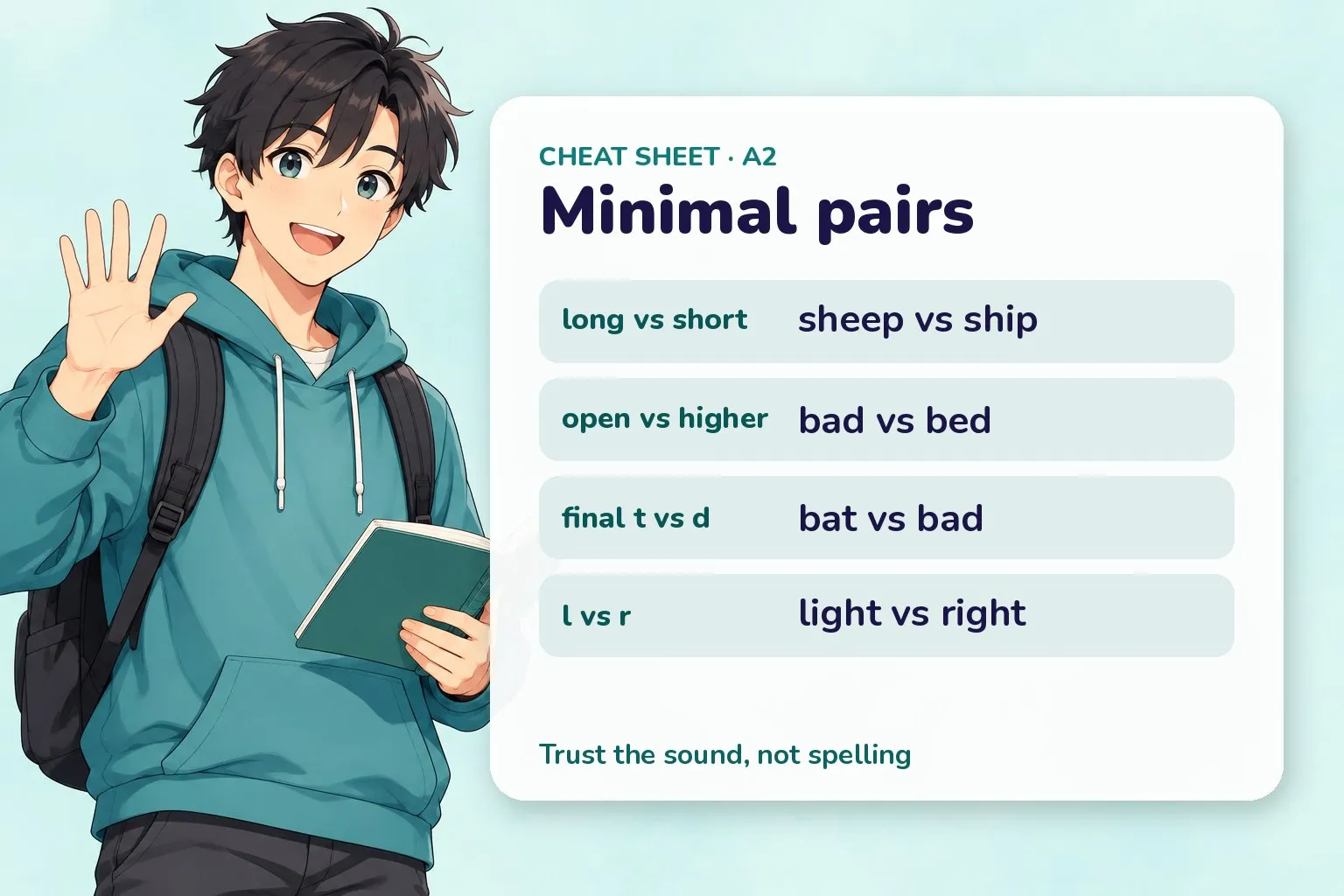
Quick recap before you practise.
Common mistakes
- Guessing from spelling. Live (short /ɪ/) and leave (long /iː/) look similar but sound very different. Trust the sound, not the letters.
- Final sound dropped. Saying bad as bat changes the meaning. Keep the vowel a touch longer and let the final sound buzz.
- /l/ and /r/ swapped. I will collect you vs I will correct you — the tongue tip touches for /l/ and curls back for /r/.
- ‘th’ turned into ‘t’ or ‘s’. Think is not tink or sink. Let your tongue tip show between your teeth.
Practice
Minimal pairs practice
Try each one, then press Check. No sign-up, nothing is sent anywhere — it all runs in your browser.
1 Match each pair to the type of change.
- ship / sheep
- bat / bad
- light / right
- think / sink
Show answer
- ship / sheep → vowel length
- bat / bad → final consonant
- light / right → l vs r
- think / sink → th vs s
Spotting which part changes helps you aim your listening.
Hint: two words: r-word then l-word
Show answer
right light — 'Right' uses /r/ (tongue curled back); 'light' uses /l/ (tongue tip up).
6 Order these from the practice steps.
Show answer
listen to the pair say both words aloud guess which one you hear — Listen first, copy the sounds, then test your ear.
Quiz
Minimal pairs quiz
11 questions · pick an answer and you'll see straight away if it's right.
-
Show answer
two words that differ in only one sound — A minimal pair changes exactly one sound, like ship and sheep.
-
Show answer
ship — 'Ship' has the short, relaxed /ɪ/; the others have the long /iː/.
-
Show answer
the final sound is voiced (/d/) and the vowel is longer — The final /d/ is voiced and lengthens the vowel before it.
-
Show answer
light / right — 'Light' uses /l/ and 'right' uses /r/; only that consonant changes.
-
Show answer
put your tongue tip between your teeth — /θ/ is made with the tongue tip showing between the teeth.
-
Show answer
back — 'Back' ends in voiceless /k/; bag, cab and rise end in voiced sounds.
-
Show answer
the first consonant (/v/ vs /w/) — /v/ uses the top teeth on the bottom lip; /w/ rounds the lips.
-
Show answer
hear the pair, say both aloud, then guess which you heard — Listening, copying out loud, and testing your ear is what trains the contrast.
-
Show answer
their first language may not use both /ɪ/ and /iː/ — If a language merges the two vowels, the ear must be trained to hear the gap.
-
Show answer
/ʃ/ (sh) and /tʃ/ (ch) — 'sh' flows smoothly; 'ch' begins with a short 't' stop.
-
Show answer
the final sound is /s/ (voiceless) vs /z/ (voiced) — 'Rice' ends in voiceless /s/; 'rise' ends in voiced /z/.
Recap cheat-sheet
| Contrast | Example pair | Listen for |
|---|---|---|
| /iː/ vs /ɪ/ | sheep / ship | long smile vs short relax |
| /æ/ vs /e/ | bad / bed | open mouth vs higher mouth |
| final /t/ vs /d/ | bat / bad | short vs longer vowel + buzz |
| /l/ vs /r/ | light / right | tongue tip up vs curled back |
| /θ/ vs /s/ | think / sink | tongue shows vs hidden |
Next
- Learn every vowel symbol: English Vowel Sounds (IPA)
- And the consonants: English Consonant Sounds
- Train rhythm and flow next: Shadowing to Improve English Speaking
- Previous set: Linking Words for Essays
- Next set: English Small-Talk & Politeness Culture
- New here? Start with Start Learning English Here
All English practice topics
Vocabulary, pronunciation, phrases, practice and exam help, ordered by level. Pick a topic and go straight to it. New lessons go live every day, so topics marked Coming soon fill in over the next weeks.
Practice
A1 1 topics · 1 ready
A2 3 topics · 3 ready
- 02 How to Practise English Listening
- 03 English Reading Practice: Elementary
- 04 English Minimal Pairs Practice You are here