Linking Words for Essays
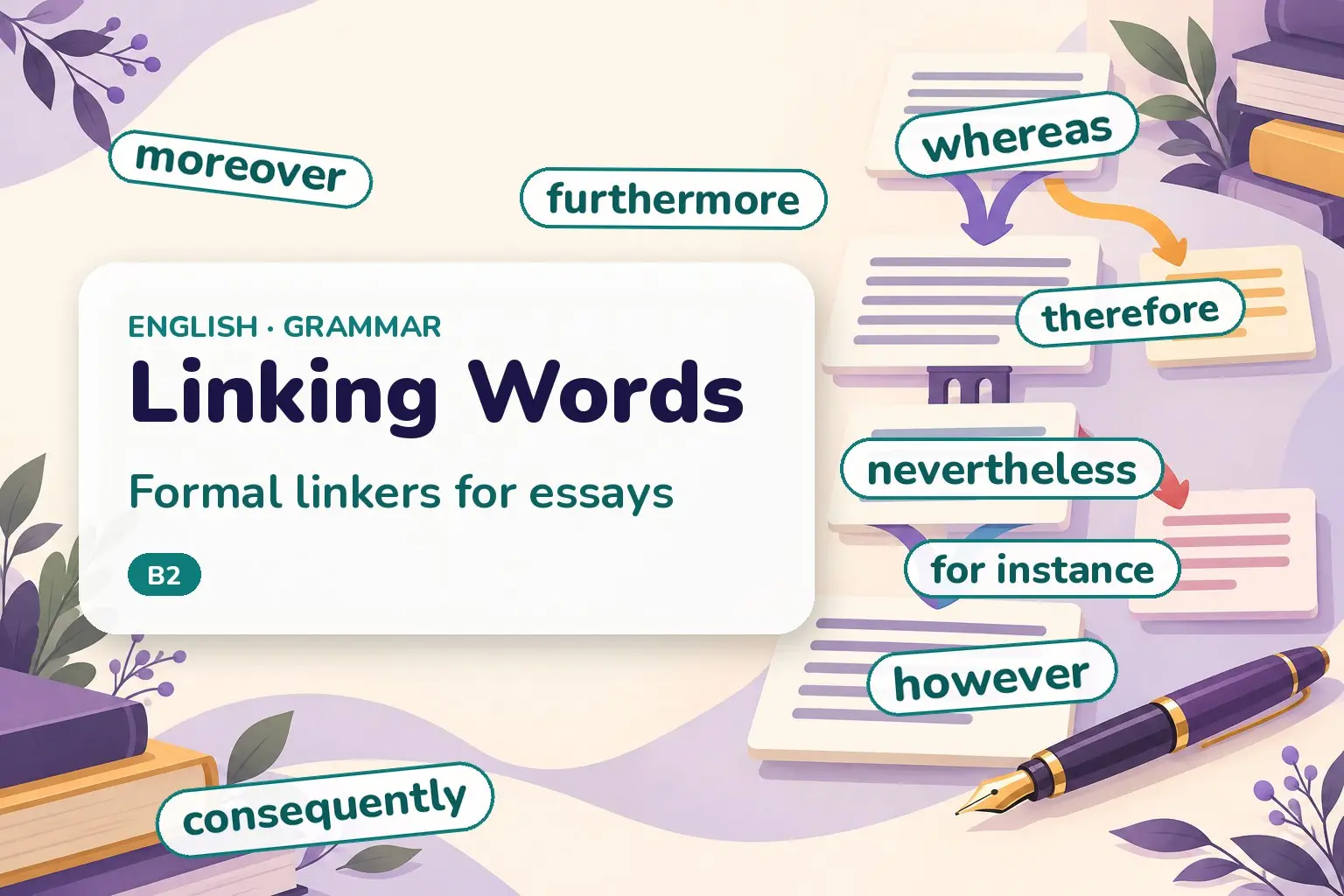
Linking words signal how your ideas connect, so a reader follows your argument. In essays use formal linkers: 'moreover' and 'furthermore' to add, 'however' and 'nevertheless' to contrast, 'therefore' and 'consequently' for result, and 'for instance' to give an example. Punctuate them correctly and do not overuse them.
On this page13 sections · tap to jump
Level: B2. In an essay the examiner follows your argument through your linking words. They tell the reader whether you are adding a point, turning against it, drawing a conclusion, or giving an example. This page groups the formal linkers an essay needs, shows how to punctuate them, and warns you off the mistakes that cost marks.
By the end of this page you can…
…choose the right formal linker for each job, punctuate linking adverbs like ‘however’ and ‘therefore’ correctly, and avoid the over-signposting that makes writing feel mechanical.
Spoken English vs essay English
Everyday speech links ideas with short words: and, but, so, because. They are not wrong in writing, but an academic essay usually reaches for a more formal word in the same slot. The meaning barely changes; the register does.
A linking adverb (however, therefore, moreover, consequently) comments on the whole sentence before it. It is not a conjunction, so it cannot join two clauses with only a comma. Start a new sentence, or use a semicolon, then put a comma after the adverb.
How this list was chosen
The everyday linkers here (and, but, so, because, however) are high-frequency words in the English list from hermitdave/FrequencyWords, which ranks words by how often they appear in a large collection of subtitles. The more formal essay linkers (moreover, consequently, nevertheless) are far rarer in speech but standard in academic writing, so this page pairs each spoken word with its formal essay partner rather than ranking them against each other.
Adding a point
| Spoken | Essay (formal) | Meaning | Example |
|---|---|---|---|
| also | moreover | adds a stronger, related point | The plan is cheap. Moreover, it is quick to run. |
| also | furthermore | adds a further point | Costs fell. Furthermore, quality improved. |
| and | in addition | as well as this | In addition, the survey covered rural areas. |
| what is more | additionally | on top of that | Additionally, the data was checked twice. |
Showing a contrast
| Spoken | Essay (formal) | Meaning | Example |
|---|---|---|---|
| but | however | by contrast (new sentence) | The theory is elegant. However, it is hard to test. |
| but still | nevertheless | in spite of that | The risk was clear. Nevertheless, the trial went ahead. |
| though | nonetheless | despite this | The budget was tight; nonetheless, the project finished. |
| on the other hand | in contrast | sets two facts against each other | Sales rose in cities. In contrast, they fell in towns. |
| but | whereas | while, by comparison (joins clauses) | Older users preferred calls, whereas younger users texted. |
Showing cause and result
| Spoken | Essay (formal) | Meaning | Example |
|---|---|---|---|
| so | therefore | for that reason | The sample was small. Therefore, the result is cautious. |
| so | consequently | as a direct result | Demand grew. Consequently, prices rose. |
| so | as a result | because of this | Funding was cut. As a result, two studies stopped. |
| because | since | for the reason that (joins clauses) | Since the data was limited, we repeated the test. |
| because of | owing to / due to | caused by (+ noun) | The delay was due to a lack of funding. |
Giving an example or detail
| Spoken | Essay (formal) | Meaning | Example |
|---|---|---|---|
| like / say | for instance | here is one case | Many sports suit beginners; tennis, for instance, is easy to start. |
| for example | for example | here is a case | For example, the 2020 study used 400 people. |
| that is | in other words | rephrasing more simply | The scheme is means-tested; in other words, income decides eligibility. |
| basically | namely | that is to say, specifically | Two groups were excluded, namely children and non-natives. |
Ordering an argument
| Spoken | Essay (formal) | Meaning | Example |
|---|---|---|---|
| first | firstly | the first point | Firstly, the method must be clear. |
| next | secondly / moreover | the next point | Secondly, the sample should be large. |
| in the end | finally / in conclusion | the last point / summary | In conclusion, the evidence supports the claim. |
| all in all | overall / on balance | weighing everything | On balance, the benefits outweigh the costs. |
Example sentences
Play each line, then say it aloud. Notice the punctuation around every linker.
- The method is simple. Moreover, it is cheap to repeat.'Moreover' adds a stronger related point; new sentence, comma after.
- The sample was small. Furthermore, it was not random.'Furthermore' stacks a second point onto the first.
- In addition, the study ran for two years, not one.'In addition' opens a sentence that adds information.
- The theory is elegant. However, it is difficult to test.'However' = but, formal, with a full stop before it.
- The risk was known; nevertheless, the trial went ahead.'Nevertheless' = in spite of that, after a semicolon.
- Older users preferred calls, whereas younger users texted.'Whereas' joins two contrasting clauses with a comma.
- Sales rose in the cities. In contrast, they fell in the towns.'In contrast' sets two facts against each other.
- The sample was small. Therefore, the result is cautious.'Therefore' = for that reason; draws a conclusion.
- Demand grew sharply. Consequently, prices rose.'Consequently' marks a direct result.
- Funding was cut, so as a result two studies stopped.'As a result' = because of this.
- Since the data was limited, we repeated the experiment.'Since' gives the reason and joins the clauses.
- The delay was due to a lack of funding.'Due to' is followed by a noun, not a clause.
- Many sports suit beginners; tennis, for instance, is easy to start.'For instance' introduces one example.
- The scheme is means-tested; in other words, income decides who qualifies.'In other words' rephrases the idea more simply.
- Two groups were excluded, namely children and non-native speakers.'Namely' names the specific items.
- Firstly, the method must be clearly described.'Firstly' opens the first point of an argument.
- On balance, the benefits outweigh the costs.'On balance' weighs everything before a judgement.
- In conclusion, the evidence supports the original claim.'In conclusion' signals the closing summary.
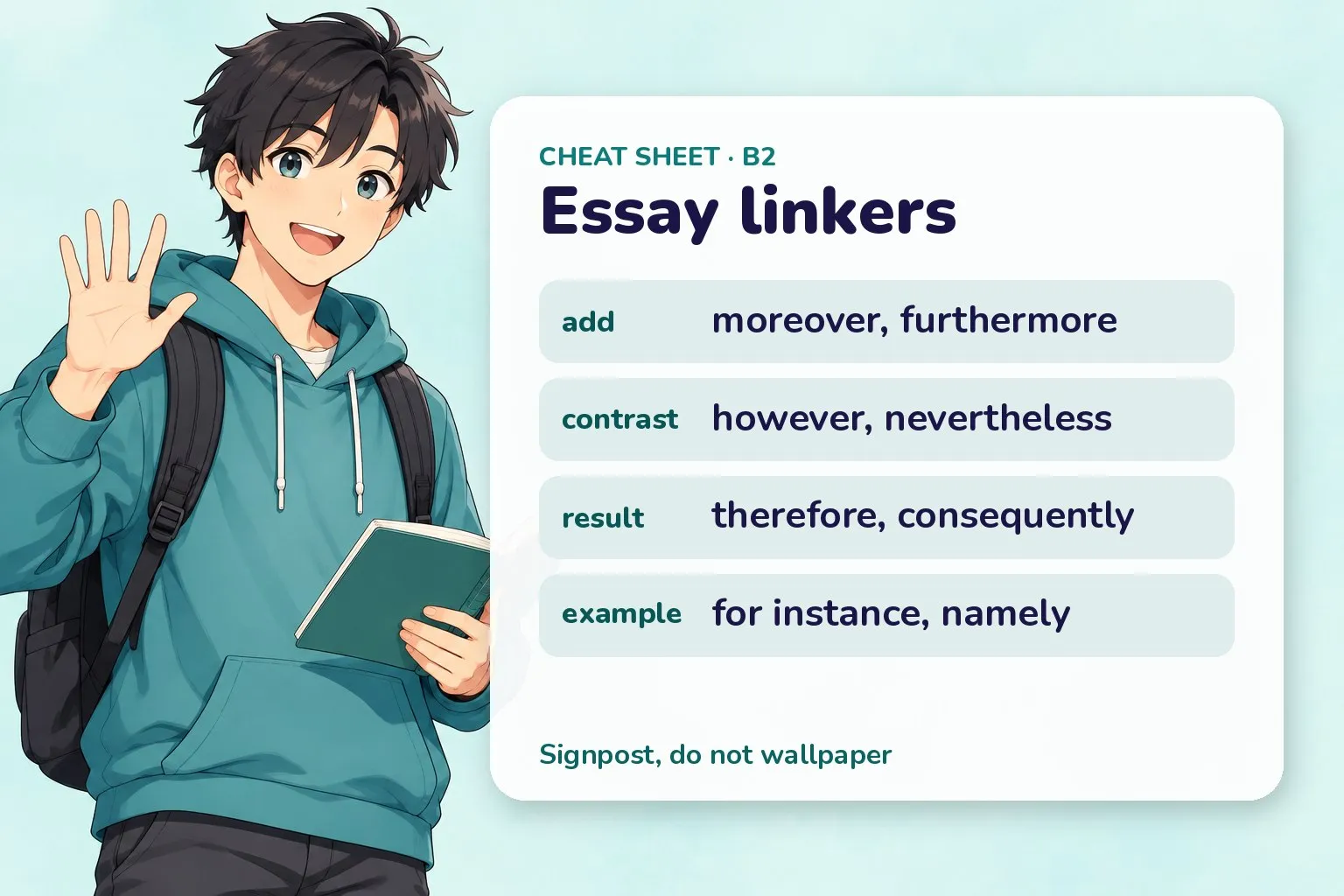
Quick recap before you practise.
Usage notes
- however (adverb) vs but (conjunction): but joins inside one sentence (it is cheap but slow); however comments after a full stop or semicolon (It is cheap. However, it is slow.). They are not swappable in punctuation.
- due to vs because of: both take a noun (due to the rain). Careful writers avoid due to after an action; prefer because of or owing to there. Never write due to + a full clause.
- firstly / first: both are correct; stay consistent — do not mix firstly then second then thirdly.
- for example vs e.g.: write the words in formal essays; keep e.g. and i.e. for notes and brackets.
- overuse: examiners reward range and control. A paragraph can work with no linker at all if the ideas flow; add one only where the logic turns.
Practice
Essay linkers practice
Try each one, then press Check. No sign-up, nothing is sent anywhere — it all runs in your browser.
1 Match each essay linker to its job.
- moreover
- however
- therefore
- for instance
Show answer
- moreover → add a point
- however → contrast
- therefore → result
- for instance → give an example
Knowing the job of each linker lets you pick the right one for your argument.
Hint: formal word for 'so'
Show answer
Therefore — 'Therefore' draws a conclusion from the point before it.
Hint: takes a noun, not a clause
Show answer
due to — 'Due to' (or 'owing to') is followed by a noun phrase, not a full clause.
6 Put the words in order to add a point formally.
Show answer
Moreover it is cheap to repeat — 'Moreover' opens the sentence, then the clause follows normally.
Quiz
Essay linkers quiz
12 questions · pick an answer and you'll see straight away if it's right.
-
Show answer
furthermore — 'Furthermore' stacks an extra point; the others contrast or give a reason.
-
Show answer
Therefore — 'Therefore' is the formal linker that draws a result or conclusion.
-
Show answer
It is cheap. However, it is slow. — Start a new sentence (or use a semicolon), then put a comma after 'however'.
-
Show answer
owing to — 'Owing to' (like 'due to') is followed by a noun: a lack of money.
-
Show answer
for instance — 'For instance' introduces one example of a general point.
-
Show answer
whereas — 'Whereas' sets two facts against each other within one sentence.
-
Show answer
in other words — 'In other words' restates the point more simply in formal writing.
-
Show answer
in spite of that — 'Nevertheless' = despite that; it introduces a surprising contrast.
-
Show answer
Although it rained, the match continued. — Never pair 'although' with 'but'; one contrast word is enough.
-
Show answer
In conclusion — 'In conclusion' signals the closing summary of an essay.
-
Show answer
a result — 'Consequently' marks a direct result of the previous idea.
-
Show answer
It is over-signposting and feels mechanical — Too many addition linkers in a row makes writing mechanical; keep the one that carries weight.
Recap cheat-sheet
| Job | Formal essay linkers |
|---|---|
| add | moreover, furthermore, in addition |
| contrast | however, nevertheless, whereas |
| result | therefore, consequently, as a result |
| example | for instance, in other words, namely |
Next
- Build the base first: English Connectors & Linking Words
- Advanced contrast grammar: Advanced contrast linking
- Advanced result grammar: Advanced result linking
- Put it to work: Formal Writing & Emails
- Next set: English Minimal Pairs Practice
- New here? Start with Start Learning English Here
All English vocabulary topics
Vocabulary, pronunciation, phrases, practice and exam help, ordered by level. Pick a topic and go straight to it. New lessons go live every day, so topics marked Coming soon fill in over the next weeks.
Vocabulary
A1 13 topics · 13 ready
- 01 100 Most Common English Words
- 02 English Words 101-250 (Frequency)
- 03 100 Essential English Verbs
- 04 Common English Adjectives
- 05 English Question Words & Phrases
- 06 English Time Expressions
- 07 English Food & Cooking Vocabulary
- 08 English Animals Vocabulary
- 09 English Clothing Vocabulary
- 10 English Weather Vocabulary
- 11 English Family & Relationships Vocabulary
- 12 English Colours Vocabulary
- 13 English Numbers, Dates & Money
A2 14 topics · 14 ready
- 14 English Words 251-500 (Frequency)
- 15 English Words 501-1000 (Frequency)
- 16 Everyday English Adverbs
- 17 English Body & Health Vocabulary
- 18 English House & Furniture Vocabulary
- 19 English Kitchen & Tableware Vocabulary
- 20 English Transport & Travel Vocabulary
- 21 English Places in Town Vocabulary
- 22 English Jobs & Professions Vocabulary
- 23 English Money & Shopping Vocabulary
- 24 English Emotions & Feelings Vocabulary
- 25 English Sports & Exercise Vocabulary
- 26 English Verbs of Motion
- 27 English Irregular Verbs Reference
B1 11 topics · 11 ready
- 28 English Words 1001-1500 (Frequency)
- 29 English Words 1501-2000 (Frequency)
- 30 English Connectors & Linking Words
- 31 English Nature & Geography Vocabulary
- 32 English Technology & Internet Vocabulary
- 33 English Education & School Vocabulary
- 34 English Medical & Pharmacy Vocabulary
- 35 English Arts, Music & Film Vocabulary
- 36 100 Essential English Phrasal Verbs
- 37 Commonly Confused English Words
- 38 British vs American English
B2 6 topics · 6 ready
- 39 English Words 2001-3000 (Frequency)
- 40 English Business & Work Vocabulary
- 41 English Opinion & Attitude Vocabulary
- 42 English Admin & Paperwork Vocabulary
- 43 English Environment & Climate Vocabulary
- 44 Linking Words for Essays You are here