100 Essential English Phrasal Verbs
A phrasal verb is a verb plus a small word (get up, give up, find out) that often means something you can't guess. This page groups the 100 most common ones by particle — up, out, off, on — so related meanings stick together, each with a meaning and example.
On this page16 sections · tap to jump
- 01By the end of this page you can…
- 02How this list was chosen
- 03With “up”
- 04With “down”
- 05With “on”
- 06With “off”
- 07With “out”
- 08With “in” and “back”
- 09With “away”, “over”, “through” and more
- 10Three-part and other everyday verbs
- 11Example sentences
- 12Common mistakes
- 13Usage notes
- 14Practice
- 15Quiz
- 16Recap cheat-sheet
Level: B1. Phrasal verbs are everywhere in everyday English, and they are the part learners most often avoid. A phrasal verb is a verb plus a particle such as up, out or off, and together they often mean something new: give up means stop, find out means discover. This page gives you 100 common ones, grouped by particle so related meanings stay together, each with a plain definition and an example.
By the end of this page you can…
…recognise and use 100 common English phrasal verbs, group them by their particle, and see how the particle changes the meaning of the base verb.
How this list was chosen
Phrasal verbs are made of two or three words, so they do not appear as single units in a word-frequency list — a frequency list counts get, up and out separately, not get up. That means an honest ranked list is impossible here. Instead these are the common, everyday phrasal verbs that English courses teach around A2–B1 level (Cambridge, English Profile), chosen because learners meet them constantly in speech, and grouped by their particle rather than by an invented rank. The example sentences are written for this lesson and kept short.
With “up”
| Verb | Meaning | Example |
|---|---|---|
| get up | rise from bed | I get up at seven every day. |
| wake up | stop sleeping | Wake up, it’s already morning. |
| stand up | rise to your feet | The whole class stood up. |
| grow up | become an adult | She grew up in a small town. |
| give up | stop doing something | He gave up smoking last year. |
| pick up | lift; collect someone | I’ll pick you up at six. |
| set up | start or arrange | They set up a new company. |
| look up | search for information | Look the word up online. |
| make up | invent; become friends again | Don’t make up excuses. |
| bring up | mention; raise a child | He brought up a good point. |
| turn up | arrive; raise the volume | She turned up an hour late. |
| hurry up | be quicker | Hurry up or we’ll miss the bus. |
| cheer up | become happier | Cheer up, it will get better. |
| end up | finally be in a situation | We ended up walking home. |
| fill up | make or become full | Fill up the bottle, please. |
With “down”
| Verb | Meaning | Example |
|---|---|---|
| sit down | take a seat | Please sit down. |
| lie down | rest on a surface | I need to lie down for a bit. |
| calm down | become calm | Calm down and take a breath. |
| break down | stop working (a machine) | The car broke down on the way. |
| cut down on | reduce | You should cut down on sugar. |
| write down | put on paper | Write down the address. |
| turn down | refuse; lower the volume | He turned down the job offer. |
| slow down | go more slowly | Slow down, you’re driving too fast. |
With “on”
| Verb | Meaning | Example |
|---|---|---|
| put on | dress yourself in | Put on your coat, it’s cold. |
| turn on | start a device | Turn on the light, please. |
| get on | board a bus or train; have a good relationship | We get on well together. |
| go on | continue; happen | Go on, finish the story. |
| carry on | continue | Carry on with your work. |
| hold on | wait | Hold on a second. |
| try on | put on to test the fit | Try on these shoes. |
| count on | rely on | You can count on me. |
With “off”
| Verb | Meaning | Example |
|---|---|---|
| take off | remove; (a plane) leave the ground | Take off your wet shoes. |
| turn off | stop a device | Turn off the TV before bed. |
| get off | leave a bus or train | Get off at the next stop. |
| put off | postpone | They put off the meeting. |
| set off | start a journey | We set off early in the morning. |
| call off | cancel | They called off the trip. |
| show off | behave to impress people | He likes to show off. |
| go off | (food) spoil; (an alarm) ring | The milk has gone off. |
| drop off | take someone there; fall asleep | I’ll drop you off at school. |
With “out”
| Verb | Meaning | Example |
|---|---|---|
| go out | leave to socialise | We went out for dinner. |
| find out | discover | I found out the truth. |
| work out | exercise; solve | I work out at the gym; I can’t work it out. |
| come out | appear; be released | The new film comes out soon. |
| figure out | understand or solve | I can’t figure out this puzzle. |
| run out of | have no more of | We ran out of milk. |
| fill out | complete a form | Fill out this form, please. |
| check out | leave a hotel; look at | We check out at noon. |
| hand out | distribute | She handed out the papers. |
| sort out | organise or fix | I’ll sort out the problem. |
| carry out | perform a task | They carried out the plan. |
| eat out | eat at a restaurant | Let’s eat out tonight. |
| point out | draw attention to | He pointed out my mistake. |
With “in” and “back”
| Verb | Meaning | Example |
|---|---|---|
| fill in | complete a form (BrE) | Fill in the gaps. |
| check in | register at a hotel or airport | We check in at three. |
| give in | surrender; stop resisting | Don’t give in so easily. |
| hand in | submit | Hand in your homework. |
| drop in | visit without warning | Drop in any time. |
| take in | understand; absorb | It’s a lot to take in. |
| come back | return | Come back soon. |
| go back | return | I went back home. |
| give back | return something | Give back my pen. |
| pay back | repay | I’ll pay you back on Friday. |
| call back | return a phone call | I’ll call you back later. |
| cut back on | reduce | We need to cut back on spending. |
With “away”, “over”, “through” and more
| Verb | Meaning | Example |
|---|---|---|
| go away | leave | Go away, I’m busy. |
| throw away | put in the rubbish | Don’t throw away that letter. |
| give away | give for free | They gave away free samples. |
| put away | return to its place | Put away your toys. |
| take over | take control | She took over the company. |
| get over | recover from | He got over the flu quickly. |
| go over | review | Let’s go over the plan again. |
| think over | consider carefully | Think it over and decide. |
| go through | experience; examine | We went through hard times. |
| get through | finish; reach by phone | I can’t get through to her. |
| look around | explore a place | Let’s look around the museum. |
| turn around | face the other way | Turn around and look. |
| get around | move about; spread | News gets around fast. |
| look forward to | await with pleasure | I look forward to the holiday. |
| go ahead | proceed | Go ahead and start without me. |
Three-part and other everyday verbs
| Verb | Meaning | Example |
|---|---|---|
| look after | take care of | I look after my neighbour’s dog. |
| look for | search for | I’m looking for my keys. |
| look into | investigate | We’ll look into the problem. |
| put up with | tolerate | I can’t put up with the noise. |
| get on with | continue; have good relations | Get on with your work. |
| come up with | produce an idea | She came up with a clever plan. |
| get rid of | remove or dispose of | Get rid of the old boxes. |
| catch up with | reach the same level or news | Let’s catch up with each other soon. |
| keep up with | stay level with | I can’t keep up with the class. |
| run into | meet by chance | I ran into an old friend. |
| dress up | wear smart or fancy clothes | We dressed up for the wedding. |
| pick out | choose | Pick out a shirt you like. |
| bring back | return; cause to remember | That song brings back memories. |
| break up | end a relationship; separate | They broke up last month. |
| split up | separate | The group split up after the show. |
| move in | start living somewhere | We moved in last week. |
| move out | leave a home | He moved out of his flat. |
| switch on | turn on | Switch on the fan. |
| switch off | turn off | Switch off the lights, please. |
| wrap up | finish; dress warmly | Let’s wrap up the meeting. |
Example sentences
Play each line and say it aloud. These use common phrasal verbs in natural, everyday patterns.
- I get up at seven and wake up my children.'get up' = rise from bed; 'wake up' = make someone stop sleeping.
- She gave up coffee but can't give up tea.'give up' = stop doing or having something.
- Can you look up the train times for me?'look up' = search for information.
- I'll pick you up at the station at six.'pick up' = collect someone in a car.
- The car broke down on the motorway.'break down' = stop working (a machine).
- Please turn off the TV and sit down.'turn off' = stop a device; 'sit down' = take a seat.
- We set off early and ended up in the wrong town.'set off' = start a journey; 'end up' = finally be somewhere.
- I found out that the shop had closed down.'find out' = discover; 'close down' pattern = stop operating.
- We ran out of milk, so I went out to buy some.'run out of' = have no more; 'go out' = leave the house.
- Could you fill in this form and hand it in at the desk?'fill in' = complete a form; 'hand in' = submit.
- He took off his coat and put on his slippers.'take off' = remove; 'put on' = dress yourself in.
- They called off the match because of the rain.'call off' = cancel.
- I'll pay you back as soon as I get paid.'pay back' = repay money.
- She looks after her grandmother every weekend.'look after' = take care of (inseparable).
- I can't put up with this noise any longer.'put up with' = tolerate (three-part, inseparable).
- We came up with a plan to sort out the mess.'come up with' = produce an idea; 'sort out' = fix.
- Don't throw away the receipt; we might need it.'throw away' = put in the rubbish.
- It took me a while to get over the flu.'get over' = recover from.
- I ran into an old friend while looking around the market.'run into' = meet by chance; 'look around' = explore.
- I'm really looking forward to the holiday.'look forward to' = await with pleasure (three-part).
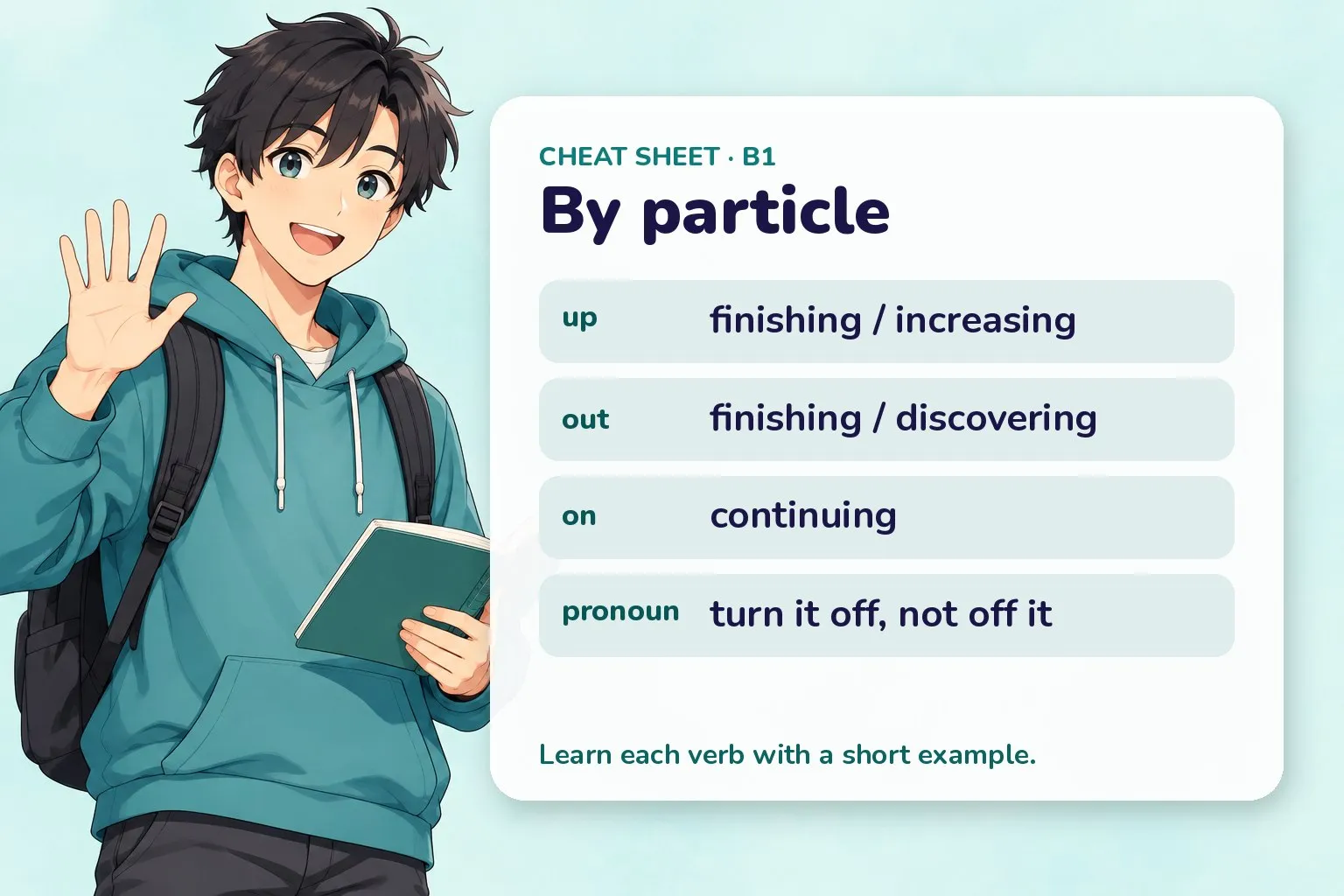
Quick recap before you practise.
Common mistakes
- ❌ I gave up to smoke. → ✅ I gave up smoking. — after give up use the -ing form, not to.
- ❌ Turn off it. → ✅ Turn it off. — with a pronoun object, the pronoun goes between the verb and the particle.
- ❌ I look forward to see you. → ✅ I look forward to seeing you. — to here is a preposition, so use -ing.
- ❌ Look her after. → ✅ Look after her. — look after is inseparable; nothing splits it.
- ❌ We ran out milk. → ✅ We ran out of milk. — run out needs of before the thing.
Usage notes
- Separable vs inseparable: many phrasal verbs let a noun object move (turn the light off / turn off the light), but a pronoun must sit in the middle (turn it off). Some verbs, like look after, never split.
- Three-part verbs (look forward to, put up with, get on with) are always inseparable; the object follows the whole group.
- Register: phrasal verbs are everyday and often informal. In formal writing you can often choose a one-word verb (find out → discover, put off → postpone).
- One verb, many meanings: make up can mean invent, reconcile, or apply cosmetics — the context tells you which.
- For the grammar of where the object goes, use the two lessons linked at the bottom.
Practice
Phrasal verbs practice
Try each one, then press Check. No sign-up, nothing is sent anywhere — it all runs in your browser.
1 Match each phrasal verb to its meaning.
- give up
- find out
- look after
- put off
Show answer
- give up → stop doing something
- find out → discover
- look after → take care of
- put off → postpone
Learning the meaning of the whole unit is the key to phrasal verbs.
Hint: the verb in 'tolerate'
Show answer
put — 'put up with' means tolerate; the missing word is 'put'.
Hint: run out needs this before the thing
Show answer
of — 'run out of' needs 'of' before the noun: ran out of milk.
6 Put the words in order.
Show answer
I look forward to seeing you — After 'look forward to' use the -ing form: looking forward to seeing you.
Quiz
Phrasal verbs quiz
12 questions · pick an answer and you'll see straight away if it's right.
-
Show answer
stop — 'give up' means to stop doing something.
-
Show answer
pick / up — 'pick up' = collect someone: I'll pick you up.
-
Show answer
Turn it off. — A pronoun object goes in the middle: turn it off.
-
Show answer
discover — 'find out' = discover a fact.
-
Show answer
-ing form — 'give up' takes the -ing form: give up smoking.
-
Show answer
inseparable — 'look after' is inseparable: look after her, never 'look her after'.
-
Show answer
called off — 'call off' = cancel: they called off the match.
-
Show answer
have no more of — 'run out of' = have no more of something: ran out of milk.
-
Show answer
forward — 'look forward to' means to await something with pleasure.
-
Show answer
postponed it — 'put off' = postpone to a later time.
-
Show answer
I look forward to seeing you. — 'to' here is a preposition, so use the -ing form: looking forward to seeing you.
-
Show answer
recover from it — 'get over' = recover from something.
Recap cheat-sheet
| Particle | Common sense it adds | Example |
|---|---|---|
| up | finishing / increasing | eat up, turn up, fill up |
| out | finishing a supply / discovering | run out, find out |
| on | continuing | carry on, go on |
| off | stopping / leaving | turn off, set off |
| back | returning | give back, pay back |
| Pronoun rule | object goes in the middle | turn it off (not turn off it) |
Next
- Previous set: English Complaint & Problem Phrases
- Grammar behind these: Phrasal Verbs: Separable and Inseparable · Phrasal Verbs (Advanced)
- More sets: English Vocabulary
- New here? Start with Start Learning English Here
All English vocabulary topics
Vocabulary, pronunciation, phrases, practice and exam help, ordered by level. Pick a topic and go straight to it. New lessons go live every day, so topics marked Coming soon fill in over the next weeks.
Vocabulary
A1 13 topics · 13 ready
- 01 100 Most Common English Words
- 02 English Words 101-250 (Frequency)
- 03 100 Essential English Verbs
- 04 Common English Adjectives
- 05 English Question Words & Phrases
- 06 English Time Expressions
- 07 English Food & Cooking Vocabulary
- 08 English Animals Vocabulary
- 09 English Clothing Vocabulary
- 10 English Weather Vocabulary
- 11 English Family & Relationships Vocabulary
- 12 English Colours Vocabulary
- 13 English Numbers, Dates & Money
A2 14 topics · 14 ready
- 14 English Words 251-500 (Frequency)
- 15 English Words 501-1000 (Frequency)
- 16 Everyday English Adverbs
- 17 English Body & Health Vocabulary
- 18 English House & Furniture Vocabulary
- 19 English Kitchen & Tableware Vocabulary
- 20 English Transport & Travel Vocabulary
- 21 English Places in Town Vocabulary
- 22 English Jobs & Professions Vocabulary
- 23 English Money & Shopping Vocabulary
- 24 English Emotions & Feelings Vocabulary
- 25 English Sports & Exercise Vocabulary
- 26 English Verbs of Motion
- 27 English Irregular Verbs Reference
B1 11 topics · 11 ready
- 28 English Words 1001-1500 (Frequency)
- 29 English Words 1501-2000 (Frequency)
- 30 English Connectors & Linking Words
- 31 English Nature & Geography Vocabulary
- 32 English Technology & Internet Vocabulary
- 33 English Education & School Vocabulary
- 34 English Medical & Pharmacy Vocabulary
- 35 English Arts, Music & Film Vocabulary
- 36 100 Essential English Phrasal Verbs You are here
- 37 Commonly Confused English Words
- 38 British vs American English