Academic Word List: Set 1
This is Set 1 of the Academic Word List (AWL): sublists 1 to 5, the most frequent of Averil Coxhead's 570 academic word families. These are the words that appear across essays and reports in every subject, such as analyse, significant, framework and sustain. Learn them first.
Level: C1. The Academic Word List (AWL) is a set of 570 word families that appear often in academic writing across all subjects but are not part of the most common everyday English. This page is Set 1: sublists 1 to 5 — the half of the list that occurs most frequently. Learn these before Set 2, because you will meet them in almost every essay, lecture and textbook.
By the end of this page you can…
…recognise and use the most frequent AWL words, read each one as a word family rather than a single form, and place it correctly in an academic sentence.
What the AWL is and how it is split
The AWL was compiled by Averil Coxhead at Victoria University of Wellington in 2000 from a large corpus of academic texts. It contains 570 word families arranged in 10 sublists, ordered by how often they appear: sublist 1 is the most frequent, sublist 10 the least. Nine sublists contain 60 families each; sublist 10 contains 30.
We split the list into two pages so each is a manageable study set. Set 1 (this page) is sublists 1 to 5 — the 300 most frequent families. Set 2 is sublists 6 to 10. The tables below group words by sublist, and each row shows the sublist number so you can see exactly where a word sits in the frequency order. We show a representative core of about a dozen headwords per sublist; the full list is on the Victoria University of Wellington site.
Sublist 1 — the most frequent academic words
| Sublist | Word | Meaning | Example |
|---|---|---|---|
| 1 | analyse | to examine something in detail | We analyse the results in Section 4. |
| 1 | approach | a way of dealing with a task or problem | The study takes a comparative approach. |
| 1 | assess | to judge the quality or value of | We assess each method against the data. |
| 1 | concept | an abstract or general idea | The concept of fairness is central here. |
| 1 | context | the wider situation around something | Read the finding in its full context. |
| 1 | data | facts and figures collected for study | The data were gathered over two years. |
| 1 | establish | to set up firmly; to show to be true | The trial established a clear link. |
| 1 | factor | one thing that affects a result | Cost is the main factor in the delay. |
| 1 | indicate | to point to; to be a sign of | The figures indicate a rising trend. |
| 1 | method | a planned way of doing something | The method is set out below. |
| 1 | significant | large or important enough to matter | The difference was statistically significant. |
| 1 | source | where information comes from | Each claim is tied to a source. |
Sublist 2
| Sublist | Word | Meaning | Example |
|---|---|---|---|
| 2 | achieve | to reach a goal through effort | The programme achieved its main aim. |
| 2 | affect | to have an influence on something | Weather can affect the final yield. |
| 2 | aspect | one part or feature of something | We focus on the social aspect here. |
| 2 | conclude | to decide after reasoning; to end | We conclude that the policy works. |
| 2 | consequent | following as a result | The delay and its consequent costs rose. |
| 2 | distinct | clearly different or separate | The two groups are distinct in age. |
| 2 | element | a basic part of a whole | Trust is a key element of the model. |
| 2 | evaluate | to judge the value or quality of | We evaluate three possible models. |
| 2 | impact | a strong effect on something | The reform had a clear impact on fees. |
| 2 | maintain | to keep in the same state; to assert | The author maintains that the data are weak. |
| 2 | range | the limits between which things vary | Scores ranged from low to very high. |
| 2 | relevant | directly connected to the matter | Only relevant data are included. |
Sublist 3
| Sublist | Word | Meaning | Example |
|---|---|---|---|
| 3 | alternative | another choice or possibility | We consider an alternative explanation. |
| 3 | circumstance | a condition that affects a situation | The result holds under these circumstances. |
| 3 | contribute | to give a part toward a result | Several factors contribute to the problem. |
| 3 | demonstrate | to show clearly with evidence | The trial demonstrates a real benefit. |
| 3 | emphasis | special importance given to something | The report places emphasis on safety. |
| 3 | ensure | to make certain something happens | We ensure the sample is representative. |
| 3 | framework | a basic structure of ideas or rules | We use a simple theoretical framework. |
| 3 | illustrate | to make clear with an example | Figure 2 illustrates the pattern. |
| 3 | imply | to suggest without stating directly | This implies a deeper structural problem. |
| 3 | justify | to show something is reasonable | The cost is hard to justify on these figures. |
| 3 | outcome | a result or consequence | The main outcome was a fall in demand. |
| 3 | sufficient | enough for a purpose | The evidence is not sufficient to decide. |
Sublist 4
| Sublist | Word | Meaning | Example |
|---|---|---|---|
| 4 | access | the right or means to reach or use | Students have access to the archive. |
| 4 | adequate | enough; good enough | The funding was adequate but not generous. |
| 4 | apparent | clearly seen; seeming | The cause was not apparent at first. |
| 4 | contrast | a clear difference between things | In contrast, the control group improved. |
| 4 | emerge | to come out or become known | A clear pattern emerged from the data. |
| 4 | hypothesis | a proposed explanation to be tested | Our hypothesis was not supported. |
| 4 | implement | to put a plan into action | The council implemented the new rule. |
| 4 | integrate | to combine parts into a whole | We integrate both data sets in Section 5. |
| 4 | investigate | to examine carefully for facts | We investigate why the effect fades. |
| 4 | predict | to say what will happen in advance | The model predicts a slow decline. |
| 4 | resolve | to settle or find a solution | The study does not resolve the debate. |
| 4 | subsequent | coming after in time or order | Subsequent trials confirmed the result. |
Sublist 5
| Sublist | Word | Meaning | Example |
|---|---|---|---|
| 5 | adjust | to change slightly to fit a purpose | We adjust the figures for inflation. |
| 5 | aware | knowing or noticing something | Readers should be aware of this limit. |
| 5 | capacity | the amount something can hold or do | The system is at full capacity. |
| 5 | conflict | a serious disagreement or clash | The two findings are in conflict. |
| 5 | decline | to decrease; to refuse politely | Membership declined over the decade. |
| 5 | enable | to make something possible | The grant enabled a larger survey. |
| 5 | expand | to make or become larger | The study expands on earlier work. |
| 5 | external | on the outside; from outside | External factors shaped the outcome. |
| 5 | generate | to produce or create | The model generates testable claims. |
| 5 | modify | to change something partly | We modify the standard equation slightly. |
| 5 | perspective | a particular way of viewing things | The paper offers a fresh perspective. |
| 5 | sustain | to keep going over time; to support | The growth was hard to sustain. |
Example sentences
Play each line, then say it aloud. These show Set 1 words in essay-style patterns.
- We analyse the survey results in the next section.analyse (sublist 1): examine in detail.
- The study takes a comparative approach.approach (sublist 1): a way of doing the work.
- Each claim is tied to a reliable source.source (sublist 1): where information comes from.
- The difference was statistically significant.significant (sublist 1): large enough to matter.
- Cost is the main factor behind the delay.factor (sublist 1): one thing that affects a result.
- Weather can affect the final yield.affect (sublist 2): to influence (verb).
- We evaluate three possible models in turn.evaluate (sublist 2): judge the value of.
- Only relevant data are included in the table.relevant (sublist 2): connected to the topic.
- We conclude that the policy works.conclude (sublist 2): decide after reasoning.
- We use a simple theoretical framework.framework (sublist 3): a structure of ideas.
- Figure 2 illustrates the pattern clearly.illustrate (sublist 3): make clear with an example.
- This implies a deeper structural problem.imply (sublist 3): suggest without stating.
- The evidence is not sufficient to decide.sufficient (sublist 3): enough for the purpose.
- A clear pattern emerged from the data.emerge (sublist 4): become known.
- Our hypothesis was not supported by the trial.hypothesis (sublist 4): a testable explanation.
- The council implemented the new rule in May.implement (sublist 4): put a plan into action.
- Subsequent trials confirmed the result.subsequent (sublist 4): coming after.
- The grant enabled a far larger survey.enable (sublist 5): make possible.
- External factors shaped the outcome.external (sublist 5): from outside.
- The rapid growth was hard to sustain.sustain (sublist 5): keep going over time.
Recap cheat-sheet
A few patterns to remember before the quiz.
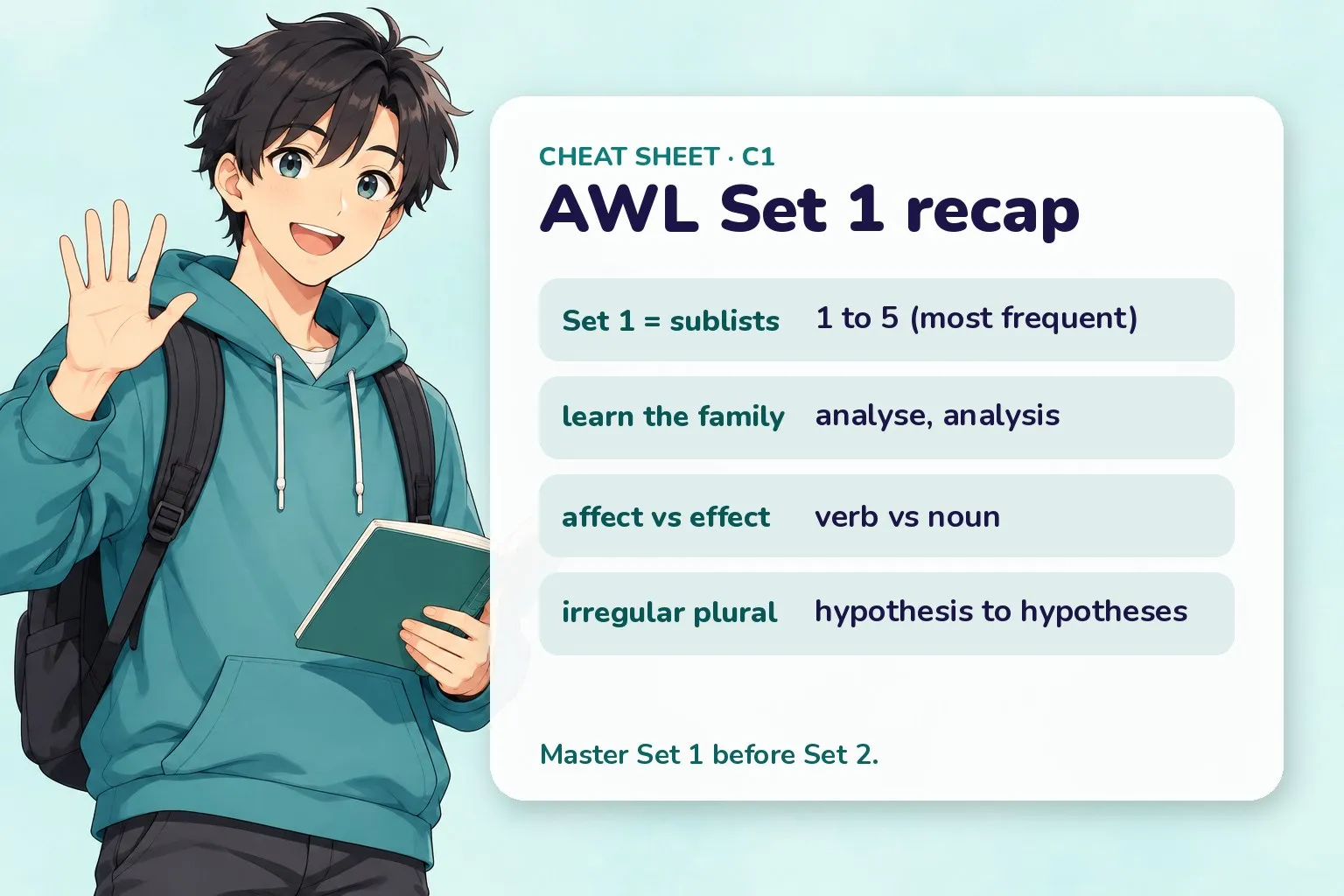
Quick recap before the quiz.
| Point | Example |
|---|---|
| Set 1 = sublists | 1 to 5 (most frequent) |
| learn the family | analyse, analysis, analytical |
| affect vs effect | affect = verb, effect = noun |
| irregular plural | hypothesis to hypotheses |
Practice
AWL Set 1 practice
Try each one, then press Check. No sign-up, nothing is sent anywhere — it all runs in your browser.
1 Match each word with its meaning.
- analyse
- factor
- framework
- sustain
Show answer
- analyse → examine in detail
- factor → one thing that affects a result
- framework → a structure of ideas
- sustain → keep going over time
These headwords come from sublists 1, 1, 3 and 5.
Hint: to influence (verb)
Show answer
affect — Affect is the verb; effect is usually the noun.
Hint: enough for the purpose
Show answer
sufficient — Sufficient (sublist 3) means enough.
6 Put the words in order.
Show answer
a clear pattern emerged from the data — A clear pattern emerged from the data: emerge = become known.
Quiz
AWL Set 1 quiz
12 questions · pick an answer and you'll see straight away if it's right.
-
Show answer
1 to 5 — Set 1 is sublists 1 to 5, the most frequent half.
-
Show answer
analyse — Analyse (sublist 1) means to examine in detail.
-
Show answer
affects — Affect is the verb; the subject is singular so affects.
-
Show answer
significant — Significant (sublist 1) means important enough to matter.
-
Show answer
framework — Framework (sublist 3) is a structure of ideas.
-
Show answer
subsequent — Subsequent (sublist 4) means coming after.
-
Show answer
implement — Implement (sublist 4) means to carry out a plan.
-
Show answer
enable — Enable (sublist 5) means to make possible.
-
Show answer
are — Formal writing treats data as plural: the data are clear.
-
Show answer
imply — Imply (sublist 3) is to suggest indirectly.
-
Show answer
most often — Sublist 1 holds the most frequent AWL words.
-
Show answer
sustain — Sustain (sublist 5) means to keep going or support.
Next
- Continue with Academic Word List: Set 2 (sublists 6 to 10)
- See these words in essay patterns: English Academic Vocabulary
- Practice formal word partners: Common English Collocations
- New here? Start with Start Learning English Here
All English vocabulary topics
Vocabulary, pronunciation, phrases, practice and exam help, ordered by level. Pick a topic and go straight to it. New lessons go live every day, so topics marked Coming soon fill in over the next weeks.
Vocabulary
A1 13 topics · 13 ready
- 01 100 Most Common English Words
- 02 English Words 101-250 (Frequency)
- 03 100 Essential English Verbs
- 04 Common English Adjectives
- 05 English Question Words & Phrases
- 06 English Time Expressions
- 07 English Food & Cooking Vocabulary
- 08 English Animals Vocabulary
- 09 English Clothing Vocabulary
- 10 English Weather Vocabulary
- 11 English Family & Relationships Vocabulary
- 12 English Colours Vocabulary
- 13 English Numbers, Dates & Money
A2 14 topics · 14 ready
- 14 English Words 251-500 (Frequency)
- 15 English Words 501-1000 (Frequency)
- 16 Everyday English Adverbs
- 17 English Body & Health Vocabulary
- 18 English House & Furniture Vocabulary
- 19 English Kitchen & Tableware Vocabulary
- 20 English Transport & Travel Vocabulary
- 21 English Places in Town Vocabulary
- 22 English Jobs & Professions Vocabulary
- 23 English Money & Shopping Vocabulary
- 24 English Emotions & Feelings Vocabulary
- 25 English Sports & Exercise Vocabulary
- 26 English Verbs of Motion
- 27 English Irregular Verbs Reference
B1 11 topics · 11 ready
- 28 English Words 1001-1500 (Frequency)
- 29 English Words 1501-2000 (Frequency)
- 30 English Connectors & Linking Words
- 31 English Nature & Geography Vocabulary
- 32 English Technology & Internet Vocabulary
- 33 English Education & School Vocabulary
- 34 English Medical & Pharmacy Vocabulary
- 35 English Arts, Music & Film Vocabulary
- 36 100 Essential English Phrasal Verbs
- 37 Commonly Confused English Words
- 38 British vs American English
B2 6 topics · 6 ready
C1 3 topics · 3 ready
- 45 English Academic Vocabulary
- 46 Academic Word List: Set 1 You are here
- 47 Academic Word List: Set 2