100 Essential English Verbs
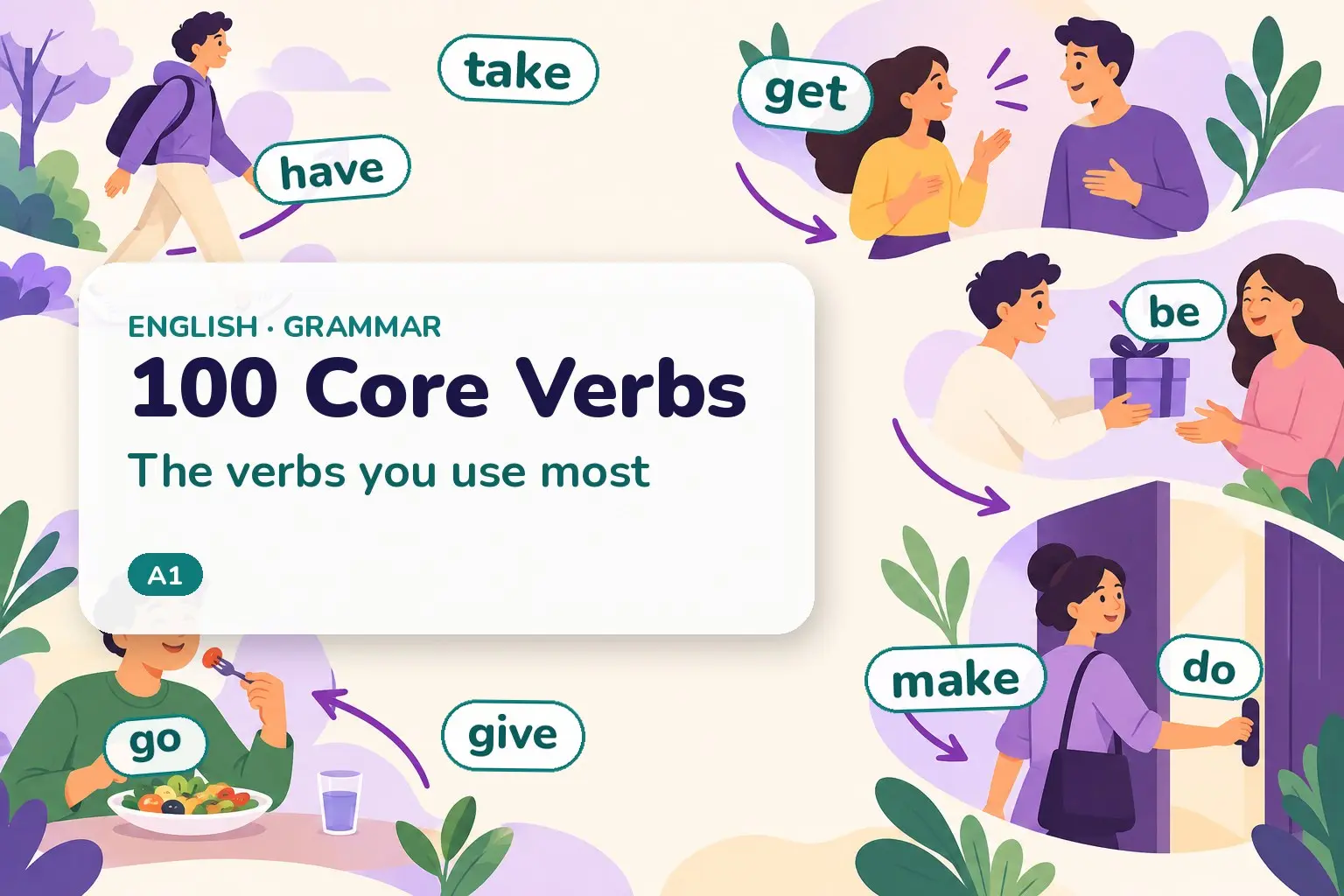
These are the English verbs you will use most. Learn the top three first: 'be', 'have' and 'do'. After those, master verbs of movement (go, come, get), saying (say, tell, ask) and daily actions (make, take, give). A few dozen verbs cover most of everyday speech.
On this page15 sections · tap to jump
- 01By the end of this page you can…
- 02How this list was chosen
- 03Being, having and doing
- 04Thinking, knowing and deciding
- 05Wanting and feeling
- 06Saying and communicating
- 07Seeing, hearing and reading
- 08Moving and travelling
- 09Everyday actions
- 10Food, body and daily life
- 11Life, work and change
- 12Example sentences
- 13Recap cheat-sheet
- 14Practice
- 15Quiz
Level: A1. Verbs are the engine of every sentence, so a small set of them unlocks most of what you want to say. This page gives you 100 essential English verbs, grouped by meaning so related words stick together, each with a plain definition and a short example you can copy.
By the end of this page you can…
…recognise and use the 100 most common English verbs, say them in simple sentences, and know which high-use verbs are irregular in the past tense.
How this list was chosen
Every verb here comes from the English frequency list (hermitdave/FrequencyWords), which ranks words by how often they appear in a large collection of everyday subtitles. From the top of that list we kept the genuine verbs an A1 learner needs first and grouped them by meaning rather than by rank, so you learn go/come/get together instead of in scattered order. The Rank column is the word’s real position in the frequency list — lower means more common.
Being, having and doing
| Rank | Verb | Meaning | Example |
|---|---|---|---|
| 22 | have | own or possess | I have two sisters. |
| 24 | do | perform an action | Do your homework now. |
| 29 | be | exist or describe a state | I am a teacher. She is happy. |
| 395 | happen | take place | What happened yesterday? |
| 530 | become | start to be | It became cold at night. |
| 626 | seem | appear to be | You seem tired today. |
| 2106 | appear | come into sight; seem | A man appeared at the door. |
Thinking, knowing and deciding
| Rank | Verb | Meaning | Example |
|---|---|---|---|
| 33 | know | have information | I know the answer. |
| 67 | think | have an idea or opinion | I think it is a good plan. |
| 125 | mean | show a meaning; intend | What does this word mean? |
| 205 | believe | feel sure something is true | I believe you. |
| 235 | understand | know the meaning | I understand the lesson. |
| 237 | remember | keep in your mind | Remember to lock the door. |
| 346 | hope | want something to happen | I hope you feel better. |
| 691 | learn | get new knowledge or skill | I want to learn English. |
| 1152 | decide | choose after thinking | We decided to stay home. |
| 1367 | consider | think about carefully | Please consider my idea. |
Wanting and feeling
| Rank | Verb | Meaning | Example |
|---|---|---|---|
| 43 | like | enjoy something | I like music. |
| 66 | want | wish to have or do | I want a cup of tea. |
| 107 | need | must have | You need a visa to travel. |
| 123 | love | like very much | They love their children. |
| 192 | feel | sense an emotion or touch | I feel happy today. |
Saying and communicating
| Rank | Verb | Meaning | Example |
|---|---|---|---|
| 97 | tell | give information to someone | Tell me the truth. |
| 101 | say | speak words | She said hello. |
| 161 | call | phone or name someone | I will call you tonight. |
| 164 | talk | speak with someone | Let us talk later. |
| 238 | ask | put a question; request | Can I ask a question? |
| 241 | show | let someone see | Show me the photo. |
| 472 | speak | use language | Do you speak English? |
| 517 | answer | reply | Please answer the phone. |
| 909 | offer | say you will give or do | She offered to help. |
Seeing, hearing and reading
| Rank | Verb | Meaning | Example |
|---|---|---|---|
| 69 | see | notice with your eyes | I can see the sea. |
| 84 | look | turn your eyes to something | Look at the board. |
| 145 | find | discover something | I found my keys. |
| 236 | hear | notice a sound | I hear music next door. |
| 365 | watch | look at for a time | We watched a film. |
| 462 | read | understand written words | I read the news. |
| 645 | write | put words on paper | Write your name here. |
Moving and travelling
| Rank | Verb | Meaning | Example |
|---|---|---|---|
| 45 | get | obtain; arrive; become | I get home at six. |
| 47 | go | move to a place | I go to school by bus. |
| 58 | come | move toward the speaker | Come here, please. |
| 184 | leave | go away from a place | The train leaves at nine. |
| 219 | stay | remain in a place | Stay here with me. |
| 278 | move | change position | Move the chair, please. |
| 322 | run | move fast on foot | The dog ran away. |
| 352 | turn | change direction | Turn left at the shop. |
| 489 | walk | move on foot | We walked to the park. |
| 637 | follow | go after someone | Follow me to the exit. |
| 673 | fall | drop down | Leaves fall in autumn. |
| 741 | pass | go by; give; succeed | I passed the exam. |
| 1087 | reach | arrive at; stretch to | We reached the top. |
Everyday actions
| Rank | Verb | Meaning | Example |
|---|---|---|---|
| 75 | let | allow | Let me help you. |
| 90 | take | carry; accept; use | Take an umbrella. |
| 114 | make | create or build | She made a cake. |
| 128 | give | hand to someone | Give me the book. |
| 140 | help | make things easier | Can you help me? |
| 151 | work | do a job | She works in a bank. |
| 159 | wait | stay until something happens | Wait for me, please. |
| 160 | stop | end movement or action | Stop the car. |
| 170 | put | move to a place | Put it on the table. |
| 181 | keep | continue to have | Keep the change. |
| 309 | start | begin | The film starts at eight. |
| 310 | use | do a job with something | I use a pen. |
| 319 | bring | carry to the speaker | Bring your passport. |
| 334 | play | do a game or music | The kids play outside. |
| 343 | open | make not closed | Open the window. |
| 388 | pay | give money for something | I paid the bill. |
| 393 | change | make different | I changed my plan. |
| 439 | set | put in place; fix | Set the alarm for seven. |
| 511 | buy | get by paying | I bought some bread. |
| 521 | send | make something go | I sent an email. |
| 761 | sell | give for money | They sell fruit here. |
| 830 | spend | use money or time | We spent a week there. |
| 1039 | continue | keep going | Continue to the next page. |
| 1193 | begin | start | Let us begin the lesson. |
Food, body and daily life
| Rank | Verb | Meaning | Example |
|---|---|---|---|
| 295 | hold | have in your hands | Hold my bag a moment. |
| 318 | meet | come together | Let us meet at noon. |
| 372 | sit | rest on a seat | Please sit down. |
| 373 | eat | put food in your mouth | We eat at seven. |
| 398 | drink | take liquid into your body | I drink water. |
| 425 | sleep | rest with eyes closed | I sleep eight hours. |
| 461 | stand | be on your feet | Stand by the door. |
| 464 | cut | divide with a knife | Cut the bread, please. |
| 486 | break | make into pieces | I broke a glass. |
| 612 | drive | control a car | She drives to work. |
| 636 | catch | take hold of; not miss | Catch the ball. |
| 789 | wear | have clothes on | She wears a red coat. |
| 1122 | grow | get bigger | Plants grow in spring. |
| 1150 | choose | pick one | Choose a colour. |
| 1264 | build | make a structure | They built a house. |
| 1391 | cook | make food with heat | I cook dinner every night. |
Life, work and change
| Rank | Verb | Meaning | Example |
|---|---|---|---|
| 281 | live | have your home; be alive | I live in London. |
| 358 | die | stop living | The old tree died. |
| 557 | lose | not win; not find | Do not lose your ticket. |
| 607 | win | come first | Our team won the game. |
| 838 | lead | guide; be first | She leads the team. |
| 1322 | raise | lift up; bring up | Raise your hand. |
| 1532 | serve | give food or help | They serve dinner at eight. |
| 1578 | remain | stay the same | Few seats remain. |
| 1654 | create | make something new | Artists create beautiful work. |
Example sentences
Play each line, then say it aloud. These use the most common verbs in natural, everyday patterns.
- I am a student and she is a nurse.'Be' describes who or what someone is.
- We have a small house in the city.'Have' shows possession.
- Do you know the answer?'Do' builds a present-simple question.
- I go to work by train every day.'Go' for regular movement to a place.
- Please come here and look at this.'Come' moves toward the speaker; 'look' directs the eyes.
- He took my pen and gave me his.Irregular pasts: take/took, give/gave.
- She said she would help us.'Say' reports words; say/said is irregular.
- Tell me what you want, please.'Tell' needs a person: tell me, tell him.
- I made a cake and we ate it together.Irregular pasts: make/made, eat/ate.
- They are building a new school near us.'Be' + -ing makes the present continuous.
- We saw a film and then walked home.Irregular see/saw next to regular walk/walked.
- Can you help me carry these bags?After 'can', use the base verb: help, carry.
- I have finished my homework.'Have' + past participle makes the perfect.
- Keep the money and buy some bread.Everyday actions: keep, buy.
- She works in a bank and drives to the office.Present simple third person adds -s: works, drives.
- Wait for me; I need to find my keys.Common sequence: wait, need, find.
- We decided to stay and watch the game.decide + to + base; stay and watch.
- Open the window, it is hot in here.Imperative uses the base verb: open.
Recap cheat-sheet
A few patterns to remember before the quiz.
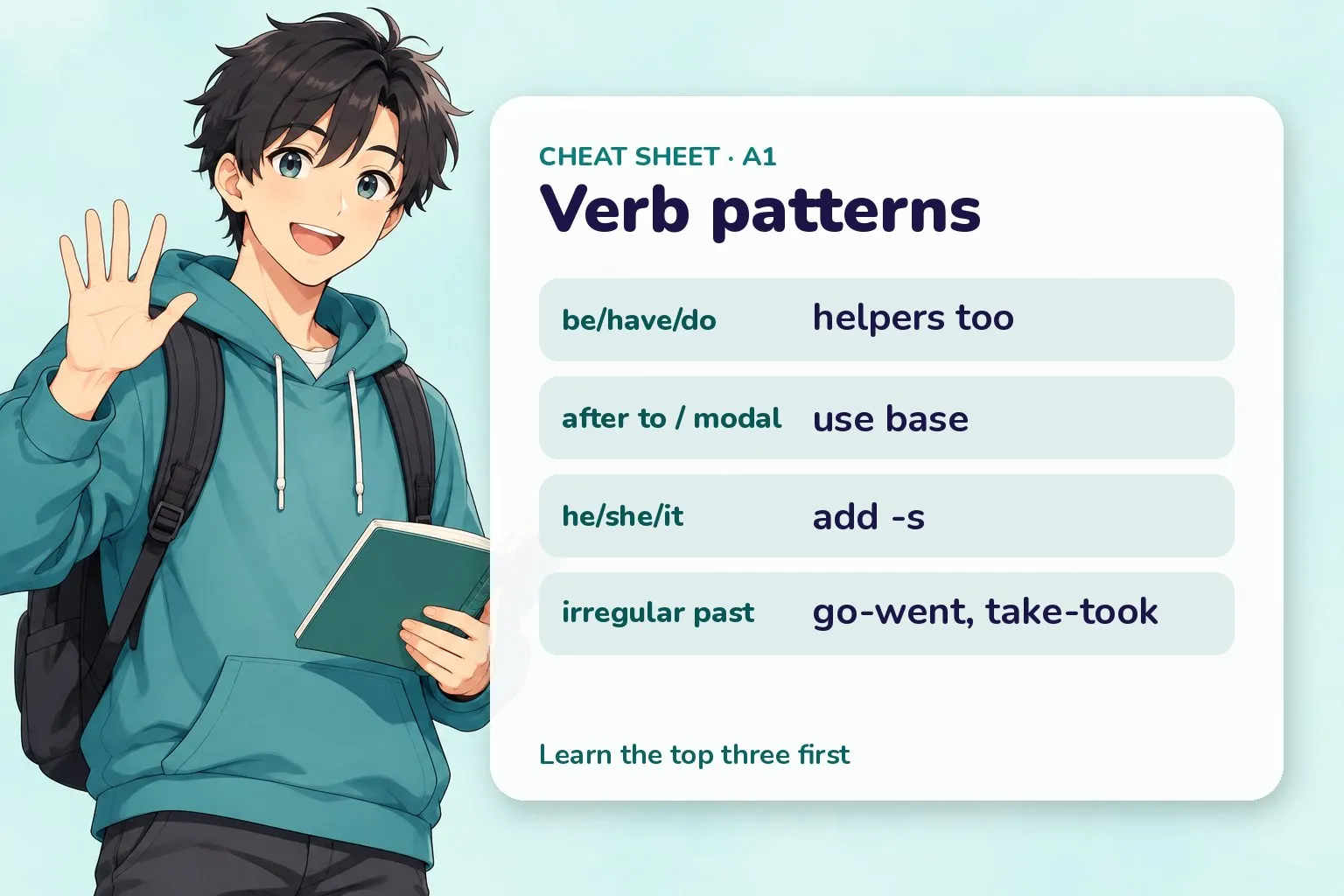
Quick recap before the quiz.
| Pattern | Example |
|---|---|
| be / have / do as helpers | I am working; I have eaten; Do you know? |
| after to / modal, use base | want to go; can swim; will help |
| present simple he/she/it + -s | he goes; she works; it rains |
| common irregular pasts | go-went, take-took, see-saw, give-gave |
Practice
Essential verbs practice
Try each one, then press Check. No sign-up, nothing is sent anywhere — it all runs in your browser.
1 Match each verb to its meaning.
- buy
- keep
- leave
- choose
Show answer
- buy → get by paying
- keep → continue to have
- leave → go away from a place
- choose → pick one
Linking a verb to its meaning helps you recall it faster.
Hint: go is irregular
Show answer
went — The past of 'go' is 'went', not 'goed'.
Hint: after a modal use the base
Show answer
speak — After 'can' use the plain base verb: can speak.
6 Put the words in order.
Show answer
I want to go home — want + to + base verb: I want to go home.
Quiz
Essential verbs quiz
10 questions · pick an answer and you'll see straight away if it's right.
-
Show answer
be, have, do — be, have and do are the top verbs and also work as helpers.
-
Show answer
works — Third person singular adds -s: she works.
-
Show answer
saw — see is irregular: see/saw.
-
Show answer
the base form — Modals like can are followed by the base verb: can swim.
-
Show answer
tell — tell takes a person: tell me, tell her.
-
Show answer
I have finished my work. — have + past participle: have finished.
-
Show answer
made — make is irregular: make/made.
-
Show answer
to buy — want + to + base: want to buy.
-
Show answer
come — come moves toward the speaker; go moves away.
-
Show answer
built — build is irregular in the past: built.
Next
- Next set: Common English Adjectives
- Previous set: English Words 2001-3000 (Frequency)
- Grammar for verbs: Present simple (affirmative), The verb to be, Past simple: irregular verbs
- New here? Start with Start Learning English Here
All English vocabulary topics
Vocabulary, pronunciation, phrases, practice and exam help, ordered by level. Pick a topic and go straight to it. New lessons go live every day, so topics marked Coming soon fill in over the next weeks.
Vocabulary
A1 13 topics · 13 ready
- 01 100 Most Common English Words
- 02 English Words 101-250 (Frequency)
- 03 100 Essential English Verbs You are here
- 04 Common English Adjectives
- 05 English Question Words & Phrases
- 06 English Time Expressions
- 07 English Food & Cooking Vocabulary
- 08 English Animals Vocabulary
- 09 English Clothing Vocabulary
- 10 English Weather Vocabulary
- 11 English Family & Relationships Vocabulary
- 12 English Colours Vocabulary
- 13 English Numbers, Dates & Money
A2 14 topics · 14 ready
- 14 English Words 251-500 (Frequency)
- 15 English Words 501-1000 (Frequency)
- 16 Everyday English Adverbs
- 17 English Body & Health Vocabulary
- 18 English House & Furniture Vocabulary
- 19 English Kitchen & Tableware Vocabulary
- 20 English Transport & Travel Vocabulary
- 21 English Places in Town Vocabulary
- 22 English Jobs & Professions Vocabulary
- 23 English Money & Shopping Vocabulary
- 24 English Emotions & Feelings Vocabulary
- 25 English Sports & Exercise Vocabulary
- 26 English Verbs of Motion
- 27 English Irregular Verbs Reference
B1 11 topics · 11 ready
- 28 English Words 1001-1500 (Frequency)
- 29 English Words 1501-2000 (Frequency)
- 30 English Connectors & Linking Words
- 31 English Nature & Geography Vocabulary
- 32 English Technology & Internet Vocabulary
- 33 English Education & School Vocabulary
- 34 English Medical & Pharmacy Vocabulary
- 35 English Arts, Music & Film Vocabulary
- 36 100 Essential English Phrasal Verbs
- 37 Commonly Confused English Words
- 38 British vs American English