English Irregular Verbs Reference
English irregular verbs do not add -ed in the past; you learn their forms instead. Grouping them by pattern makes this far lighter: some never change (cut/cut/cut), some share one past form (buy/bought/bought), and some have three separate forms (go/went/gone).
On this page11 sections · tap to jump
- 01By the end of this page you can…
- 02How this list was chosen
- 03Group 1: no change (base = past = participle)
- 04Group 2: past = past participle (two forms the same)
- 05Group 3: three different forms
- 06Group 4: base = past participle (only the past differs)
- 07Example sentences
- 08Common mistakes
- 09Recap cheat-sheet
- 10Practice
- 11Quiz
Level: A2. Most English verbs form the past with -ed (walk → walked), but the most common verbs are irregular: you have to learn their forms. The good news is that they fall into a few clear patterns. This reference lists the everyday irregular verbs by pattern, with the three forms every verb has.
By the end of this page you can…
…name the three forms of the common English irregular verbs (base, past simple, past participle), group them by pattern to learn them faster, and use the right form after ‘have’ and in the past.
How this list was chosen
These are the common irregular verbs an A2–B1 learner meets first, selected from the English frequency list (hermitdave/FrequencyWords) and grouped by the shape of their forms rather than alphabetically, so each group teaches one pattern. Forms are checked against standard references; the groups below cover the verbs you will actually use in everyday speaking and writing.
Group 1: no change (base = past = participle)
These verbs keep the same form for all three. Many end in -t or -d.
| Base | Past simple | Past participle | Example (past) |
|---|---|---|---|
| cut | cut | cut | I cut my finger. |
| put | put | put | She put it down. |
| let | let | let | They let us in. |
| set | set | set | He set the table. |
| hit | hit | hit | The ball hit the wall. |
| cost | cost | cost | It cost ten pounds. |
| hurt | hurt | hurt | My leg hurt a lot. |
| shut | shut | shut | We shut the door. |
| read | read | read | I read it yesterday. |
Group 2: past = past participle (two forms the same)
The past simple and the past participle share one form; only the base differs.
| Base | Past simple | Past participle | Example (participle) |
|---|---|---|---|
| buy | bought | bought | I have bought it. |
| bring | brought | brought | She has brought lunch. |
| think | thought | thought | We have thought about it. |
| catch | caught | caught | He has caught a cold. |
| teach | taught | taught | They have taught me. |
| find | found | found | I have found my keys. |
| make | made | made | She has made a cake. |
| say | said | said | He has said yes. |
| pay | paid | paid | We have paid the bill. |
| have | had | had | I have had enough. |
| hear | heard | heard | I have heard the news. |
| feel | felt | felt | She has felt better. |
| keep | kept | kept | We have kept it safe. |
| leave | left | left | They have left already. |
| meet | met | met | I have met her before. |
| sit | sat | sat | He has sat there all day. |
| tell | told | told | You have told me twice. |
| sell | sold | sold | We have sold the car. |
| win | won | won | They have won the match. |
| spend | spent | spent | I have spent it all. |
| build | built | built | They have built a house. |
| sleep | slept | slept | The baby has slept well. |
Group 3: three different forms
The base, past simple and past participle are all different. Many participles end in -en or -n.
| Base | Past simple | Past participle | Example (participle) |
|---|---|---|---|
| be | was / were | been | I have been busy. |
| go | went | gone | She has gone home. |
| do | did | done | We have done it. |
| eat | ate | eaten | I have eaten lunch. |
| give | gave | given | He has given up. |
| take | took | taken | They have taken the bus. |
| see | saw | seen | I have seen that film. |
| write | wrote | written | She has written a letter. |
| speak | spoke | spoken | We have spoken already. |
| break | broke | broken | He has broken the glass. |
| choose | chose | chosen | I have chosen a seat. |
| drive | drove | driven | She has driven to work. |
| drink | drank | drunk | They have drunk the water. |
| begin | began | begun | The film has begun. |
| know | knew | known | I have known him for years. |
| grow | grew | grown | The plant has grown tall. |
| fly | flew | flown | We have flown to Rome. |
| throw | threw | thrown | He has thrown the ball. |
| wear | wore | worn | She has worn that dress. |
| fall | fell | fallen | A tree has fallen. |
| ring | rang | rung | The bell has rung. |
| sing | sang | sung | They have sung together. |
| swim | swam | swum | I have swum here before. |
| ride | rode | ridden | He has ridden a horse. |
| forget | forgot | forgotten | I have forgotten the name. |
Group 4: base = past participle (only the past differs)
A small set returns to the base form for the participle.
| Base | Past simple | Past participle | Example (participle) |
|---|---|---|---|
| come | came | come | She has come back. |
| become | became | become | He has become a doctor. |
| run | ran | run | I have run a marathon. |
Example sentences
Play each line. Notice the past simple for finished actions and the participle after have/has.
- I cut the bread and put it on the plate.No-change verbs: cut, put (past).
- The trip cost a lot, but it was worth it.cost stays the same in the past.
- She bought a ticket and caught the train.Group 2 past forms: bought, caught.
- We have already paid the bill.Participle after have: paid.
- They told me the news and I felt happy.told, felt as past simple.
- He has kept every letter she wrote.kept (participle) and wrote (past).
- I went to the market and bought some fruit.went (past simple of go).
- She has gone to the station already.gone is the participle, after has.
- We ate dinner and then watched a film.ate is the past simple of eat.
- I have eaten too much cake today.eaten is the participle, after have.
- He drank his coffee and left for work.drank (past), left (past).
- They have drunk all the juice.drunk is the participle.
- The children sang a song and rang the bell.sang, rang as past simple.
- I have known her since school.known is the participle (present perfect).
- She has become a teacher this year.become: base = participle.
- We have run out of milk.run as participle in a phrase.
Common mistakes
Typical errors learners make with irregular forms.
- ✗ I goed home. → ✓ I went home. — go is irregular: the past simple is went, not goed.
- ✗ She has ate lunch. → ✓ She has eaten lunch. — After has, use the participle eaten, not the past simple ate.
- ✗ He catched the ball. → ✓ He caught the ball. — catch → caught, not catched.
- ✗ They have went to Spain. → ✓ They have gone to Spain. — The participle of go is gone.
- ✗ I have buyed a new phone. → ✓ I have bought a new phone. — buy → bought for both past forms.
Recap cheat-sheet
The patterns to remember before the quiz.
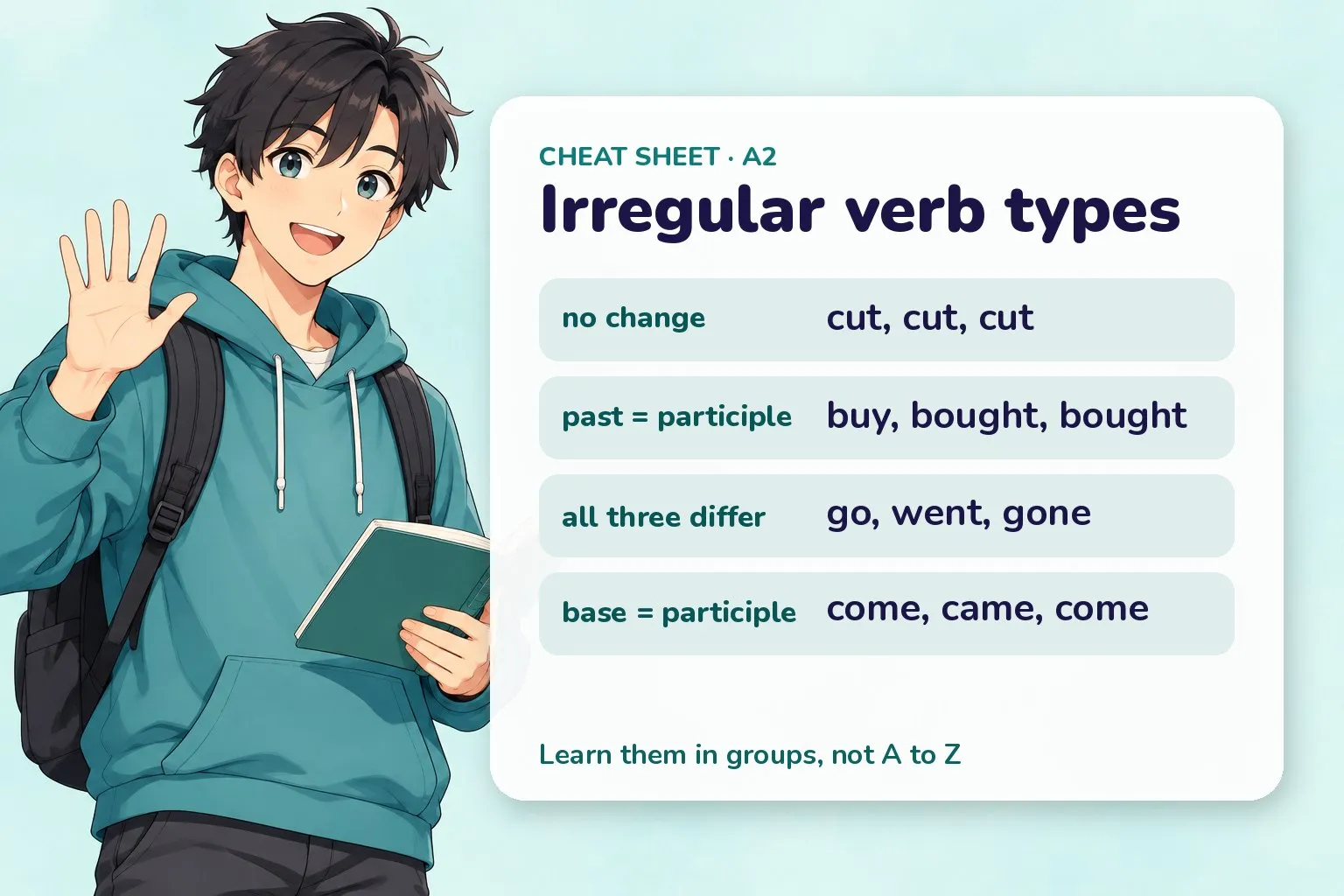
Quick recap before the quiz.
| Pattern | Example |
|---|---|
| no change | cut, cut, cut |
| past = participle | buy, bought, bought |
| all three differ | go, went, gone |
| base = participle | come, came, come |
Practice
Irregular verbs practice
Try each one, then press Check. No sign-up, nothing is sent anywhere — it all runs in your browser.
1 Match each base verb to its past simple.
- go
- buy
- eat
- see
Show answer
- go → went
- buy → bought
- eat → ate
- see → saw
These past-simple forms are irregular and must be learned.
Hint: base do, past did, participle ___
Show answer
done — The participle of do is done: she has done her homework.
Hint: go is irregular
Show answer
went — The past simple of go is went.
6 Put the words in order.
Show answer
I have already eaten — Present perfect: have + participle (eaten).
Quiz
Irregular verbs quiz
12 questions · pick an answer and you'll see straight away if it's right.
-
Show answer
went — go → went (past simple).
-
Show answer
eaten — eat → ate → eaten.
-
Show answer
broken — After has, use the participle broken.
-
Show answer
put — put/put/put never changes.
-
Show answer
bought — buy → bought (past and participle).
-
Show answer
won — win → won.
-
Show answer
written — write → wrote → written.
-
Show answer
He has gone home. — The participle of go is gone.
-
Show answer
caught — catch → caught.
-
Show answer
sung — sing → sang → sung; the participle is sung.
-
Show answer
drank — drink → drank (past simple); drunk is the participle.
-
Show answer
got — British uses got; American uses gotten.
Next
- Previous set: British vs American English
- Grammar that helps: Past simple: irregular verbs, Present perfect for experience, Passive: present and past
- New here? Start with Start Learning English Here
All English vocabulary topics
Vocabulary, pronunciation, phrases, practice and exam help, ordered by level. Pick a topic and go straight to it. New lessons go live every day, so topics marked Coming soon fill in over the next weeks.
Vocabulary
A1 13 topics · 13 ready
- 01 100 Most Common English Words
- 02 English Words 101-250 (Frequency)
- 03 100 Essential English Verbs
- 04 Common English Adjectives
- 05 English Question Words & Phrases
- 06 English Time Expressions
- 07 English Food & Cooking Vocabulary
- 08 English Animals Vocabulary
- 09 English Clothing Vocabulary
- 10 English Weather Vocabulary
- 11 English Family & Relationships Vocabulary
- 12 English Colours Vocabulary
- 13 English Numbers, Dates & Money
A2 14 topics · 14 ready
- 14 English Words 251-500 (Frequency)
- 15 English Words 501-1000 (Frequency)
- 16 Everyday English Adverbs
- 17 English Body & Health Vocabulary
- 18 English House & Furniture Vocabulary
- 19 English Kitchen & Tableware Vocabulary
- 20 English Transport & Travel Vocabulary
- 21 English Places in Town Vocabulary
- 22 English Jobs & Professions Vocabulary
- 23 English Money & Shopping Vocabulary
- 24 English Emotions & Feelings Vocabulary
- 25 English Sports & Exercise Vocabulary
- 26 English Verbs of Motion
- 27 English Irregular Verbs Reference You are here
B1 11 topics · 11 ready
- 28 English Words 1001-1500 (Frequency)
- 29 English Words 1501-2000 (Frequency)
- 30 English Connectors & Linking Words
- 31 English Nature & Geography Vocabulary
- 32 English Technology & Internet Vocabulary
- 33 English Education & School Vocabulary
- 34 English Medical & Pharmacy Vocabulary
- 35 English Arts, Music & Film Vocabulary
- 36 100 Essential English Phrasal Verbs
- 37 Commonly Confused English Words
- 38 British vs American English