English Words 1501-2000 (Frequency)
Ranks 1501-2000 complete your first 2000 words — enough to read and talk about most everyday topics. This band adds precise verbs, descriptive adjectives, and nouns for places, the body and the natural world. Learn them in themed groups and use each one.
On this page15 sections · tap to jump
- 01By the end of this page you can…
- 02How this core was chosen
- 03Precise action verbs — set 1
- 04Precise action verbs — set 2
- 05People, roles and groups
- 06Describing things — adjectives
- 07Places, the body and everyday nouns
- 08Ideas, time and other useful words
- 09Example sentences
- 10Common mistakes
- 11Usage notes
- 12Practice
- 13How to say it
- 14Quiz
- 15Recap cheat-sheet
Level: B1. This set completes your first 2000 English words — the words ranked 1501 to 2000 on the frequency list. Together with the earlier bands, knowing these covers most of what you meet in everyday conversation. The focus now shifts from survival to precision: choosing the right verb, the right adjective, and the right noun. Work through the themed groups below and build a sentence with each word.
By the end of this page you can…
…recognise and use a core set of the 1501-2000 most frequent English words, grouped by meaning, and reach the 2000-word everyday fluency milestone.
How this core was chosen
The ranking is from the hermitdave FrequencyWords English 50k list, built by counting how often each word appears in a large collection of film and TV subtitles. A lower rank number means a more common word.
As before, the raw list mixes in things that are not vocabulary to study — proper names (kevin, maria, england), single letters (e, h), and transcription labels for sounds (screams, groaning, beeping). We leave those out and keep a representative core of about 140 real, high-value words from ranks 1501-2000, grouped by theme. Every word keeps its exact rank (in brackets); we never invent ranks, and skipped items are omitted on purpose.
Precise action verbs — set 1
| Word (rank) | Meaning | Example |
|---|---|---|
| breathe (1511) | take air in and out | Breathe slowly and relax. |
| serve (1532) | give food; be of use | They serve breakfast until ten. |
| survive (1560) | stay alive through danger | They survived the storm. |
| feed (1563) | give food to | I feed the cat every morning. |
| belong (1573) | be owned by; fit in | This book belongs to me. |
| remain (1578) | stay; be left | Few seats remain. |
| discuss (1586) | talk about | Let’s discuss the plan. |
| fill (1594) | make full | Fill the glass with water. |
| recognize (1603) | know again; accept as true | I didn’t recognize you! |
| pretend (1608) | act as if something is true | Don’t pretend you’re asleep. |
| pray (1625) | speak to a god | They prayed for good weather. |
| prepare (1631) | get ready | I’ll prepare dinner. |
| wash (1635) | clean with water | Wash your hands first. |
| prefer (1641) | like better | I prefer tea to coffee. |
| lift (1647) | raise up | Lift with your legs, not your back. |
| create (1654) | make something new | She creates beautiful art. |
Precise action verbs — set 2
| Word (rank) | Meaning | Example |
|---|---|---|
| afford (1656) | have enough money for | I can’t afford a new car. |
| focus (1681) | give full attention | Focus on your work. |
| exist (1684) | be real; be present | Does life exist on Mars? |
| draw (1687) | make a picture with lines | She drew a map for me. |
| suggest (1699) | offer an idea | I suggest we leave early. |
| settle (1719) | make calm; decide finally | They settled the argument. |
| bite (1724) | cut with the teeth | The dog might bite. |
| introduce (1743) | present people to each other | Let me introduce my friend. |
| split (1745) | divide | Let’s split the bill. |
| add (1748) | put with something else | Add some salt. |
| enter (1755) | go into | Enter through the side door. |
| manage (1818) | succeed in doing; be in charge | I managed to finish on time. |
| dig (1828) | make a hole | They dug a hole for the tree. |
| spread (1851) | open out; reach more places | Spread the jam on the bread. |
| regret (1879) | feel sorry about | I regret saying that. |
| avoid (1984) | keep away from | Avoid the main road at rush hour. |
People, roles and groups
| Word (rank) | Meaning | Example |
|---|---|---|
| student (1507) | someone who studies | She’s a medical student. |
| coach (1525) | a sports trainer | The coach praised the team. |
| grandpa (1550) | grandfather (informal) | My grandpa tells great stories. |
| criminal (1554) | someone who breaks the law | The criminal was caught. |
| nurse (1564) | someone who cares for the sick | The nurse checked my pulse. |
| guest (1614) | a visitor you invite | We have guests tonight. |
| female (1621) | of the woman or girl sex | A female doctor saw me. |
| male (1644) | of the man or boy sex | The male lion is larger. |
| soldier (1634) | a member of an army | The soldier stood at the gate. |
| member (1752) | someone who belongs to a group | She’s a club member. |
| gang (1723) | an organised group, often criminal | A gang robbed the bank. |
| mayor (1732) | the head of a city | The mayor opened the bridge. |
| staff (1738) | the people who work somewhere | The hotel staff were friendly. |
| gentleman (1742) | a polite or well-mannered man | He’s a real gentleman. |
| chef (1826) | a professional cook | The chef made a special dish. |
| owner (1890) | the person something belongs to | The owner locked the shop. |
| secretary (1896) | someone who does office work | The secretary booked the room. |
| assistant (1902) | someone who helps | She’s my new assistant. |
| thief (1946) | someone who steals | A thief took my phone. |
| university (1928) | a place of higher study | He studies law at university. |
Describing things — adjectives
| Word (rank) | Meaning | Example |
|---|---|---|
| loud (1514) | making a lot of noise | The music is too loud. |
| horrible (1524) | very unpleasant | The smell was horrible. |
| fantastic (1530) | excellent | We had a fantastic time. |
| older (1536) | more old | My older sister is a nurse. |
| incredible (1549) | very hard to believe; amazing | The view was incredible. |
| fake (1566) | not real | That bag is fake. |
| original (1579) | first; not a copy | This is the original painting. |
| comfortable (1612) | giving physical ease | The bed is very comfortable. |
| dry (1616) | not wet | Hang the clothes to dry. |
| aware (1642) | knowing about something | I’m aware of the risk. |
| dumb (1659) | silly; unable to speak | That was a dumb idea. |
| brilliant (1671) | very clever; very bright | What a brilliant plan! |
| ugly (1679) | not pleasant to look at | It’s an ugly building. |
| weak (1709) | not strong | I feel weak and tired. |
| lonely (1711) | sad from being alone | She felt lonely at first. |
| tiny (1714) | very small | A tiny insect landed on me. |
| handsome (1735) | good-looking (often of a man) | He’s tall and handsome. |
| brave (1759) | ready to face danger | It was a brave decision. |
| soft (1778) | not hard; gentle | The towel is soft. |
| bright (1795) | giving a lot of light; clever | The room is bright and warm. |
| cheap (1978) | low in price | The ticket was cheap. |
| boring (1955) | not interesting | The lecture was boring. |
| complicated (1974) | hard to understand | It’s a complicated story. |
| familiar (1987) | known; easy to recognise | Your face looks familiar. |
Places, the body and everyday nouns
| Word (rank) | Meaning | Example |
|---|---|---|
| market (1502) | a place to buy and sell | We shop at the market. |
| meat (1503) | animal flesh as food | I don’t eat much meat. |
| color (1512) | the quality like red or blue (UK spelling: colour) | What color is your car? |
| photo (1515) | a picture from a camera | Take a photo of the view. |
| bridge (1521) | a crossing over water or a road | Cross the bridge carefully. |
| mountain (1596) | a very high hill | We climbed the mountain. |
| teeth (1553) | the hard parts in your mouth | Brush your teeth twice a day. |
| chair (1590) | a seat for one person | Pull up a chair. |
| shirt (1611) | a top with a collar | He wore a white shirt. |
| garden (1757) | land for plants by a house | We grow herbs in the garden. |
| finger (1762) | a part of the hand | I cut my finger. |
| medicine (1763) | something you take when ill | Take this medicine twice a day. |
| weather (1773) | the state of the sky and air | The weather is lovely today. |
| snow (1792) | frozen white rain | The snow covered the hills. |
| lake (1794) | a large area of inland water | We swam in the lake. |
| roof (1796) | the top of a building | Rain leaked through the roof. |
| bread (1882) | a basic baked food | Buy a loaf of bread. |
| cheese (1857) | a food made from milk | I love cheese on toast. |
| eggs (1877) | food laid by hens | I had eggs for breakfast. |
| forest (1875) | a large area of trees | A path led into the forest. |
| airport (1993) | where planes take off and land | Meet me at the airport. |
| ocean (1942) | a very large sea | The ocean was calm. |
| clock (1941) | a device that shows time | The clock stopped. |
| insurance (1999) | protection you pay for | Do you have travel insurance? |
Ideas, time and other useful words
| Word (rank) | Meaning | Example |
|---|---|---|
| towards (1504) | in the direction of | Walk towards the station. |
| nearly (1517) | almost | It’s nearly eight o’clock. |
| truly (1557) | really; honestly | I’m truly grateful. |
| honestly (1558) | in a truthful way | Honestly, I don’t know. |
| perfectly (1575) | completely; faultlessly | It fits perfectly. |
| view (1589) | what you can see; an opinion | The view is amazing. |
| condition (1595) | the state of something | The car is in good condition. |
| society (1609) | people living together | Society is changing. |
| meaning (1613) | what something stands for | What’s the meaning of this word? |
| opinion (1632) | what you think | In my opinion, it’s fair. |
| proof (1650) | evidence that something is true | Do you have any proof? |
| purpose (1688) | the reason for doing something | What is the purpose of the trip? |
| distance (1701) | the space between two points | We walked a long distance. |
| responsibility (1702) | a duty you must take care of | Safety is everyone’s responsibility. |
| issue (1704) | a problem or topic | We discussed the main issue. |
| process (1706) | a series of steps | Learning is a slow process. |
| access (1764) | the right or way to reach | Students have access to the library. |
| amount (1815) | how much of something | A small amount of sugar. |
| safety (1819) | being safe | Your safety comes first. |
| journey (1836) | a trip from place to place | The journey took six hours. |
| reality (1845) | the way things really are | In reality, it’s harder. |
| success (1812) | achieving what you wanted | The event was a success. |
| century (1912) | a hundred years | The castle is five centuries old. |
| event (1973) | something that happens | The sports event was huge. |
Example sentences
Press play on each line and say it out loud.
- This umbrella belongs to me, not to you.belong (1573) to.
- I prefer tea to coffee in the morning.prefer (1641) A to B.
- Can you afford the ticket, or should we split it?afford (1656), split (1745).
- Let me introduce you to my coach.introduce (1743) to; coach (1525).
- Focus on your breathing and try to relax.focus (1681) on, breathe (1511).
- The nurse gave the patient some medicine.nurse (1564), medicine (1763).
- We walked towards the lake as the snow fell.towards (1504), lake (1794), snow (1792).
- Honestly, the view from the mountain was incredible.honestly (1558), view (1589), mountain (1596), incredible (1549).
- In my opinion, the plan is too complicated.opinion (1632), complicated (1974).
- The hotel staff prepared a fantastic breakfast.staff (1738), prepare (1631), fantastic (1530).
- I nearly forgot — the market closes at noon.nearly (1517), market (1502).
- Safety is everyone's responsibility on the site.safety (1819), responsibility (1702).
- She managed to create a brilliant design.manage (1818), create (1654), brilliant (1671).
- Do you have any proof, or is it just a theory?proof (1650).
- The students have free access to the library.student (1507), access (1764).
- Wash the shirt in cold water so it stays soft.wash (1635), shirt (1611), soft (1778).
- The journey towards success is a slow process.journey (1836), success (1812), process (1706).
- I'd suggest you avoid the main road today.suggest (1699), avoid (1984).
- That bag looks fake, but it's cheap, so who cares?fake (1566), cheap (1978).
- The weather was horrible, so we stayed in.weather (1773), horrible (1524).
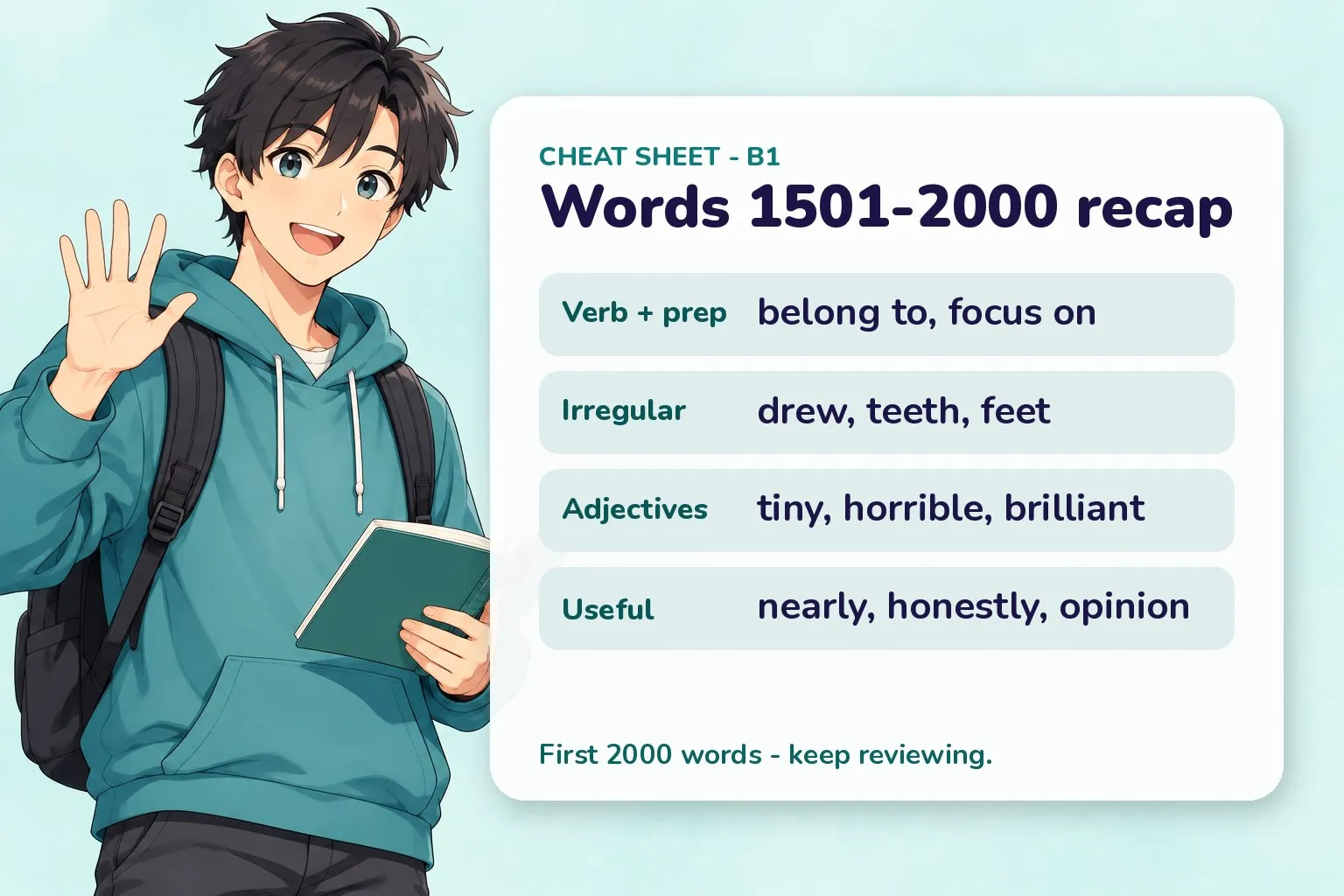
Quick recap before you practise.
Common mistakes
- ✗ This book belongs me. → ✓ This book belongs to me. — belong needs to.
- ✗ I prefer tea than coffee. → ✓ I prefer tea to coffee. — prefer uses to, not than.
- ✗ I can’t afford to a car. / I can’t afford buying a car. → ✓ I can’t afford a car / to buy a car. — afford takes an object or a to-infinitive, not afford buying.
- ✗ She suggested me to leave. → ✓ She suggested (that) I leave / She suggested leaving. — suggest is not followed by someone to do. See Verb Patterns and Meaning.
- ✗ He draw a picture yesterday. → ✓ He drew a picture yesterday. — draw → drew is irregular.
- ✗ My teeth is clean. → ✓ My teeth are clean. — teeth is the plural of tooth. See Plural Nouns.
Usage notes
- prefer A to B (prefer tea to coffee) or prefer to do (I prefer to walk). Both use to, never than.
- meat vs meet: meat is food; meet is to come together. They sound the same but are spelled differently.
- colour / color: British spelling is colour; American is color. Pick one and be consistent.
- teeth, feet, children are irregular plurals (tooth → teeth, foot → feet, child → children).
- nearly / almost are close in meaning (nearly eight = almost eight); both go before the word they modify.
Practice
Words 1501-2000 practice
Try each one, then press Check. No sign-up, nothing is sent anywhere — it all runs in your browser.
Hint: a preposition
Show answer
to — Belong needs the preposition to: belongs to me.
3 Match each verb to its fixed preposition.
- belong
- focus
- introduce (someone)
- succeed
Show answer
- belong → to
- focus → on
- introduce (someone) → to
- succeed → in
Store verbs with their preposition: belong to, focus on, introduce to, succeed in.
4 Put the words in order.
Show answer
I can't afford a new car — Afford takes a direct object: I can't afford a new car.
Hint: irregular past of draw
Show answer
drew — Draw is irregular: draw → drew.
How to say it
- breathe (verb, with a th and a z sound: breeth) is different from breath (noun, short, breth).
- comfortable is often said in three beats: KUMF-ter-bul — the middle is weak.
- recognize is REK-uhg-nyze, stress on the first part.
- mountain ends in a weak -tun: MOWN-tun, not moun-TAIN.
- colour / color is KUL-er; the spelling changes but the sound does not.
Quiz
Words 1501-2000 quiz
12 questions · pick an answer and you'll see straight away if it's right.
-
Show answer
to have enough money for — Afford means to have enough money for something.
-
Show answer
I prefer walking to driving. — Prefer uses to: I prefer walking to driving.
-
Show answer
belong to me — Belong needs the preposition to: it belongs to me.
-
Show answer
drew — Draw is irregular: draw → drew (past participle drawn).
-
Show answer
teeth — Tooth → teeth is an irregular plural.
-
Show answer
nearly — Nearly means almost: nearly eight o'clock.
-
Show answer
She suggested that I go. — Suggest takes 'that I go' or 'going', not 'me to go'.
-
Show answer
steals — A thief is a person who steals.
-
Show answer
comfortable — Comfortable means giving physical ease.
-
Show answer
My teeth are clean. — Teeth is plural, so it takes 'are'.
-
Show answer
what you personally think — In my opinion introduces a personal view.
-
Show answer
to stay alive through danger — Survive means to stay alive through danger or difficulty.
Recap cheat-sheet
| Group | Sample words | Remember |
|---|---|---|
| Verbs + preposition | belong to, prefer to, focus on | Learn the preposition with the verb. |
| Irregular pasts/plurals | drew, teeth, feet | tooth → teeth, draw → drew. |
| Adjectives | tiny, horrible, brilliant | Learn the shade of meaning. |
| Nouns | market, mountain, medicine | Body, places, food. |
| Useful | nearly, honestly, opinion | Degree, manner and opinion words. |
Quick recap before the quiz.
Next
- Previous set: English Words 1001-1500 (Frequency)
- You have now met your first 2000 words — keep reviewing with How to Use Flashcards for English and Spaced Repetition Explained.
- New here? Start with Start Learning English Here.
All English vocabulary topics
Vocabulary, pronunciation, phrases, practice and exam help, ordered by level. Pick a topic and go straight to it. New lessons go live every day, so topics marked Coming soon fill in over the next weeks.
Vocabulary
A1 13 topics · 13 ready
- 01 100 Most Common English Words
- 02 English Words 101-250 (Frequency)
- 03 100 Essential English Verbs
- 04 Common English Adjectives
- 05 English Question Words & Phrases
- 06 English Time Expressions
- 07 English Food & Cooking Vocabulary
- 08 English Animals Vocabulary
- 09 English Clothing Vocabulary
- 10 English Weather Vocabulary
- 11 English Family & Relationships Vocabulary
- 12 English Colours Vocabulary
- 13 English Numbers, Dates & Money
A2 14 topics · 14 ready
- 14 English Words 251-500 (Frequency)
- 15 English Words 501-1000 (Frequency)
- 16 Everyday English Adverbs
- 17 English Body & Health Vocabulary
- 18 English House & Furniture Vocabulary
- 19 English Kitchen & Tableware Vocabulary
- 20 English Transport & Travel Vocabulary
- 21 English Places in Town Vocabulary
- 22 English Jobs & Professions Vocabulary
- 23 English Money & Shopping Vocabulary
- 24 English Emotions & Feelings Vocabulary
- 25 English Sports & Exercise Vocabulary
- 26 English Verbs of Motion
- 27 English Irregular Verbs Reference
B1 11 topics · 11 ready
- 28 English Words 1001-1500 (Frequency)
- 29 English Words 1501-2000 (Frequency) You are here
- 30 English Connectors & Linking Words
- 31 English Nature & Geography Vocabulary
- 32 English Technology & Internet Vocabulary
- 33 English Education & School Vocabulary
- 34 English Medical & Pharmacy Vocabulary
- 35 English Arts, Music & Film Vocabulary
- 36 100 Essential English Phrasal Verbs
- 37 Commonly Confused English Words
- 38 British vs American English