Everyday English Adverbs
Adverbs tell you how, when, how often, how much or where something happens. Learn the high-frequency ones first: always, never, often (how often); now, soon, already (when); very, too, quite (how much); quickly, well, together (how). Most manner adverbs just add -ly to an adjective.
On this page12 sections · tap to jump
Level: A2. Adverbs add the detail a sentence needs: how you do something, when, how often, how much and where. This page groups the everyday English adverbs by job so related words stick together, each with a plain meaning and a short example you can copy.
By the end of this page you can…
…recognise and use the most common English adverbs, put frequency adverbs in the right place, form manner adverbs with -ly, and avoid the classic ‘good’ versus ‘well’ mistake.
How this list was chosen
Every adverb here comes from the English frequency list (hermitdave/FrequencyWords), which ranks words by how often they appear in a large collection of everyday subtitles. From the top of that list we kept the adverbs an A2 learner needs and grouped them by job rather than by rank. The Rank column is the word’s real position in the frequency list — a lower number means more common.
How often: adverbs of frequency
| Rank | Adverb | Meaning | Example |
|---|---|---|---|
| 116 | never | not at any time | I never drink coffee at night. |
| 144 | still | continuing up to now | She is still asleep. |
| 154 | again | one more time | Say that again, please. |
| 180 | always | every time | He always locks the door. |
| 277 | already | before now, earlier than expected | The bus has already left. |
| 288 | once | one time | I met her once. |
| 529 | sometimes | on some occasions | We sometimes eat out. |
| 972 | often | many times | They often visit us. |
| 1112 | usually | most of the time | I usually walk to work. |
When: adverbs of time
| Rank | Adverb | Meaning | Example |
|---|---|---|---|
| 55 | now | at this moment | We can start now. |
| 91 | then | at that time; next | First we eat, then we leave. |
| 232 | today | on this day | It is cold today. |
| 342 | ago | back in the past | She left two hours ago. |
| 360 | soon | in a short time | Dinner will be ready soon. |
| 382 | late | after the usual time | He arrived late. |
| 622 | finally | after a long wait; last | We finally found the house. |
| 694 | early | before the usual time | I woke up early. |
| 1111 | suddenly | quickly and without warning | The lights suddenly went out. |
How much: adverbs of degree
| Rank | Adverb | Meaning | Example |
|---|---|---|---|
| 38 | so | to a high degree | I am so tired. |
| 39 | just | a moment ago; only; exactly | I just arrived. |
| 98 | really | very; truly | It is really cold. |
| 110 | too | more than is good | This bag is too heavy. |
| 115 | very | to a high degree | She is very kind. |
| 222 | enough | as much as needed (after the word) | The room is big enough. |
| 428 | quite | fairly; to some degree | The film was quite good. |
| 475 | almost | nearly | I am almost ready. |
How: adverbs of manner
| Rank | Adverb | Meaning | Example |
|---|---|---|---|
| 59 | well | in a good way | She sings well. |
| 267 | together | with each other | We travel together. |
| 324 | hard | with effort | They work hard. |
| 624 | fast | at high speed | He runs fast. |
| 885 | quickly | at high speed | Answer quickly. |
| 1409 | clearly | in a clear way | Please speak clearly. |
| 1750 | slowly | at low speed | Drive slowly here. |
| 2046 | carefully | with care | Read the question carefully. |
Where: adverbs of place
| Rank | Adverb | Meaning | Example |
|---|---|---|---|
| 40 | there | in that place | Put it there. |
| 41 | here | in this place | Come here. |
| 83 | back | to the place before | Go back home. |
| 165 | away | to another place | He is away this week. |
| 653 | somewhere | in some place | I left it somewhere. |
| 833 | anywhere | in any place | I cannot find it anywhere. |
| 1137 | everywhere | in all places | Dust was everywhere. |
Comment and attitude
| Rank | Adverb | Meaning | Example |
|---|---|---|---|
| 155 | maybe | perhaps | Maybe we will come. |
| 283 | actually | in fact | It is actually quite easy. |
| 369 | probably | almost certainly | She will probably call. |
| 384 | exactly | precisely | That is exactly right. |
| 586 | perhaps | maybe | Perhaps later. |
| 779 | instead | in place of something | Let us take the train instead. |
| 782 | certainly | surely | I will certainly help. |
| 996 | especially | more than usual | I love fruit, especially mangoes. |
Example sentences
Play each line, then say it aloud. Notice where each adverb sits in the sentence.
- She always drinks tea in the morning.Frequency adverb before the main verb.
- He is never late for work.After 'be', the frequency adverb comes next: is never.
- We often meet on Fridays.'Often' = many times.
- I usually walk to school.'Usually' = most of the time, before the verb.
- The bus has already left.'Already' sits in the middle, after the helper 'has'.
- Please speak slowly and clearly.Two manner adverbs ending in -ly.
- He drives too fast.'Too' = more than is safe; 'fast' has no -ly.
- The soup is very hot.'Very' strengthens the adjective 'hot'.
- I know the city quite well.'Quite' softens; 'well' is the adverb of 'good'.
- They finished the job quickly.Manner adverb from 'quick' + -ly.
- Come here and sit down.'Here' = this place.
- I looked everywhere for my keys.'Everywhere' = in all places.
- Maybe it will rain later.'Maybe' gives an opinion; it often starts the sentence.
- She works hard every day.'Hard' as an adverb keeps its adjective form.
- We arrived early, so we waited outside.'Early' = before the usual time.
- I have almost finished.'Almost' = nearly, in the middle of the verb phrase.
- Let us do it together.'Together' = with each other, at the end.
- Actually, I prefer the blue one.'Actually' = in fact, used as a comment.
Recap cheat-sheet
A few patterns to remember before the quiz.
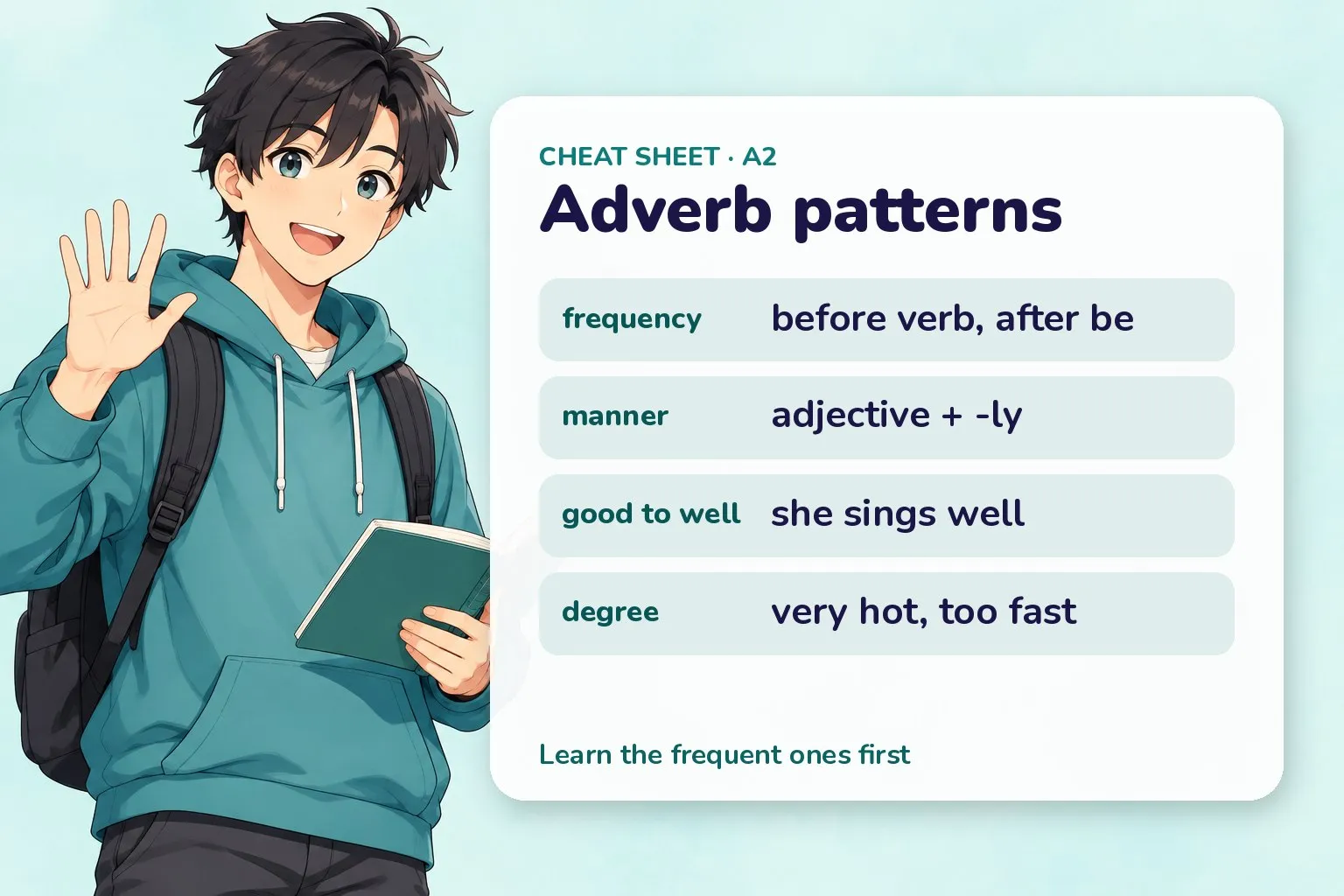
Quick recap before the quiz.
| Pattern | Example |
|---|---|
| frequency: before verb, after ‘be’ | I always walk; I am always late |
| manner: adjective + -ly | quick to quickly; easy to easily |
| ‘good’ to ‘well’ | she sings well (not good) |
| degree before adjective | very hot; too fast; quite good |
Practice
Everyday adverbs practice
Try each one, then press Check. No sign-up, nothing is sent anywhere — it all runs in your browser.
1 Match each adjective to its adverb.
- quick
- careful
- good
- easy
Show answer
- quick → quickly
- careful → carefully
- good → well
- easy → easily
Most adverbs add -ly; 'good' becomes the irregular 'well'.
Hint: add -ly
Show answer
slowly — slow to slowly; it describes how you drive.
Hint: not 'good'
Show answer
well — The adverb of 'good' is 'well'.
6 Put the words in order.
Show answer
I never drink black coffee — Frequency adverb before the main verb: I never drink black coffee.
Quiz
Everyday adverbs quiz
12 questions · pick an answer and you'll see straight away if it's right.
-
Show answer
how often something happens — Frequency adverbs (always, often, never) say how often.
-
Show answer
He speaks English well. — Use the adverb 'well' to say how he speaks.
-
Show answer
He always takes the bus. — Frequency adverbs go before the main verb: he always takes.
-
Show answer
carefully — Add -ly to the full adjective: careful to carefully.
-
Show answer
too — 'Too' shows an excess: too heavy, too fast.
-
Show answer
too — 'Too heavy to lift' shows the weight is a problem.
-
Show answer
I have never been there. — The adverb goes after the helper 'have': have never been.
-
Show answer
fast — 'Fast' and 'hard' are the same as adjective and adverb.
-
Show answer
very — 'Very' strengthens the adjective 'cold'.
-
Show answer
before now, sooner than expected — 'Already' = the action happened before now.
-
Show answer
sometimes — 'Once a month' matches 'sometimes', not always or never.
-
Show answer
I very much like tea. — 'Very much' can strengthen a verb: I like tea very much / I very much like tea.
Next
- Next set: English Connectors & Linking Words
- Related set: Common English Adjectives
- Grammar for order and form: Present simple (affirmative)
- New here? Start with Start Learning English Here
All English vocabulary topics
Vocabulary, pronunciation, phrases, practice and exam help, ordered by level. Pick a topic and go straight to it. New lessons go live every day, so topics marked Coming soon fill in over the next weeks.
Vocabulary
A1 13 topics · 13 ready
- 01 100 Most Common English Words
- 02 English Words 101-250 (Frequency)
- 03 100 Essential English Verbs
- 04 Common English Adjectives
- 05 English Question Words & Phrases
- 06 English Time Expressions
- 07 English Food & Cooking Vocabulary
- 08 English Animals Vocabulary
- 09 English Clothing Vocabulary
- 10 English Weather Vocabulary
- 11 English Family & Relationships Vocabulary
- 12 English Colours Vocabulary
- 13 English Numbers, Dates & Money
A2 14 topics · 14 ready
- 14 English Words 251-500 (Frequency)
- 15 English Words 501-1000 (Frequency)
- 16 Everyday English Adverbs You are here
- 17 English Body & Health Vocabulary
- 18 English House & Furniture Vocabulary
- 19 English Kitchen & Tableware Vocabulary
- 20 English Transport & Travel Vocabulary
- 21 English Places in Town Vocabulary
- 22 English Jobs & Professions Vocabulary
- 23 English Money & Shopping Vocabulary
- 24 English Emotions & Feelings Vocabulary
- 25 English Sports & Exercise Vocabulary
- 26 English Verbs of Motion
- 27 English Irregular Verbs Reference
B1 11 topics · 11 ready
- 28 English Words 1001-1500 (Frequency)
- 29 English Words 1501-2000 (Frequency)
- 30 English Connectors & Linking Words
- 31 English Nature & Geography Vocabulary
- 32 English Technology & Internet Vocabulary
- 33 English Education & School Vocabulary
- 34 English Medical & Pharmacy Vocabulary
- 35 English Arts, Music & Film Vocabulary
- 36 100 Essential English Phrasal Verbs
- 37 Commonly Confused English Words
- 38 British vs American English