English Numbers, Dates & Money
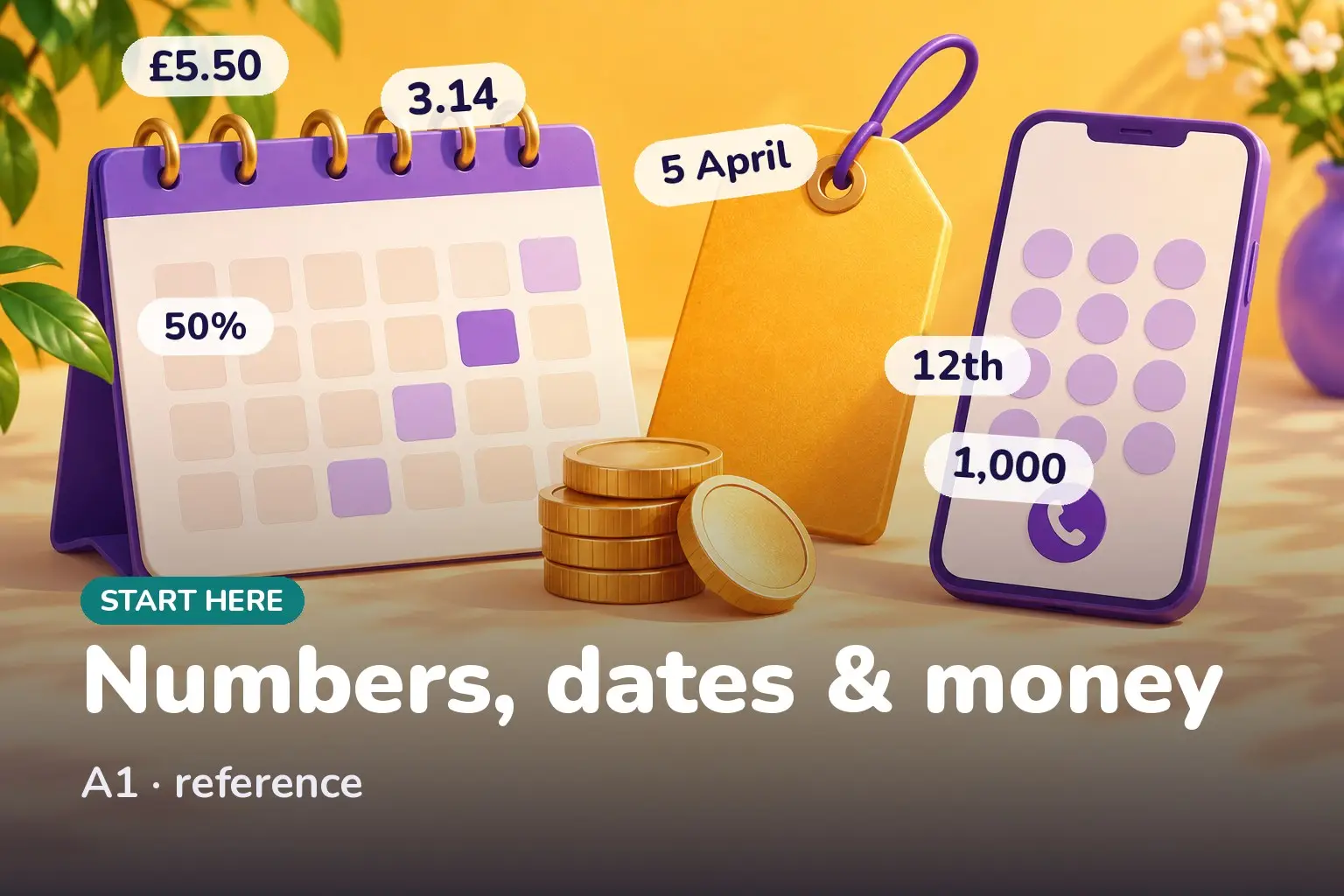
English groups big numbers with a comma every three digits and reads decimals with 'point'. Dates differ by country: Britain writes 5 April 2026, America writes April 5, 2026. Prices put the symbol first, so £5.50 is 'five pounds fifty'.
On this page13 sections · tap to jump
- 01By the end of this page you can…
- 02How this page is organised
- 03Cardinals: the counting numbers
- 04Ordinals: first, second, third…
- 05Dates: the British and American split
- 06Money and prices
- 07Phone numbers and the small maths words
- 08Example sentences
- 09Usage notes
- 10Practice
- 11How to say it
- 12Quiz
- 13Recap cheat-sheet
Level: A1. Numbers, dates, prices and phone numbers come up every single day — and each has its own small set of rules for how you say and write it. This page is a reference you can come back to, grouped by type rather than ranked by frequency.
By the end of this page you can…
…read large numbers aloud, form ordinals, say and write dates the British and American way, read prices and phone numbers, and handle percentages, fractions and decimals.
How this page is organised
This is a reference page, not a frequency-ranked word list, so it is grouped by job: counting, ordering, dates, money, phone numbers and the small maths words. Example sentences are written for this lesson and kept deliberately simple. If you have not yet learned to count, start with the two lessons linked at the end.
Cardinals: the counting numbers
Cardinal numbers answer how many. The first twenty words and the tens must be learned; after that the pattern repeats. Large numbers group in threes with a comma:
| Figure | Words |
|---|---|
| 100 | one hundred / a hundred |
| 101 | one hundred and one (British) / one hundred one (American) |
| 1,000 | one thousand / a thousand |
| 1,500 | one thousand five hundred / fifteen hundred |
| 10,000 | ten thousand |
| 100,000 | one hundred thousand |
| 1,000,000 | one million |
Ordinals: first, second, third…
Ordinals answer which one in order — they label dates, floors, races and centuries. Most are the cardinal plus -th, but a few change spelling:
| Number | Ordinal | Number | Ordinal |
|---|---|---|---|
| 1 | first | 8 | eighth |
| 2 | second | 9 | ninth |
| 3 | third | 12 | twelfth |
| 4 | fourth | 20 | twentieth |
| 5 | fifth | 21 | twenty-first |
| 6 | sixth | 30 | thirtieth |
| 7 | seventh | 100 | hundredth |
Watch fifth (not fiveth), eighth (one t), ninth (no e) and twelfth. For the tens, change the final -y to -ieth: twenty → twentieth.
Dates: the British and American split
This is the single biggest source of confusion, because the two main styles reverse the day and month.
| Style | Written | Said |
|---|---|---|
| British | 5 April 2026 / 5th April | the fifth of April, twenty twenty-six |
| American | April 5, 2026 | April fifth, twenty twenty-six |
Say years in pairs when you can: 1984 is “nineteen eighty-four”, 2026 is “twenty twenty-six”. The 2000s are the exception — 2005 is usually “two thousand and five” (British) or “two thousand five” (American), and only later did “twenty oh-five” appear.
Money and prices
The currency symbol comes first in writing (£5, $20, €3.50), but you say the amount then the unit:
- £5.50 = “five pounds fifty” (the word pounds can drop: “five fifty”)
- $3.99 = “three dollars ninety-nine” or just “three ninety-nine”
- €10 = “ten euros”
- 50p = “fifty pence” / “fifty p”; ¢ = cents
Say the price as two numbers split by the decimal point, and do not say “point” with money: $4.25 is “four twenty-five”, not “four point two five”.
Phone numbers and the small maths words
Phone numbers are read digit by digit. The digit 0 is usually “oh”; a repeated digit can take “double”: 7700 = “double seven, double oh” or “seven seven zero zero”.
For maths: per cent (50% = “fifty per cent”), simple fractions (½ = “a half”, ⅓ = “a third”, ¾ = “three quarters”), and decimals read each figure after the point (3.14 = “three point one four”, not “three point fourteen”).
Example sentences
Play each line and say the number, date or price aloud.
- There are three hundred and sixty-five days in a year.A large number with British 'and'.
- The stadium holds forty-five thousand people.Thousands grouped in threes.
- She finished in first place and he came third.Ordinals for a race result.
- My office is on the twelfth floor.An irregular ordinal: twelfth.
- His birthday is on the fifth of April.A British spoken date.
- The meeting is on April 5, 2026.An American written date.
- I was born in nineteen ninety-nine.A year said in pairs.
- The lease started in two thousand and five.A 2000s year keeps 'two thousand'.
- The coffee costs three pounds fifty.A price said as two numbers.
- It was only three ninety-nine in the sale.Dropping 'dollars' in speech.
- The ticket is ten euros each.Euros after the figure.
- Please call me on oh-two-oh, seven double four six.A phone number, digit by digit.
- Almost fifty per cent of the class passed.Reading a percentage.
- Add half a cup of sugar.A simple fraction: a half.
- The value of pi is about three point one four.A decimal read figure by figure.
- We need a quarter of the budget for travel.The fraction a quarter.
- The train leaves at a quarter past nine.A fraction used in telling time.
- That is the twenty-first century.An ordinal for a century.
- Round it up to the nearest hundred.A round number in everyday maths.
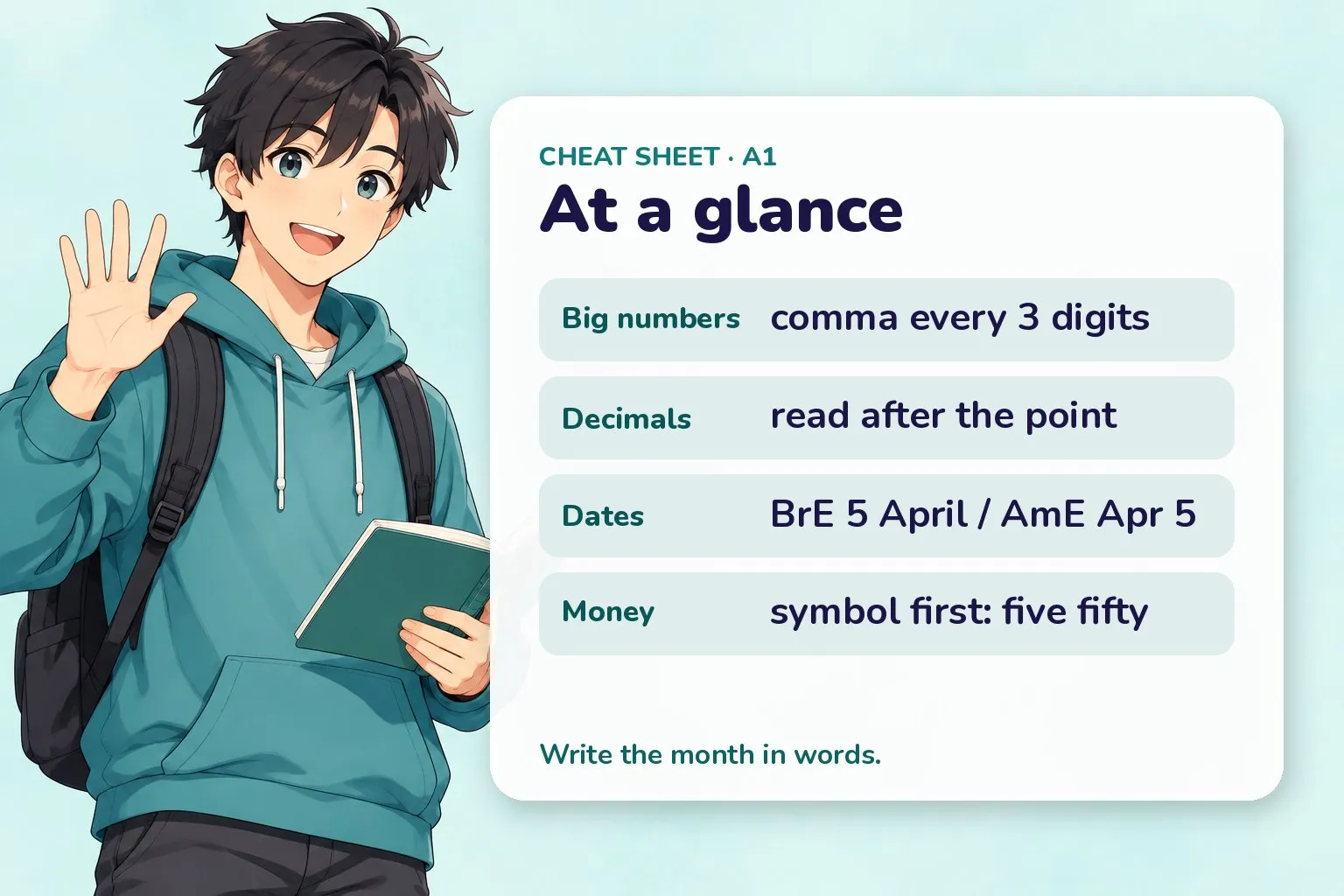
Quick recap before you practise.
Usage notes
- per cent / percent: British English often writes two words (per cent); American English writes one (percent). Both are correct; the symbol % is universal.
- ordinals in dates: in speech you say the ordinal (the fifth of April) even when you write the figure (5 April).
- “a” vs “one”: a hundred / a thousand is relaxed everyday speech; one hundred / one thousand is used for counting and precision.
- zero: say “oh” for phone and room numbers, “nil” for football scores, “zero” in neutral or technical contexts, “nought” for the British digit itself.
- time: quarters and halves of an hour use the same fraction words — see the telling-time lesson linked below.
Practice
Numbers, dates and money practice
Try each one, then press Check. No sign-up, nothing is sent anywhere — it all runs in your browser.
Hint: an irregular spelling
Show answer
twelfth — 12 is 'twelfth' — note the spelling change from twelve.
Hint: drop the word dollars
Show answer
ninety-nine — Prices split at the point: $3.99 is 'three ninety-nine'.
5 Put the words in order to say the year 1999.
Show answer
nineteen ninety-nine — Years are said in pairs: nineteen ninety-nine.
6 Match each symbol or figure to how you read it.
- 50%
- ½
- 3.5
- £5
Show answer
- 50% → fifty per cent
- ½ → a half
- 3.5 → three point five
- £5 → five pounds
Each has a fixed phrasing: percentages, fractions, decimals and prices.
Hint: read each figure after the point separately
Show answer
one — Decimals are read figure by figure: three point one four.
How to say it
A few of these words catch English learners out — focus on these sounds.
- twelfth packs l-f-th together; say it slowly as twelf-th, tongue between the teeth for the final sound.
- fifth and sixth also end in that th; don’t let them collapse into fith or sik.
- per cent stresses the second part: per-SENT.
- euro is said YOO-roh in English, with the stress on the first part.
Quiz
Numbers, dates and money quiz
11 questions · pick an answer and you'll see straight away if it's right.
-
Show answer
a point (full stop) — English uses a point for decimals and a comma for thousands.
-
Show answer
ninth — 9 is 'ninth' — the 'e' of nine is dropped.
-
Show answer
After 'hundred' — British usage puts 'and' after hundred: one hundred and one.
-
Show answer
April 5, 2026 — American order is month-day-year: April 5, 2026.
-
Show answer
nineteen eighty-four — Years before 2000 are usually said in pairs: nineteen eighty-four.
-
Show answer
two thousand and five — The 2000s keep 'two thousand': two thousand and five.
-
Show answer
five pounds fifty — Prices split at the point and never use 'point': five pounds fifty.
-
Show answer
digit by digit — Phone numbers are read one digit at a time; 0 is usually 'oh'.
-
Show answer
fifty per cent — The symbol % is read 'per cent': fifty per cent.
-
Show answer
three point one four — Read each figure after the point: three point one four.
-
Show answer
fifth — 5 is 'fifth' — the spelling changes from five.
Recap cheat-sheet
| Thing | Rule | Example |
|---|---|---|
| Big numbers | comma every 3 digits | 1,000,000 |
| Decimals | read figure by figure after “point” | 3.14 = three point one four |
| Ordinals | add -th (watch fifth, eighth, ninth, twelfth) | the twelfth floor |
| Dates | BrE 5 April 2026 / AmE April 5, 2026 | write the month in words |
| Years | said in pairs | 1999 = nineteen ninety-nine |
| Money | symbol first; price split at the point | £5.50 = five pounds fifty |
| Phone | digit by digit; 0 = “oh” | double four six |
Next
- Learn to count first: English: Numbers 0 to 100
- Days and the calendar: English: Days, Months & Dates
- Clock times: English: Telling the Time
- The grammar of “on Monday”, “in July”: Prepositions of Time
- Next in this set: Writing Business Emails in English
- New here? Start with Start Learning English Here
All English vocabulary topics
Vocabulary, pronunciation, phrases, practice and exam help, ordered by level. Pick a topic and go straight to it. New lessons go live every day, so topics marked Coming soon fill in over the next weeks.
Vocabulary
A1 13 topics · 13 ready
- 01 100 Most Common English Words
- 02 English Words 101-250 (Frequency)
- 03 100 Essential English Verbs
- 04 Common English Adjectives
- 05 English Question Words & Phrases
- 06 English Time Expressions
- 07 English Food & Cooking Vocabulary
- 08 English Animals Vocabulary
- 09 English Clothing Vocabulary
- 10 English Weather Vocabulary
- 11 English Family & Relationships Vocabulary
- 12 English Colours Vocabulary
- 13 English Numbers, Dates & Money You are here
A2 14 topics · 14 ready
- 14 English Words 251-500 (Frequency)
- 15 English Words 501-1000 (Frequency)
- 16 Everyday English Adverbs
- 17 English Body & Health Vocabulary
- 18 English House & Furniture Vocabulary
- 19 English Kitchen & Tableware Vocabulary
- 20 English Transport & Travel Vocabulary
- 21 English Places in Town Vocabulary
- 22 English Jobs & Professions Vocabulary
- 23 English Money & Shopping Vocabulary
- 24 English Emotions & Feelings Vocabulary
- 25 English Sports & Exercise Vocabulary
- 26 English Verbs of Motion
- 27 English Irregular Verbs Reference
B1 11 topics · 11 ready
- 28 English Words 1001-1500 (Frequency)
- 29 English Words 1501-2000 (Frequency)
- 30 English Connectors & Linking Words
- 31 English Nature & Geography Vocabulary
- 32 English Technology & Internet Vocabulary
- 33 English Education & School Vocabulary
- 34 English Medical & Pharmacy Vocabulary
- 35 English Arts, Music & Film Vocabulary
- 36 100 Essential English Phrasal Verbs
- 37 Commonly Confused English Words
- 38 British vs American English