English Academic Vocabulary
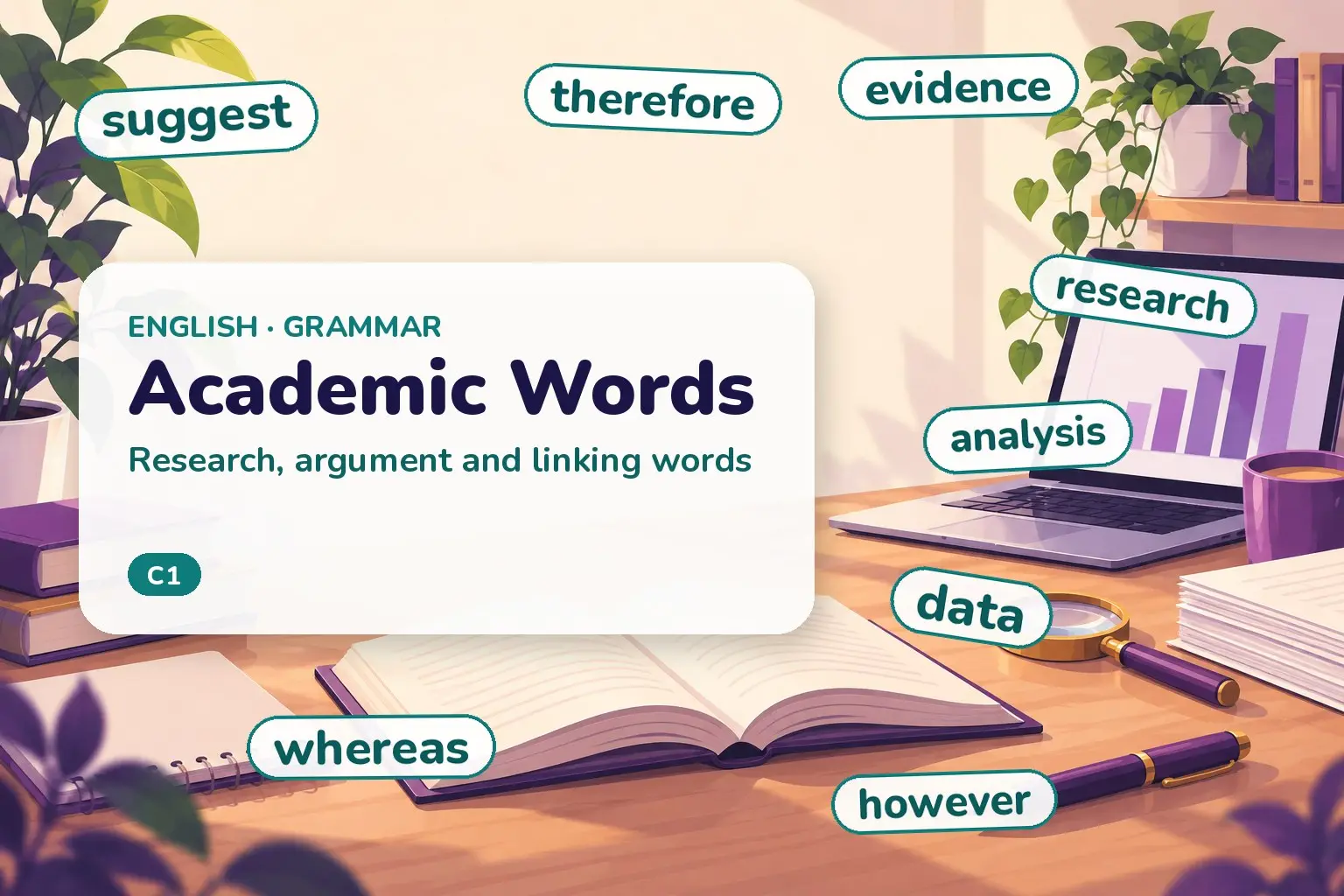
Academic English rewards precise, neutral words: research verbs (analyse, demonstrate, indicate), nouns for ideas (hypothesis, evidence, framework), and formal linkers (however, therefore, whereas). Learn them in the patterns essays use — 'the data suggest that…', 'however, …' — not as isolated words.
Level: C1. Academic English is not harder words for their own sake — it is precise, neutral, and cautious. This page gathers the research verbs, idea nouns and formal linkers you need for essays, reports and presentations, grouped by the job they do in an argument, each with a plain meaning and a model sentence you can adapt.
By the end of this page you can…
…choose a precise research verb, name an idea with the right noun, link clauses with formal connectors, and hedge a claim so it is accurate rather than overstated.
How this list was chosen
Every word here comes from the English frequency list (hermitdave/FrequencyWords), which ranks words by how often they appear in a large collection of everyday subtitles. From that list we kept the words that do academic work — reporting research, naming ideas, and linking arguments — and grouped them by function rather than by rank. The Rank column is the word’s real position in the list: a lower number means more common. Notice how high the numbers are here: academic words are rarer in everyday speech because they belong to writing and formal talk, so a high rank is expected, not a mistake.
Research and evidence
| Rank | Word | Meaning | Example |
|---|---|---|---|
| 766 | evidence | facts that support a claim | There is strong evidence for this view. |
| 1289 | study | a piece of research | The study covered two thousand people. |
| 1587 | research | careful investigation into a subject | Further research is needed here. |
| 1706 | process | a series of steps or changes | We describe the process in Section 2. |
| 1846 | theory | an explanation supported by evidence | The theory predicts a slow decline. |
| 2045 | data | facts and figures collected for analysis | The data were collected over a year. |
| 2150 | source | where information comes from | Each claim is tied to a source. |
| 2601 | approach | a way of dealing with a problem | We take a mixed-method approach. |
| 4044 | concept | an abstract idea | The concept of fairness is central here. |
| 4197 | analysis | detailed examination of something | The analysis reveals a clear pattern. |
| 4293 | method | a defined way of doing research | The method is set out below. |
| 11946 | hypothesis | a proposed explanation to be tested | Our hypothesis was not supported. |
Reporting and arguing (verbs)
| Rank | Word | Meaning | Example |
|---|---|---|---|
| 1699 | suggest | to put forward as possible (hedged) | The results suggest a link, not a cause. |
| 2038 | assume | to take as true without proof | We assume the sample is representative. |
| 2302 | claim | to state as true (often to be tested) | The author claims the effect is large. |
| 2897 | argue | to give reasons for a position | Smith argues that the model is flawed. |
| 4361 | conduct | to carry out (a study, a test) | We conducted three experiments. |
| 5872 | indicate | to point to; to be a sign of | The figures indicate a rising trend. |
| 7063 | define | to state the exact meaning | First we define the key terms. |
| 7458 | demonstrate | to show clearly with evidence | The trial demonstrates the benefit. |
| 11251 | conclude | to decide after reasoning | We conclude that the policy works. |
| 11692 | interpret | to explain the meaning of results | We interpret this as weak support. |
| 14532 | imply | to suggest without stating directly | This implies a deeper problem. |
| 15445 | evaluate | to judge the value of something | We evaluate three possible models. |
Describing ideas and their importance
| Rank | Word | Meaning | Example |
|---|---|---|---|
| 3524 | previous | coming before; earlier | Previous studies reached a similar result. |
| 3891 | critical | very important; analytical | This step is critical to the argument. |
| 4001 | structure | the way parts are arranged | The essay structure follows the plan. |
| 4774 | significant | important; large enough to matter | The difference was statistically significant. |
| 5031 | principle | a basic rule or truth | The principle applies to both cases. |
| 5259 | accurate | correct and exact | The estimate proved accurate. |
| 5813 | factor | one thing that affects a result | Cost is the main factor here. |
| 6272 | relevant | directly connected to the topic | Only relevant data are included. |
| 8058 | context | the wider setting of something | Read the finding in its full context. |
| 13067 | abstract | existing as an idea, not a thing | The paper opens with an abstract idea. |
| 15208 | criteria | standards used to judge something | The criteria are listed in the table. |
| 21236 | framework | a structure of ideas or rules | We use a simple theoretical framework. |
Formal linking words
| Rank | Word | Meaning | Example |
|---|---|---|---|
| 1282 | however | but; in contrast (formal) | The plan is cheap; however, it is slow. |
| 2349 | therefore | for that reason; so | The cost rose; therefore, demand fell. |
| 2576 | despite | in spite of | Despite the risk, the trial went ahead. |
| 3345 | thus | in this way; as a result | Numbers fell, thus confirming the trend. |
| 4288 | regarding | about; concerning | Regarding cost, two points stand out. |
| 6501 | hence | for this reason | The data are weak; hence our caution. |
| 6678 | whereas | while, by contrast | Group A improved, whereas Group B did not. |
| 6875 | nevertheless | in spite of that | It is costly; nevertheless, it works. |
| 9193 | moreover | in addition; what is more | The method is cheap; moreover, it is fast. |
| 10190 | furthermore | in addition (very formal) | Furthermore, the sample was small. |
| 20178 | consequently | as a result | Funding fell; consequently, work stopped. |
Example sentences
Play each line, then say it aloud. These show the academic words in essay-style patterns.
- This paper examines how price affects demand.A neutral opening verb: 'examine'.
- Previous studies reached a similar conclusion.'Previous studies' frames your work.
- We conducted three experiments over six months.'Conduct' + a study or test.
- The data were collected from public records.'Data' takes a plural verb in formal use.
- The results suggest a link, but not a cause.'Suggest' hedges the claim.
- The figures clearly indicate a rising trend.'Indicate' = point to.
- The trial demonstrates a measurable benefit.'Demonstrate' = show with evidence.
- We interpret this as weak support for the theory.'Interpret' explains the meaning.
- The difference was statistically significant.'Significant' in its technical sense.
- Only relevant data are included in the table.'Relevant' = connected to the topic.
- The plan is cheap; however, it is slow to set up.'However' contrasts two clauses.
- Costs rose; therefore, demand fell sharply.'Therefore' marks a result.
- Group A improved, whereas Group B did not.'Whereas' sets two cases against each other.
- The method is cheap; moreover, it is fast.'Moreover' adds a second point.
- Despite the small sample, the pattern was clear.'Despite' + noun for concession.
- We assume the sample is representative.'Assume' flags an untested starting point.
- First, we define the key terms.'Define' sets the meaning of terms.
- We evaluate three possible models in turn.'Evaluate' = judge the value of.
- The evidence for this claim is limited.'Evidence' is uncountable: no plural.
- We therefore conclude that the policy works.'Conclude' states the final judgement.
Recap cheat-sheet
A few patterns to remember before the quiz.
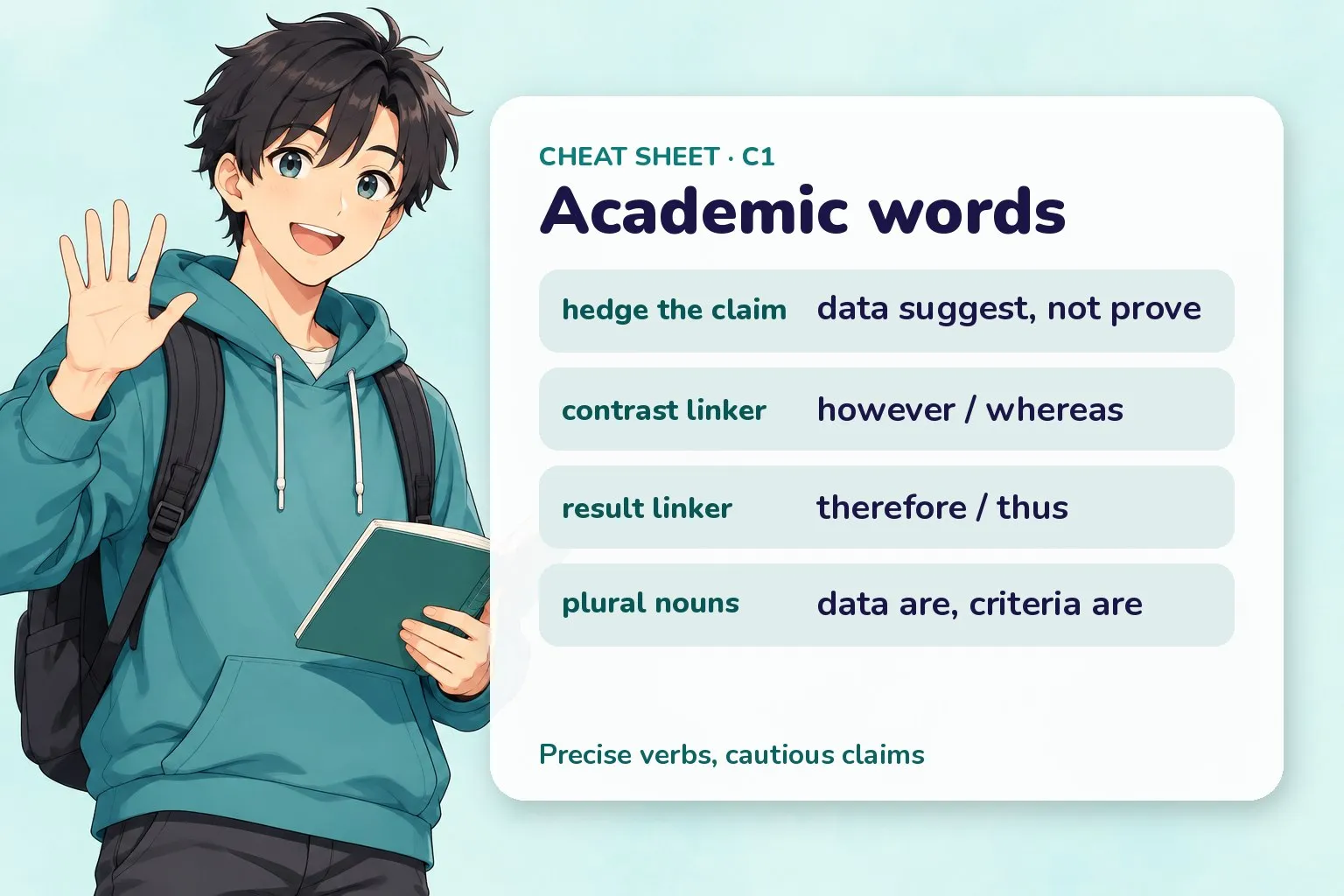
Quick recap before the quiz.
| Point | Example |
|---|---|
| hedge the claim | the data suggest (not prove) |
| contrast linker | however / whereas |
| result linker | therefore / thus |
| plural nouns | data are, criteria are |
Practice
Academic vocabulary practice
Try each one, then press Check. No sign-up, nothing is sent anywhere — it all runs in your browser.
1 Match each linker to its job.
- however
- therefore
- moreover
- despite
Show answer
- however → contrast
- therefore → result
- moreover → adding a point
- despite → concession (+ noun)
Choose linkers by the logical link, not by sound.
Hint: do not overstate
Show answer
suggest — 'Suggest' or 'indicate' hedge; 'prove' overstates.
Hint: data is plural in formal writing
Show answer
are — Formal English treats 'data' as plural: the data are clear.
6 Put the words in order.
Show answer
however it is slow to set up — Sentence-opening 'However,' then the clause: However, it is slow to set up.
Quiz
Academic vocabulary quiz
12 questions · pick an answer and you'll see straight away if it's right.
-
Show answer
suggest — 'Suggest' is cautious; the others sound certain.
-
Show answer
The data are clear. — Formal writing treats 'data' as plural.
-
Show answer
whereas — 'Whereas' sets two cases in contrast.
-
Show answer
therefore — 'Therefore' marks a consequence.
-
Show answer
point to it — 'Indicate' = point to.
-
Show answer
evidence — 'Evidence' is uncountable: no 'evidences'.
-
Show answer
criteria — 'Criterion' → 'criteria'.
-
Show answer
conducted — You 'conduct' an experiment.
-
Show answer
previous — 'Previous' = earlier.
-
Show answer
suggests it indirectly — 'Imply' = suggest without stating.
-
Show answer
moreover — 'Moreover' adds another point.
-
Show answer
Despite — 'Despite' + noun signals concession.
Next
- Previous set: English Opinion & Attitude Vocabulary
- Next set: English Medical & Pharmacy Vocabulary
- Related set: English Education Vocabulary, Linking Words & Connectors
- Grammar for academic writing: The passive — advanced uses, Advanced contrast linkers, Advanced result linkers, Participle clauses
- New here? Start with Start Learning English Here
All English vocabulary topics
Vocabulary, pronunciation, phrases, practice and exam help, ordered by level. Pick a topic and go straight to it. New lessons go live every day, so topics marked Coming soon fill in over the next weeks.
Vocabulary
A1 13 topics · 13 ready
- 01 100 Most Common English Words
- 02 English Words 101-250 (Frequency)
- 03 100 Essential English Verbs
- 04 Common English Adjectives
- 05 English Question Words & Phrases
- 06 English Time Expressions
- 07 English Food & Cooking Vocabulary
- 08 English Animals Vocabulary
- 09 English Clothing Vocabulary
- 10 English Weather Vocabulary
- 11 English Family & Relationships Vocabulary
- 12 English Colours Vocabulary
- 13 English Numbers, Dates & Money
A2 14 topics · 14 ready
- 14 English Words 251-500 (Frequency)
- 15 English Words 501-1000 (Frequency)
- 16 Everyday English Adverbs
- 17 English Body & Health Vocabulary
- 18 English House & Furniture Vocabulary
- 19 English Kitchen & Tableware Vocabulary
- 20 English Transport & Travel Vocabulary
- 21 English Places in Town Vocabulary
- 22 English Jobs & Professions Vocabulary
- 23 English Money & Shopping Vocabulary
- 24 English Emotions & Feelings Vocabulary
- 25 English Sports & Exercise Vocabulary
- 26 English Verbs of Motion
- 27 English Irregular Verbs Reference
B1 11 topics · 11 ready
- 28 English Words 1001-1500 (Frequency)
- 29 English Words 1501-2000 (Frequency)
- 30 English Connectors & Linking Words
- 31 English Nature & Geography Vocabulary
- 32 English Technology & Internet Vocabulary
- 33 English Education & School Vocabulary
- 34 English Medical & Pharmacy Vocabulary
- 35 English Arts, Music & Film Vocabulary
- 36 100 Essential English Phrasal Verbs
- 37 Commonly Confused English Words
- 38 British vs American English
B2 6 topics · 6 ready
C1 3 topics · 3 ready
- 45 English Academic Vocabulary You are here
- 46 Academic Word List: Set 1
- 47 Academic Word List: Set 2