Commonly Confused English Words
Several English words look or sound alike but do different jobs, and learners mix them up in writing. Each pair has a short, reliable rule you can apply every time, so these mistakes are easy to stop once you know the trick.
Level: B1. Some English words are easy to confuse because they sound the same or look almost the same, yet they mean different things. This page collects the pairs learners get wrong most often and gives you one clear rule and a correct example for each, so you can fix the mistake in your own writing.
By the end of this page you can…
…tell apart the English words most often confused in writing — affect/effect, its/it’s, their/there/they’re, your/you’re, then/than and a few more — and choose the right one with a quick mental test.
Apostrophe pairs: a missing letter vs belonging
The apostrophe form is two words squeezed together. The plain form shows belonging and never takes an apostrophe.
| Confused pair | Rule of thumb | Right example |
|---|---|---|
| it’s / its | it’s = it is / it has; its = belonging to it | It’s cold. The dog hurt its paw. |
| they’re / their / there | they’re = they are; their = belonging; there = that place | They’re at their house over there. |
| you’re / your | you’re = you are; your = belonging to you | You’re late. Is this your bag? |
| who’s / whose | who’s = who is / who has; whose = belonging | Who’s there? Whose coat is this? |
| we’re / were / where | we’re = we are; were = past of are; where = which place | We’re sure they were there. Where? |
Sound-alike pairs
These are not about apostrophes; each word is simply a different word with a different job.
| Confused pair | Rule of thumb | Right example |
|---|---|---|
| affect / effect | affect = verb (to change); effect = noun (a result) | The rain affects traffic. It has an effect. |
| then / than | then = time or next; than = comparison | We ate, then left. She is taller than me. |
| lose / loose | lose = verb (to misplace); loose = adjective (not tight) | Don’t lose the key. My belt is loose. |
| to / too / two | to = direction/verb; too = also/excessive; two = 2 | I want to go too, with two friends. |
| accept / except | accept = to receive; except = apart from | I accept the gift. Everyone came except Ann. |
| advice / advise | advice = noun; advise = verb | She gave good advice. I advise you to wait. |
| your / you’re | see apostrophe pairs above | Your idea is good; you’re right. |
| quiet / quite | quiet = little noise; quite = fairly/completely | Be quiet. It was quite good. |
Example sentences
Play each line and read it aloud. Notice how the matching rule decides which spelling is correct.
- It's a long way, and its engine is old.it's = it is; its = belonging to the car.
- They're bringing their dog over there.All three forms in one sentence.
- You're sure your answer is right?you're = you are; your = belonging to you.
- The weather affects my mood every winter.affect is the verb here.
- Cold weather has a strong effect on me.effect is the noun (an effect).
- First we eat, then we go home.then shows the next step in time.
- This bag is heavier than that one.than is used for a comparison.
- Be careful not to lose your passport.lose is the verb (to misplace).
- The handle feels loose; please tighten it.loose is the adjective (not tight).
- Everyone passed the test except me.except means apart from.
- I can't accept money from you.accept means to receive.
- Can you give me some advice, please?advice is the noun.
- The doctor will advise you about the diet.advise is the verb.
- Who's going to tell me whose book this is?who's = who is; whose = belonging.
- Please be quiet; the baby is quite tired.quiet = silent; quite = fairly.
- We're not sure where they were last night.we're / were / where contrasted.
Common mistakes
Real errors learners make, with the fix and the reason.
- ✗ Your welcome. → ✓ You’re welcome. — You are welcome: use the short form of two words.
- ✗ The company lost it’s biggest client. → ✓ The company lost its biggest client. — Belonging to the company, so no apostrophe.
- ✗ This soup is more hot then yesterday. → ✓ This soup is hotter than yesterday. — Comparison needs than, not then.
- ✗ I will loose the game. → ✓ I will lose the game. — The verb is lose (one o); loose means not tight.
- ✗ The medicine had a good affect. → ✓ The medicine had a good effect. — A result is a noun: effect.
- ✗ Their going to be late. → ✓ They’re going to be late. — They are: use they’re.
Recap cheat-sheet
The quick tests to run before you hit send.
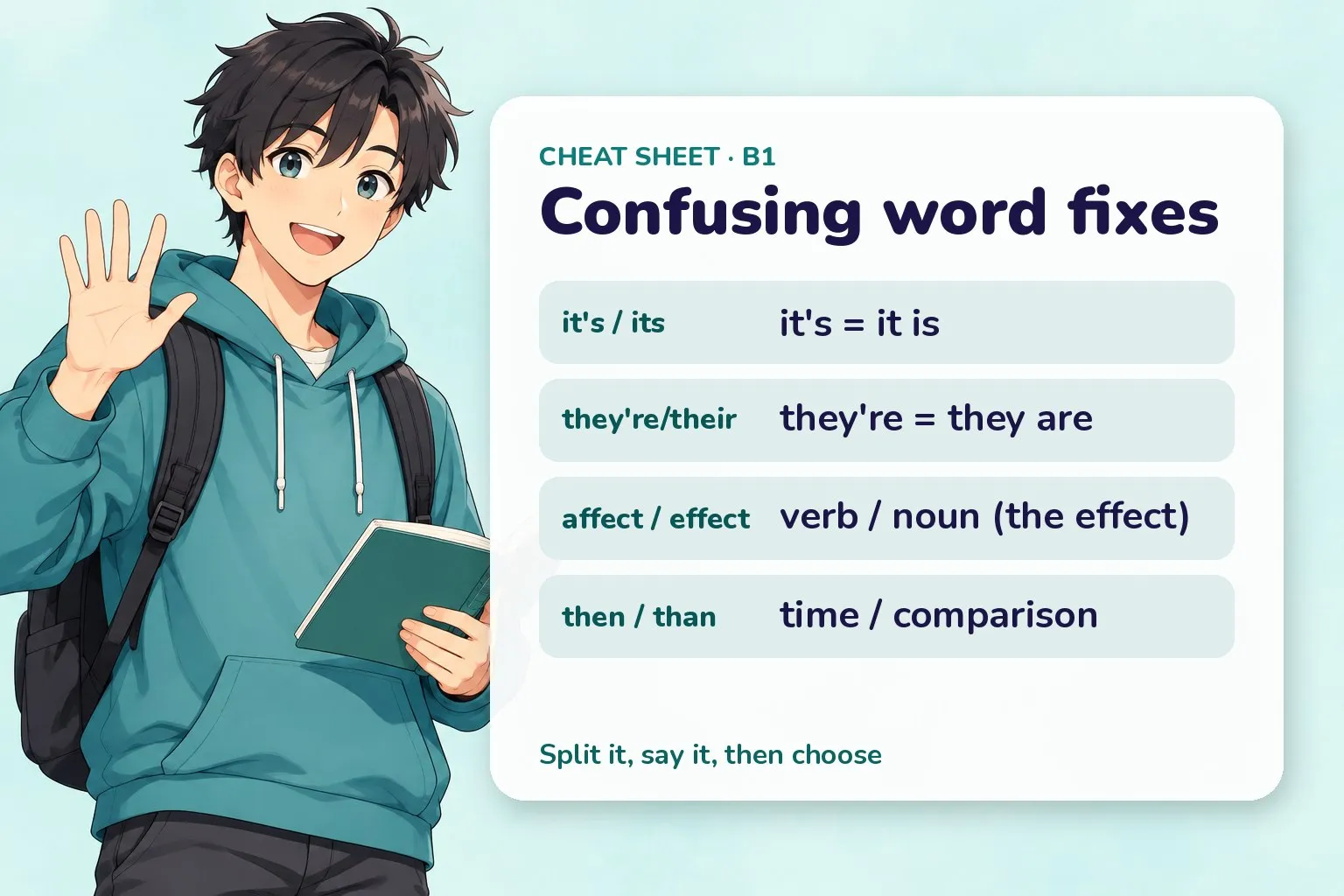
Quick recap before the quiz.
| Pair | Quick test |
|---|---|
| it’s / its | split to “it is”? use it’s |
| they’re / their / there | “they are”? use they’re |
| affect / effect | “the ___”? use effect |
| then / than | comparing? use than |
Practice
Confusing words practice
Try each one, then press Check. No sign-up, nothing is sent anywhere — it all runs in your browser.
1 Match each form to its meaning.
- it's
- its
- they're
- their
Show answer
- it's → it is
- its → belonging to it
- they're → they are
- their → belonging to them
The apostrophe form is always two words joined; the plain form shows belonging.
Hint: it is = short form with an apostrophe
Show answer
it's — it's = it is. The plain 'its' shows belonging and would be wrong here.
Hint: this is a comparison
Show answer
than — Comparisons use 'than'; 'then' is for time or sequence.
6 Put the words in order.
Show answer
you're welcome — You are welcome: the polite reply uses the short form you're.
Quiz
Confusing words quiz
12 questions · pick an answer and you'll see straight away if it's right.
-
Show answer
It's a nice day. — It's = it is.
-
Show answer
its — Belonging to the dog, so the plain form 'its'.
-
Show answer
than — Comparisons use 'than'.
-
Show answer
You're — You are = you're.
-
Show answer
to affect — Affect is the verb (to change something).
-
Show answer
except — except = apart from.
-
Show answer
lose — The verb 'to misplace' is lose (one o).
-
Show answer
Whose — Whose shows belonging; who's = who is.
-
Show answer
advice — The noun is advice; advise is the verb.
-
Show answer
quiet — quiet = little noise; quite = fairly.
-
Show answer
where — where asks which place.
-
Show answer
They're — They are my best friends → They're.
Next
- Next set: British vs American English
- Grammar that helps: Possessive adjectives, Subject pronouns, Comparative adjectives
- New here? Start with Start Learning English Here
All English vocabulary topics
Vocabulary, pronunciation, phrases, practice and exam help, ordered by level. Pick a topic and go straight to it. New lessons go live every day, so topics marked Coming soon fill in over the next weeks.
Vocabulary
A1 13 topics · 13 ready
- 01 100 Most Common English Words
- 02 English Words 101-250 (Frequency)
- 03 100 Essential English Verbs
- 04 Common English Adjectives
- 05 English Question Words & Phrases
- 06 English Time Expressions
- 07 English Food & Cooking Vocabulary
- 08 English Animals Vocabulary
- 09 English Clothing Vocabulary
- 10 English Weather Vocabulary
- 11 English Family & Relationships Vocabulary
- 12 English Colours Vocabulary
- 13 English Numbers, Dates & Money
A2 14 topics · 14 ready
- 14 English Words 251-500 (Frequency)
- 15 English Words 501-1000 (Frequency)
- 16 Everyday English Adverbs
- 17 English Body & Health Vocabulary
- 18 English House & Furniture Vocabulary
- 19 English Kitchen & Tableware Vocabulary
- 20 English Transport & Travel Vocabulary
- 21 English Places in Town Vocabulary
- 22 English Jobs & Professions Vocabulary
- 23 English Money & Shopping Vocabulary
- 24 English Emotions & Feelings Vocabulary
- 25 English Sports & Exercise Vocabulary
- 26 English Verbs of Motion
- 27 English Irregular Verbs Reference
B1 11 topics · 11 ready
- 28 English Words 1001-1500 (Frequency)
- 29 English Words 1501-2000 (Frequency)
- 30 English Connectors & Linking Words
- 31 English Nature & Geography Vocabulary
- 32 English Technology & Internet Vocabulary
- 33 English Education & School Vocabulary
- 34 English Medical & Pharmacy Vocabulary
- 35 English Arts, Music & Film Vocabulary
- 36 100 Essential English Phrasal Verbs
- 37 Commonly Confused English Words You are here
- 38 British vs American English