English Verbs of Motion
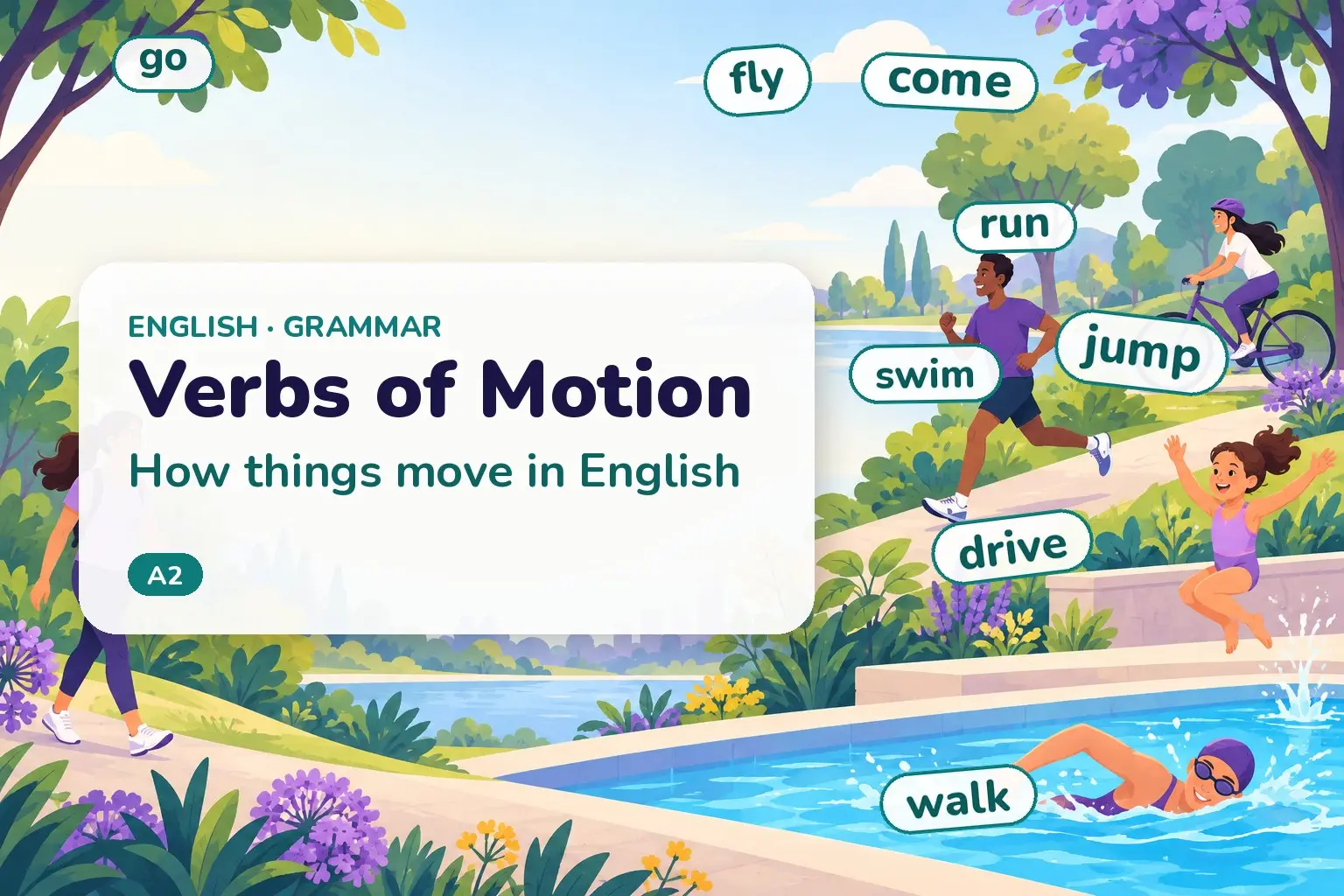
Verbs of motion say how something moves: go and come, walk and run, jump, climb, fall, drive, fly and swim. Many are irregular in the past (go/went, run/ran, fly/flew), and most take a direction word after them: go to work, climb up, walk across the road.
Level: A2. Verbs of motion are the words you reach for all day: going to work, walking the dog, catching a bus. This page groups the motion verbs an A2 learner needs, each with a plain meaning and a short example, plus the irregular past forms that trip learners up.
By the end of this page you can…
…choose the right verb for how something moves, add the direction word that goes with it, and use the common irregular past forms like went, came and ran.
How this list was chosen
Every word here comes from the English frequency list (hermitdave/FrequencyWords), which ranks words by how often they appear in a large collection of everyday subtitles. From that list we kept the verbs of motion an A2 learner needs and grouped them by the kind of movement rather than by rank. The Rank column is the word’s real position in the list — a lower number means the word is more common.
Everyday movement
| Rank | Word | Meaning | Example |
|---|---|---|---|
| 47 | go | to move from one place to another | I go to work by bus. |
| 58 | come | to move toward the speaker | Come here, please. |
| 489 | walk | to move on foot at a normal speed | We walk to school every day. |
| 322 | run | to move fast on foot | She runs in the park each morning. |
| 278 | move | to change place or position | Please move your car. |
| 352 | turn | to change direction | Turn left at the corner. |
Up, down and across
| Rank | Word | Meaning | Example |
|---|---|---|---|
| 1116 | jump | to push off the ground into the air | The cat jumped onto the table. |
| 673 | fall | to drop down suddenly | Be careful not to fall. |
| 2578 | climb | to move up using your hands and feet | They climbed the hill slowly. |
| 1239 | cross | to go from one side to the other | Cross the road at the lights. |
| 692 | step | to move one foot forward or back | Step back from the edge. |
| 1136 | escape | to get away from a place | The bird escaped from its cage. |
Travelling
| Rank | Word | Meaning | Example |
|---|---|---|---|
| 184 | leave | to go away from a place | I leave home at eight. |
| 612 | drive | to control and move a car | He drives to work every day. |
| 768 | ride | to travel on a bike, horse or bus | I ride my bike to the market. |
| 964 | fly | to move through the air | Birds fly south in winter. |
| 2225 | swim | to move through water | We swim at the beach in summer. |
| 2293 | arrive | to reach a place | We arrived at the station early. |
Moving things
| Rank | Word | Meaning | Example |
|---|---|---|---|
| 319 | bring | to take something toward the speaker | Bring your books to class. |
| 1019 | carry | to hold and move something | She carried the baby upstairs. |
| 1065 | push | to move something away from you | Push the door to open it. |
| 663 | pull | to move something toward you | Pull the rope hard. |
| 699 | throw | to send something through the air | Throw the ball to me. |
| 636 | catch | to take hold of something moving | Catch the ball! |
| 637 | follow | to go after someone | Follow me to the exit. |
Irregular past forms to learn
Many of the most common motion verbs do not add -ed in the past. Learn these forms as whole words:
| Verb | Past simple |
|---|---|
| go | went |
| come | came |
| run | ran |
| fall | fell |
| drive | drove |
| ride | rode |
| fly | flew |
| swim | swam |
| leave | left |
| bring | brought |
| throw | threw |
| catch | caught |
For the full pattern and more verbs, see the past simple irregular verbs lesson.
Adding the direction
Most motion verbs are followed by a small word that shows the direction or place: go to work, come from China, walk across the road, climb up the stairs, jump over the wall. Choosing the right one is part of learning the verb — the prepositions of place lesson lists them. To say an action is happening right now, use the present continuous: she is running, they are driving (see present continuous).
Example sentences
Play each line, then say it aloud. These use the motion verbs in natural, everyday patterns.
- I go to work by bus every morning.'Go to' + place for a routine.
- Please come here for a moment.'Come here' moves toward the speaker.
- We walked across the bridge together.'Walk across' with a direction word.
- She runs in the park before breakfast.'Run' for fast movement on foot.
- The children climbed up the big tree.'Climb up' moving upward.
- Be careful not to fall on the ice.'Fall' means to drop down suddenly.
- He drives to the office every day.'Drive' for controlling a car.
- I ride my bike to the market.'Ride' for a bike, horse or bus.
- Birds fly south when it gets cold.'Fly' for moving through the air.
- We swim at the beach in summer.'Swim' for moving through water.
- Turn left at the second corner.'Turn' + direction as an instruction.
- Please carry this bag for me.'Carry' to hold and move something.
- Bring your passport to the airport.'Bring' moves something toward us.
- Push the door, do not pull it.'Push' and 'pull' are opposites.
- Throw the ball and I will catch it.'Throw' and 'catch' work as a pair.
- The cat jumped over the fence.'Jump over' a barrier.
- We left home early and arrived on time.Irregular past: 'left'; and 'arrive'.
- Follow me to the exit, please.'Follow' means to go after someone.
Recap cheat-sheet
A few patterns to remember before the quiz.
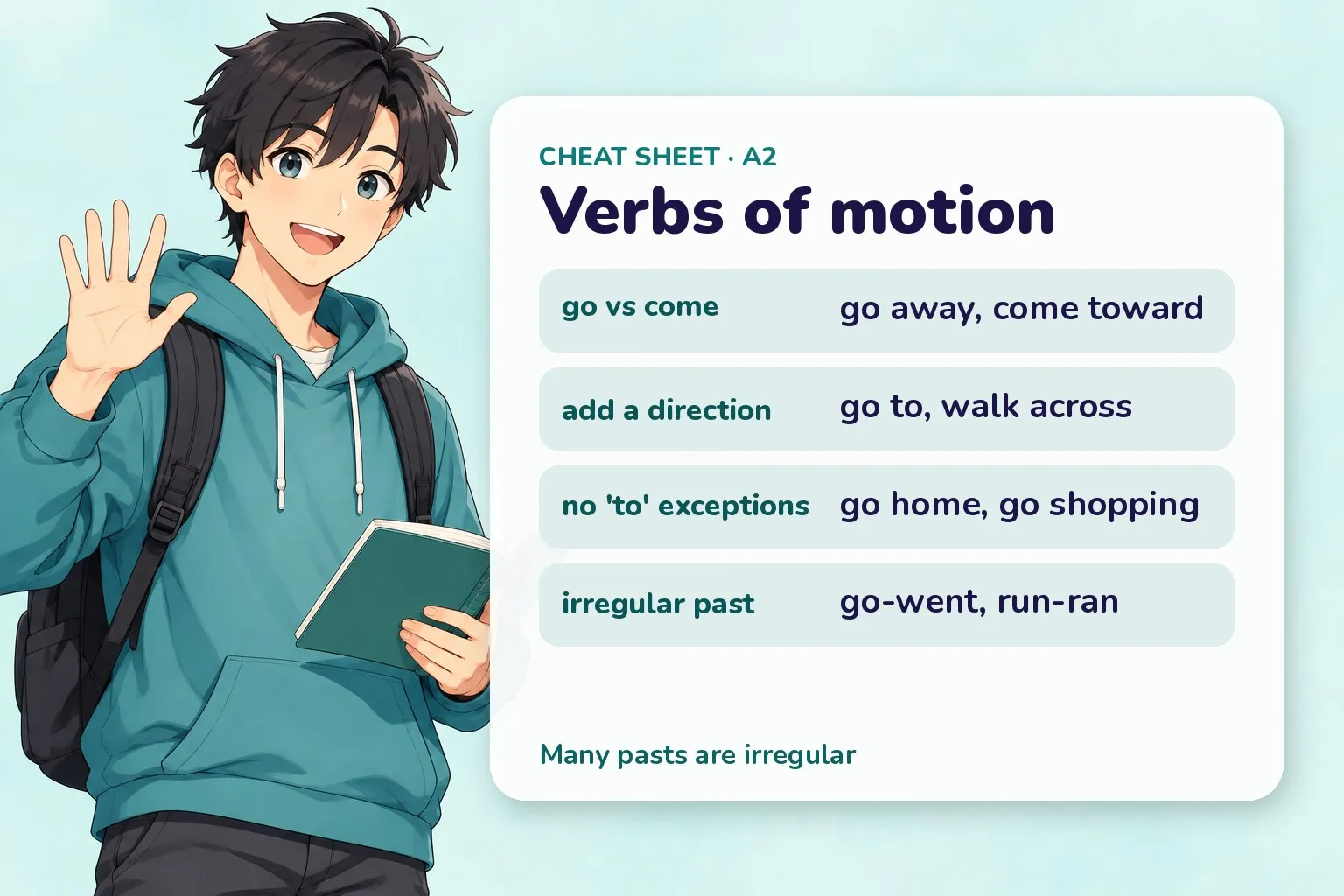
Quick recap before the quiz.
| Point | Example |
|---|---|
| go vs come | go away, come toward |
| add a direction | go to, walk across |
| no ‘to’ exceptions | go home, go shopping |
| irregular past | go-went, run-ran |
Practice
Verbs of motion practice
Try each one, then press Check. No sign-up, nothing is sent anywhere — it all runs in your browser.
1 Match each verb to its meaning.
- climb
- swim
- carry
- arrive
Show answer
- climb → to move up using your hands and feet
- swim → to move through water
- carry → to hold and move something
- arrive → to reach a place
Linking a verb to its meaning helps you recall it faster.
Hint: irregular past of go
Show answer
went — The past simple of 'go' is 'went', not 'goed'.
Hint: no 'to' with this word
Show answer
home — Say 'go home' with no 'to': go home.
6 Put the words in order.
Show answer
the cat jumped over the fence — Subject + verb + direction + object: the cat jumped over the fence.
Quiz
Verbs of motion quiz
12 questions · pick an answer and you'll see straight away if it's right.
-
Show answer
went — The past simple of 'go' is 'went'.
-
Show answer
run — 'Run' is moving fast on foot.
-
Show answer
I go shopping. — Say 'go shopping' with no 'to'.
-
Show answer
swim — You swim through water.
-
Show answer
ran — The past simple of 'run' is 'ran'.
-
Show answer
push — 'Push' moves something away from you; 'pull' moves it toward you.
-
Show answer
fly — Present simple for a fact: birds fly south.
-
Show answer
go — 'Go' moves away; 'come' moves toward.
-
Show answer
flew — The past simple of 'fly' is 'flew'.
-
Show answer
crossed — Past simple 'crossed' fits a finished action.
-
Show answer
drive — You drive a car; you ride a bike.
-
Show answer
brought — The past simple of 'bring' is 'brought'.
Next
- More vocabulary: English Vocabulary hub
- Previous set: English Colours Vocabulary
- Grammar for motion verbs: Past simple: irregular verbs, Present continuous, Prepositions of place
- New here? Start with Start Learning English Here
All English vocabulary topics
Vocabulary, pronunciation, phrases, practice and exam help, ordered by level. Pick a topic and go straight to it. New lessons go live every day, so topics marked Coming soon fill in over the next weeks.
Vocabulary
A1 13 topics · 13 ready
- 01 100 Most Common English Words
- 02 English Words 101-250 (Frequency)
- 03 100 Essential English Verbs
- 04 Common English Adjectives
- 05 English Question Words & Phrases
- 06 English Time Expressions
- 07 English Food & Cooking Vocabulary
- 08 English Animals Vocabulary
- 09 English Clothing Vocabulary
- 10 English Weather Vocabulary
- 11 English Family & Relationships Vocabulary
- 12 English Colours Vocabulary
- 13 English Numbers, Dates & Money
A2 14 topics · 14 ready
- 14 English Words 251-500 (Frequency)
- 15 English Words 501-1000 (Frequency)
- 16 Everyday English Adverbs
- 17 English Body & Health Vocabulary
- 18 English House & Furniture Vocabulary
- 19 English Kitchen & Tableware Vocabulary
- 20 English Transport & Travel Vocabulary
- 21 English Places in Town Vocabulary
- 22 English Jobs & Professions Vocabulary
- 23 English Money & Shopping Vocabulary
- 24 English Emotions & Feelings Vocabulary
- 25 English Sports & Exercise Vocabulary
- 26 English Verbs of Motion You are here
- 27 English Irregular Verbs Reference
B1 11 topics · 11 ready
- 28 English Words 1001-1500 (Frequency)
- 29 English Words 1501-2000 (Frequency)
- 30 English Connectors & Linking Words
- 31 English Nature & Geography Vocabulary
- 32 English Technology & Internet Vocabulary
- 33 English Education & School Vocabulary
- 34 English Medical & Pharmacy Vocabulary
- 35 English Arts, Music & Film Vocabulary
- 36 100 Essential English Phrasal Verbs
- 37 Commonly Confused English Words
- 38 British vs American English