English Reading Practice: Beginner
This page gives you two short, original reading texts at beginner (A1) level, with the new words glossed and comprehension questions. Read each text first for the general idea, then again slowly, and only check the word list when you are stuck.
Level: A1 (beginner). Reading is one of the gentlest ways to grow your English, because you control the speed. Below are two short texts written for beginners, with the new words explained and questions to check what you understood.
By the end of this page you can…
…read two short A1 texts, work out the new words, and answer simple comprehension questions.
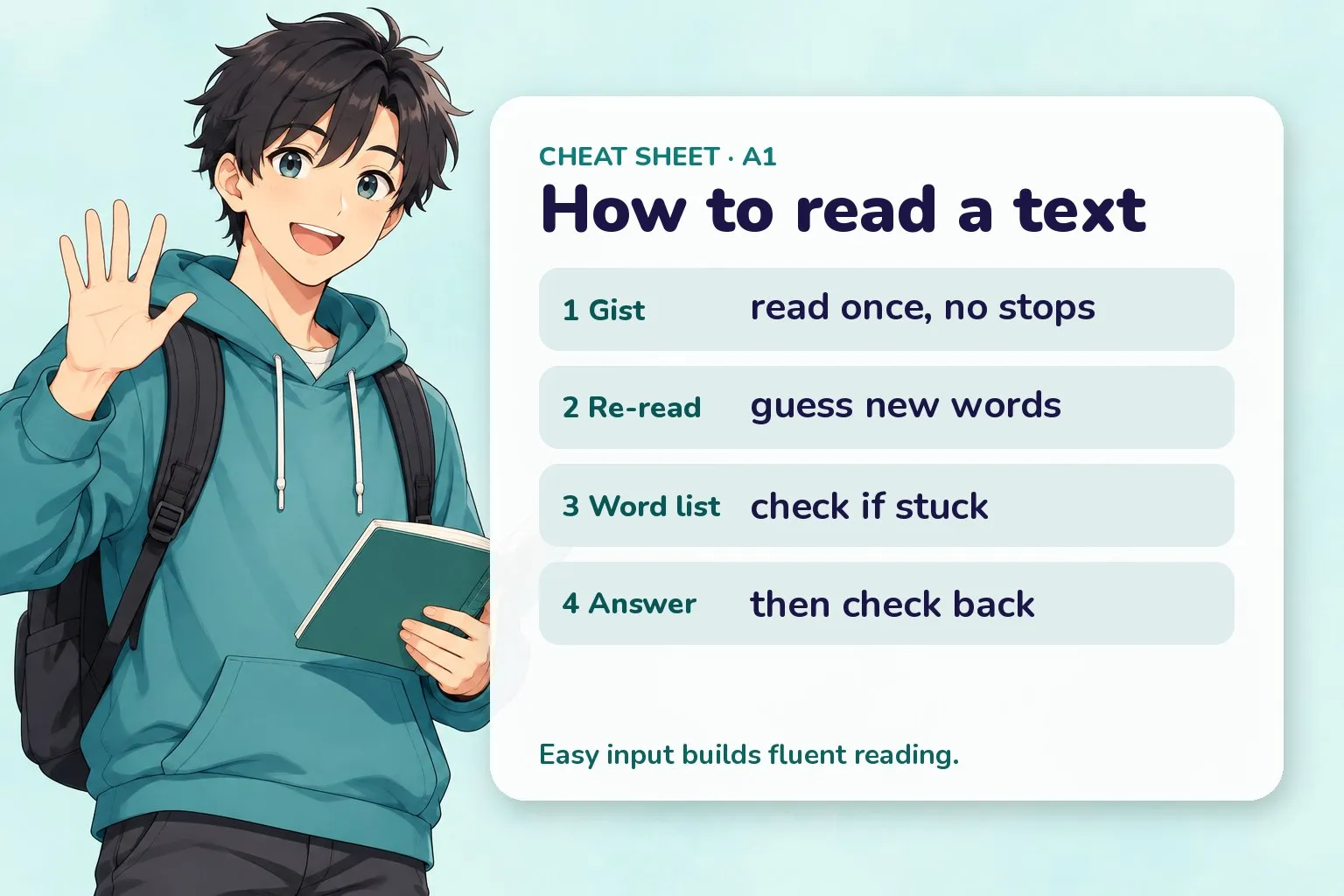
How to use this page
- Read once for the gist. Do not stop at every word. What is the text about? Who is in it?
- Read again, slowly. Try to guess any new words from the sentence around them.
- Check the word list under each text — but only for the words you could not guess.
- Read it aloud once, or play the audio sentences, so you hear the words too.
- Answer the questions at the bottom without looking back, then check.
Reading 1: Maria’s day
Maria is a student. She lives in a small flat with her sister. Every morning she gets up at seven o’clock. She has a shower and she eats breakfast. She drinks tea with milk. She likes tea very much.
Maria goes to school by bus. School starts at nine o’clock. She has lunch with her friends at one o’clock. In the afternoon she studies at home.
In the evening Maria watches television or she reads a book. She goes to bed at eleven o’clock. She is tired, but she is happy.
New words (Reading 1)
| Word | Meaning | Example from the text |
|---|---|---|
| flat | a home inside a building; an apartment | She lives in a small flat. |
| gets up | leaves the bed in the morning | She gets up at seven o’clock. |
| breakfast | the first meal of the day | She eats breakfast. |
| by bus | travelling in a bus | She goes to school by bus. |
| in the afternoon | the time after midday | In the afternoon she studies. |
| tired | needing rest or sleep | She is tired, but happy. |
Reading 2: Tom’s weekend
Tom does not work on Saturday and Sunday. On Saturday morning he plays football in the park with his brother. They like football very much. After the game they are hungry, so they eat a big lunch.
In the afternoon Tom goes shopping. He buys food for the week: bread, eggs, fruit and vegetables.
On Sunday Tom stays at home. He cleans the flat and he calls his mother on the phone. In the evening he cooks dinner for two friends. They eat, talk and laugh together. It is a good weekend.
New words (Reading 2)
| Word | Meaning | Example from the text |
|---|---|---|
| weekend | Saturday and Sunday | Tom does not work at the weekend. |
| hungry | wanting to eat | After the game they are hungry. |
| goes shopping | goes to buy things | In the afternoon Tom goes shopping. |
| vegetables | plants we eat, like carrots | He buys fruit and vegetables. |
| stays at home | does not go out | On Sunday he stays at home. |
| cooks | makes hot food | He cooks dinner for his friends. |
How to say it
A few of these everyday words do not sound the way they look:
- does sounds like “duz”, not “doh-es”.
- vegetables has three beats in speech: “VEJ-tuh-bulz”.
- breakfast sounds like “BREK-fust”, not “break-fast”.
Example sentences
Listen to key sentences from the texts, then read them aloud.
- Maria is a student.A simple is-sentence introducing a person.
- She gets up at seven o'clock.A daily routine with a time.
- She goes to school by bus.How she travels: by bus.
- In the evening she reads a book.A time phrase plus an activity.
- Tom plays football in the park.Present simple with -s: he plays.
- They eat a big lunch.A plural subject, no extra -s on the verb.
- He buys bread, eggs and fruit.A list of common foods.
- It is a good weekend.A short closing sentence with it is.
Quick recap before you answer the questions.
Comprehension practice
Reading comprehension practice
Try each one, then press Check. No sign-up, nothing is sent anywhere — it all runs in your browser.
Hint: a white drink from cows
Show answer
milk — The text says she drinks tea with milk and likes it very much.
Hint: makes hot food
Show answer
cooks — He cooks dinner for two friends in the evening.
5 Match each person to what they do.
- Maria goes to school
- Tom goes shopping
- Maria reads a book
- Tom cleans the flat
Show answer
- Maria goes to school → by bus
- Tom goes shopping → in the afternoon
- Maria reads a book → in the evening
- Tom cleans the flat → on Sunday
Each pair matches a routine from the two texts.
6 Put Maria's day in order.
Show answer
she gets up she goes to school she has lunch she goes to bed — Up first, then school, lunch at one, and bed at eleven.
Quiz
Beginner reading quiz
8 questions · pick an answer and you'll see straight away if it's right.
-
Show answer
in a small flat with her sister — The text says she lives in a small flat with her sister.
-
Show answer
she studies at home — In the afternoon she studies at home; TV is in the evening.
-
Show answer
on Saturday and Sunday — Tom does not work at the weekend — Saturday and Sunday.
-
Show answer
they are hungry after the game — After the football game they are hungry, so they eat a big lunch.
-
Show answer
food for the week — He buys bread, eggs, fruit and vegetables — food for the week.
-
Show answer
because the subject is he (he/she/it takes -s) — In the present simple, he, she and it add -s: he plays, she gets, it is.
-
Show answer
read once for the general idea — Read for the gist first; check only the words you cannot guess.
-
Show answer
needing rest or sleep — Maria is tired (needs rest), but she is happy.
Next
- Read a longer step up: English Reading Practice: Elementary
- Say what you read: Shadowing to Improve English Speaking
- New here? Start with Start Learning English Here
All English practice topics
Vocabulary, pronunciation, phrases, practice and exam help, ordered by level. Pick a topic and go straight to it. New lessons go live every day, so topics marked Coming soon fill in over the next weeks.
Practice
A1 1 topics · 1 ready
- 01 English Reading Practice: Beginner You are here