How to Practise English Writing
Build from clear sentences to short paragraphs, keep one idea per paragraph, and improve through a feedback loop: draft, read it aloud, check it against a short list, then redraft. Little and often beats one long session.
Level: B1. Writing improves fastest when you build up in steps and redraft. This page gives you a simple paragraph shape, model sentences, and a feedback loop you can repeat every week.
By the end of this page you can…
…write a clear paragraph with one main idea and improve it through a short draft-and-redraft loop.
Start small: sentence, then paragraph
Before long texts, make sure a single sentence is clear and correct. A strong simple sentence has a subject and a verb and says one thing: The bus was late. Once your sentences are reliable, join a few that share an idea into a paragraph. A short, correct paragraph is a real achievement at B1 — do not reach for complex sentences you cannot control yet.
Combine ideas with a few linking words rather than commas alone. The bus was late, so I missed the start. I waited for twenty minutes, but it never came. Used well, and, but, so and because make your writing flow.
A simple paragraph shape
Most clear paragraphs follow the same shape. Learn it, then vary it:
- Topic sentence — states the paragraph’s one main idea.
- Supporting sentences — explain or give reasons.
- Example — a specific detail that shows the idea.
- Closing sentence — rounds the idea off or links to the next paragraph.
Keep to one main idea per paragraph. When you start a new idea, start a new paragraph.
Model sentences and a model paragraph
Press play to hear these models, then use them as patterns for your own writing.
- My neighbourhood is a good place to live.a topic sentence: it states one main ideastart the paragraph with the point you will support
- It is quiet, and the streets are clean.a supporting sentence with a reasonand joins two linked ideas
- For example, there is a small park on my street.an example sentencefor example introduces a specific detail
- The shops are close, so I can walk to them.a supporting sentence with a resultso shows a result
- However, the buses are not very frequent.a contrast sentencehowever adds a limitation politely
- Because of this, most people drive to work.a cause-and-effect sentencebecause of this links back to the previous point
- In short, it is a calm and friendly area.a closing sentencein short signals a summary
- I have lived here for three years.a present perfect sentence about durationuse have lived for an unfinished time period
- Last winter, the community planted new trees.a past simple sentence with a time markerlast winter places the action in finished time
- I would recommend it to a new family.a recommendation with wouldwould recommend softens advice
Get feedback and redraft
A draft is a start, not a finish. Improve it with this loop:
- Read it aloud. Your ear catches missing words, run-on sentences and wrong verb forms that your eye skips.
- Check against a short list. Pick three things you often get wrong — for example articles (a / the), verb endings (-s, -ed) and sentence length — and scan for just those.
- Mark, do not rewrite, first. Underline problems on the first pass; fix them on the second. Separating finding from fixing is faster.
- Redraft. Write a clean second version. The gap between draft one and draft two is where most of the learning happens.
A weekly writing routine
- Most days: write five to eight sentences about your day or a prompt.
- Twice a week: write one short paragraph using the shape above.
- Once a week: take one paragraph through the full feedback loop and redraft it.
- Keep a list: note the mistakes you fix most often and check for them first next time.
Little and often builds the habit; redrafting turns practice into progress. For grammar you are unsure of, follow the links below rather than guessing.
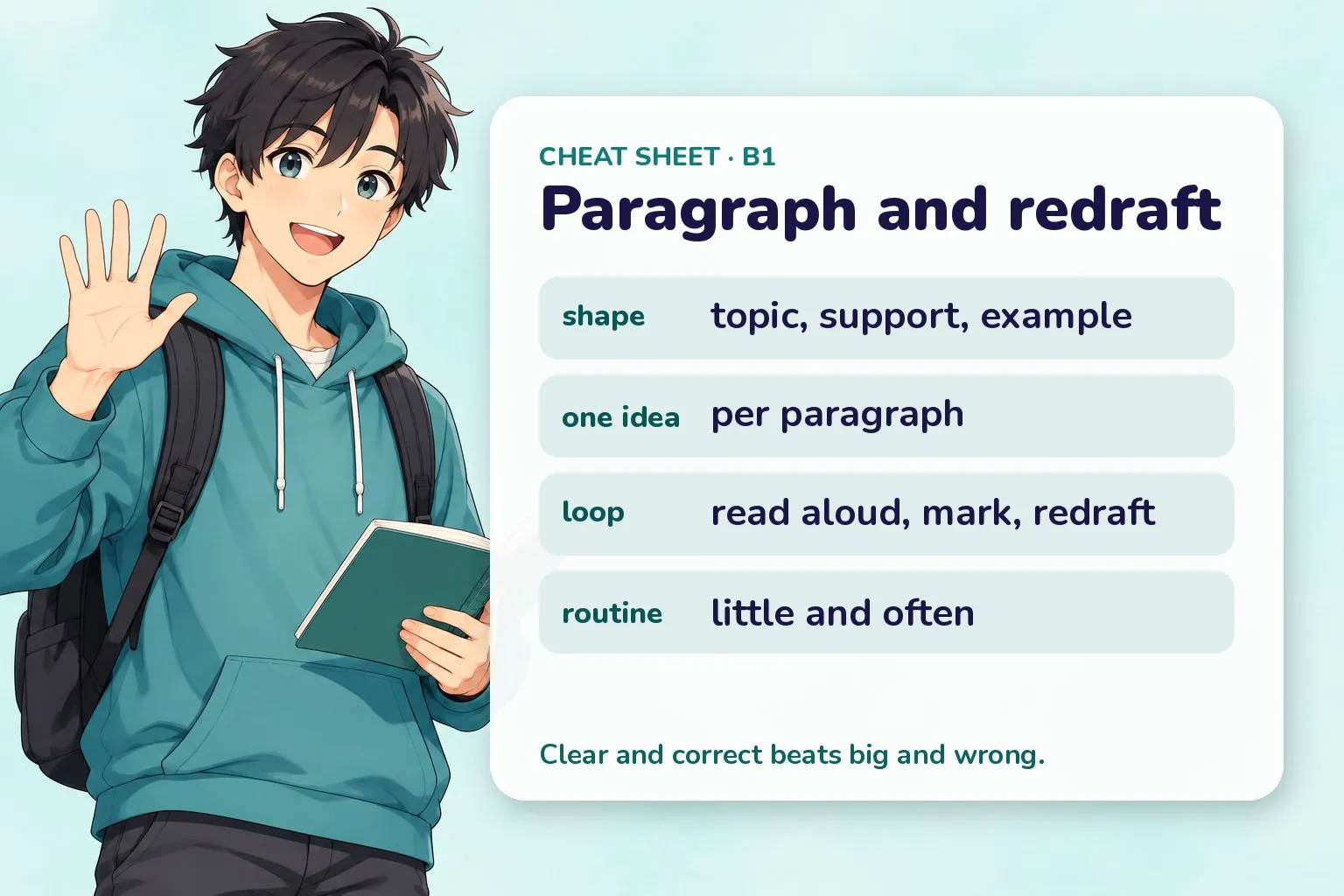
Quick recap before you practise.
How to say it
A few words in this lesson are easy to misread aloud:
- paragraph: PARR-uh-graf, three syllables, stress on the first.
- vocabulary: vuh-KAB-yuh-luh-ree, stress on the second syllable.
- routine: roo-TEEN, stress on the second syllable.
Practice
Writing practice loop
Try each one, then press Check. No sign-up, nothing is sent anywhere — it all runs in your browser.
2 Put these sentences in the usual paragraph order.
Show answer
My street is a nice place to live. It is quiet and clean. For example, there is a park nearby. In short, I am happy here. — Topic sentence, then support, then example, then a closing summary.
Hint: go is irregular in the past simple
Show answer
went — The past simple of go is went; reading aloud often catches this slip.
4 Match each linking word to what it shows.
- so
- but
- because
- for example
Show answer
- so → a result
- but → a contrast
- because → a reason
- for example → a detail
so = result, but = contrast, because = reason, for example = a specific detail.
Quiz
English writing practice quiz
7 questions · pick an answer and you'll see straight away if it's right.
-
Show answer
clear, correct simple sentences — Reliable simple sentences come before complex ones you cannot yet control.
-
Show answer
one — One idea per paragraph; start a new paragraph for a new idea.
-
Show answer
catch missing words and wrong verb forms — Your ear notices errors that your eye skips over.
-
Show answer
mark the problems, then fix them on a second pass — Separating finding from fixing is faster and clearer.
-
Show answer
I went to the shop yesterday and bought some bread. — It fixes the past tense (went, bought) and the uncountable noun (some bread).
-
Show answer
short, regular practice with redrafting — Little and often, plus redrafting, drives steady improvement.
-
Show answer
a result — so links a cause to its result.
Next
- Browse every task in the English practice section
- Build the tenses you need in Past Simple: Regular Verbs and the Present Continuous
- Keep new words with How to Use Flashcards for English
All English practice topics
Vocabulary, pronunciation, phrases, practice and exam help, ordered by level. Pick a topic and go straight to it. New lessons go live every day, so topics marked Coming soon fill in over the next weeks.
Practice
A1 1 topics · 1 ready
A2 3 topics · 3 ready
B1 3 topics · 3 ready
- 05 Shadowing to Improve English Speaking
- 06 English Reading Practice: Intermediate
- 07 How to Practise English Writing You are here