Shadowing to Improve English Speaking
Shadowing means playing a short clip of natural English and speaking along with it almost at the same time, copying the sounds, stress and intonation without reading. Work in short daily bursts and record yourself to hear what to fix.
Level: B1. Shadowing is one of the most efficient ways to make your spoken English clearer and more natural. You copy a speaker almost in real time, so your mouth learns the rhythm of English instead of the rhythm of your first language.
By the end of this page you can…
…run a short shadowing session on your own, avoid the common mistakes, and fit the practice into a daily routine.
What shadowing is
Shadowing means listening to a short piece of spoken English and speaking along with it at almost the same time — a beat behind the speaker — while you copy their sounds, word stress and intonation. You are not translating and you are not reading aloud from a page. You are imitating a voice, the way you might hum along to a song you half know.
Because you speak with the audio rather than after it, you cannot slow down or stop to think. That pressure is the point: it forces your mouth to produce the connected, flowing sound of real English instead of one careful word at a time.
How to shadow, step by step
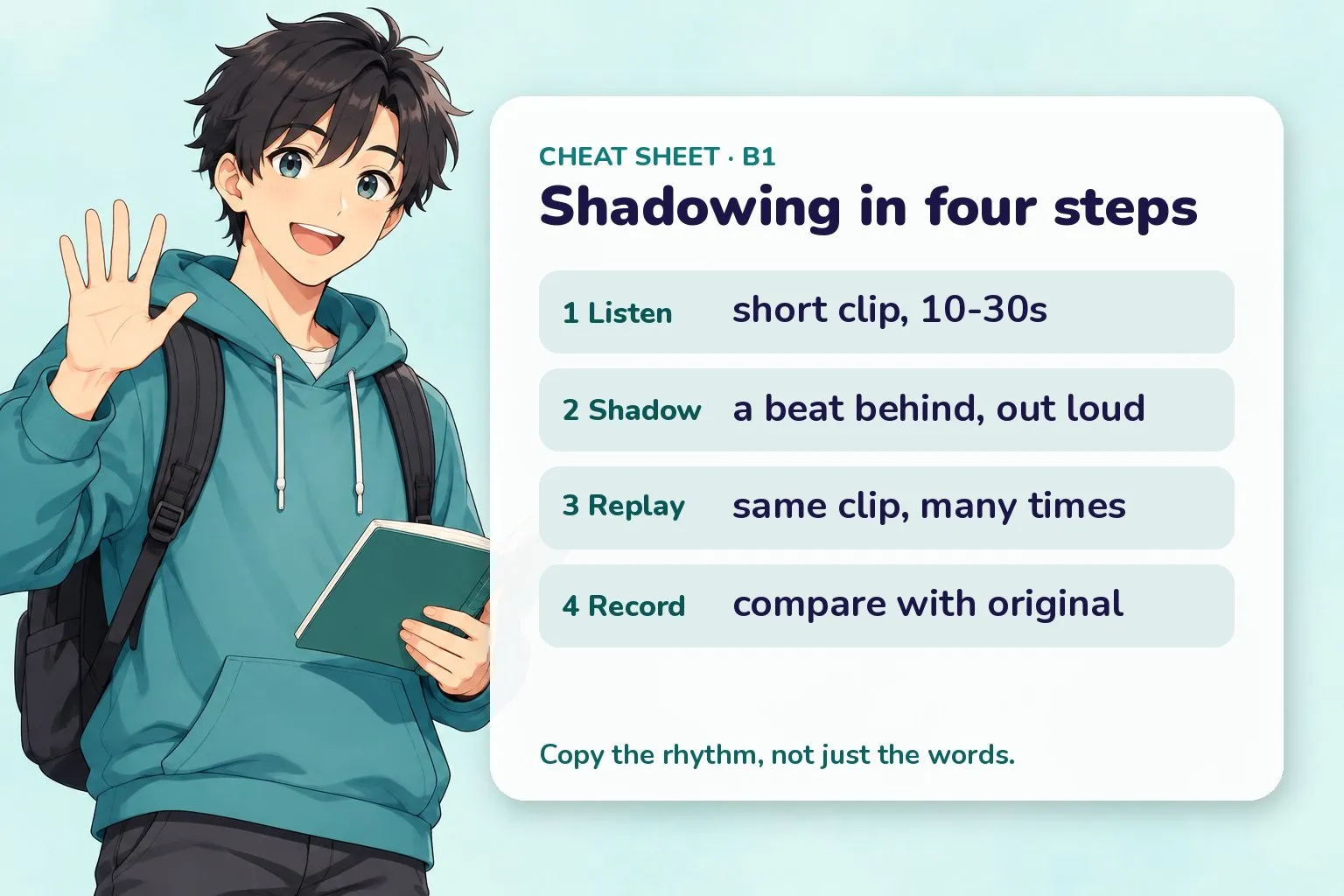
- Choose a short clip, 10–30 seconds. A single sentence or two is plenty. Natural, clear speech works best — a slow interview, a simple story, or the lesson audio on this site.
- Listen once or twice for meaning. Make sure you understand it before you try to speak.
- Shadow with your eyes closed, no text. Play the clip and speak along, a fraction behind the voice. Do not worry about getting every word — hold on to the melody and the beat.
- Replay the same clip several times. Each pass, catch a little more: a linked phrase, a stressed word, a falling tone at the end.
- Now open the transcript. Read along while you shadow to find the exact words you were blurring or missing.
- Record yourself shadowing once more, then play your voice next to the original. The gaps you hear are your to-do list.
Common pitfalls
- Reading instead of listening. If your eyes are glued to the text from the start, you copy spelling, not sound. Ears first, text later.
- Chasing speed. Speaking fast but flat is not fluency. Copy the rhythm — which words are long and loud, which are short and quiet.
- Clips that are too long or too hard. A 30-second clip you understand beats a two-minute clip you don’t. Keep it short and repeat it.
- Practising silently. Shadowing only works out loud. Mouthing the words gives your muscles no workout.
- One pass and move on. The improvement comes from repeating the same clip until it feels easy, not from always finding new audio.
Choose the right audio
Good shadowing audio is clear, not too fast, and comes with a transcript so you can check yourself. The spoken examples in these lessons are made for exactly this: each one has an audio button, so you can shadow a single phrase, then a full sentence. Start with the short ones below.
How to say it
English runs its words together, so shadowing is where you train that “joined-up” sound:
- Linking. Pick it up sounds like “pi-ki-tup”; an apple sounds like “a-napple”. Copy the links, don’t separate every word.
- Weak forms. Little words like to, of, and, can almost disappear: a cup of tea → “a cuppa tea”; fish and chips → “fish’n chips”.
- Sentence stress. English stresses the words that carry meaning (nouns, main verbs) and swallows the rest. Shadowing teaches your ear this beat faster than any rule.
Example sentences
Shadow each line below: play the audio, then speak along a beat behind. Start slow, repeat, and copy the rhythm.
- Hi, how are you?An everyday greeting — let the three words run together.Link how-are into one smooth sound.
- Nice to meet you.A fixed polite phrase; keep it light and quick.
- Can I have a coffee, please?A café request — notice how can and a shrink.
- What time does it start?A question with falling intonation at the end.
- I'd like to book a table for two.Copy the linked I'd-like-to at the front.
- Could you say that again, please?A longer polite request; keep could-you joined.
- I've been waiting for about ten minutes.Stress waiting and ten, swallow the small words.
- Sorry, I didn't catch your name.Notice didn't and catch linking together.
- We're going to need a bit more time.Reduce going-to to gonna in fast speech.
- It was one of the best films I've ever seen.A longer sentence; ride the stress on best and ever.
- If I were you, I'd leave a little earlier.Advice with a gentle rise then fall.
- Thanks so much for all your help today.End warmly, stress much and help.
Quick recap before you practise.
Practice
Shadowing method practice
Try each one, then press Check. No sign-up, nothing is sent anywhere — it all runs in your browser.
Hint: the written version of the audio
Show answer
transcript — Ears first, then use the transcript to catch words you blurred.
4 Put a shadowing session in order.
Show answer
choose a short clip listen for meaning shadow with no text record and compare — Choose, understand, shadow by ear, then record and compare.
5 Match each pitfall to its fix.
- reading from the start
- chasing speed
- practising silently
- one pass only
Show answer
- reading from the start → listen first, text later
- chasing speed → copy the rhythm, not the pace
- practising silently → say it out loud
- one pass only → repeat the same clip
Each fix turns a common shadowing mistake into good practice.
Quiz
Shadowing quiz
8 questions · pick an answer and you'll see straight away if it's right.
-
Show answer
to copy the sounds, stress and rhythm of English — Shadowing reshapes how you sound by imitating a speaker closely.
-
Show answer
about 10–30 seconds — A short clip you can repeat beats a long one you cannot.
-
Show answer
so you copy the sound, not the spelling — Starting by ear stops you copying spelling instead of real pronunciation.
-
Show answer
fluency is about rhythm and stress, not raw pace — Copy which words are long and loud; speaking fast but flat is not fluent.
-
Show answer
reduced to a weak 'n sound — Small words weaken in natural English: fish'n chips.
-
Show answer
repeating the same clip until it feels easy — Repetition of one clip is what builds the muscle memory.
-
Show answer
hear the gaps between your voice and the original — Comparing your recording to the original shows you exactly what to fix.
-
Show answer
a speaking and pronunciation drill — It is an out-loud speaking drill that trains rhythm and pronunciation.
Next
- Pair this with How to Practise English Listening
- Build the rhythm it relies on: Sentence Stress & Rhythm
- New here? Start with Start Learning English Here
All English practice topics
Vocabulary, pronunciation, phrases, practice and exam help, ordered by level. Pick a topic and go straight to it. New lessons go live every day, so topics marked Coming soon fill in over the next weeks.
Practice
A1 1 topics · 1 ready
A2 3 topics · 3 ready
B1 3 topics · 3 ready
- 05 Shadowing to Improve English Speaking You are here
- 06 English Reading Practice: Intermediate
- 07 How to Practise English Writing