TOEFL Reading Strategies
The TOEFL iBT Reading section has 50 items in about 30 minutes across three task types. Every answer is in the text, so the best strategy is to read for the writer's purpose, use context for vocabulary, and never rely on outside knowledge.
On this page11 sections · tap to jump
- 01By the end of this page you can…
- 02What the Reading section looks like
- 03Task 1: Complete the Words — read for word families
- 04Task 2: Read in Daily Life — skim for purpose
- 05Task 3: Read an Academic Passage — trace the ideas
- 06Timing across the section
- 07Vocabulary you’ll meet
- 08Practice
- 09Quiz
- 10Recap cheat-sheet
- 11How to prepare with this course
Level: B2. The TOEFL iBT Reading section is not about long textbook chapters. It uses short, focused texts and three task types, and every answer is contained in the text in front of you. That changes how you should read it. This page shows the format and the strategy that fits each task.
By the end of this page you can…
…name the three Reading task types, budget your time across 50 items, and apply the right reading skill — skimming, scanning or tracing ideas — to each one.
What the Reading section looks like
Reading comes first in the test: 50 items in about 30 minutes. It is multistage adaptive, so how you do on the first part decides the difficulty of the second part (ETS). The texts are concise and focused, and a key principle runs through all of them: all the information you need is in the text, and you do not need prior knowledge of the topic (ETS).
| Task type | Text | What it measures |
|---|---|---|
| Complete the Words | a short paragraph with missing letters | vocabulary and meaning from context |
| Read in Daily Life | short everyday texts, 2 to 3 questions each | main ideas, key details, implied meaning |
| Read an Academic Passage | a short academic passage, about 200 words | main ideas, supporting details, vocabulary, inference |
Task 1: Complete the Words — read for word families
In Complete the Words you see a short paragraph where parts of some words are missing, and you type the missing letters. It tests whether you can process a text for both meaning and form (ETS). The fix is vocabulary depth: knowing a word’s full spelling and its family (decide, decision, decisive) lets you complete it from the few letters and the surrounding sense.
Task 2: Read in Daily Life — skim for purpose
These are short, non-academic texts you meet in real life: notices, menus, schedules, emails, messages, signs, adverts and the like, each followed by two or three multiple-choice questions (ETS). The skills being measured are skimming and scanning, finding the main purpose, handling informal or idiomatic language, and making inferences from brief, telegraphic text.
Here is an illustrative example in that style:
Library notice: Returns box relocated to the main entrance during renovation. Staffed desk closed until 9 March. Online renewals unaffected.
Main purpose? To tell readers where to return items while the desk is closed — not to advertise, not to charge a fee.
Read for why the text exists before you read for detail. One scan to grasp the purpose, a second to find the specific answer, and you are done.
Task 3: Read an Academic Passage — trace the ideas
The academic passages are short — about 200 words — and expository, drawn from fields such as history, art and music, business and economics, life science, physical science and social science (ETS). Each is followed by five questions that may ask about factual information, vocabulary in context, inference, the relationship between ideas, and the purpose of part or all of the text.
A reliable routine: read the whole passage once for the main idea; for a detail question, scan back to the exact sentence; for a vocabulary-in-context question, cover the word and predict a synonym from the sentence; for a purpose question, ask what the writer is trying to do in that part.
Timing across the section
Fifty items in thirty minutes is brisk. Do not sink several minutes into one Complete the Words gap or one hard inference — mark your best answer and move on, because every item counts toward the adaptive path. Save your final seconds to settle any item you flagged.
Vocabulary you’ll meet
Tap a word to hear it. These are the reading skills and terms the section is built around.
- to skimto read quickly to get the general idea or purpose of a text.
- to scanto search a text fast for one specific piece of information.
- to inferto work out something that is suggested but not stated directly.
- the main ideathe single most important point a text makes.
- a supporting detaila fact or example that backs up the main idea.
- vocabulary in contextthe meaning of a word as used in this particular sentence.
- expositorywriting that explains or informs, rather than telling a story.
- the purposethe reason a text, or a part of it, was written.
- telegraphicvery short, cut-down language, as on a sign or in a note.
- idiomaticnatural everyday phrasing whose meaning is not literal.
- a word familya group of related words, such as decide, decision, decisive.
- to flagto mark an item so you can return to it before time runs out.
Practice
TOEFL Reading strategy practice
Try each one, then press Check. No sign-up, nothing is sent anywhere — it all runs in your browser.
2 Match each task to the best strategy.
- Complete the Words
- Read in Daily Life
- Read an Academic Passage
- Any question
Show answer
- Complete the Words → use the sentence, then the letters
- Read in Daily Life → skim for the main purpose
- Read an Academic Passage → trace how ideas connect
- Any question → find the line that proves it
Each task rewards a slightly different reading skill.
Hint: Reading comes first in the test
Show answer
30 — You have roughly 30 minutes, so work at a steady pace.
4 Put a sensible routine for an academic passage in order.
Show answer
read once for the main idea scan back for the detail check the line that proves your answer — Grasp the whole, then locate the detail, then verify against the text.
Hint: a word with the same meaning
Show answer
synonym — Predicting a synonym from context points you to the right option.
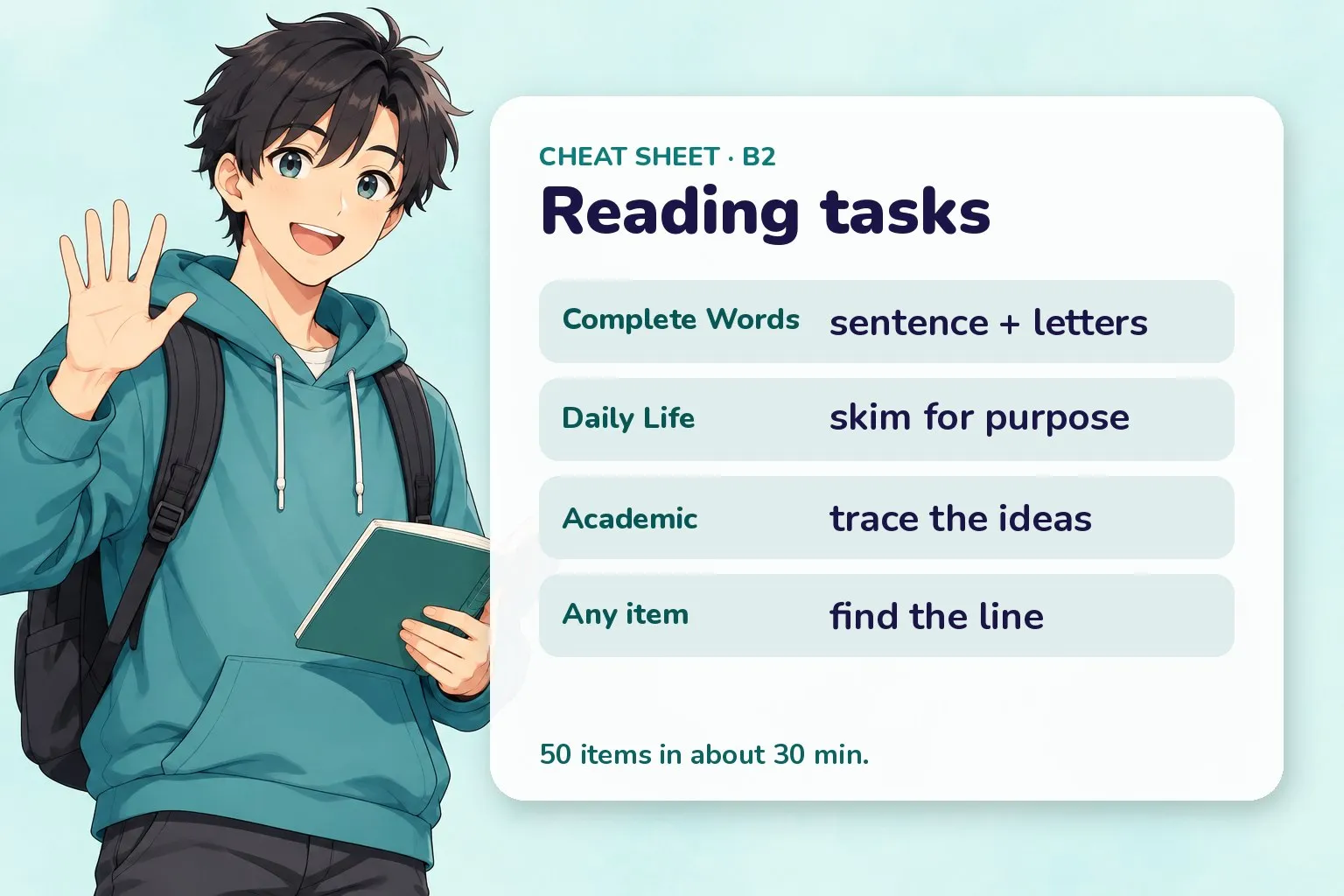
Quick recap before the quiz.
Quiz
TOEFL Reading strategies quiz
12 questions · pick an answer and you'll see straight away if it's right.
-
Show answer
Complete the Words — Complete the Words tests vocabulary and meaning from context.
-
Show answer
notices, menus and messages — They are short, everyday, non-academic texts.
-
Show answer
200 words — The passages are concise, roughly 200 words.
-
Show answer
multistage adaptive — Your first-part answers set the difficulty of the second part.
-
Show answer
a line in the text you can point to — Every answer is supported somewhere in the text.
-
Show answer
reading quickly for the general idea or purpose — Skimming gets you the gist or purpose fast.
-
Show answer
searching fast for one specific detail — Scanning locates a specific piece of information.
-
Show answer
knowing whole word families and spelling — You rebuild words from context, so vocabulary depth is key.
-
Show answer
why the text exists (its purpose) — Grasping the purpose makes the detail questions quick.
-
Show answer
the meaning the word has in that sentence — Context decides which meaning applies here.
-
Show answer
mark your best answer, flag it, and move on — Every item counts; answer, flag, and return if time allows.
-
Show answer
history, science, business, art and social science — Topics span many subject areas, but need no prior knowledge.
Recap cheat-sheet
| Task | Strategy |
|---|---|
| Complete the Words | read the sentence, use the letters, know word families |
| Read in Daily Life | skim for purpose, then scan for the detail |
| Read an Academic Passage | read for the main idea, trace how ideas connect |
| Every question | find the line in the text that proves it |
| Timing | ~50 items in ~30 minutes, steady pace |
How to prepare with this course
Reading speed and comprehension grow with regular, timed reading:
- Timed reading: work through the B2 reading practice and the full practice pages.
- Vocabulary depth: the vocabulary sets build the word families Complete the Words relies on.
- Grammar for structure: grammar lessons on linking and clause structure help you trace how ideas connect.
- New to the exams? Start at the English exams hub.
Next
- Rehearse reading: English Reading Practice: Upper-Intermediate
- Build word families: English Vocabulary sets
- Compare the exams: English exams hub
- New here? Start with Start Learning English Here
All English exams topics
Vocabulary, pronunciation, phrases, practice and exam help, ordered by level. Pick a topic and go straight to it. New lessons go live every day, so topics marked Coming soon fill in over the next weeks.
Exams
A2 1 topics · 1 ready
B1 6 topics · 6 ready
B2 12 topics · 12 ready
- 08 IELTS Reading: Format & Strategies
- 09 IELTS Academic Writing Task 1
- 10 IELTS Writing Task 2 (Essay)
- 11 IELTS Speaking: Parts 1-3
- 12 TOEFL iBT Overview: Format & Scoring
- 13 TOEFL Reading Strategies You are here
- 14 TOEFL Listening Strategies
- 15 TOEFL Speaking Tasks
- 16 TOEFL Writing (incl. Integrated)
- 17 B2 First (FCE) Overview
- 18 Exam Essay & Writing Skills
- 19 Exam Speaking Strategies