TOEFL iBT Speaking Tasks
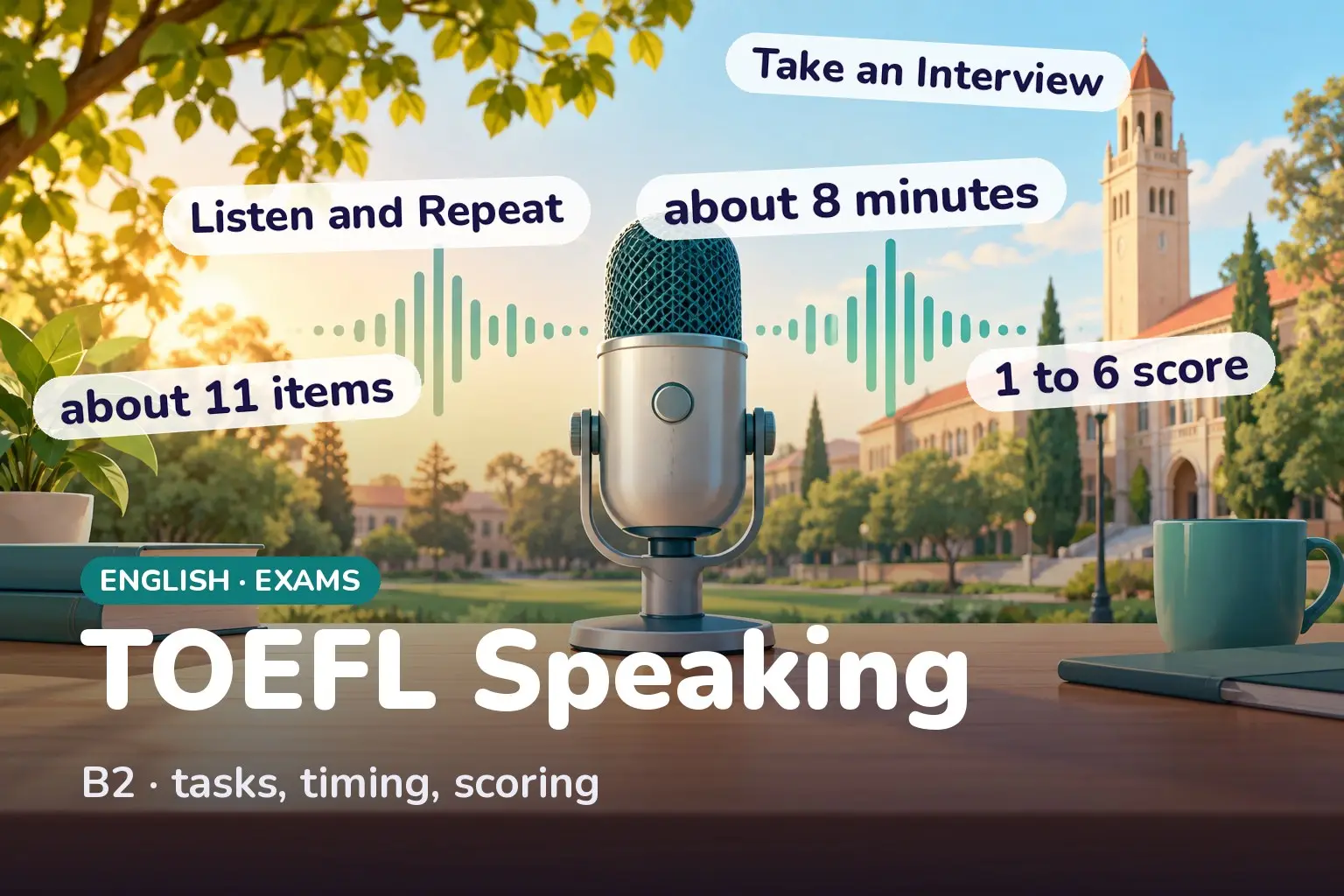
The revised TOEFL iBT Speaking section has two task types, Listen and Repeat and Take an Interview, with about 11 items in roughly 8 minutes. You speak into a microphone, and the section feeds a score on the 1 to 6 scale.
On this page11 sections · tap to jump
Level: B2. The TOEFL iBT was revised in 2026, and Speaking is now one of the shortest sections. You speak into a microphone across two task types, and your recordings are scored afterwards. This page shows what those tasks are, what each rewards, and how to train for them with this course.
By the end of this page you can…
…name the two current Speaking task types, know how many items and how long to plan for, understand how the section is scored, and practise with model answers.
What the Speaking section looks like now
The Speaking section measures how clearly and effectively you communicate in spoken English in academic and campus-life settings (ETS). The tasks are focused and structured, and you record your answers rather than talk to a live examiner.
| Detail | TOEFL iBT Speaking |
|---|---|
| Number of items | about 11 |
| Approximate base time | about 8 minutes |
| Task types | two (below) |
| How you answer | speak into a microphone; responses are recorded |
| Score | a section score on the 1 to 6 scale |
Allow about two hours for the whole test (the per-section times exclude directions), and remember the test adapts, so the exact timing can vary (ETS).
The two Speaking task types
ETS lists these Speaking tasks for the current test:
- Listen and Repeat — you hear short sentences and repeat them exactly as you heard them. This checks whether you can process spoken English and produce speech that is accurate and clearly intelligible.
- Take an Interview — you join a simulated interview about academic or campus situations and answer questions about your experiences and opinions. This checks whether you communicate clearly, keep a natural speaking pace, and use suitable vocabulary and grammar.
No specialist background knowledge is needed. You may hear North American, British, Australian or New Zealand accents in the prompts (ETS).
How it is scored
You receive four section scores and an overall score on the 1 to 6 scale; the overall is the average of all four sections, rounded to the nearest half band (ETS). During a two-year transition after January 2026, ETS also reports a comparable overall on the older 0 to 120 scale. ETS says scoring focuses on how clearly you communicate, so a steady, intelligible answer beats a fast, error-filled one.
Sample answers (illustrative)
These are our own model answers, written to show the shape of a strong response — not official TOEFL answers.
Notice how the sample answers the question directly, gives one clear reason, adds a short example, and ends cleanly — all at a natural pace.
Example: useful spoken-answer phrases
Play each line and say it aloud. These give you a confident opening or a way to keep going.
- The main reason is that it saves a lot of time.State one clear reason first.
- For example, last year I joined a study group.Back a point with a quick example.
- Personally, I prefer studying in the morning.Give an opinion in the interview task.
- On the one hand it is cheaper, but on the other it is slower.Balance two sides smoothly.
- What I mean is that practice matters more than talent.Rephrase to stay clear if you stumble.
- To be honest, I had not thought about that before.A natural way to buy a second to think.
- That is a good question; let me give an example.Open the interview answer naturally.
- In my experience, group work helps me learn faster.Draw on personal experience, as the task asks.
- So overall, I would choose the second option.Close with a clear decision.
- Could you repeat the question, please?A polite, correct way to ask for a repeat.
How to prepare with this course
Spoken fluency grows from daily output, not from reading model answers:
- Build rhythm and clear sounds with the Shadowing technique and the sentence stress and rhythm page — both feed the Listen and Repeat task directly.
- Smooth your delivery with intonation patterns and connected speech.
- Keep accuracy up with the grammar lessons at your level, so quick answers stay controlled.
- Widen the words you can reach for with the vocabulary sets.
Quick visual recap
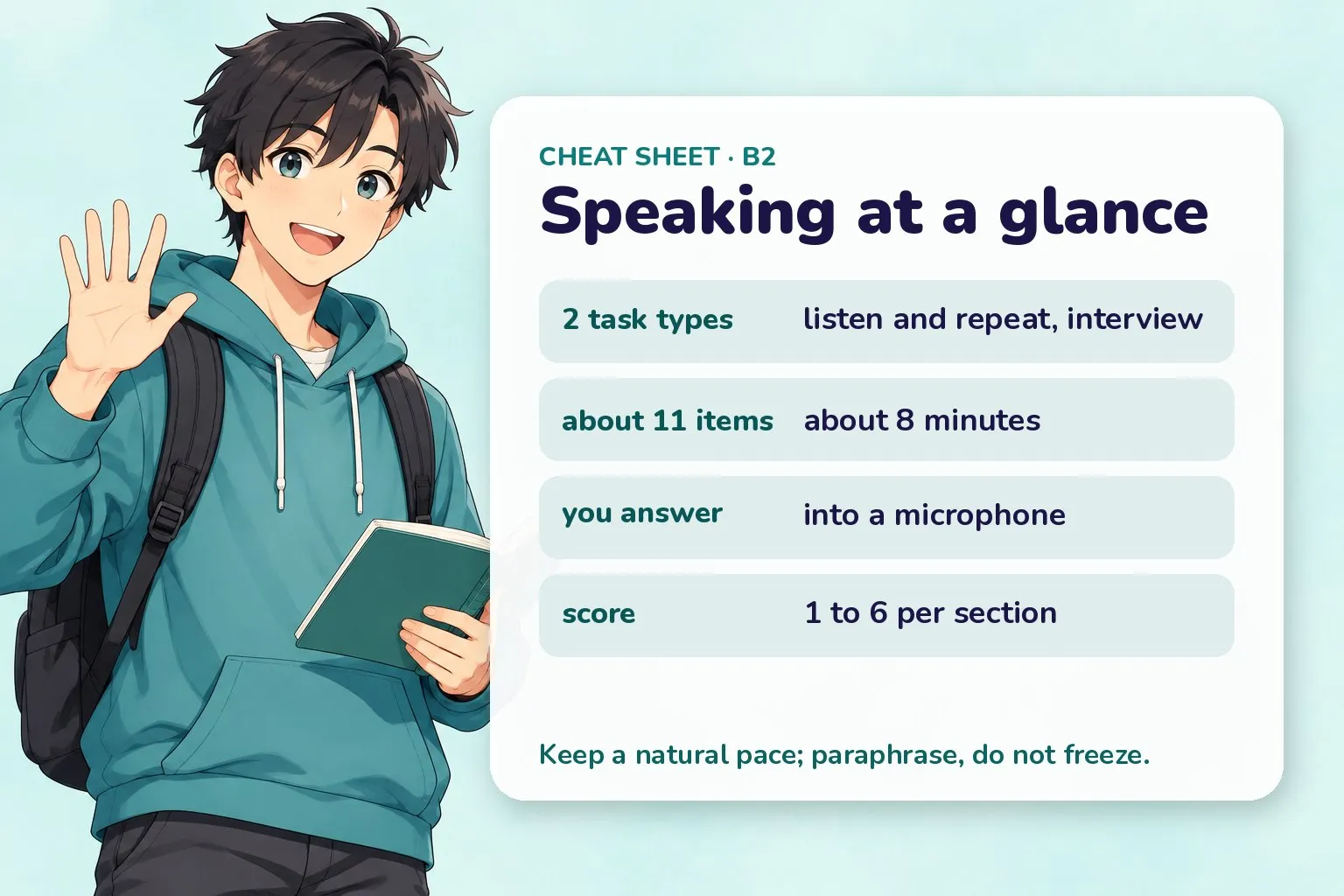
Quick recap before the quiz.
Practice
TOEFL Speaking practice
Try each one, then press Check. No sign-up, nothing is sent anywhere — it all runs in your browser.
Hint: see the overview table
Show answer
11 — ETS lists about 11 items for Speaking.
3 Match each task to what it checks.
- Listen and Repeat
- Take an Interview
- Overall score
- Transition score
Show answer
- Listen and Repeat → accurate, clear pronunciation
- Take an Interview → natural pace and relevant answers
- Overall score → average of four sections
- Transition score → 0 to 120 scale
Each task rewards a different speaking skill.
4 Order a strong interview answer.
Show answer
state your main point give one reason add a short example end with a clear decision — Point, reason, example, clean finish keeps a timed answer tight.
Hint: the top of the new scale
Show answer
6 — The revised TOEFL iBT uses the 1 to 6 scale.
Quiz
TOEFL Speaking quiz
12 questions · pick an answer and you'll see straight away if it's right.
-
Show answer
Clear, effective spoken English in academic settings — It measures how clearly you communicate in spoken English in academic and campus life.
-
Show answer
Two — The current Speaking section has two task types.
-
Show answer
about 8 minutes — ETS lists an approximate base time of about 8 minutes.
-
Show answer
11 — ETS lists about 11 items for Speaking.
-
Show answer
accurate, clearly intelligible speech — It measures processing spoken English and producing accurate, intelligible speech.
-
Show answer
answer questions about your experiences and opinions — You answer interview questions about academic or campus situations.
-
Show answer
Spoken into a microphone and recorded — You record your responses by speaking into a microphone.
-
Show answer
how clearly and effectively you communicate — ETS says scoring focuses on clear, effective communication.
-
Show answer
Paraphrase and keep going — Paraphrasing keeps fluency up; long silences hurt a timed answer.
-
Show answer
No specialist background is needed — Topics stay in academic and campus life and need no background knowledge.
-
Show answer
A comparable overall on the 0 to 120 scale — ETS reports a comparable 0 to 120 overall for a two-year transition.
-
Show answer
Speaking aloud, shadowing and recording yourself — Daily spoken output, shadowing and self-recording build timed fluency.
Recap cheat-sheet
| Item | TOEFL iBT Speaking |
|---|---|
| Tasks | Listen and Repeat, Take an Interview |
| Items / time | about 11 / about 8 minutes |
| How you answer | spoken into a microphone, recorded |
| Score | section score, 1 to 6 (0 to 120 in transition) |
Next
- Train rhythm and sounds: Shadowing technique
- Smooth delivery: Sentence stress and rhythm
- Compare the exams: English Exams hub
- New here? Start with Start Learning English Here
All English exams topics
Vocabulary, pronunciation, phrases, practice and exam help, ordered by level. Pick a topic and go straight to it. New lessons go live every day, so topics marked Coming soon fill in over the next weeks.
Exams
A2 1 topics · 1 ready
B1 6 topics · 6 ready
B2 12 topics · 12 ready
- 08 IELTS Reading: Format & Strategies
- 09 IELTS Academic Writing Task 1
- 10 IELTS Writing Task 2 (Essay)
- 11 IELTS Speaking: Parts 1-3
- 12 TOEFL iBT Overview: Format & Scoring
- 13 TOEFL Reading Strategies
- 14 TOEFL Listening Strategies
- 15 TOEFL Speaking Tasks You are here
- 16 TOEFL Writing (incl. Integrated)
- 17 B2 First (FCE) Overview
- 18 Exam Essay & Writing Skills
- 19 Exam Speaking Strategies