IELTS Speaking: Parts 1-3
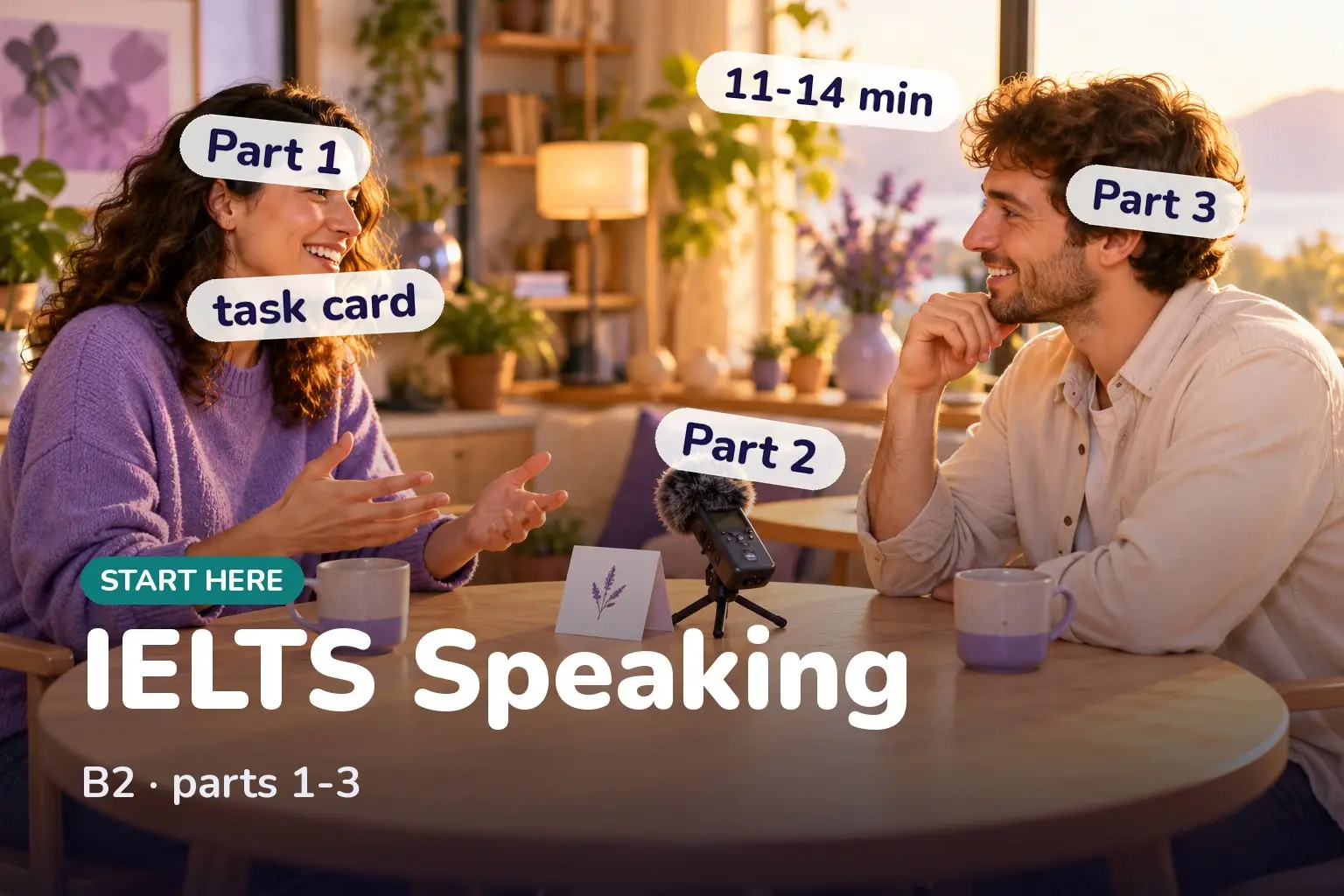
IELTS Speaking is an 11 to 14 minute face-to-face interview with an examiner, recorded and split into three parts: a short interview, a 1 to 2 minute talk from a task card, and a deeper two-way discussion. It is the same in Academic and General Training.
On this page14 sections · tap to jump
- 01By the end of this page you can…
- 02IELTS Speaking at a glance
- 03Part 1 — Introduction and interview
- 04Part 2 — The long turn
- 05Part 3 — The discussion
- 06How the four marking criteria work
- 07Sample answers
- 08Example sentences
- 09How to say it
- 10Usage notes
- 11Practice
- 12Quiz
- 13Recap cheat-sheet
- 14How to prepare with this course
Level: B2. The Speaking test is a real conversation with an examiner, not a computer. It is short — 11 to 14 minutes — and follows the same three parts every time, so you can rehearse the shape and walk in knowing exactly what happens. This page explains each part, the marking, and gives sample answers, then links the course pages that build fluency.
By the end of this page you can…
…describe all three parts of the test, know how long each lasts, understand the four things the examiner scores, and practise with sample answers for each part.
IELTS Speaking at a glance
The Speaking test is a face-to-face interview between the test taker and an examiner, and it is recorded (IELTS). It has three parts and lasts 11 to 14 minutes in total:
| Part | What happens | Length |
|---|---|---|
| Part 1 — Introduction and interview | The examiner checks your identity, then asks general questions on familiar topics | 4–5 minutes |
| Part 2 — Long turn | You speak from a task card on a given topic after one minute to prepare | 1–2 minute talk |
| Part 3 — Discussion | A two-way discussion of the Part 2 topic, more general and abstract | 4–5 minutes |
Part 1 — Introduction and interview
The examiner introduces themselves and checks your identity, then asks general questions on familiar topics such as home, family, work, studies or interests (IELTS). Answers should be a sentence or two — enough to show range, not a monologue.
Part 2 — The long turn
The examiner gives you a task card asking you to talk about a particular topic. You have one minute to prepare and may make notes, then you talk for one to two minutes, after which the examiner asks one or two rounding-off questions (IELTS).
The card gives a topic and bullet points to cover. Use your preparation minute to jot a few words against each bullet, then keep talking until the examiner stops you.
Part 3 — The discussion
In Part 3, you and the examiner discuss issues related to the Part 2 topic in a more general and abstract way, and in greater depth (IELTS). Expect opinion, comparison and prediction questions about society rather than about you personally.
How the four marking criteria work
A certificated examiner scores your speaking across the whole test on four criteria, each weighting equally; the average gives your Speaking band (IELTS):
| Criterion | What it rewards |
|---|---|
| Fluency and coherence | Speaking at a normal speed without too much hesitation, in a logical order |
| Lexical resource | A range of vocabulary, and paraphrasing when you don’t know a word |
| Grammatical range and accuracy | A mix of correct, varied structures |
| Pronunciation | Being understood without too much effort |
Sample answers
Example sentences
Press play and copy the rhythm. These are flexible lines you can reuse across the whole test.
- I'm a student — I'm in my final year of engineering.A full Part 1 answer with one extra detail.
- I'd say my hometown is fairly quiet but very green.Describing a familiar topic in Part 1.
- That's an interesting question — let me think for a second.Buying a moment without awkward silence.
- The thing I'd most like to talk about is a trip I took last year.Opening a Part 2 long turn.
- I'd learn it by taking lessons and practising every day.Covering a 'how' bullet on the task card.
- It matters to me because it helps me relax after work.Covering a 'why it is important' bullet.
- To sum up, it was one of the best decisions I've made.Rounding off a long turn.
- In my opinion, the main reason is a lack of free time.Giving an opinion in Part 3.
- For example, many people work long hours these days.Supporting an opinion with an example.
- On the whole, I think things have improved over the years.Making a comparison across time in Part 3.
- That said, some people would strongly disagree.Acknowledging another view.
- It's likely that this trend will continue in the future.Making a prediction with cautious language.
- Sorry, I mean affordable rather than cheap.Correcting yourself naturally, which is fine.
- It's a kind of tool you use to measure things.Paraphrasing when you can't recall a word.
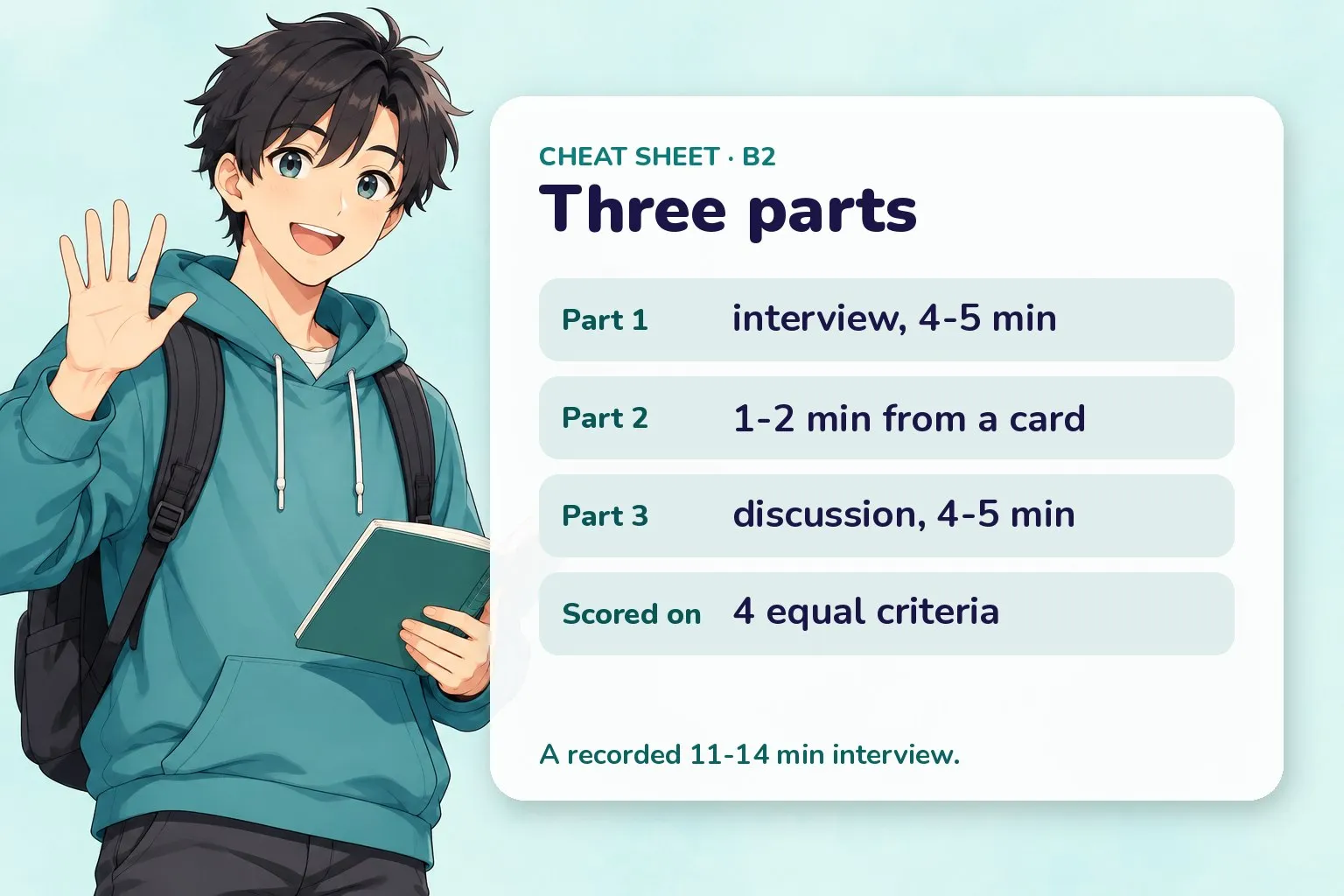
Quick recap before you practise.
How to say it
A few test words trip up learners — copy the stress.
- interview is IN-ter-vyoo, stress on the first beat.
- pronunciation is pruh-nun-see-AY-shun — note it is not pro-NOUN-ciation.
- vocabulary is vuh-KAB-yuh-lree, stress on the second beat.
- comfortable is often said in three beats: KUMF-tuh-bul.
Usage notes
- It is a conversation, not a speech. In Parts 1 and 3 you reply to the examiner; only Part 2 is a solo turn.
- Self-correction is fine. Fixing a slip naturally shows control; freezing in silence does not.
- Range beats memorised scripts. Examiners recognise rehearsed speeches, which sound unnatural and can lower your fluency score.
- Accent is not marked. Pronunciation is about being understood with little effort, not about sounding British or American.
Practice
Speaking practice
Try each one, then press Check. No sign-up, nothing is sent anywhere — it all runs in your browser.
Hint: the maximum length of the long turn
Show answer
2 — The long turn lasts one to two minutes.
4 Match each part to what it involves.
- Part 1
- Part 2
- Part 3
- Whole test
Show answer
- Part 1 → questions on familiar topics
- Part 2 → a talk from a task card
- Part 3 → an abstract two-way discussion
- Whole test → a recorded interview
Part 1 is an interview, Part 2 a long turn, Part 3 a discussion.
5 Put the three parts in the order they happen.
Show answer
Introduction and interview Long turn Discussion — Part 1 interview, Part 2 long turn, Part 3 discussion.
Hint: a verb for correcting yourself
Show answer
mean — 'Sorry, I mean…' is a natural way to self-correct.
Quiz
Speaking quiz
12 questions · pick an answer and you'll see straight away if it's right.
-
Show answer
As a face-to-face interview with an examiner — It is a face-to-face interview between the test taker and an examiner, and it is recorded.
-
Show answer
Three — There are three parts to the Speaking test.
-
Show answer
General questions on familiar topics — Part 1 asks general questions on familiar topics such as home, family, work and studies.
-
Show answer
A task card with a topic to talk about — In Part 2 the examiner gives you a task card and you speak about the topic.
-
Show answer
One to two minutes — After one minute of preparation you talk for one to two minutes.
-
Show answer
A more general, abstract discussion of the Part 2 topic — Part 3 is a two-way discussion exploring the topic more generally and in greater depth.
-
Show answer
Spelling accuracy — The four criteria are fluency and coherence, lexical resource, grammatical range and accuracy, and pronunciation.
-
Show answer
Equally, and averaged — The criteria carry equal weighting and the average gives your Speaking band.
-
Show answer
No, it is the same — The Speaking test is the same in both IELTS Academic and General Training.
-
Show answer
A short answer plus one reason or detail — Add a reason or detail to show range without over-talking.
-
Show answer
Being understood without too much effort — Pronunciation is about being understood easily, not about a particular accent.
-
Show answer
Paraphrase, e.g. 'a kind of tool you use to…' — Paraphrasing shows lexical resource and keeps you fluent.
Recap cheat-sheet
| Point | IELTS Speaking |
|---|---|
| Length | 11–14 minutes, three parts |
| Delivery | face-to-face, recorded |
| Part 1 | familiar-topic interview (4–5 min) |
| Part 2 | 1-minute prep, 1–2 minute talk from a card |
| Part 3 | abstract discussion (4–5 min) |
| Scored on | fluency, vocabulary, grammar, pronunciation (equal) |
How to prepare with this course
- Build opinion and discussion language in Expressing opinions and extend Part 2 with Storytelling and narration.
- Warm up Part 1 small talk with Small talk and networking.
- Improve flow and sound with the Pronunciation overview, Sentence stress and rhythm and the Shadowing technique.
- Talk about your life accurately with Past simple (regular verbs) and Present perfect for experience.
Next
- Start here: English Exams: Which One & How to Prepare
- Speak more smoothly: Shadowing technique
- Build ideas to say: Expressing opinions
- New here? Start with Start Learning English Here
All English exams topics
Vocabulary, pronunciation, phrases, practice and exam help, ordered by level. Pick a topic and go straight to it. New lessons go live every day, so topics marked Coming soon fill in over the next weeks.
Exams
A2 1 topics · 1 ready
B1 6 topics · 6 ready
B2 12 topics · 12 ready
- 08 IELTS Reading: Format & Strategies
- 09 IELTS Academic Writing Task 1
- 10 IELTS Writing Task 2 (Essay)
- 11 IELTS Speaking: Parts 1-3 You are here
- 12 TOEFL iBT Overview: Format & Scoring
- 13 TOEFL Reading Strategies
- 14 TOEFL Listening Strategies
- 15 TOEFL Speaking Tasks
- 16 TOEFL Writing (incl. Integrated)
- 17 B2 First (FCE) Overview
- 18 Exam Essay & Writing Skills
- 19 Exam Speaking Strategies