IELTS Overview: Format & Scoring
IELTS has four sections — Listening, Reading, Writing and Speaking — and is reported on a 0-9 band scale. Your overall band is the average of the four section bands, rounded to the nearest half band, with no pass or fail.
On this page12 sections · tap to jump
Level: B1. IELTS (the International English Language Testing System) is one of the most widely accepted English tests for study, work and migration. This page explains how it is built — the four sections, the timing, the Academic and General Training split, and the 0-9 band scale — so you know exactly what you are signing up for before you book.
By the end of this page you can…
…name the four IELTS sections and their timing, tell Academic from General Training, explain how the 0-9 band scale and the overall band work, and start a preparation plan with this course.
The four sections
IELTS tests all four language skills. On the Academic test the total test time is about 2 hours 45 minutes, and the format is the same whether you sit it at a centre or online (IELTS Academic).
| Section | Time allowed | What happens |
|---|---|---|
| Listening | about 30 minutes | four recordings, 40 questions |
| Reading | 60 minutes (including transfer time) | three passages, 40 questions |
| Writing | 60 minutes | two tasks |
| Speaking | 11-14 minutes | a face-to-face interview in three parts |
Listening, Reading and Writing are taken one after another with no break. The Speaking test may be on the same day or up to a week before or after the other three (IELTS Academic). Listening is sat first; on the paper test you also get 10 extra minutes to copy your answers onto the answer sheet.
Academic vs General Training
Both versions share the same Listening and Speaking papers. The difference is in the reading and writing material:
- Academic Reading and Writing use texts and tasks drawn from a study context — journal-style passages and, in Writing, describing a chart or process.
- General Training Reading and Writing use everyday and workplace material — notices, advertisements, job and training texts, and a letter task.
If your goal is a degree or professional registration, you almost certainly need Academic; for most migration and work routes you need General Training (IELTS test types). The score requirement is set by the body you are applying to, not by IELTS.
The 0-9 band scale
IELTS does not give a percentage or a pass/fail. Every section is marked and converted to a band score from 0 to 9, in whole and half bands (for example 6.0 or 6.5). Each band has a plain description of what a test taker at that level can do (IELTS scoring in detail):
| Band | Skill level | In short |
|---|---|---|
| 9 | Expert | fully operational, accurate and fluent |
| 8 | Very good | fully operational with occasional slips |
| 7 | Good | operational, handles complex language well |
| 6 | Competent | effective despite some inaccuracies |
| 5 | Modest | partial command, copes with overall meaning |
| 4 | Limited | basic competence in familiar situations |
| 3 | Extremely limited | conveys only general meaning |
| 2 | Intermittent | great difficulty understanding English |
| 1 | Non-user | only a few isolated words |
| 0 | Did not attempt | no questions answered |
How the overall band is worked out
You receive a band for each of the four sections and one overall band score. The overall score is simply the average of the four section bands, rounded to the nearest half band (IELTS scoring in detail).
Where IELTS sits on the CEFR
IELTS bands map onto the Common European Framework of Reference (CEFR), the international A1-to-C2 scale that every lesson on this site is tagged with (Cambridge English; Council of Europe). A rough guide: band 4-5 sits around B1, band 5.5-6.5 around B2, and band 7+ around C1. Treat this as orientation, not an exact conversion — use the official comparison tools when a precise figure matters.
Useful IELTS phrases to know
These are the instruction and planning phrases you meet on test day and when you talk about your preparation.
- I am taking the Academic version of the test.Saying which IELTS you sit.
- The Listening section has four parts and forty questions.Describing the format.
- You hear each recording only once.A key rule of the Listening test.
- Reading and Writing are each sixty minutes long.Talking about timing.
- My overall band is the average of the four sections.Explaining how scoring works.
- I need an overall band of 6.5 for my course.Stating a target score.
- There is no pass or fail in IELTS.A common point to remember.
- I booked the computer-delivered test.Choosing a delivery mode.
- The Speaking test is a face-to-face interview.Describing Speaking.
- Could you tell me the time allowed for this section?A polite question about timing.
- Please transfer your answers to the answer sheet.A paper-test instruction.
- My result is valid for about two years.Talking about validity.
- Which version does the university accept?Checking the requirement first.
- I want to improve my Writing band before I rebook.Planning a retake.
- Let me check the official band descriptors.Using the right reference.
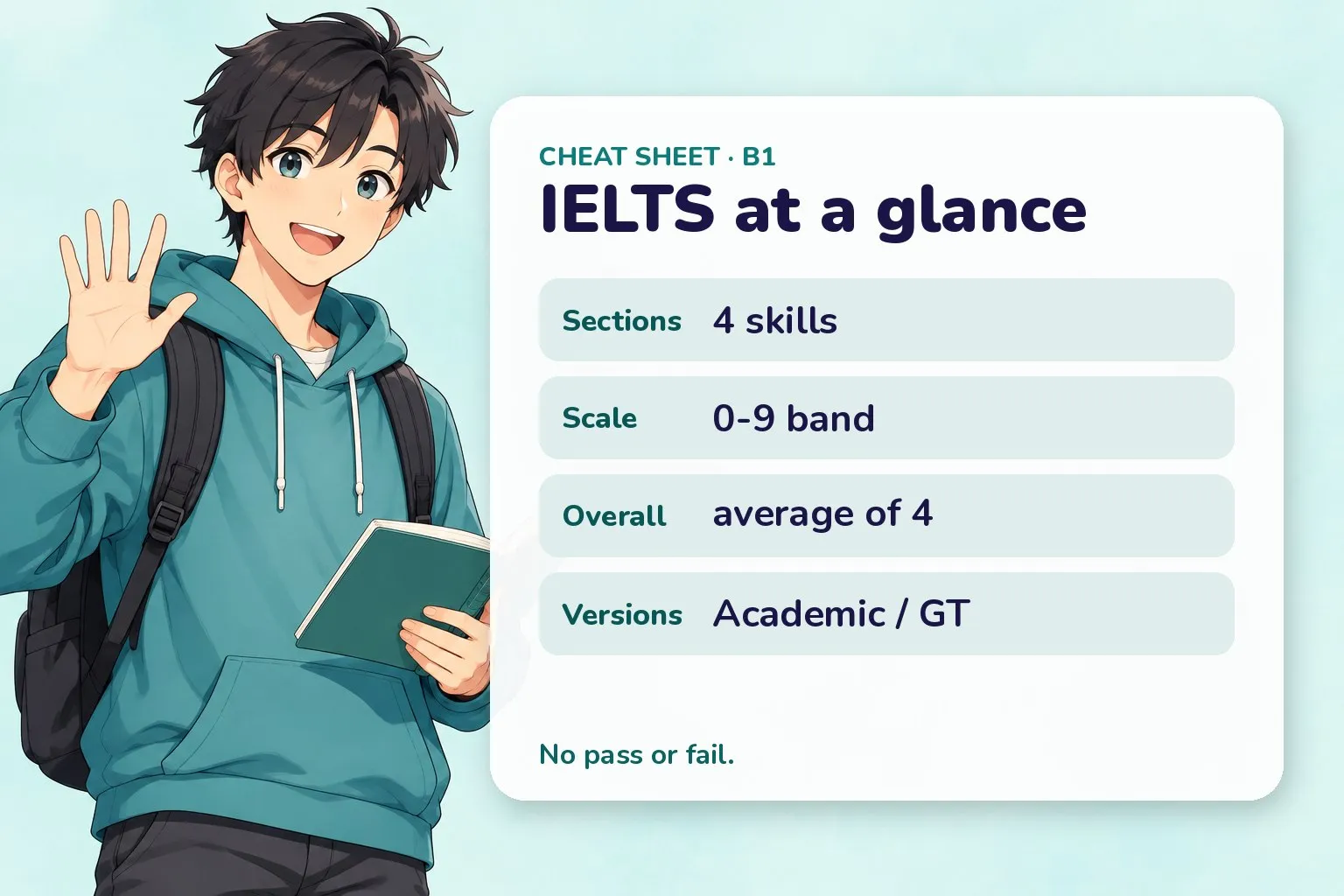
Quick recap before you practise.
Usage notes
- band, not grade or mark: IELTS results are always called band scores; saying you got a grade or a mark sounds off to anyone who knows the test.
- whole and half bands only: you cannot get a 6.25 as a reported score — the overall is rounded to 6.0 or 6.5. Section scores are also whole or half bands.
- one-skill retake: if only one section lets you down, some test takers resit a single skill rather than the whole test; availability depends on the centre.
- Academic vs General Training on your report: the version is printed on your result, so a General Training result will not satisfy a requirement that asks for Academic.
Prepare with this course
The skills IELTS tests are the skills this course builds:
- Grammar: accuracy lifts your Writing and Speaking bands most — work through the English grammar lessons at and just above your CEFR level.
- Vocabulary: examiners reward range, so build the vocabulary sets, especially the Academic Word List (part 1).
- Timed practice: rehearse under the clock with the practice pages — managing time is half the battle in every section.
- Skill-by-skill guides: start with this hub, English Exams: Which One & How to Prepare; detailed section guides for Listening, Reading, Writing and Speaking are being added alongside this one.
Practice
IELTS format and scoring practice
Try each one, then press Check. No sign-up, nothing is sent anywhere — it all runs in your browser.
Hint: the top band
Show answer
9 — The scale runs from 0 to 9 in whole and half bands.
Hint: add them up and divide by four
Show answer
average — The overall band is the average of the four sections, rounded to the nearest half band.
5 Put the four sections in the order they are usually described.
Show answer
Listening Reading Writing Speaking — The standard order is Listening, Reading, Writing, Speaking.
6 Match each band to its skill level.
- 9
- 7
- 5
- 1
Show answer
- 9 → Expert
- 7 → Good
- 5 → Modest
- 1 → Non-user
Each band has a fixed descriptor from Non-user up to Expert.
Quiz
IELTS overview quiz
10 questions · pick an answer and you'll see straight away if it's right.
-
Show answer
A higher level of English skill — Bands 1 to 9 describe rising skill levels, from Non-user to Expert.
-
Show answer
Academic — Academic is for study and professional registration.
-
Show answer
The average of the four sections — It is the average of the four section bands, rounded to the nearest half band.
-
Show answer
No, you get a band score — There is no pass or fail; you report a band and meet the requirement set by your institution.
-
Show answer
2 hours 45 minutes — The Academic test runs about 2 hours 45 minutes.
-
Show answer
40 — Listening has four recordings and 40 questions.
-
Show answer
Reading and Writing — Only Reading and Writing change; Listening and Speaking are identical.
-
Show answer
Expert — Band 9 is the Expert level, with fully operational command.
-
Show answer
About two years — IELTS recommends about two years, though organisations set their own windows.
-
Show answer
Build all four skills with timed practice — Because the overall band averages four sections, a balanced plan works best.
Recap cheat-sheet
| Part | Detail |
|---|---|
| Sections | Listening, Reading, Writing, Speaking |
| Scale | 0-9 band, whole and half bands |
| Overall | average of 4 sections, rounded to nearest half |
| Versions | Academic (study) vs General Training (migration/work) |
| Validity | about 2 years recommended |
Next
- Start here: English Exams: Which One & How to Prepare
- Build accuracy: English Grammar lessons
- Build range: English Vocabulary sets
- Rehearse under time: English Practice pages
- New here? Start with Start Learning English Here
All English exams topics
Vocabulary, pronunciation, phrases, practice and exam help, ordered by level. Pick a topic and go straight to it. New lessons go live every day, so topics marked Coming soon fill in over the next weeks.
Exams
A2 1 topics · 1 ready
B1 6 topics · 6 ready
- 02 English Exams: Which One & How to Prepare
- 03 IELTS Overview: Format & Scoring You are here
- 04 IELTS Listening: Format & Strategies
- 05 Understanding IELTS Band Scores
- 06 Cambridge English Exams Explained
- 07 B1 Preliminary (PET) Overview
B2 12 topics · 12 ready
- 08 IELTS Reading: Format & Strategies
- 09 IELTS Academic Writing Task 1
- 10 IELTS Writing Task 2 (Essay)
- 11 IELTS Speaking: Parts 1-3
- 12 TOEFL iBT Overview: Format & Scoring
- 13 TOEFL Reading Strategies
- 14 TOEFL Listening Strategies
- 15 TOEFL Speaking Tasks
- 16 TOEFL Writing (incl. Integrated)
- 17 B2 First (FCE) Overview
- 18 Exam Essay & Writing Skills
- 19 Exam Speaking Strategies