TOEFL iBT Listening Strategies
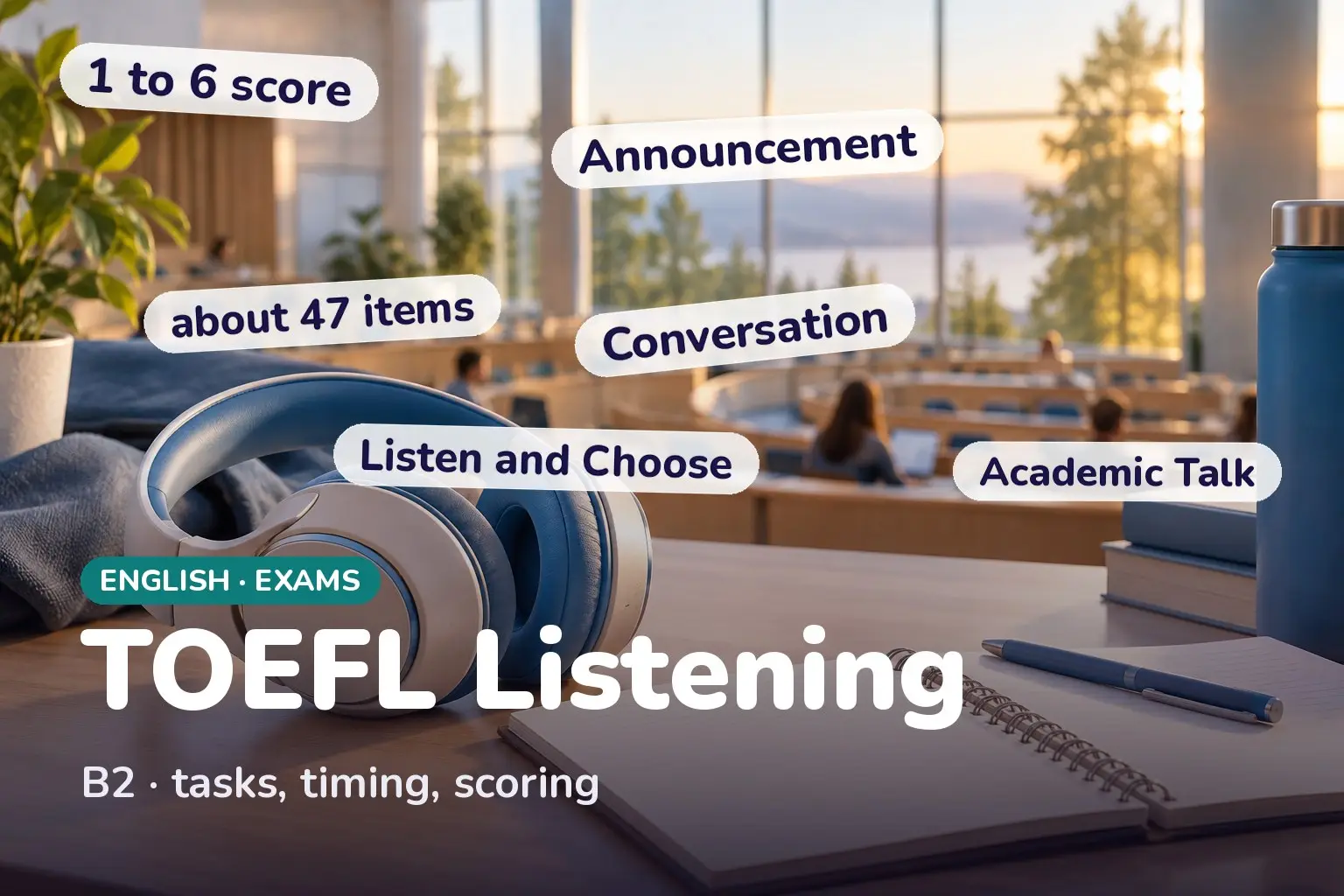
The revised TOEFL iBT Listening section uses short academic audio clips across four task types, about 47 items in roughly 29 minutes. You may take notes, then answer, for a section score on the 1 to 6 scale.
Level: B2. The TOEFL iBT was revised in 2026, and Listening changed with it. Instead of a few long lecture sets, you now meet several short, focused audio clips and answer as you go. This page explains what the section tests today and how to prepare with this course.
By the end of this page you can…
…recognise the four current Listening task types, know how many items and how long to plan for, understand how the section is scored, and start a listening-prep routine.
What the Listening section looks like now
The Listening section measures how well you understand spoken English in university settings — classrooms, lectures and everyday campus situations (ETS). The clips are short and focused rather than long sets, so you stay engaged and manage your time.
| Detail | TOEFL iBT Listening |
|---|---|
| Number of items | about 47 |
| Approximate base time | about 29 minutes |
| Task types | four (below) |
| Notes | you may take notes while listening |
| Score | a section score on the 1 to 6 scale |
Total test time excludes the directions, and ETS says to allow about two hours for the whole test. Because the test adapts to your answers, the exact time and number of items can vary (ETS).
The four Listening task types
ETS lists these Listening tasks for the current test:
- Listen and Choose a Response — you hear a spoken prompt and pick the most appropriate reply. It checks whether you grasp meaning, intent and the normal patterns of academic spoken English.
- Listen to a Conversation — usually about campus life. It checks main ideas, key details, the speaker’s intent and implied meaning.
- Listen to an Announcement — an academic or campus announcement. It checks the speaker’s purpose, key information, implied meaning and the likely next step.
- Listen to an Academic Talk — a short talk by a professor or expert. It checks main ideas, supporting details, organisation, inferences and sometimes uncommon or idiomatic vocabulary.
No background knowledge is required; topics come from a range of academic fields. You may hear North American, British, Australian or New Zealand accents, reflecting the English used in real study settings (ETS).
How it is scored
You receive four section scores and an overall score on the 1 to 6 scale. The overall is the average of all four sections, rounded to the nearest half band (ETS). For a two-year transition period after January 2026, ETS also reports a comparable overall score on the older 0 to 120 scale, so institutions that still think in those numbers can read your result.
How to prepare with this course
The skill the test rewards is active academic listening, built over weeks:
- Train comprehension on real talks with the Listening Practice guide, then stretch to faster, denser audio.
- Copy natural rhythm and intonation with the Shadowing technique and the intonation patterns page, so fast speech stops blurring together.
- Work on connected speech — the linking and reductions that make spoken English hard to catch.
- Build the academic words examiners use through the vocabulary sets.
Example: signpost language you will hear
Play each line and notice what it signals — these cues tell you where a talk or conversation is going.
- Today I want to focus on three main causes.A talk announcing its structure: expect three points.
- But here is where it gets interesting.A shift signal: an important or surprising point is next.
- In other words, the process repeats itself.A restatement: the idea is being made simpler.
- As a result, the population dropped sharply.A cause-and-effect link: note what caused what.
- Could you clarify what you mean by that term?In a conversation, a request for an explanation.
- Please note that the deadline has moved to Monday.An announcement giving key, testable information.
- On the other hand, some researchers disagree.A contrast: a second, opposing view is coming.
- So the first thing you should do is register online.An announcement pointing to a next action.
- That is similar to what we saw last week.A comparison linking new content to old.
- To sum up, the experiment supported the theory.A closing signal: the main point is restated.
Practice
TOEFL Listening practice
Try each one, then press Check. No sign-up, nothing is sent anywhere — it all runs in your browser.
Hint: see the overview table
Show answer
47 — ETS lists about 47 items for Listening.
4 Match each phrase to what it signals.
- On the other hand
- As a result
- To sum up
- In other words
Show answer
- On the other hand → a contrast
- As a result → cause and effect
- To sum up → a conclusion
- In other words → a restatement
Signpost language tells you where the speaker is going.
5 Order the steps for a lecture task.
Show answer
note the main idea listen for signposts spot supporting details answer the questions — Get the main idea first, follow the signposts, catch details, then answer.
Hint: the top of the new scale
Show answer
6 — The revised TOEFL iBT uses a 1 to 6 scale, with a 0 to 120 comparison during the transition.
Quick visual recap
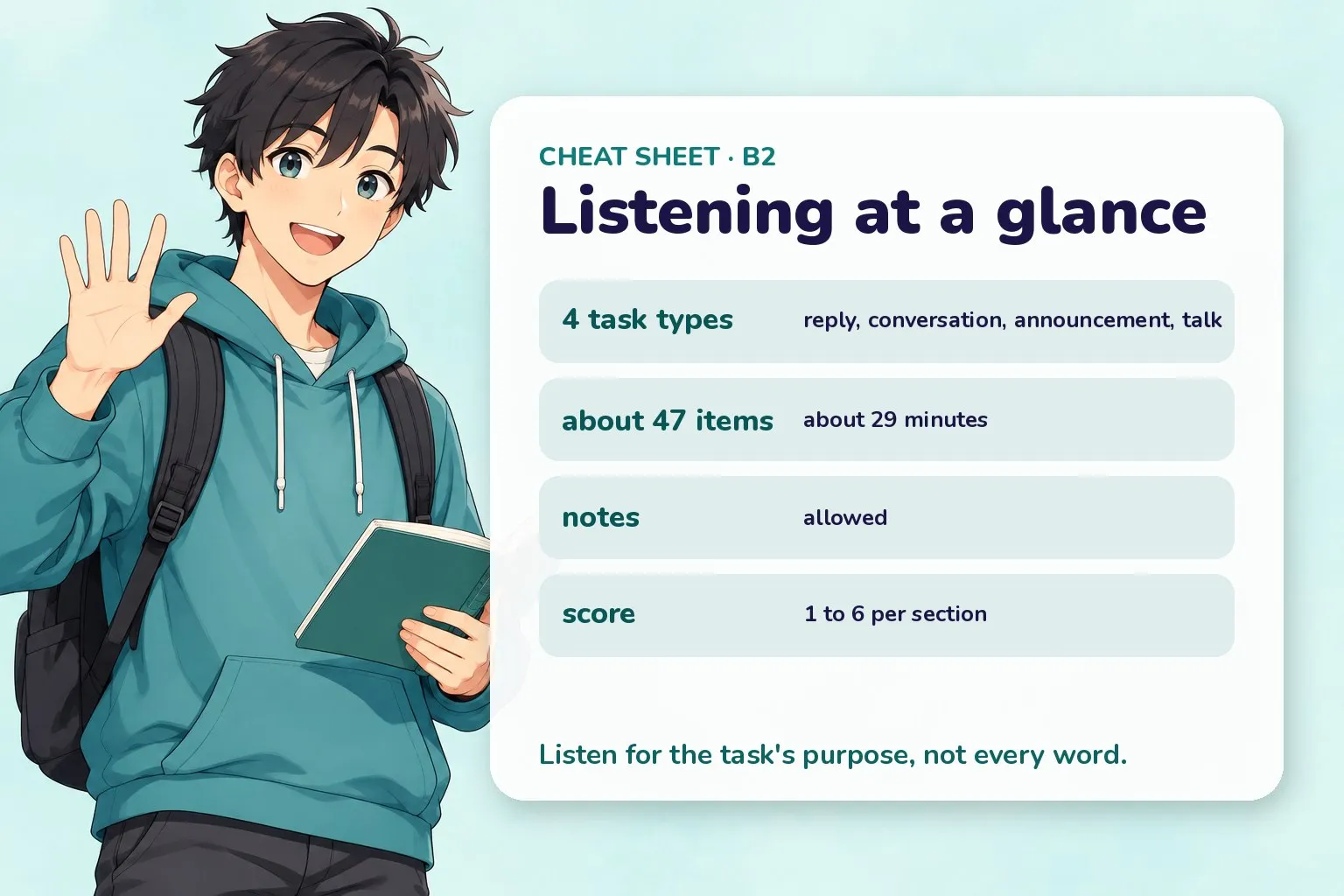
Quick recap before the quiz.
Quiz
TOEFL Listening quiz
12 questions · pick an answer and you'll see straight away if it's right.
-
Show answer
Understanding spoken English in university settings — It measures understanding of spoken English in classrooms, lectures and campus life.
-
Show answer
about 29 minutes — ETS lists an approximate base time of about 29 minutes.
-
Show answer
47 — ETS lists about 47 items for Listening.
-
Show answer
Listen and Choose a Response — Listen and Choose a Response tests meaning, intent and spoken patterns.
-
Show answer
main ideas, details, intent and implied meaning — The conversation task targets main ideas, key details, intent and implied meaning.
-
Show answer
North American, British, Australian or New Zealand — ETS lists North American, British, Australian and New Zealand accents.
-
Show answer
No background knowledge is required — Topics are chosen so that no background knowledge is needed.
-
Show answer
The average of all four sections, rounded to the nearest half band — The overall is the average of the four sections, rounded to the nearest half band.
-
Show answer
A comparable overall on the 0 to 120 scale — ETS reports a comparable 0 to 120 overall for a two-year transition period.
-
Show answer
The test adapts to your answers — The test adapts, so time and items may vary between candidates.
-
Show answer
Note names, numbers and the argument's shape — Light, structured notes beat a full transcript on short clips.
-
Show answer
Practise with real academic talks and shadowing — Active listening to varied, real talks plus shadowing builds the skill the test rewards.
Recap cheat-sheet
| Item | TOEFL iBT Listening |
|---|---|
| Tasks | Choose a Response, Conversation, Announcement, Academic Talk |
| Items / time | about 47 / about 29 minutes |
| Notes | allowed |
| Score | section score, 1 to 6 (0 to 120 in transition) |
Next
- Rehearse real audio: Listening Practice guide
- Catch fast speech: Connected speech
- Compare the exams: English Exams hub
- New here? Start with Start Learning English Here
All English exams topics
Vocabulary, pronunciation, phrases, practice and exam help, ordered by level. Pick a topic and go straight to it. New lessons go live every day, so topics marked Coming soon fill in over the next weeks.
Exams
A2 1 topics · 1 ready
B1 6 topics · 6 ready
B2 12 topics · 12 ready
- 08 IELTS Reading: Format & Strategies
- 09 IELTS Academic Writing Task 1
- 10 IELTS Writing Task 2 (Essay)
- 11 IELTS Speaking: Parts 1-3
- 12 TOEFL iBT Overview: Format & Scoring
- 13 TOEFL Reading Strategies
- 14 TOEFL Listening Strategies You are here
- 15 TOEFL Speaking Tasks
- 16 TOEFL Writing (incl. Integrated)
- 17 B2 First (FCE) Overview
- 18 Exam Essay & Writing Skills
- 19 Exam Speaking Strategies