IELTS Writing Task 2 (Essay)
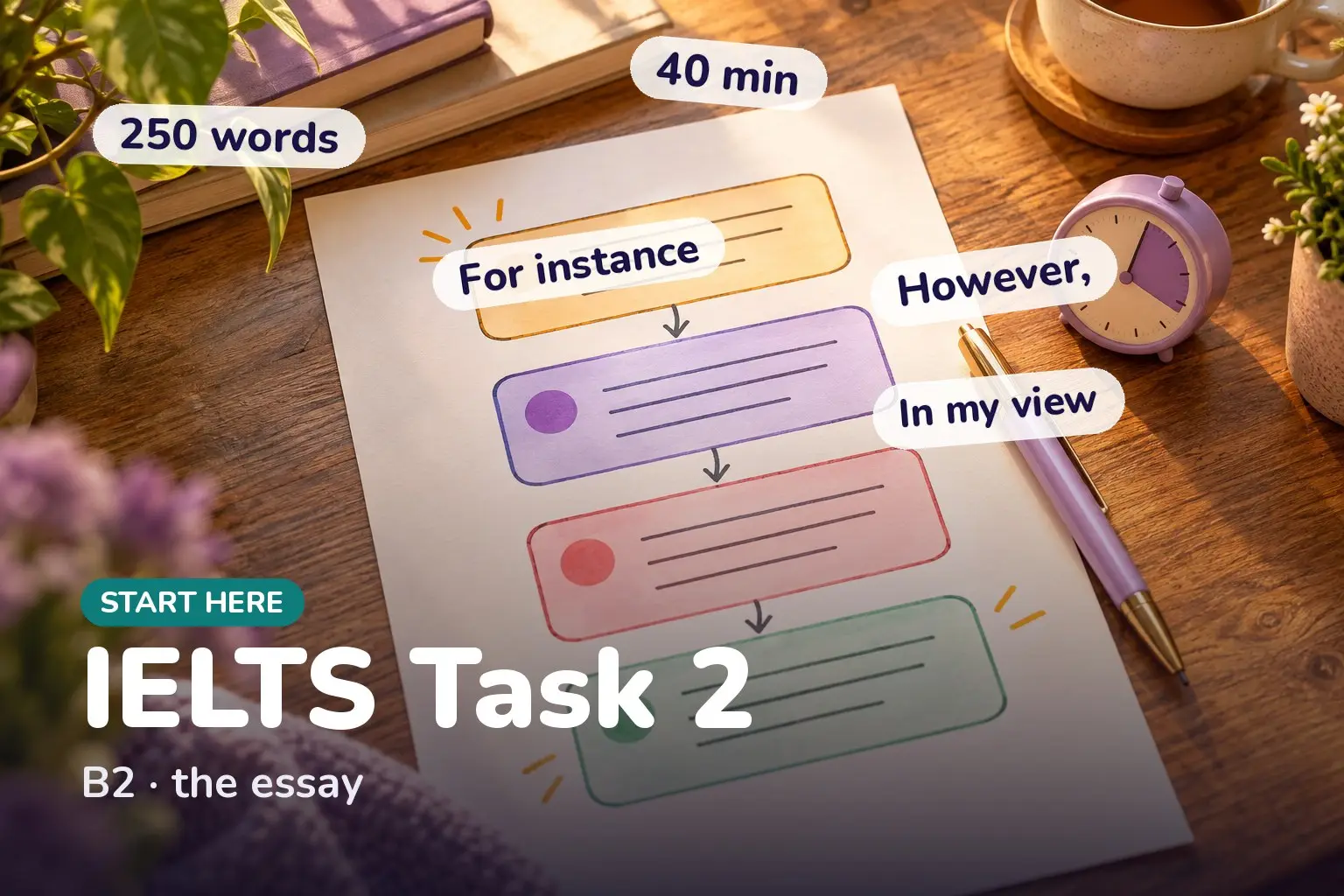
IELTS Writing Task 2 is an essay: you discuss a point of view, argument or problem and give your own position in at least 250 words in about 40 minutes. It is worth twice as much as Task 1, so it is the task to get right.
On this page14 sections · tap to jump
- 01By the end of this page you can…
- 02IELTS Writing Task 2 at a glance
- 03The four common question types
- 04How the four marking criteria work
- 05A dependable four-paragraph plan
- 06Useful language for Task 2
- 07A sample Task 2 answer
- 08Example sentences
- 09How to say it
- 10Usage notes
- 11Practice
- 12Quiz
- 13Recap cheat-sheet
- 14How to prepare with this course
Level: B2. Task 2 is the essay, and it is the bigger prize in IELTS Writing. You are given a view, an argument or a problem and you write a clear, organised response that takes a position. This page breaks down the question types, the marking, a dependable plan and a full sample essay, then links the course pages that build each skill.
By the end of this page you can…
…spot which of the four question types you have, plan a four-paragraph essay, use the language of opinion and linking accurately, and give yourself time to check your work.
IELTS Writing Task 2 at a glance
The Writing paper is 60 minutes for two tasks, both of which you must complete (IELTS). Task 2 is the larger job:
| Feature | Task 2 |
|---|---|
| What you do | Discuss a point of view, argument or problem and give your position |
| Minimum length | 250 words |
| Suggested time | About 40 minutes |
| Weighting | Contributes twice as much as Task 1 to the Writing band |
| Answer form | Full sentences, in a formal or semi-formal essay |
Because Task 2 contributes twice as much as Task 1 to the Writing score (IELTS), always protect your 40 minutes for it — even if Task 1 is unfinished.
The four common question types
The prompt always tells you exactly what to do. Read it twice and match it to one of these:
- Opinion (agree/disagree): a statement, then To what extent do you agree or disagree? Take a clear stance and defend it.
- Discussion (both views): Discuss both views and give your own opinion. Cover each side fairly, then state your position.
- Problem and solution: a situation, then What are the causes/problems and what solutions do you suggest?
- Two-part (direct questions): two linked questions you must answer in turn.
How the four marking criteria work
An examiner marks each task on four criteria, weighted equally (IELTS):
| Criterion | What it rewards in Task 2 |
|---|---|
| Task response | Answering the whole prompt, with a clear position and developed ideas, examples and reasons |
| Coherence and cohesion | A logical paragraph plan and smooth linking between ideas |
| Lexical resource | A range of accurate, appropriate vocabulary |
| Grammatical range and accuracy | Varied, correct sentence structures |
A dependable four-paragraph plan
- Introduction — paraphrase the statement, then state your position or what the essay will cover.
- Main paragraph 1 — your first reason, explained, with an example.
- Main paragraph 2 — your second reason (or the other side), explained, with an example.
- Conclusion — restate your position in new words; add nothing new.
One well-developed idea per paragraph beats three half-finished ones. Lead each main paragraph with a clear topic sentence, then support it.
Useful language for Task 2
| Job | Language |
|---|---|
| State an opinion | In my view, … / I firmly believe that… / It seems to me that… |
| Introduce a side | On the one hand, … / Those who support this argue that… |
| Add a reason | This is because… / One reason for this is… |
| Give an example | For instance, … / A clear example of this is… |
| Contrast | However, … / On the other hand, … / Nevertheless, … |
| Show result | As a result, … / Consequently, … / This leads to… |
| Soften a claim | tends to, is likely to, in many cases, arguably |
| Conclude | In conclusion, … / Overall, … / To sum up, … |
A sample Task 2 answer
This essay answers both views, gives a clear position, develops each idea with a reason and an example, and closes without new information.
Example sentences
Press play and copy the rhythm. These are flexible lines you can adapt to almost any essay.
- This essay will discuss both views before giving my own opinion.A thesis line for a discussion essay.
- In my view, the benefits clearly outweigh the drawbacks.Stating a clear position.
- On the one hand, supporters argue that it saves money.Introducing the first side fairly.
- On the other hand, there are serious risks to consider.Introducing the opposing side.
- This is mainly because people have less free time than before.Adding a reason with 'because'.
- For instance, many cities have reduced traffic by adding cycle lanes.Supporting a point with an example.
- As a result, pollution levels in those areas have fallen.Showing a result.
- However, this solution is not suitable for every country.Adding a contrast or limit.
- Governments tend to focus on short-term results.Softening a general claim with 'tend to'.
- It could be argued that education is the better long-term answer.A cautious, academic way to make a claim.
- A further advantage is that it creates local jobs.Adding a second supporting point.
- In conclusion, the advantages of this approach are greater.Opening a conclusion.
- Overall, I believe stronger regulation is the best way forward.Restating the position in new words.
- While I accept this point, I still think the risks are too high.Conceding, then holding your position.
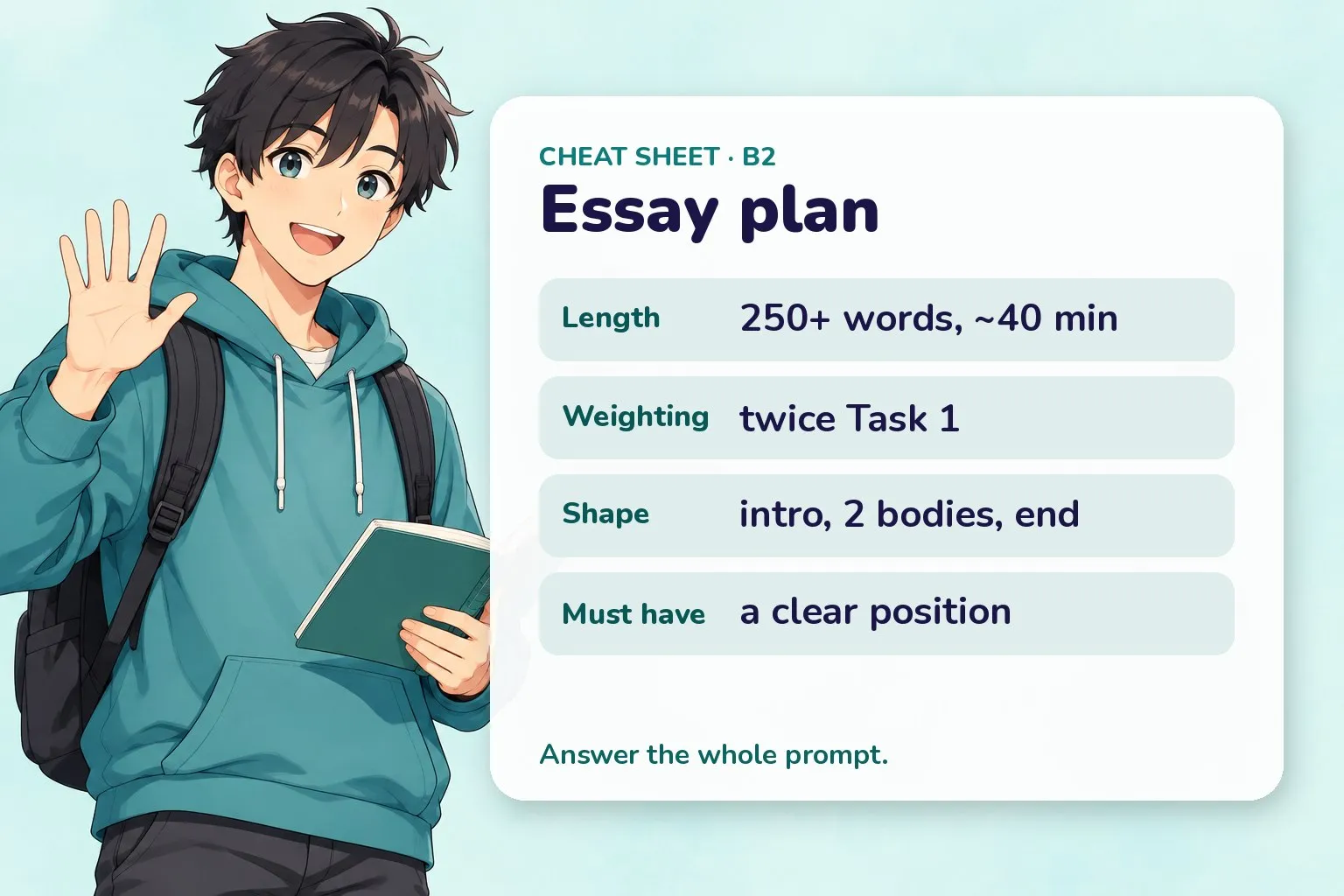
Quick recap before you practise.
How to say it
A few essay words are easy to mispronounce — copy the stress.
- argument is AR-gyoo-ment, stress on the first beat (no e sound in the middle).
- opinion is uh-PIN-yun, stress on the second beat.
- consequently is KON-si-kwent-lee, stress on the first beat.
- beneficial is ben-uh-FISH-uhl, stress on the third beat.
Usage notes
- State a position, even in a discussion essay. Discuss both views and give your own opinion means you must still say what you think.
- Keep it formal. Avoid contractions, slang and etc.; prefer full forms and precise words.
- One idea per paragraph. Depth beats a list of thin points.
- Examples can be general. You do not need real statistics; a clear, plausible example is enough — invented numbers are risky.
Practice
Task 2 practice
Try each one, then press Check. No sign-up, nothing is sent anywhere — it all runs in your browser.
Hint: the minimum length
Show answer
250 — The minimum for Task 2 is 250 words.
4 Match each question type to what it asks.
- Opinion
- Discussion
- Problem-solution
- Two-part
Show answer
- Opinion → agree or disagree
- Discussion → both views plus your opinion
- Problem-solution → causes and solutions
- Two-part → answer two linked questions
Identify the type from the instruction words before you plan.
5 Put a four-paragraph essay plan in order.
Show answer
Introduction Main paragraph 1 Main paragraph 2 Conclusion — Introduce, develop two main ideas, then conclude.
Hint: a formal linking word for contrast
Show answer
However — However and Nevertheless both signal a contrast in formal writing.
Quiz
Task 2 quiz
12 questions · pick an answer and you'll see straight away if it's right.
-
Show answer
An essay responding to a view, argument or problem — Task 2 is an essay in which you discuss a prompt and give your position.
-
Show answer
60 minutes — The Writing paper lasts 60 minutes for both tasks.
-
Show answer
250 words — You must write at least 250 words in Task 2.
-
Show answer
Task 2 is worth twice as much — Task 2 contributes twice as much as Task 1 to the Writing score.
-
Show answer
Task response — Task response is one of the four criteria, with coherence and cohesion, lexical resource, and grammatical range and accuracy.
-
Show answer
Yes, after covering both sides — A discussion essay still requires your own clear position.
-
Show answer
The conclusion — The conclusion restates your position; it adds nothing new.
-
Show answer
One developed idea per paragraph — One well-supported idea per paragraph scores higher than many thin points.
-
Show answer
Formal or semi-formal, no contractions — Task 2 is a formal or semi-formal essay in full sentences.
-
Show answer
Answering a different question than the prompt — Drifting from the exact prompt damages the task-response score most.
-
Show answer
tends to — Cautious language such as 'tends to' or 'is likely to' is safer and more academic.
-
Show answer
Check verbs, articles and spelling — A quick check of grammar and spelling protects your accuracy marks.
Recap cheat-sheet
| Point | Task 2 |
|---|---|
| Length | at least 250 words |
| Time | about 40 minutes |
| Weighting | twice Task 1 |
| Shape | intro + 2 main paragraphs + conclusion |
| Must have | a clear position that answers the whole prompt |
| Register | formal / semi-formal, no contractions |
How to prepare with this course
- Build opinion and argument language in Expressing opinions and Debating and argumentation.
- Link ideas smoothly with Linking words for writing, Linking: contrast (advanced) and Linking: result (advanced).
- Sound academic and cautious with Hedging and cautious language and get the tone right with Formal and informal register.
- Rehearse timed essays with the Writing practice guide.
Next
- Start here: English Exams: Which One & How to Prepare
- Build arguments: Debating and argumentation
- Rehearse writing: Writing practice guide
- New here? Start with Start Learning English Here
All English exams topics
Vocabulary, pronunciation, phrases, practice and exam help, ordered by level. Pick a topic and go straight to it. New lessons go live every day, so topics marked Coming soon fill in over the next weeks.
Exams
A2 1 topics · 1 ready
B1 6 topics · 6 ready
B2 12 topics · 12 ready
- 08 IELTS Reading: Format & Strategies
- 09 IELTS Academic Writing Task 1
- 10 IELTS Writing Task 2 (Essay) You are here
- 11 IELTS Speaking: Parts 1-3
- 12 TOEFL iBT Overview: Format & Scoring
- 13 TOEFL Reading Strategies
- 14 TOEFL Listening Strategies
- 15 TOEFL Speaking Tasks
- 16 TOEFL Writing (incl. Integrated)
- 17 B2 First (FCE) Overview
- 18 Exam Essay & Writing Skills
- 19 Exam Speaking Strategies