Exam Essay & Writing Skills
Every major English exam marks your writing on the same skills: answering the task, organising ideas clearly, and using a good range of accurate vocabulary and grammar. Learn one solid essay structure and a set of linking phrases, then adapt them to IELTS, TOEFL iBT or Cambridge.
On this page13 sections · tap to jump
- 01By the end of this page you can…
- 02What each exam’s writing asks
- 03IELTS Writing: two tasks, 60 minutes
- 04TOEFL iBT Writing: the 2026 tasks
- 05Cambridge Writing: an essay and a choice
- 06What examiners actually reward
- 07A reliable essay structure
- 08Useful phrases you can reuse
- 09Common mistakes
- 10How to say it
- 11Practice
- 12Quiz
- 13Recap cheat-sheet
Level: B2. Exam writing feels like three different tests, but it rewards one set of skills. Whether you sit IELTS, TOEFL iBT or a Cambridge exam, the marker is asking the same questions: did you answer the task, is it organised, and is your English varied and accurate? This page shows you what each exam asks, then gives you a structure and phrases you can carry into any of them.
By the end of this page you can…
…name the writing tasks and word counts for IELTS, TOEFL iBT and Cambridge, explain what the marking criteria reward, and plan and open a clear opinion essay with reusable phrases.
What each exam’s writing asks
The format differs; the skills do not. Here is the shape of each, from the exam bodies’ own pages.
| Exam | Writing section | Main tasks | Length |
|---|---|---|---|
| IELTS Academic | 60 minutes, 2 tasks | Task 1 describe visual data; Task 2 discuss an argument | 150 / 250 words |
| TOEFL iBT (2026) | about 23 minutes, 12 items | Build a Sentence, Write an Email, Write for an Academic Discussion | short, task-set |
| Cambridge B2 First | 1 hour 20 minutes, 2 parts | Part 1 compulsory essay; Part 2 one of several text types | 140–190 words each |
IELTS Writing: two tasks, 60 minutes
IELTS Academic Writing has two tasks and you must complete both in 60 minutes (IELTS). In Task 1 you describe visual information — a graph, table, chart or diagram — in your own words, writing at least 150 words in about 20 minutes. In Task 2 you are given a point of view, argument or problem to discuss, writing at least 250 words in about 40 minutes (IELTS).
Two rules decide a lot of marks. You must write in full sentences, not notes or bullet points, and Task 2 counts twice as much as Task 1 toward your writing score (IELTS). So if time runs short, protect Task 2. (IELTS General Training replaces the Task 1 chart with a letter, but Task 2 works the same way.)
TOEFL iBT Writing: the 2026 tasks
TOEFL iBT was revised, and its writing section is now short and practical: Build a Sentence, Write an Email, and Write for an Academic Discussion, about 12 items in roughly 23 minutes (ETS). The academic-discussion task is the one most like an exam essay: you read a short online-style discussion and add your own reasoned contribution. The whole test is taken on a computer, at a test centre or at home with a live proctor, and writing is scored as part of an overall 1–6 result, with a comparable 0–120 score during a transition period after January 2026 (ETS).
Cambridge Writing: an essay and a choice
Cambridge B2 First Writing lasts 1 hour 20 minutes and has two parts of 140–190 words each (Cambridge English). Part 1 is a compulsory essay: you are given a title and two ideas, and you write an opinion essay that uses both ideas and adds one of your own. Part 2 lets you choose one task from a short menu — an article, an email or letter, a review, or a report — each with a set context, purpose and reader (Cambridge English). Writing close to the word count matters: much under it usually means the task is not fully done, and much over it invites repetition and poor organisation.
What examiners actually reward
The IELTS writing criteria are a clear map of what every exam marker is looking for (IELTS):
- Task achievement / response — did you cover everything the task asked, with enough relevant detail?
- Coherence and cohesion — are your ideas in a logical order, linked with words like however, therefore, for instance?
- Lexical resource — is your vocabulary varied, precise and used correctly?
- Grammatical range and accuracy — do you use a mix of structures with few errors?
TOEFL and Cambridge use different names and scales, but they reward the same four things. Build these skills and your writing travels across all three exams.
A reliable essay structure
For any opinion essay — IELTS Task 2, Cambridge Part 1, or a TOEFL academic discussion — this four-part shape works:
- Introduction — rephrase the question and state your position in one or two sentences.
- Body paragraph 1 — your first reason, explained, with an example.
- Body paragraph 2 — a second reason, or the other side, then your response to it.
- Conclusion — restate your position and summarise; add no new arguments.
Useful phrases you can reuse
These are model lines for the jobs an essay needs. Press play to hear the rhythm, then adapt the words to your topic.
- In this essay I will argue that stricter rules are needed.Stating your position in the introduction.
- There are strong arguments on both sides of this issue.A balanced opener before you take a side.
- This essay will first examine the causes and then suggest solutions.Signalling your structure.
- The main reason for this is that it saves time and money.Giving your first reason.
- For instance, several cities have cut traffic by charging drivers.Introducing a concrete example.
- Furthermore, this approach is easier to manage over time.Adding a supporting point.
- On the one hand it lowers costs; on the other, it reduces choice.Weighing two sides in one sentence.
- However, critics point out that the change is expensive.Introducing the opposing view.
- Although this is true, the long-term benefits outweigh the drawbacks.Answering the opposing view.
- It could be argued that the policy is unfair to small firms.A cautious, hedged claim.
- As the chart shows, sales rose steadily between 2010 and 2020.Describing a trend in IELTS Task 1.
- The figure for imports then fell sharply to around 20 per cent.Describing a sharp change in data.
- In contrast, exports remained stable over the same period.Comparing two trends.
- Overall, the data suggests a clear upward trend.A one-line summary of the data.
- One possible solution is to invest more in cycle lanes.Proposing a solution in a problem essay.
- A further point worth considering is the effect on families.Adding a new angle in a later paragraph.
- To sum up, the advantages of the plan clearly outweigh its costs.Opening a conclusion.
- In conclusion, governments should act now rather than wait.A firm closing statement.
Quick recap before you practise.
Common mistakes
- ❌ Writing everything you know about the topic. → ✅ Answer only what the prompt asks; relevance is marked.
- ❌ One long paragraph. → ✅ One idea per paragraph, with clear linking — that is the coherence mark.
- ❌ Memorising a whole essay to reuse. → ✅ Markers spot off-topic templates; learn flexible phrases instead.
- ❌ Ignoring the word count. → ✅ Under the minimum loses task marks; aim a little over, not double.
- ❌ Bullet points or note form in IELTS. → ✅ Full, connected sentences only.
How to say it
A few words here are easy to mispronounce when you read your plan aloud.
- criteria is said cry-TEER-ee-uh; the singular is criterion.
- argument has no e in the middle and three beats: AR-gyoo-ment.
- cohesion is koh-HEE-zhun, with a soft s sound.
- paragraph ends in an f sound: PA-ruh-graf.
Practice
Exam writing practice
Try each one, then press Check. No sign-up, nothing is sent anywhere — it all runs in your browser.
Hint: x2
Show answer
twice — Task 2 contributes twice as much as Task 1, so protect it if time is short.
3 Match each exam to one of its writing tasks.
- IELTS Task 1
- Cambridge B2 Part 1
- TOEFL iBT 2026
- IELTS Task 2
Show answer
- IELTS Task 1 → describe a graph or chart
- Cambridge B2 Part 1 → a compulsory opinion essay
- TOEFL iBT 2026 → Write for an Academic Discussion
- IELTS Task 2 → discuss an argument in 250 words
Each exam packages writing differently, but all test the same underlying skills.
4 Put the four parts of an opinion essay in the usual order.
Show answer
Introduction Body paragraph 1 Body paragraph 2 Conclusion — Introduce and state your view, develop two points, then conclude.
Quiz
Exam writing quiz
12 questions · pick an answer and you'll see straight away if it's right.
-
Show answer
60 minutes — IELTS Writing lasts 60 minutes for both tasks together.
-
Show answer
Describe visual information such as a graph or chart — Task 1 asks you to describe a graph, table, chart or diagram in your own words.
-
Show answer
250 — Task 2 needs at least 250 words.
-
Show answer
Task 2 (twice as much) — Task 2 contributes twice as much as Task 1 to the writing score.
-
Show answer
No — write full sentences — You must write in full connected sentences, not notes or bullets.
-
Show answer
Pronunciation — Pronunciation is a speaking criterion; writing uses task, coherence, lexical resource and grammar.
-
Show answer
Write for an Academic Discussion — The revised TOEFL writing section includes Build a Sentence, Write an Email and Write for an Academic Discussion.
-
Show answer
a compulsory essay — Part 1 is a compulsory opinion essay using two given ideas plus one of your own.
-
Show answer
140–190 — Both Part 1 and Part 2 ask for 140–190 words.
-
Show answer
Plan your paragraphs for a minute or two — A quick plan keeps every paragraph on task and protects your coherence mark.
-
Show answer
Logical order and good linking of ideas — It assesses how clearly you organise and connect your ideas.
-
Show answer
Restate your position and summarise — Summarise and restate your stance; do not add new arguments at the end.
Recap cheat-sheet
| Exam | Main writing task(s) | Words |
|---|---|---|
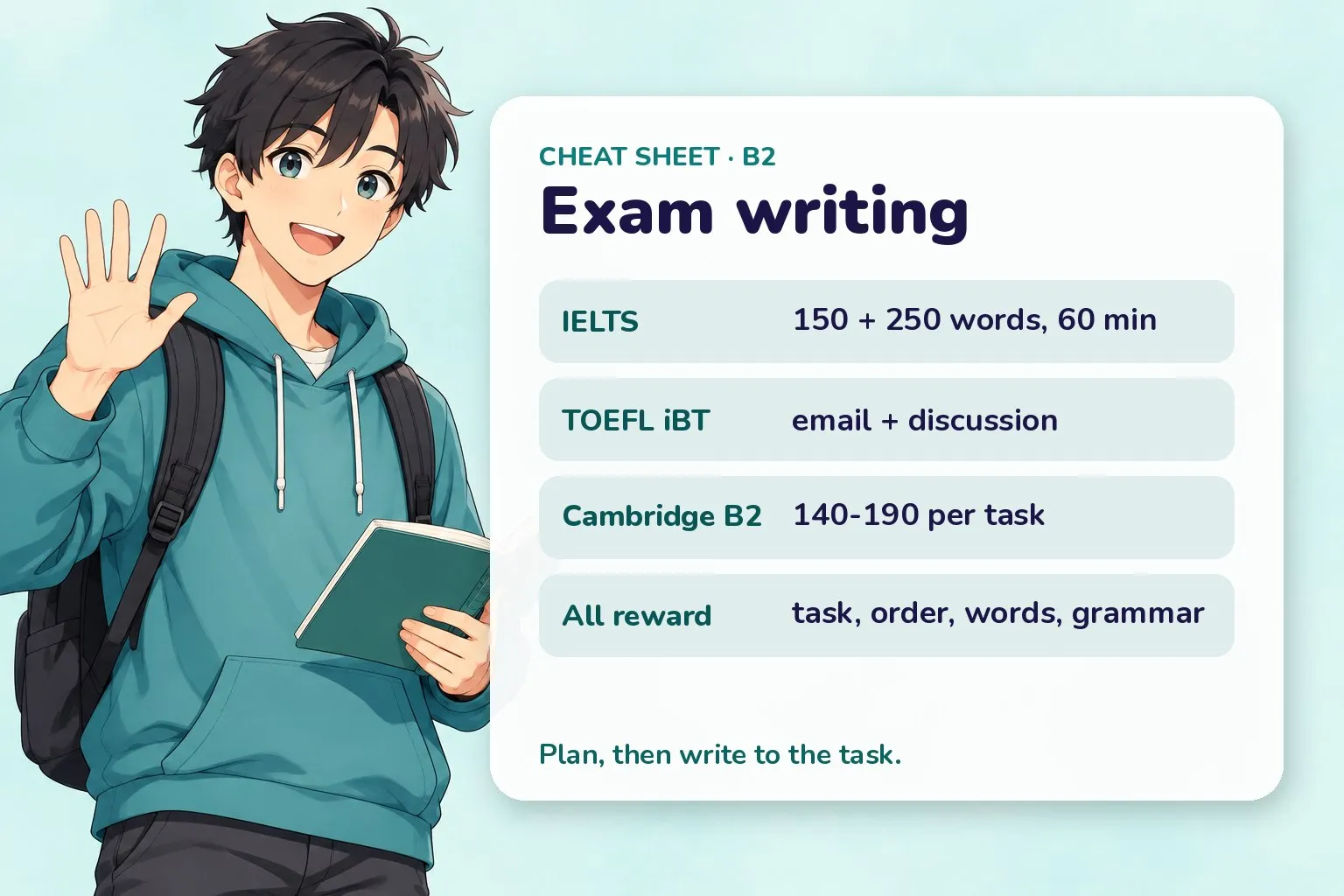
| IELTS Academic | Task 1 (describe data) + Task 2 (essay) | 150 / 250 |
| TOEFL iBT (2026) | Build a Sentence, Write an Email, Academic Discussion | short, task-set |
| Cambridge B2 First | Essay (Part 1) + choice (Part 2) | 140–190 each |
| All reward | task answer, organisation, vocabulary, grammar | — |
Next
- Start here: English Exams: Which One & How to Prepare
- Build accuracy: English Grammar lessons
- Build range: English Vocabulary sets
- Practise the register: Formal Writing & Emails and Writing Business Emails in English
- Rehearse under time: English Practice pages
- New here? Start with Start Learning English Here
All English exams topics
Vocabulary, pronunciation, phrases, practice and exam help, ordered by level. Pick a topic and go straight to it. New lessons go live every day, so topics marked Coming soon fill in over the next weeks.
Exams
A2 1 topics · 1 ready
B1 6 topics · 6 ready
B2 12 topics · 12 ready
- 08 IELTS Reading: Format & Strategies
- 09 IELTS Academic Writing Task 1
- 10 IELTS Writing Task 2 (Essay)
- 11 IELTS Speaking: Parts 1-3
- 12 TOEFL iBT Overview: Format & Scoring
- 13 TOEFL Reading Strategies
- 14 TOEFL Listening Strategies
- 15 TOEFL Speaking Tasks
- 16 TOEFL Writing (incl. Integrated)
- 17 B2 First (FCE) Overview
- 18 Exam Essay & Writing Skills You are here
- 19 Exam Speaking Strategies