IELTS Reading: Format & Strategies
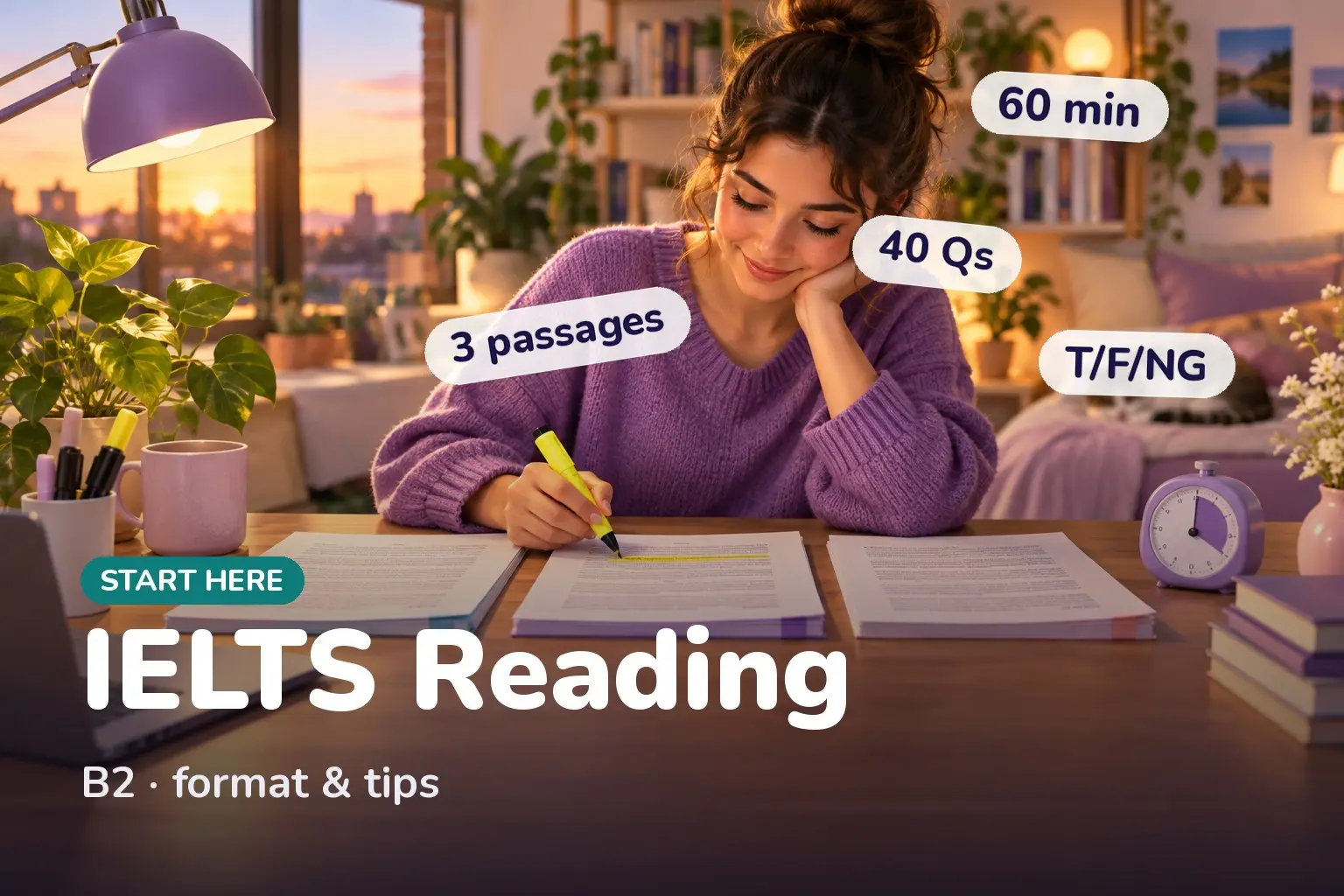
IELTS Academic Reading gives you three passages and 40 questions in 60 minutes, with no extra time to transfer answers. Each correct answer scores one mark towards a 0-9 band, so the skill is pacing: skim, locate and answer without reading every word.
Level: B2. IELTS Reading is a race against the clock: three passages and 40 questions in exactly 60 minutes, with no extra time to copy answers. This page explains the Academic format, how it differs from General Training, the question types that catch people out, and how to pace yourself to the end.
By the end of this page you can…
…describe the three-passage Academic Reading format, explain the main question types, handle True/False/Not Given with confidence, and pace a 60-minute paper so you answer all 40 questions.
The Academic Reading format
The Academic Reading paper has three passages and 40 questions and lasts 60 minutes (IELTS Reading format). The texts come from books, journals, magazines, newspapers and online sources, written for a non-specialist audience on topics of general interest to university students. Styles vary — narrative, descriptive and discursive or argumentative — and at least one passage contains detailed logical argument. Texts may include diagrams, graphs or illustrations, and if a technical word appears, a simple dictionary definition is given (IELTS Reading format).
| Feature | Academic Reading |
|---|---|
| Passages | 3 |
| Total text length | 2,150-2,750 words |
| Questions | 40 |
| Time | 60 minutes (no extra transfer time) |
| Marking | 1 mark per answer, band 1-9 |
Academic vs General Training Reading
The two versions differ in their reading material (IELTS test format):
- Academic uses longer, more complex passages of the kind you meet in study.
- General Training has three sections of increasing difficulty — everyday texts (notices, advertisements, timetables) in Section 1, workplace texts (job descriptions, contracts, training) in Section 2, and one longer general-interest text in Section 3, with a total length of 2,150-2,375 words (IELTS General Training Reading).
Both have 40 questions in 60 minutes, and both are marked one mark per answer (IELTS Reading formats). If you need Academic, prepare with academic-style passages, not everyday notices.
The main question types
A single passage carries a mix of tasks. The common ones are:
- Multiple choice — a question with four options, or a sentence start with four endings; sometimes you choose more than one from a longer list.
- True / False / Not Given — decide whether a statement agrees with the information in the text.
- Yes / No / Not Given — decide whether a statement agrees with the writer’s views or claims (not just facts).
- Matching information — find which paragraph contains a given piece of information.
- Matching headings, features or sentence endings, sentence / summary / note / table / flow-chart completion, diagram-label completion and short-answer questions.
Multiple choice and completion tasks follow the order of the text; heading and matching tasks do not, so you scan the whole passage for them (IELTS Reading format).
Strategies that work
Pace yourself: with 60 minutes for three passages, aim for about 20 minutes each, and never spend five minutes on one question — mark your best guess, flag it, and move on. On completion tasks, copy words exactly and keep to the word limit, because wrong spelling or too many words scores zero.
Reading task language to recognise
These are the instruction lines and signpost words that tell you what each task wants.
- Choose the correct letter, A, B, C or D.A standard multiple-choice instruction.
- Do the following statements agree with the information in the passage?The True/False/Not Given prompt.
- Do the following statements agree with the views of the writer?The Yes/No/Not Given prompt.
- Write NO MORE THAN TWO WORDS from the passage.A completion word-limit instruction.
- Which paragraph contains the following information?A matching-information task.
- Choose the correct heading for each paragraph.A matching-headings task.
- The statement contradicts the passage, so the answer is False.How to reason about False.
- The passage does not mention this, so the answer is Not Given.How to reason about Not Given.
- The writer argues that the policy failed.An opinion signal for Yes/No/Not Given.
- According to the passage, the method was unreliable.A fact signal for True/False/Not Given.
- The author suggests, however, that the data is limited.A contrast word flagging the writer's view.
- Complete the summary using words from the box.A summary-completion instruction.
- Label the diagram with words from the passage.A diagram-label task.
- Answer the question in no more than three words.A short-answer instruction.
- The term is defined in brackets after it first appears.How technical words are handled.
Quick recap before you practise.
Usage notes
- spelling counts: a correctly located answer spelt wrong is marked wrong — copy words straight from the passage.
- word limits: no more than two words means two words maximum; a number can count as a word depending on the instruction, so read it carefully.
- order of answers: for ordered tasks, a found answer tells you roughly where the next one is; for heading and matching tasks, there is no such order.
- do not leave blanks: there is no penalty for a wrong answer, so guess every remaining question before time runs out.
Prepare with this course
- Academic vocabulary: passages reward range — work through the Academic Word List part 1 and part 2.
- Linking and argument: recognising how writers signal contrast and cause speeds up Yes/No/Not Given — see Linking words for writing.
- Collocations: collocations practice helps you read set phrases as single chunks.
- Timed sets: build reading speed on the practice pages, and see how Reading feeds your score in the IELTS Overview.
Practice
IELTS Reading practice
Try each one, then press Check. No sign-up, nothing is sent anywhere — it all runs in your browser.
Hint: and 40 questions
Show answer
3 — There are three passages and 40 questions.
Hint: what the author thinks
Show answer
views — Yes/No/Not Given is about the writer's views or claims.
5 Put the reading approach in a sensible order.
Show answer
skim the passage read the question locate with keywords answer and record it — Skim, read the question, locate, then answer.
6 Match each task to what it follows.
- Multiple choice
- Completion
- Matching headings
- Matching information
Show answer
- Multiple choice → order of the text
- Completion → order of the text
- Matching headings → no fixed order
- Matching information → no fixed order
Ordered tasks follow the text; heading and matching tasks do not.
Quiz
IELTS Reading quiz
10 questions · pick an answer and you'll see straight away if it's right.
-
Show answer
40 — There are 40 questions across the three passages.
-
Show answer
No, the 60 minutes includes writing answers — Reading has no extra transfer time, unlike Listening.
-
Show answer
Books, journals, magazines, newspapers and online sources — Texts are drawn from a wide range of published sources for a non-specialist audience.
-
Show answer
The text contradicts the statement — False means the passage directly contradicts the statement.
-
Show answer
the writer's views or claims — It is about the writer's views or claims, not just facts.
-
Show answer
Multiple choice and completion — Multiple choice and completion follow the text order; heading and matching tasks do not.
-
Show answer
20 minutes — About 20 minutes each keeps you on pace for all three.
-
Show answer
A simple definition is provided for it — Technical vocabulary is given a simple dictionary definition.
-
Show answer
Mark a best guess, flag it and move on — Guess, flag and move on; never let one question cost you others.
-
Show answer
No, there is no penalty, so always guess — There is no penalty for a wrong answer, so fill every gap.
Recap cheat-sheet
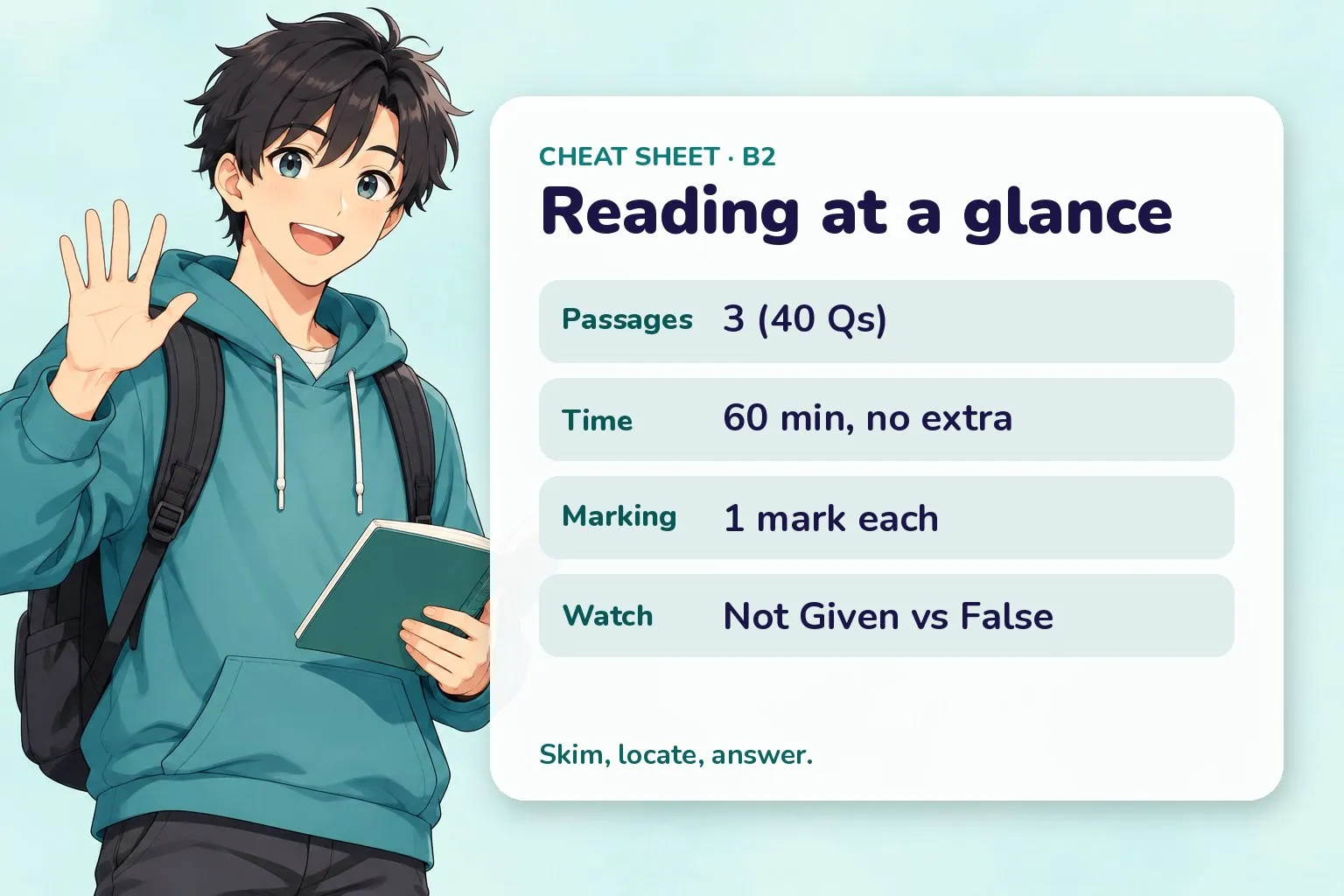
| Feature | Academic Reading |
|---|---|
| Passages | 3 (2,150-2,750 words total) |
| Questions | 40 |
| Time | 60 minutes, no transfer time |
| Marking | 1 mark each, band 1-9 |
| Watch | Not Given vs False; word limits |
Next
- The big picture: IELTS Overview: Format & Scoring
- Hub: English Exams: Which One & How to Prepare
- Build range: Academic Word List part 1
- Read arguments faster: Linking words for writing
- New here? Start with Start Learning English Here
All English exams topics
Vocabulary, pronunciation, phrases, practice and exam help, ordered by level. Pick a topic and go straight to it. New lessons go live every day, so topics marked Coming soon fill in over the next weeks.
Exams
A2 1 topics · 1 ready
B1 6 topics · 6 ready
B2 12 topics · 12 ready
- 08 IELTS Reading: Format & Strategies You are here
- 09 IELTS Academic Writing Task 1
- 10 IELTS Writing Task 2 (Essay)
- 11 IELTS Speaking: Parts 1-3
- 12 TOEFL iBT Overview: Format & Scoring
- 13 TOEFL Reading Strategies
- 14 TOEFL Listening Strategies
- 15 TOEFL Speaking Tasks
- 16 TOEFL Writing (incl. Integrated)
- 17 B2 First (FCE) Overview
- 18 Exam Essay & Writing Skills
- 19 Exam Speaking Strategies