IELTS Listening: Format & Strategies

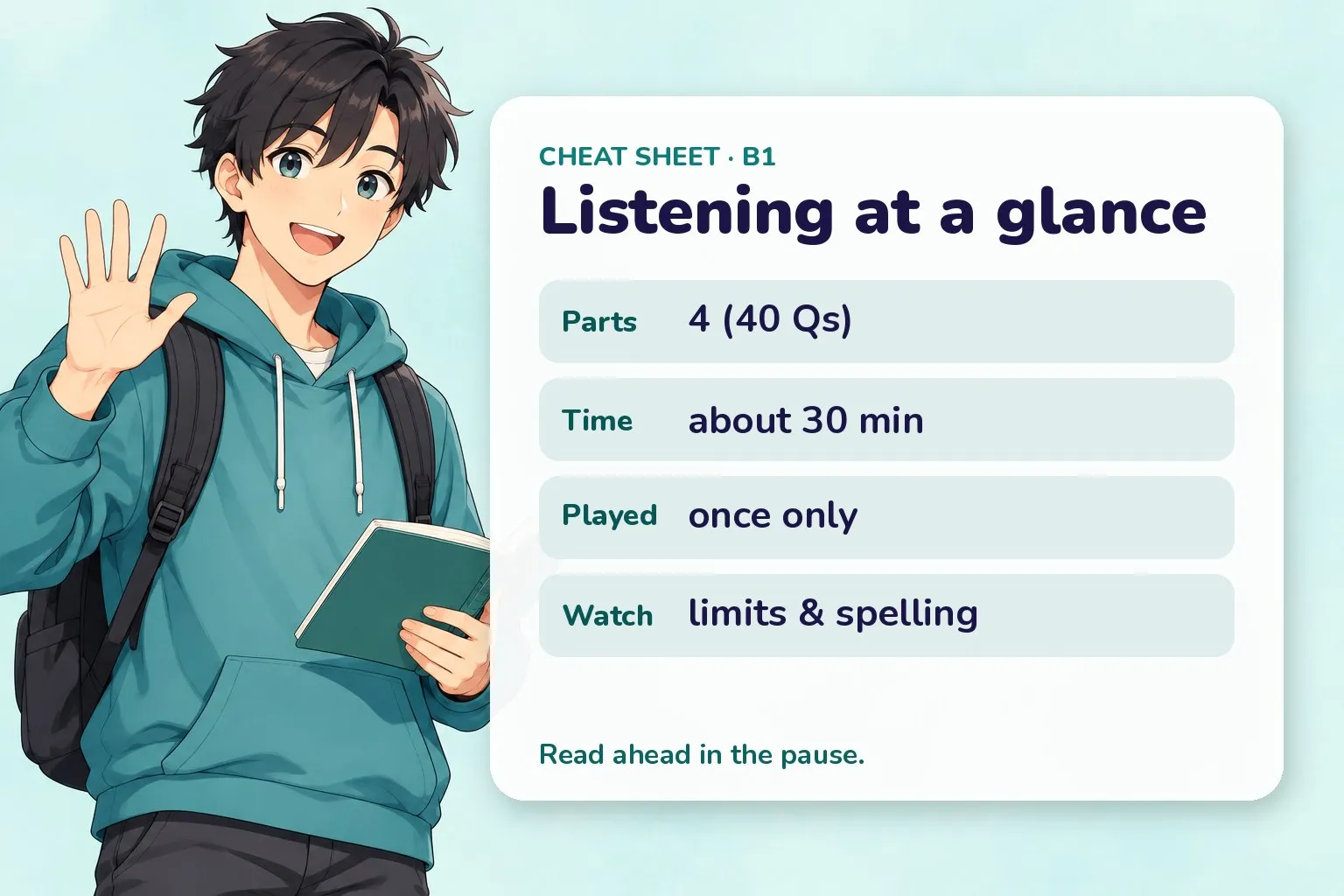
IELTS Listening has four parts and 40 questions, takes about 30 minutes, and every recording is played once only. Parts 1 and 2 cover everyday situations, Parts 3 and 4 educational ones, and each correct answer scores one mark towards a 0-9 band.
Level: B1. IELTS Listening is the same paper in both Academic and General Training. It is short — about 30 minutes — but it moves fast, because you hear each recording only once. This page breaks down the four parts, the question types and the habits that stop you losing easy marks.
By the end of this page you can…
…describe the four parts of IELTS Listening, name the main question types, explain why spelling and word limits matter, and practise the strategies that keep you with the recording.
The four parts
The paper has four parts with ten questions each — 40 questions in total. The questions follow the order of the recording, so the answer to question 1 comes before the answer to question 2, and so on (IELTS Listening format).
| Part | Situation | Speakers |
|---|---|---|
| Part 1 | everyday, social (e.g. travel arrangements) | a conversation between two people |
| Part 2 | everyday, social (e.g. local facilities) | one main speaker |
| Part 3 | educational or training | up to two main speakers, sometimes a tutor |
| Part 4 | an academic subject | one person speaking |
Parts 1 and 2 deal with everyday, social situations; Parts 3 and 4 move into educational and training settings and get harder (IELTS Listening format).
Timing and marking
The recording runs for about 30 minutes. On the paper-based test you then get an extra 10 minutes to transfer your answers onto the answer sheet; on the computer-delivered test you type answers as you go and get a short review time instead (IELTS Academic). Each correct answer earns one mark, and your raw score out of 40 becomes a band score in whole or half bands, for example 5.5 or 7.0 (IELTS Listening format).
Accents you will hear
IELTS uses a range of native-speaker accents — British, Australian, New Zealand and North American (IELTS Listening format). If you only ever practise with one accent, a different voice on test day can throw you. Mix your listening sources so no accent is a surprise.
The main question types
The same recording can carry several task types. The common ones are:
- Multiple choice — a question with three options, or the start of a sentence with three endings; sometimes you pick more than one answer from a longer list.
- Matching — match a list of items from the recording to a set of options and write the correct letter.
- Plan, map or diagram labelling — complete labels on a map, plan or diagram, often choosing from a list.
- Form, note, table, flow-chart or summary completion — fill gaps with words from the recording, keeping to the word limit given.
- Sentence completion and short-answer questions — write a word or short phrase you hear.
Strategies that work
A few more habits pay off: write numbers and dates in figures, check whether a plural -s is needed, and keep an eye on spelling of place and people names, which are often spelt out in the audio for exactly this reason.
Listening phrases and signposts
Speakers signal answers with set phrases. Learn to hear these turning points.
- You will hear the recording once only.The rule that shapes the whole test.
- Now turn to Part 2.A part-change signal.
- Write no more than two words for each answer.A typical word-limit instruction.
- Actually, let me correct that — it is on Tuesday, not Monday.A speaker self-corrects; the second answer is right.
- Sorry, did you say fifteen or fifty?A clarification that flags a tricky number.
- The library is on the second floor, next to the lift.Location detail for a map or plan task.
- That is spelt B-A-K-E-R, Baker.A name spelt out — copy it exactly.
- The deadline has been moved to the tenth of May.A changed detail you must catch.
- First, we will look at the results; after that, the method.Signposting the order of a talk.
- In other words, the project ran over budget.A rephrase that often holds the answer.
- The main reason for the delay was the weather.A cause being stated clearly.
- Could you repeat the postcode, please?A request that previews a code answer.
- Finally, let us turn to the costs involved.A signal the talk is near its end.
- You now have ten minutes to transfer your answers.The paper-test transfer instruction.
- Check your spelling before you hand in the sheet.A reminder that spelling is marked.
Quick recap before you practise.
Usage notes
- figures vs words for numbers: writing 15 is safe and fast; if you write it in words, spell it correctly.
- plurals: listen for whether the answer is one item or several — a missing or extra -s makes the answer wrong.
- capital letters: they are not usually penalised, but names of people and places read more clearly with a capital.
- do not leave blanks: there is no penalty for a wrong guess, so always write something for every question.
Prepare with this course
- Ears first: train with the pronunciation and minimal-pairs practice so similar sounds (ship/sheep, three/tree) stop tripping you.
- Numbers and dates: Listening is full of them — drill them with English Numbers, Dates & Money.
- Timed sets: build stamina and speed on the practice pages.
- See the bigger picture: the IELTS Overview: Format & Scoring shows how your Listening band feeds the overall score.
Practice
IELTS Listening practice
Try each one, then press Check. No sign-up, nothing is sent anywhere — it all runs in your browser.
Hint: ten questions in each
Show answer
4 — There are four parts, ten questions each.
Hint: not twice
Show answer
once — The recording is played a single time.
5 Put the listening strategy steps in order.
Show answer
read the questions in the pause predict the answer type answer as you listen check spelling at the end — Read ahead, predict, catch the answer, then check.
6 Match each part to its situation.
- Part 1
- Part 2
- Part 3
- Part 4
Show answer
- Part 1 → everyday conversation
- Part 2 → one speaker, social topic
- Part 3 → educational discussion
- Part 4 → academic talk
Parts 1-2 are social; Parts 3-4 are educational.
Quiz
IELTS Listening quiz
10 questions · pick an answer and you'll see straight away if it's right.
-
Show answer
About 30 minutes — The recording runs about 30 minutes.
-
Show answer
10 minutes — Paper test takers get 10 extra minutes to copy answers to the sheet.
-
Show answer
The order of the recording — Questions follow the order of the recording.
-
Show answer
British, Australian, New Zealand and North American — IELTS uses a range of native accents.
-
Show answer
a conversation about an everyday topic — Part 1 is an everyday conversation between two people.
-
Show answer
one person on an academic subject — Part 4 is a single speaker on an academic topic.
-
Show answer
Move on and come back later — Let it go so you catch the next answers, then return at the end.
-
Show answer
One mark — Each correct answer earns one mark towards your band.
-
Show answer
Because spelling is marked and the name is the answer — Names are spelt so you can write them exactly; spelling counts.
-
Show answer
Read the upcoming questions and predict answers — Reading ahead and predicting the answer type keeps you with the recording.
Recap cheat-sheet
| Feature | Detail |
|---|---|
| Parts | 4, ten questions each (40 total) |
| Time | about 30 minutes (+10 to transfer on paper) |
| Played | once only |
| Accents | British, Australian, NZ, North American |
| Watch | word limits and spelling |
Next
- The big picture: IELTS Overview: Format & Scoring
- Hub: English Exams: Which One & How to Prepare
- Train your ear: Minimal pairs practice
- Numbers and dates: English Numbers, Dates & Money
- New here? Start with Start Learning English Here
All English exams topics
Vocabulary, pronunciation, phrases, practice and exam help, ordered by level. Pick a topic and go straight to it. New lessons go live every day, so topics marked Coming soon fill in over the next weeks.
Exams
A2 1 topics · 1 ready
B1 6 topics · 6 ready
- 02 English Exams: Which One & How to Prepare
- 03 IELTS Overview: Format & Scoring
- 04 IELTS Listening: Format & Strategies You are here
- 05 Understanding IELTS Band Scores
- 06 Cambridge English Exams Explained
- 07 B1 Preliminary (PET) Overview
B2 12 topics · 12 ready
- 08 IELTS Reading: Format & Strategies
- 09 IELTS Academic Writing Task 1
- 10 IELTS Writing Task 2 (Essay)
- 11 IELTS Speaking: Parts 1-3
- 12 TOEFL iBT Overview: Format & Scoring
- 13 TOEFL Reading Strategies
- 14 TOEFL Listening Strategies
- 15 TOEFL Speaking Tasks
- 16 TOEFL Writing (incl. Integrated)
- 17 B2 First (FCE) Overview
- 18 Exam Essay & Writing Skills
- 19 Exam Speaking Strategies