Understanding IELTS Band Scores
IELTS reports each skill and an overall result on a 0 to 9 band scale, in whole and half bands. Your overall band is the average of Listening, Reading, Writing and Speaking, rounded to the nearest half band. There is no pass or fail.
On this page11 sections · tap to jump
- 01By the end of this page you can…
- 02The 0 to 9 band scale
- 03How your overall band is worked out
- 04What the marks look like in Listening and Reading
- 05How Writing and Speaking are scored
- 06The four parts, in brief
- 07Vocabulary you’ll meet
- 08Practice
- 09Quiz
- 10Recap cheat-sheet
- 11How to prepare with this course
Level: B1. An IELTS result is not a percentage or a pass mark. It is a band score from 0 to 9 that describes how well you use English. This page shows what each band means and how your overall band is worked out, so your result stops being a mystery.
By the end of this page you can…
…read the 0 to 9 band scale, work out an overall band from four section scores, and know how Listening, Reading, Writing and Speaking are each marked.
The 0 to 9 band scale
Every IELTS score sits on one nine-band scale, reported in whole and half bands (for example 6.0 or 6.5). You get a band for each of the four skills and one overall band. Each band is tied to a described level of skill (IELTS).
| Band | Skill level | What it means |
|---|---|---|
| 9 | Expert | Fully operational command; accurate and fluent |
| 8 | Very good | Fully operational with occasional slips; handles complex argument well |
| 7 | Good | Operational command with occasional inaccuracies |
| 6 | Competent | Effective command despite some inaccuracies, especially in familiar situations |
| 5 | Modest | Partial command; copes with overall meaning but makes many mistakes |
| 4 | Limited | Basic competence limited to familiar situations |
| 3 | Extremely limited | Conveys only general meaning; frequent breakdowns |
| 2 | Intermittent | Great difficulty understanding spoken and written English |
| 1 | Non-user | No real ability beyond a few isolated words |
| 0 | Did not attempt | No answers given |
How your overall band is worked out
Your overall band is the average of the four section bands, rounded to the nearest half band (IELTS). The rounding has one rule worth memorising: an average ending in .25 rounds up to the next half band, and an average ending in .75 rounds up to the next whole band.
| Listening | Reading | Writing | Speaking | Average | Overall |
|---|---|---|---|---|---|
| 6.5 | 6.5 | 5.0 | 7.0 | 6.25 | 6.5 |
| 4.0 | 3.5 | 4.0 | 4.0 | 3.875 | 4.0 |
| 6.5 | 6.5 | 5.5 | 6.0 | 6.125 | 6.0 |
What the marks look like in Listening and Reading
In Listening and Reading you answer 40 questions, each worth one mark. Your raw score out of 40 is converted to the band scale; the precise mark for each band shifts a little between test versions (IELTS). As a guide to a recent conversion:
| Band | Listening (/40) | Academic Reading (/40) |
|---|---|---|
| 5 | 16 | 15 |
| 6 | 23 | 23 |
| 7 | 30 | 30 |
| 8 | 35 | 35 |
General Training Reading needs more correct answers for the same band (for example, 30/40 is a band 6, not a band 7), because its texts are less demanding (IELTS).
How Writing and Speaking are scored
These two skills are not marked out of 40. An examiner awards a band for each of four criteria and averages them. For Speaking the criteria are fluency and coherence, lexical resource (vocabulary), grammatical range and accuracy, and pronunciation; each carries equal weight (IELTS). Writing is judged on a similar set of four criteria. This is why padding your answer does not help: the examiner is looking at range and accuracy, not word count.
The four parts, in brief
So you can picture where the marks come from: Listening is 30 minutes (four recordings, 40 questions); Reading is 60 minutes (40 questions); Writing is 60 minutes (a shorter Task 1 of about 150 words and an essay-style Task 2 of about 250 words); Speaking is an 11 to 14 minute interview in three parts. Listening, Reading and Writing are taken on the same day with no breaks; Speaking may be the same day or up to a week before or after (IELTS).
Vocabulary you’ll meet
Tap a word to hear it. These are the scoring terms that appear in your result and in official guidance.
- a band scorethe 0 to 9 number that describes your English level on IELTS.
- an overall bandthe single result that averages your four section bands.
- a sectionone of the four parts: Listening, Reading, Writing or Speaking.
- to roundto adjust a number to the nearest half or whole band.
- a half banda score ending in .5, such as 6.5, between two whole bands.
- a raw scorethe number of questions you got right, before conversion to a band.
- to convertto change a raw mark out of 40 into a band on the 0 to 9 scale.
- criteriathe things an examiner judges, such as fluency or accuracy.
- an examinerthe trained person who marks your Writing and Speaking.
- fluencyhow smoothly and easily you speak, without long hesitation.
- accuracyhow correct your grammar and word choice are.
- a requirementthe minimum band an institution asks you to reach.
Practice
IELTS band scores practice
Try each one, then press Check. No sign-up, nothing is sent anywhere — it all runs in your browser.
Hint: an average ending in .25 rounds up to the next half band
Show answer
6.5 — An average ending in .25 rounds up to the next half band, so 6.25 becomes 6.5.
3 Match each band to its skill level.
- 9
- 7
- 6
- 5
Show answer
- 9 → Expert
- 7 → Good
- 6 → Competent
- 5 → Modest
These are the official skill-level labels for each band.
4 Put the four IELTS sections in the usual test order.
Show answer
Listening Reading Writing Speaking — The four skills are reported in this order, and your overall band averages all four.
Hint: fluency, vocabulary, grammar, pronunciation for Speaking
Show answer
4 — Each of these skills is judged on four equally weighted criteria, then averaged.
Quick recap before the quiz.
Quiz
IELTS band scores quiz
11 questions · pick an answer and you'll see straight away if it's right.
-
Show answer
9 — Band 9 is the top of the scale, described as Expert.
-
Show answer
the average of the four section bands — The overall band averages Listening, Reading, Writing and Speaking.
-
Show answer
up to the next whole band — An average ending in .75 rounds up to the next whole band.
-
Show answer
Competent — Band 6 is Competent: an effective command despite some inaccuracies.
-
Show answer
40 — There are 40 questions in each, worth one mark each.
-
Show answer
30 — Around 30 out of 40 corresponds to band 7, varying slightly by version.
-
Show answer
examiners judge range and accuracy, not length — Writing and Speaking are scored on quality criteria, not word count.
-
Show answer
handwriting — Speaking is judged on fluency, vocabulary, grammar and pronunciation.
-
Show answer
no, each institution sets its own minimum — There is no pass or fail; the institution decides the minimum band it accepts.
-
Show answer
two years — Two years is the recommended validity, though institutions may vary.
-
Show answer
more correct answers for the same band — Its texts are less demanding, so more correct answers are needed for the same band.
Recap cheat-sheet
| Thing | The rule |
|---|---|
| Scale | 0 to 9, whole and half bands |
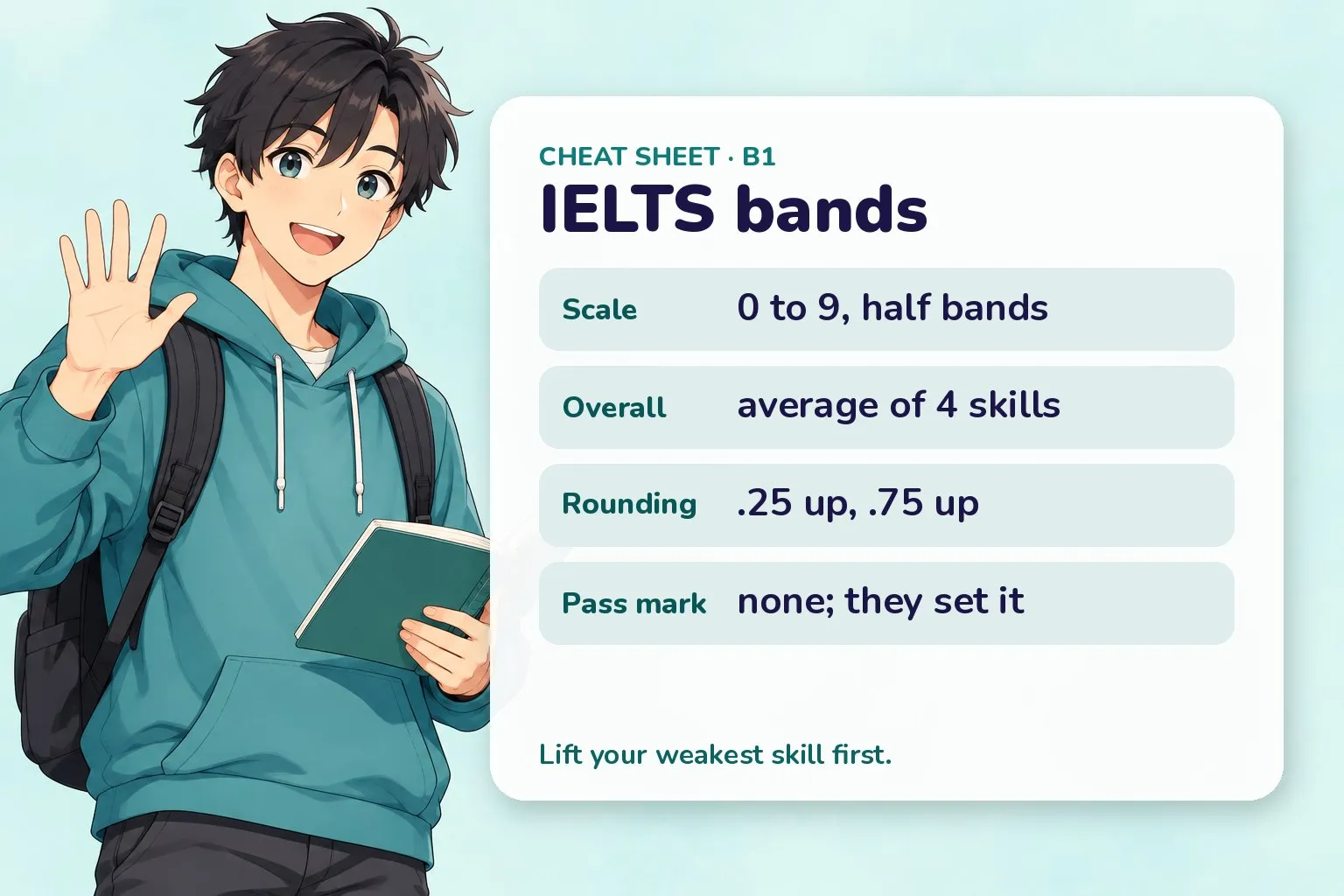
| Overall band | average of four sections, rounded to nearest half |
| Rounding | .25 up to next half, .75 up to next whole |
| Listening / Reading | 40 questions, raw mark converted to band |
| Writing / Speaking | four equal criteria, averaged |
| Pass mark | none; the institution sets it |
How to prepare with this course
Band scores go up when all four skills improve together:
- Accuracy first: work through the English grammar lessons at and just above your level, since grammar lifts Writing and Speaking most.
- Range next: the vocabulary sets build the words examiners reward.
- Rehearse under time: the practice pages let you train against the clock.
- Still choosing an exam? Start at the English exams hub.
Next
- Build accuracy: English Grammar lessons
- Build range: English Vocabulary sets
- Compare the exams: English exams hub
- New here? Start with Start Learning English Here
All English exams topics
Vocabulary, pronunciation, phrases, practice and exam help, ordered by level. Pick a topic and go straight to it. New lessons go live every day, so topics marked Coming soon fill in over the next weeks.
Exams
A2 1 topics · 1 ready
B1 6 topics · 6 ready
- 02 English Exams: Which One & How to Prepare
- 03 IELTS Overview: Format & Scoring
- 04 IELTS Listening: Format & Strategies
- 05 Understanding IELTS Band Scores You are here
- 06 Cambridge English Exams Explained
- 07 B1 Preliminary (PET) Overview
B2 12 topics · 12 ready
- 08 IELTS Reading: Format & Strategies
- 09 IELTS Academic Writing Task 1
- 10 IELTS Writing Task 2 (Essay)
- 11 IELTS Speaking: Parts 1-3
- 12 TOEFL iBT Overview: Format & Scoring
- 13 TOEFL Reading Strategies
- 14 TOEFL Listening Strategies
- 15 TOEFL Speaking Tasks
- 16 TOEFL Writing (incl. Integrated)
- 17 B2 First (FCE) Overview
- 18 Exam Essay & Writing Skills
- 19 Exam Speaking Strategies