Exam Speaking Strategies
Every English speaking exam rewards the same things: speaking fluently, using varied and accurate language, and being easy to understand. Learn the shape of each part and a few phrases to buy thinking time, organise ideas and interact, and you can stay calm under pressure.
On this page13 sections · tap to jump
- 01By the end of this page you can…
- 02What each exam’s speaking looks like
- 03IELTS Speaking: three parts, 11–14 minutes
- 04TOEFL iBT Speaking: on a computer
- 05Cambridge Speaking: with a partner
- 06What examiners actually reward
- 07A strategy for the hard questions
- 08Model phrases for every part
- 09Common mistakes
- 10How to say it
- 11Practice
- 12Quiz
- 13Recap cheat-sheet
Level: B2. The speaking test is where nerves do the most damage — not because your English is weak, but because you freeze or race. Good news: each exam has a predictable shape, and a handful of strategies carry across all of them. This page shows you the format of IELTS, TOEFL iBT and Cambridge speaking, what examiners reward, and the phrases that keep you talking.
By the end of this page you can…
…describe the parts and timings of each speaking exam, explain the skills examiners mark, and use phrases to buy thinking time, structure a long turn, and interact in a discussion.
What each exam’s speaking looks like
The three exams test speaking in different formats — alone with an examiner, with a partner, or into a computer.
| Exam | Format | Time |
|---|---|---|
| IELTS | Face-to-face interview with one examiner, recorded; 3 parts | 11–14 minutes |
| TOEFL iBT (2026) | On a computer: Listen and Repeat, Take an Interview; 11 items | about 8 minutes |
| Cambridge B2 First | With a partner and two examiners; 4 parts | 14 minutes per pair |
IELTS Speaking: three parts, 11–14 minutes
IELTS Speaking is a recorded, face-to-face interview with an examiner in three parts (IELTS):
- Part 1 — Introduction and interview (4–5 minutes): familiar questions about you, your home, work, studies and interests. Treat it as a warm-up and answer naturally.
- Part 2 — Long turn (up to 2 minutes talking): you get a cue card with a topic, one minute to prepare, then you speak for up to two minutes, after which the examiner asks a short follow-up (IELTS).
- Part 3 — Discussion (4–5 minutes): more abstract questions linked to the Part 2 topic, with no preparation time. Being interrupted here is normal — it pushes you to go deeper (IELTS).
The examiner marks four things: fluency and coherence, lexical resource, grammatical range and accuracy, and pronunciation (IELTS).
TOEFL iBT Speaking: on a computer
TOEFL iBT was revised in 2026, and its speaking section is now short — about 11 items in roughly 8 minutes, built from Listen and Repeat and Take an Interview tasks (ETS). You speak into a microphone rather than to a live examiner, so clear pronunciation and a steady pace matter even more. The whole test is scored on an overall 1–6 scale, with a comparable 0–120 score during a transition period after January 2026 (ETS).
Cambridge Speaking: with a partner
Cambridge B2 First Speaking lasts 14 minutes per pair, with two examiners and another candidate, across four parts (Cambridge English):
- Part 1 — Interview (about 2 minutes): questions about your life, experiences and plans.
- Part 2 — Long turn: you compare two photographs and speak for about a minute, then your partner gives a short response.
- Part 3 — Collaborative task: you discuss written prompts with your partner for about two minutes, then make a decision together in about a minute.
- Part 4 — Discussion: a broader discussion with your partner and the examiner on the Part 3 theme.
What examiners actually reward
The IELTS criteria describe what every speaking examiner listens for, whatever the exam (IELTS):
- Fluency and coherence — speaking at a natural speed without too much hesitation, in a logical order.
- Lexical resource — a range of words used accurately, and the ability to work around a word you don’t know.
- Grammatical range and accuracy — a mix of structures with few errors.
- Pronunciation — being understood easily, without strain on the listener.
Notice that accuracy is only one of four areas. A fluent, well-organised answer with a small grammar slip usually scores better than a slow, perfect one.
A strategy for the hard questions
For abstract Part 3 questions, IELTS publishes a simple four-step framework you can use for any opinion question (IELTS):
- Give a direct answer to the question.
- Explain with a reason.
- Give an example to support it.
- Offer an alternative or consequence.
Model phrases for every part
Say these aloud until they come without thinking. They give you time, structure and a way to interact.
- That's an interesting question. Let me think for a moment.Buying thinking time without going silent.
- Well, it really depends on the situation.A natural, nuanced opener.
- In my experience, this works better in small groups.Answering Part 1 from your own life.
- I'd say the main reason is that it saves people time.Giving a clear reason.
- For example, when I was at university, we tried exactly this.Supporting a point with an example.
- The topic I'd like to talk about is a trip I took last year.Opening the IELTS Part 2 long turn.
- The first thing I should mention is where it happened.Structuring the long turn so it flows.
- What really stands out for me is how friendly everyone was.Adding emphasis and detail.
- On the whole, I think the benefits are worth it.Summing up your view.
- Looking at these two photos, the first one shows a busy market.Comparing photographs in Cambridge Part 2.
- I see what you mean, but I'm not sure I agree.Disagreeing politely in a discussion.
- It's hard to generalise, but on balance I'd say yes.Handling an abstract Part 3 question.
- Some people argue that it is risky, whereas others welcome it.Showing both sides before your view.
- Shall we say the library is the best option, then?Moving toward a joint decision with a partner.
- I'm not entirely sure, but I'd guess it would cost more.Speculating when you don't know.
- To put it another way, it is about fairness.Rephrasing to show range.
- That reminds me of something similar at my workplace.Extending an answer naturally.
- So, to sum up, I believe the advantages outweigh the costs.Rounding off a Part 3 answer.
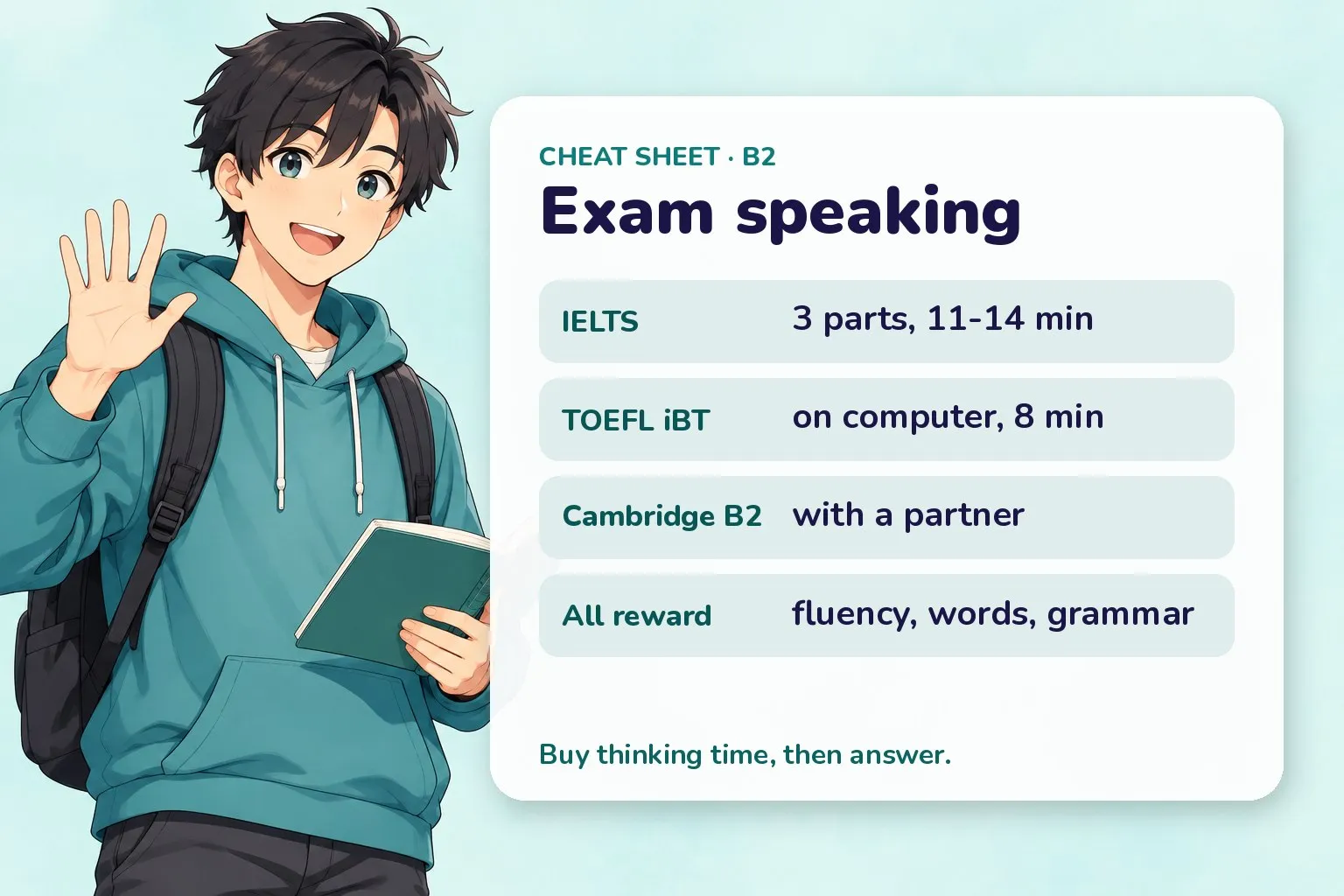
Quick recap before you practise.
Common mistakes
- ❌ Reciting a memorised speech. → ✅ Examiners spot it; use flexible phrases and real ideas instead.
- ❌ One-word answers in Part 1. → ✅ Add a reason or example so the examiner hears your range.
- ❌ Going silent to think. → ✅ Use a short filler phrase, then answer.
- ❌ Talking over your Cambridge partner. → ✅ Invite them in; interaction is marked.
- ❌ Repeating Part 2 ideas in Part 3. → ✅ Part 3 wants broader, more abstract points.
How to say it
A few exam words trip learners up when nerves hit.
- examiner has four beats, stress on the second: ig-ZAM-in-er.
- comfortable is often said in three beats: KUMF-tuh-bul.
- vocabulary is voh-KAB-yoo-luh-ree.
- pronunciation is pruh-nun-see-AY-shun — note it is not pronounce-iation.
Practice
Exam speaking practice
Try each one, then press Check. No sign-up, nothing is sent anywhere — it all runs in your browser.
Hint: the number of minutes
Show answer
one — You have one minute to prepare, then speak for up to two minutes.
3 Match each part to what it asks of you.
- IELTS Part 1
- IELTS Part 2
- IELTS Part 3
- Cambridge Part 3
Show answer
- IELTS Part 1 → familiar questions about you
- IELTS Part 2 → a long turn on a cue card
- IELTS Part 3 → an abstract discussion
- Cambridge Part 3 → a decision made with a partner
Each part has a clear job; knowing it keeps you on task.
4 Put the official IELTS Part 3 answer strategy in order.
Show answer
Give a direct answer Explain with a reason Give an example Offer an alternative or consequence — Answer, reason, example, then an alternative or consequence.
Quiz
Exam speaking quiz
12 questions · pick an answer and you'll see straight away if it's right.
-
Show answer
Three — IELTS Speaking has three parts.
-
Show answer
11–14 minutes — The test runs 11–14 minutes in total.
-
Show answer
One minute — You get one minute to prepare, then speak for up to two minutes.
-
Show answer
Familiar topics about you and your life — Part 1 asks familiar questions about your background and interests.
-
Show answer
It is abstract, with no preparation time — Part 3 is a broader, more abstract discussion with no prep time.
-
Show answer
Task achievement — Task achievement is a writing criterion; speaking uses fluency, lexical resource, grammar and pronunciation.
-
Show answer
Listen and Repeat, and Take an Interview — The revised TOEFL speaking section uses Listen and Repeat and Take an Interview, in about 8 minutes.
-
Show answer
Another candidate, with two examiners — You take it with a partner and there are two examiners.
-
Show answer
Compare two photographs for about a minute — Part 2 is a long turn comparing two photographs.
-
Show answer
Use a short phrase to buy thinking time, then answer — A filler phrase keeps your fluency mark while you plan your answer.
-
Show answer
It is normal and prompts deeper discussion — Interruptions in Part 3 are normal and push you to develop your ideas.
-
Show answer
An alternative or consequence — The steps are: answer, reason, example, then an alternative or consequence.
Recap cheat-sheet
| Exam | Format | Time |
|---|---|---|
| IELTS | 3 parts, recorded interview | 11–14 min |
| TOEFL iBT (2026) | Listen and Repeat + Take an Interview, on computer | about 8 min |
| Cambridge B2 First | 4 parts, with a partner + 2 examiners | 14 min |
| All reward | fluency, vocabulary, grammar, pronunciation | — |
Next
- Start here: English Exams: Which One & How to Prepare
- Build range: English Vocabulary sets
- Build accuracy: English Grammar lessons
- Rehearse under time: English Practice pages
- New here? Start with Start Learning English Here
All English exams topics
Vocabulary, pronunciation, phrases, practice and exam help, ordered by level. Pick a topic and go straight to it. New lessons go live every day, so topics marked Coming soon fill in over the next weeks.
Exams
A2 1 topics · 1 ready
B1 6 topics · 6 ready
B2 12 topics · 12 ready
- 08 IELTS Reading: Format & Strategies
- 09 IELTS Academic Writing Task 1
- 10 IELTS Writing Task 2 (Essay)
- 11 IELTS Speaking: Parts 1-3
- 12 TOEFL iBT Overview: Format & Scoring
- 13 TOEFL Reading Strategies
- 14 TOEFL Listening Strategies
- 15 TOEFL Speaking Tasks
- 16 TOEFL Writing (incl. Integrated)
- 17 B2 First (FCE) Overview
- 18 Exam Essay & Writing Skills
- 19 Exam Speaking Strategies You are here