English Politeness & Please/Thank-You
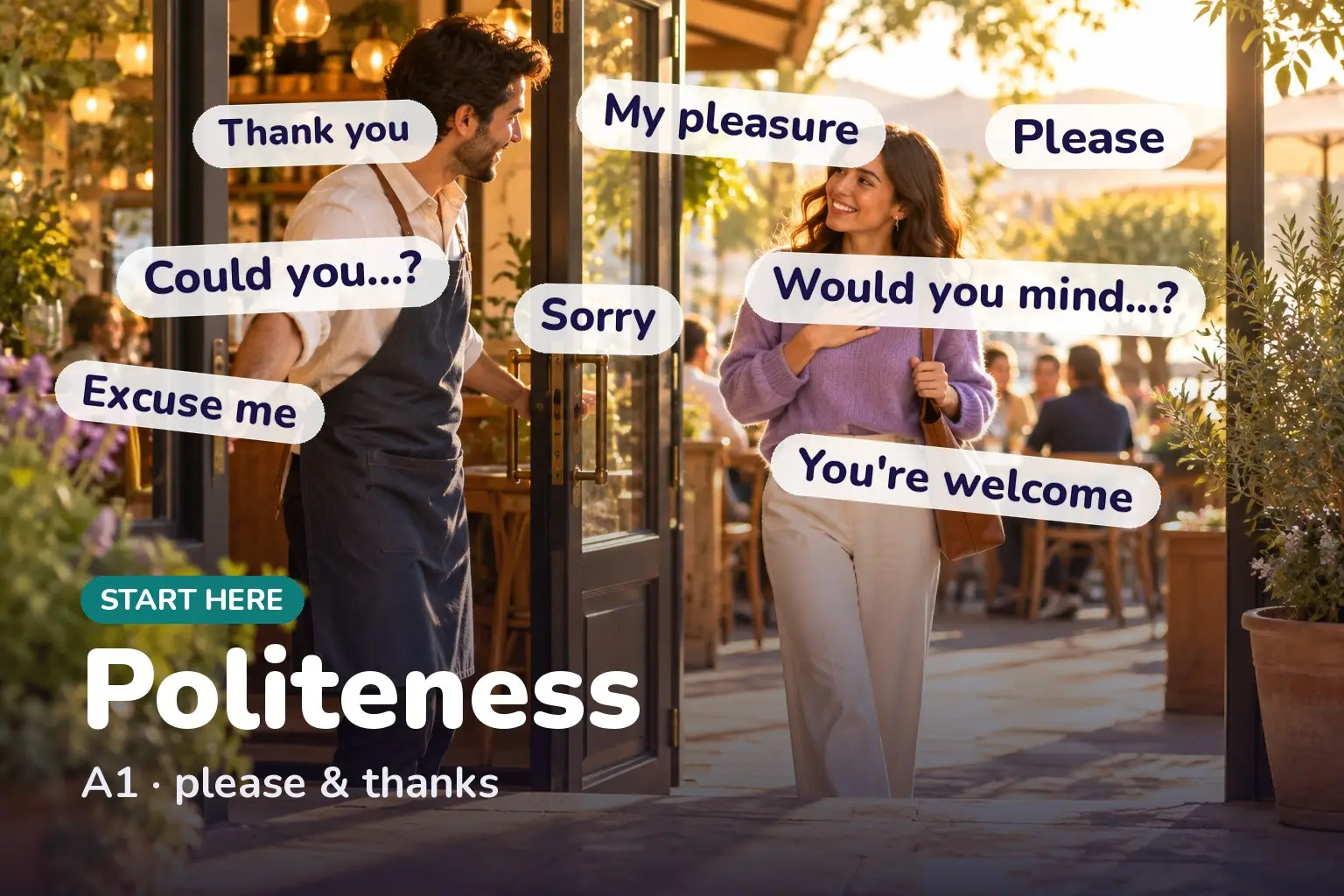
English sounds polite when you soften requests and show thanks. Add 'please', open with 'Excuse me' or 'Could you…', and reply to thanks with 'You're welcome'. A direct order like 'Give me that' becomes friendly as 'Could I have that, please?'
Level: A1. English can feel blunt if you translate word-for-word from your own language. The fix is a small kit of polite phrases: please, thank you, excuse me, sorry, and the gentle request forms Could you…? and Would you mind…? This page gives you all of them, with a note on when each one fits.
By the end of this page you can…
…ask for things politely, thank people and reply to thanks, apologise, and turn a blunt order into a friendly request.
Why English wraps its requests
In English, a direct command (Open the window) can sound rude to a stranger, even if you don’t mean it to. Speakers soften requests by turning them into questions and adding words like please. The more you want from someone, the more softening you add. This isn’t about being fake — it’s how respect is shown in the language.
Please and thank you
| Phrase | Meaning / when to use | Register |
|---|---|---|
| Please. | Softens any request | Neutral |
| Thank you. / Thanks. | Showing gratitude | Neutral / Casual |
| Thank you very much. | Stronger, warmer thanks | Neutral |
| Thanks a lot. / Thanks so much. | Friendly, emphatic thanks | Casual |
| Cheers. | ‘Thanks’ in casual British English | Casual |
| I really appreciate it. | Warm, sincere thanks for a favour | Neutral / Formal |
| You’re welcome. | The standard reply to thanks | Neutral |
| No problem. / No worries. | A relaxed reply to thanks | Casual |
| My pleasure. | A warm, slightly formal reply to thanks | Formal |
| Don’t mention it. | A modest reply to thanks | Neutral |
Excuse me and sorry
These two are easy to mix up. The simple rule: Excuse me comes before (you’re about to interrupt, pass, or ask); Sorry comes after (you made a mistake or bumped someone).
| Phrase | Meaning / when to use | Register |
|---|---|---|
| Excuse me. | Before interrupting, passing or asking | Polite |
| Excuse me, could I ask you something? | Politely getting attention | Polite |
| Sorry. | After a small mistake or bump | Neutral |
| I’m so sorry. | A stronger, sincere apology | Neutral |
| Sorry to bother you, but… | Softens an interruption | Polite |
| Pardon? / Sorry? | Asking someone to repeat | Polite |
| My apologies. | A formal apology | Formal |
| Excuse me? (rising tone) | Mild surprise or ‘please repeat’ | Neutral |
Making polite requests
Order these from lighter to bigger asks. The bigger the favour, the more softening you use.
| Phrase | Meaning / when to use | Register |
|---|---|---|
| Can I have …, please? | A simple, everyday request | Neutral |
| Could I have …, please? | A touch more polite than ‘can’ | Polite |
| Could you …, please? | Asking someone to do something | Polite |
| Would you mind …-ing? | A gentle request; note the -ing | Polite |
| Do you think you could …? | For a slightly bigger favour | Polite |
| I was wondering if you could … | A soft, formal lead-in | Formal |
| I’d like …, please. | Ordering or stating a wish politely | Polite |
| Is it okay if I …? | Asking permission | Neutral |
Softeners that smooth everything
Small words make a request feel lighter without changing it.
| Softener | Example | Effect |
|---|---|---|
| just | Could I just ask a quick question? | Makes it sound small |
| a little / a bit | Could you speak a little slower? | Gentler than a bare request |
| if that’s okay | I’ll take this one, if that’s okay. | Leaves room to refuse |
| possibly | Could you possibly help me? | Extra polite for a favour |
| maybe | Maybe we could meet later? | Soft suggestion |
Example sentences
Play each line and say it along with the audio.
- Could you help me, please?The all-purpose polite request.The magic frame: Could you …, please?
- Can I have a coffee, please?A simple everyday request.Add please to soften it.
- Could I have the menu, please?A touch more polite than 'can'.Could is softer than can.
- Would you mind closing the door?A gentle request; note the -ing form.Answer 'No' or 'Not at all' to agree.
- Do you think you could give me a hand?For a slightly bigger favour.Softer than a direct ask.
- I was wondering if you could help me.A soft, formal lead-in to a request.Common in email and at work.
- Excuse me, could I ask you something?Politely getting someone's attention.Excuse me comes before the question.
- Sorry to bother you, but is this seat free?Softens an interruption.A very natural opener.
- I'm so sorry, that was my fault.A sincere apology after a mistake.Stronger than a plain 'sorry'.
- Thank you very much, that's really kind.Warm, emphatic thanks.Good for a real favour.
- Thanks so much for your help.Friendly, emphatic thanks.Casual and warm.
- I really appreciate it.Sincere thanks for a favour.Shows you mean it.
- You're welcome.The standard reply to thanks.Never leave 'thank you' hanging.
- No problem at all.A relaxed reply to thanks.Casual and friendly.
- My pleasure.A warm, slightly formal reply.Common in service settings.
- Could you speak a little slower, please?A softened request using 'a little'.Gentler than a bare request.
- Could I just ask one quick question?'Just' makes the ask sound small.A handy softener.
- Is it okay if I open the window?Asking permission politely.Leaves room to say no.
- I'd like a table for two, please.Stating a wish politely.Softer than 'I want'.
- Thanks anyway, that's very kind of you.Polite even when you decline help.Keeps things warm.
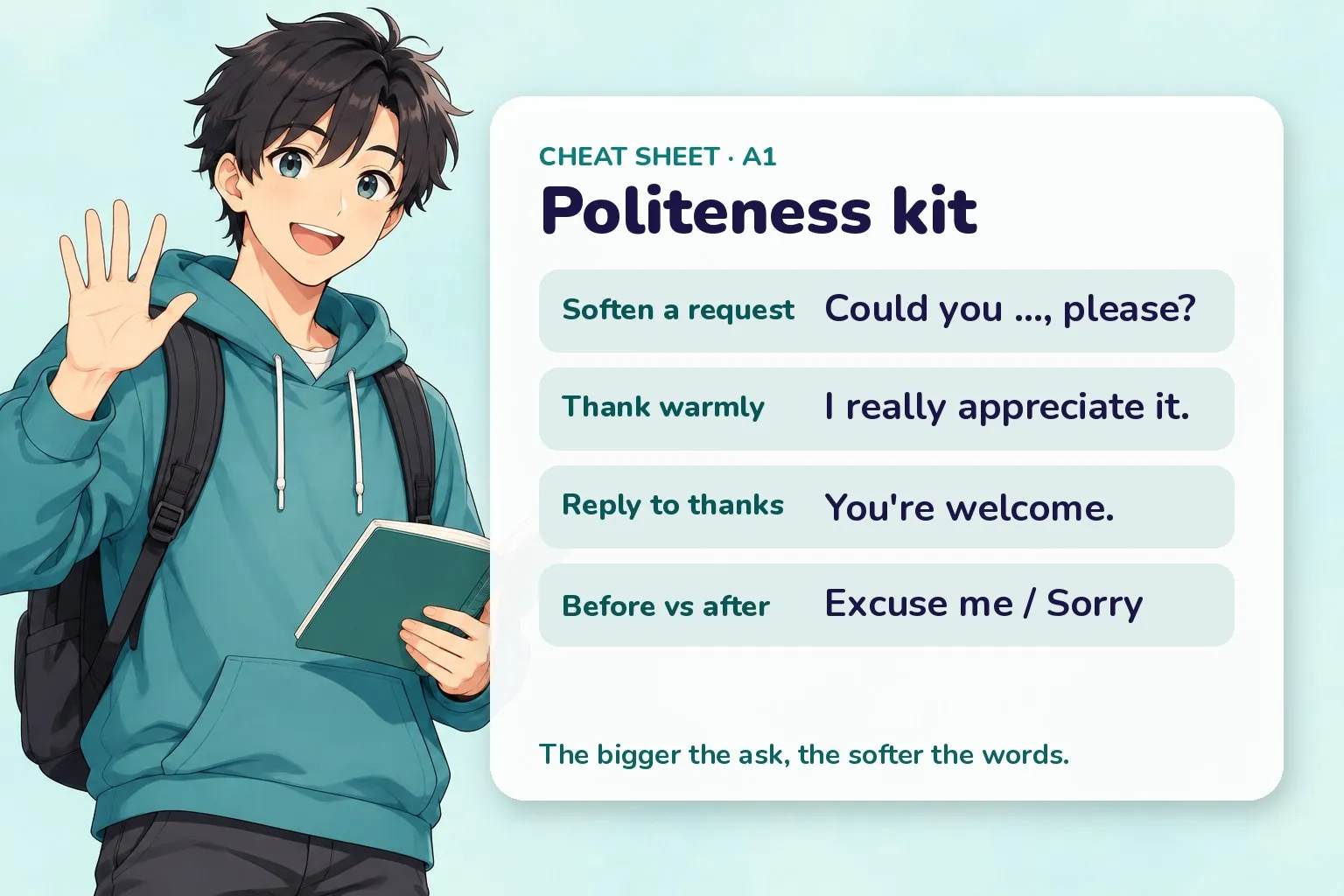
Quick recap before you practise.
Common mistakes
- ❌ Give me the salt. → ✅ Could you pass the salt, please? — turn an order into a question and add please.
- ❌ I want a coffee. → ✅ I’d like a coffee, please. — I’d like is far warmer than I want.
- ❌ Saying Excuse me after you bump someone → ✅ Say Sorry; Excuse me is for before you pass or interrupt.
- ❌ Would you mind to open the window? → ✅ Would you mind opening the window? — use the -ing form after would you mind.
- ❌ Answering Would you mind…? with Yes to agree → ✅ Say No / Not at all / Sure to agree to do it.
Practice
Politeness phrases practice
Try each one, then press Check. No sign-up, nothing is sent anywhere — it all runs in your browser.
Hint: verb + -ing
Show answer
closing — After 'would you mind', use the -ing form: 'closing'.
Hint: the standard reply to thanks
Show answer
welcome — 'You're welcome' is the standard reply to 'thank you'.
5 Put the words in order to make a polite request.
Show answer
Could you help me, please? — The polite frame is 'Could you help me, please?'
6 Match each phrase to its job.
- Excuse me
- Sorry
- My pleasure
- Would you mind…?
Show answer
- Excuse me → before you interrupt or pass
- Sorry → after a mistake
- My pleasure → a warm reply to thanks
- Would you mind…? → a gentle request
Each polite phrase has one typical moment.
How to say it
Polite phrases rely on a gentle, rising tone as much as the words.
- Please at the end of a request usually rises a little — it sounds softer than a flat, falling please.
- Could you blurs into “куд-you” / “cudja” in fast speech; the d and y join.
- Thank you often sounds like “thankyou” as one word; the th is soft, not a t.
- A request said with a flat, falling tone can sound like an order — let the voice lift slightly to stay polite.
Quiz
Politeness phrases quiz
12 questions · pick an answer and you'll see straight away if it's right.
-
Show answer
Please — 'Please' is the core softener in English requests.
-
Show answer
Excuse me. — 'Excuse me' comes before you pass or interrupt.
-
Show answer
I'm so sorry. — 'Sorry' (here stronger, 'I'm so sorry') follows a mistake.
-
Show answer
I'd like a tea, please. — 'I'd like …, please' is warm and polite.
-
Show answer
opening — Use the -ing form after 'would you mind'.
-
Show answer
No, not at all. — 'No, not at all' means 'it's no problem' — you'll help.
-
Show answer
You're welcome. — 'You're welcome' answers thanks warmly.
-
Show answer
My pleasure. — 'My pleasure' is warm and a little formal.
-
Show answer
Could you possibly help me? — 'Could you possibly…?' adds extra softening for a bigger ask.
-
Show answer
casual British English — 'Cheers' means 'thanks' informally in British English.
-
Show answer
Making it a question with 'Could you…?' — Framing it as a question softens a command.
-
Show answer
Is it okay if I open the window? — 'Is it okay if I…?' politely asks permission.
Recap cheat-sheet
| Job | Polite phrase |
|---|---|
| Soften a request | Could you …, please? |
| Thank someone | Thank you very much. / I appreciate it. |
| Reply to thanks | You’re welcome. / My pleasure. |
| Before vs after | Excuse me (before) / Sorry (after) |
Next
- Previous: English Greetings & Goodbyes
- Next: English Travel Phrases
- Grammar behind it: Polite requests with could and ‘would like’
- New here? Start with Start Learning English Here
All English phrases topics
Vocabulary, pronunciation, phrases, practice and exam help, ordered by level. Pick a topic and go straight to it. New lessons go live every day, so topics marked Coming soon fill in over the next weeks.
Phrases
A1 4 topics · 4 ready
- 01 50 English Survival Phrases
- 02 English Greetings & Goodbyes
- 03 English Politeness & Please/Thank-You You are here
- 04 English Classroom Phrases