English Greetings & Goodbyes
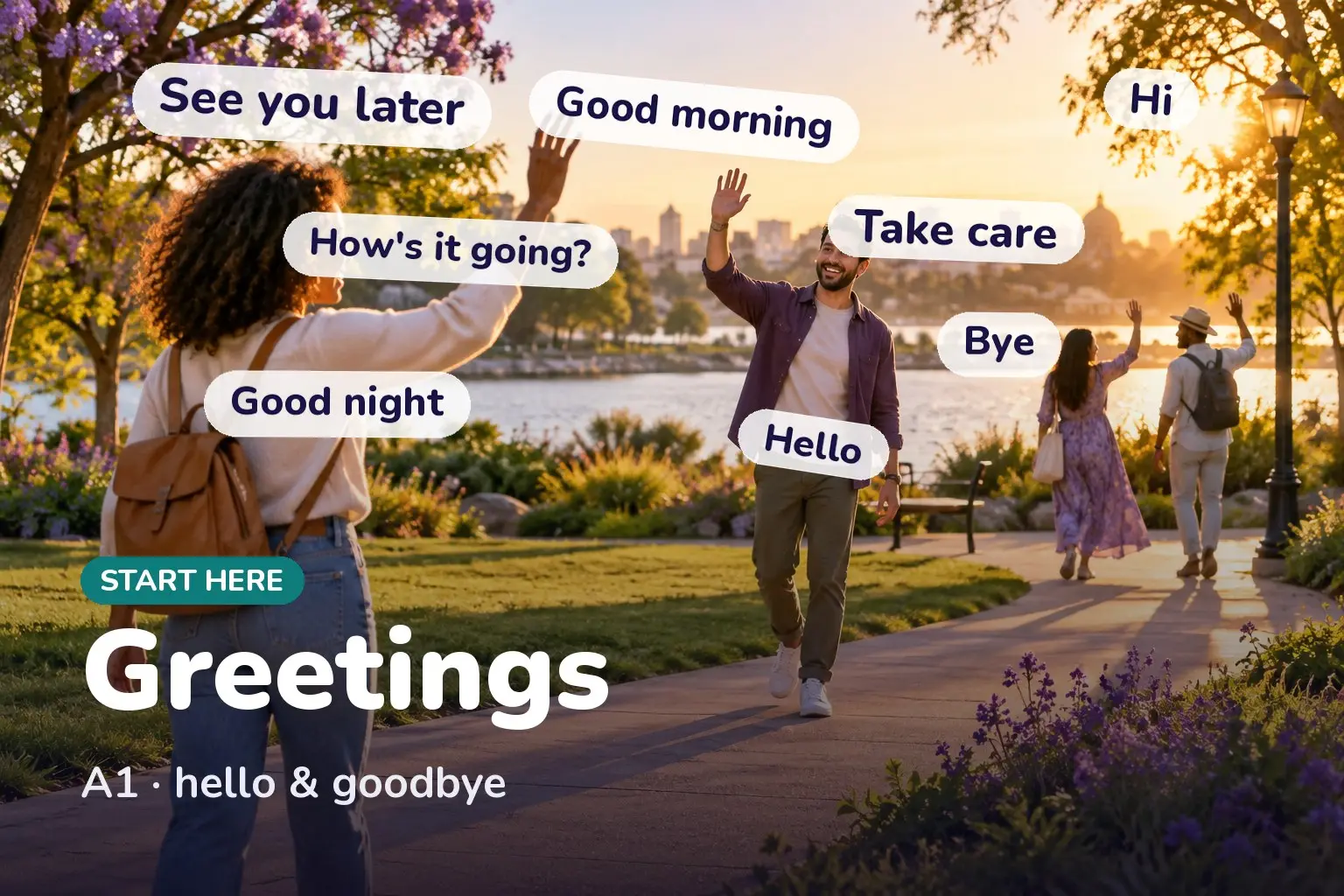
English greetings and goodbyes come in levels of formality. 'Hello' and 'Goodbye' are safe everywhere; 'Hi', 'Hey' and 'Bye' are casual; 'Good morning' and 'Pleased to meet you' sound more formal. Match the phrase to who you're speaking to.
On this page13 sections · tap to jump
Level: A1. This is a phrasebook of ways to say hello and goodbye in English — sorted by how formal they are, so you can pick the right one for a new boss, a close friend, or an email. Learn a couple from each group and you’ll always have something that fits.
By the end of this page you can…
…choose a greeting and a goodbye that match the situation, open and close a conversation smoothly, and tell a formal setting from a casual one.
How formal should you be?
The single most useful idea here is register — how formal or casual a phrase feels. Get it wrong and you sound either stiff or over-familiar. The safe rule: when you don’t know someone, lean polite; with friends, relax. Every phrase below is marked formal, neutral or casual so you can choose quickly.
Ways to say hello
| Phrase | Meaning / when to use | Register |
|---|---|---|
| Good morning. | A polite greeting before noon | Formal / Neutral |
| Good afternoon. | A polite greeting from noon to evening | Formal / Neutral |
| Good evening. | A polite greeting after dark | Formal / Neutral |
| Hello. | The all-purpose greeting for anyone | Neutral |
| Hi. | A friendly, everyday greeting | Neutral / Casual |
| Hey. | A relaxed greeting for people you know | Casual |
| Hiya. / Hey there. | Warm and informal, for friends | Casual |
| Morning! / Afternoon! | A breezy short form of the time greetings | Casual |
Asking and answering ‘how are you’
A greeting is usually followed by a quick check-in. Remember that most of these are friendly rituals, not real questions — a short reply and the same question back is all anyone expects.
| Phrase | Meaning / when to use | Register |
|---|---|---|
| How are you? | The standard, polite check-in | Neutral |
| How are you doing? | A slightly warmer version | Neutral |
| How’s it going? | A casual check-in among friends | Casual |
| What’s up? / What’s new? | Very casual; expects a light answer | Casual |
| Fine, thanks. And you? | The safe, standard reply | Neutral |
| I’m good, thank you. | A natural, friendly reply | Neutral |
| Not bad, you? | A relaxed reply | Casual |
Ways to say goodbye
| Phrase | Meaning / when to use | Register |
|---|---|---|
| Goodbye. | The full, slightly formal farewell | Formal / Neutral |
| Bye. / Bye-bye. | The everyday goodbye | Neutral / Casual |
| See you later. | Casual; you expect to meet again | Casual |
| See you tomorrow. | When you’ll meet the next day | Neutral |
| See you soon. | Warm; sometime in the near future | Neutral |
| Take care. | A kind, caring goodbye | Neutral |
| Have a good day! / Have a good one! | A friendly parting, common from staff | Casual |
| Good night. | Leaving at night or going to bed | Neutral |
| Catch you later. | Very casual, for friends | Casual |
Opening and closing a conversation
Native speakers rarely stop a chat dead. They signal the end first, then say goodbye — two steps.
A: Anyway, I should get going. B: Oh, okay. It was nice talking to you! A: You too. See you soon. B: Bye! Take care.
The phrases Anyway, I should go and It was nice talking to you are the signal; See you soon and Bye are the actual goodbye. Doing both makes the ending feel polite rather than sudden.
Greetings in writing
Email and messages have their own greetings. Don’t carry spoken slang into a formal message.
| Phrase | Meaning / when to use | Register |
|---|---|---|
| Dear Mr Smith, | A formal email or letter opening | Formal |
| Hello Anna, | A neutral, friendly email opening | Neutral |
| Hi team, | A relaxed work message | Casual |
| Best regards, / Kind regards, | A formal email sign-off | Formal |
| Best, / Thanks, | A neutral, common sign-off | Neutral |
| Cheers, | A casual British sign-off | Casual |
Example sentences
Play each line and say it along with the audio.
- Good morning! How are you today?A polite morning greeting and check-in.Use before noon.
- Good afternoon, everyone.A greeting for the middle of the day.Common at the start of a meeting.
- Good evening. Nice to see you.A warm greeting after dark.Not 'good night' to say hello.
- Hello! Lovely to see you.The safe all-purpose greeting.Right for friends and strangers.
- Hi, how's it going?A friendly, casual opener.Let the words run together.
- Hey! What's up?A very casual greeting among friends.Expects a short, light reply.
- Fine, thanks. And you?The standard reply plus the question back.What the ritual expects.
- Not bad, you?A relaxed reply to 'how's it going?'.Casual and natural.
- It was nice talking to you.A warm way to signal the end of a chat.Say this before the goodbye.
- Anyway, I should get going.Politely signals you're about to leave.Softens an abrupt ending.
- See you later!A casual goodbye when you'll meet again.Among friends and coworkers.
- See you tomorrow.Used when you'll meet the next day.Great for classmates and colleagues.
- Take care!A kind, caring goodbye.Warmer than a plain 'bye'.
- Have a good day!A friendly parting, common from shop staff.AmE: Have a good one!
- Good night, sleep well.Only for leaving at night or going to bed.Never a greeting.
- Goodbye, and thanks for everything.A fuller, slightly formal farewell.Polite in work settings.
- Dear Ms Lee, thank you for your email.A formal written greeting.Use 'Dear …' in formal email.
- Hi team, quick update below.A relaxed work-message opener.Casual but still professional.
- Best regards, DavidA formal email sign-off.Kind regards works too.
- Cheers, SamA casual British email sign-off.Friendly, informal.
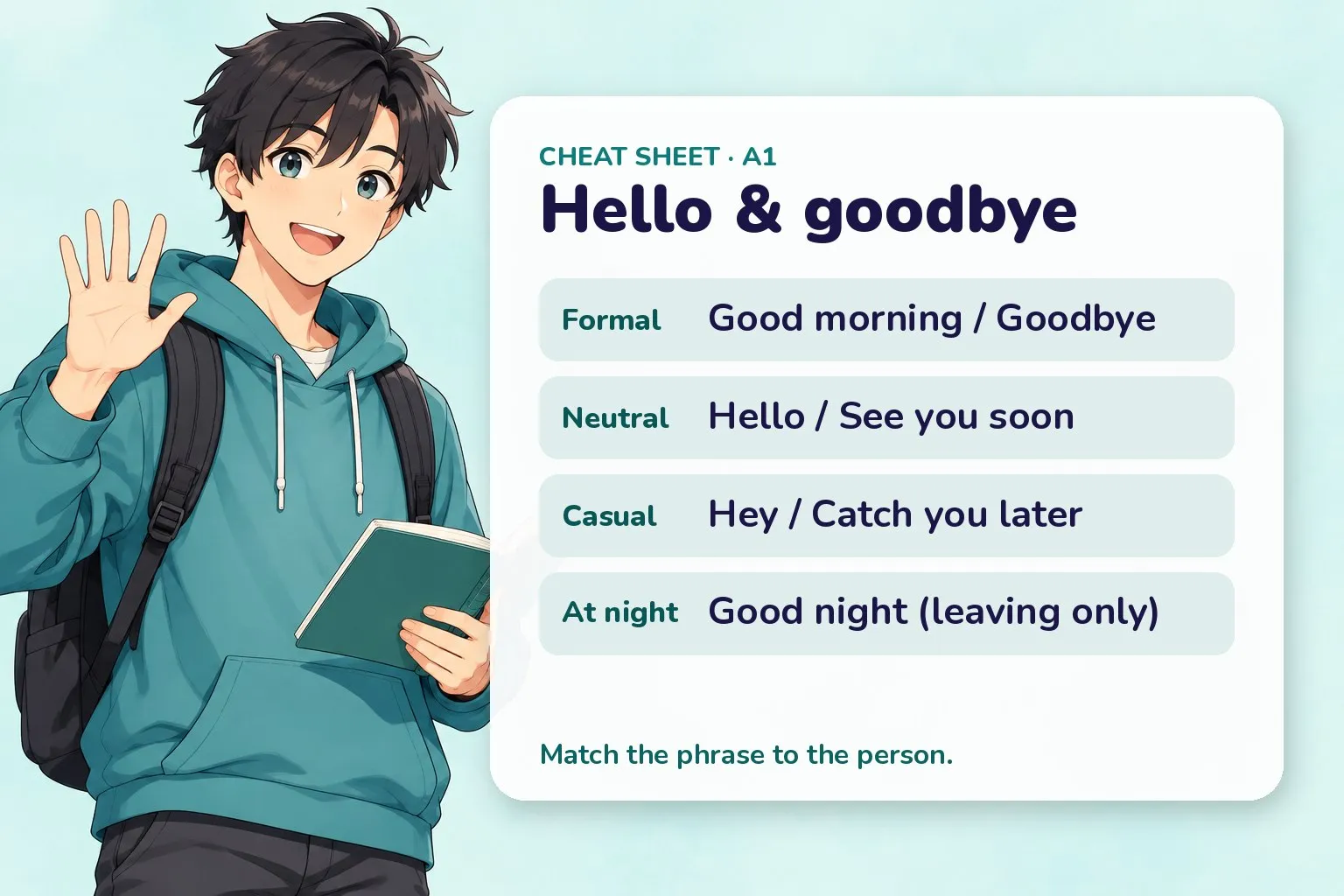
Quick recap before you practise.
Common mistakes
- ❌ Using Good night to greet someone in the evening → ✅ Use Good evening; Good night is only for leaving.
- ❌ Hey to a new manager or in a formal email → ✅ Hello or Good morning in speech, Dear … in writing.
- ❌ Stopping a chat with a sudden Bye → ✅ Signal first (Anyway, I should go), then say goodbye.
- ❌ How are you? answered with a long story → ✅ Fine, thanks. And you? — it’s a friendly ritual.
- ❌ See you tomorrow when you won’t → ✅ See you soon or See you later if you’ve no fixed time.
Practice
Greetings and goodbyes practice
Try each one, then press Check. No sign-up, nothing is sent anywhere — it all runs in your browser.
Hint: the opposite of day
Show answer
night — 'Good night' is a parting phrase for the evening or bedtime.
Hint: with 'kind' or 'best' before it
Show answer
regards — 'Best regards' / 'Kind regards' is a standard formal sign-off.
5 Put the words in order to signal the end of a chat.
Show answer
Anyway, I should get going. — This softens the goodbye so it isn't abrupt.
6 Match each phrase to its register.
- Good morning
- Hey
- Dear Mr Smith
- Catch you later
Show answer
- Good morning → formal / neutral
- Hey → casual
- Dear Mr Smith → formal writing
- Catch you later → casual
Each greeting or goodbye fits a level of formality.
How to say it
A few of these phrases blur together in natural speech — copy the links, don’t separate every word.
- How are you? runs into one smooth sound, roughly “howaryou”; the are almost disappears.
- How’s it going? sounds like “howzit-going” — the s links straight into it.
- Good morning drops the d: say “goo-morning”, not two sharp words.
- See you later often becomes “see-ya-later” in casual speech.
Quiz
Greetings and goodbyes quiz
12 questions · pick an answer and you'll see straight away if it's right.
-
Show answer
Hello — 'Hello' is neutral — right for friends and strangers alike.
-
Show answer
when you leave at night or go to bed — It is a parting phrase, never a greeting.
-
Show answer
Hey — 'Hey' is the most informal — fine with friends, not with a new boss.
-
Show answer
Good morning. — Before noon, 'Good morning' is the right polite greeting.
-
Show answer
a short, light reply — It's a casual ritual; a brief answer is enough.
-
Show answer
Take care! — 'Take care' is a warm farewell.
-
Show answer
Dear Mr Smith, — 'Dear …' is the standard formal opening.
-
Show answer
Cheers, — 'Cheers' is friendly and informal in British English.
-
Show answer
signals the end, e.g. 'Anyway, I should go' — Signalling first keeps the ending from feeling abrupt.
-
Show answer
See you tomorrow. — 'See you tomorrow' fits a next-day meeting.
-
Show answer
Fine, thanks. And you? — A short positive answer plus 'and you?' is expected.
-
Show answer
Good night — 'Good night' is for leaving, not for greeting.
Recap cheat-sheet
| Register | Hello | Goodbye |
|---|---|---|
| Formal | Good morning / Good evening | Goodbye / Take care |
| Neutral | Hello / Hi | Bye / See you soon |
| Casual | Hey / What’s up? | See you! / Catch you later |
Next
- Previous: 50 English Survival Phrases
- Next: English Politeness & Please/Thank-You
- Related lesson: English: Greetings & Introductions
- New here? Start with Start Learning English Here
All English phrases topics
Vocabulary, pronunciation, phrases, practice and exam help, ordered by level. Pick a topic and go straight to it. New lessons go live every day, so topics marked Coming soon fill in over the next weeks.
Phrases
A1 4 topics · 4 ready
- 01 50 English Survival Phrases
- 02 English Greetings & Goodbyes You are here
- 03 English Politeness & Please/Thank-You
- 04 English Classroom Phrases